There are four types of traffic calming that have been used in Sacramento central city: median islands, traffic circles, traffic diverters, and speed humps. It was recently said by city staff that only speed humps are a current solution for traffic calming, but I’d really like the city to bring back diverters.
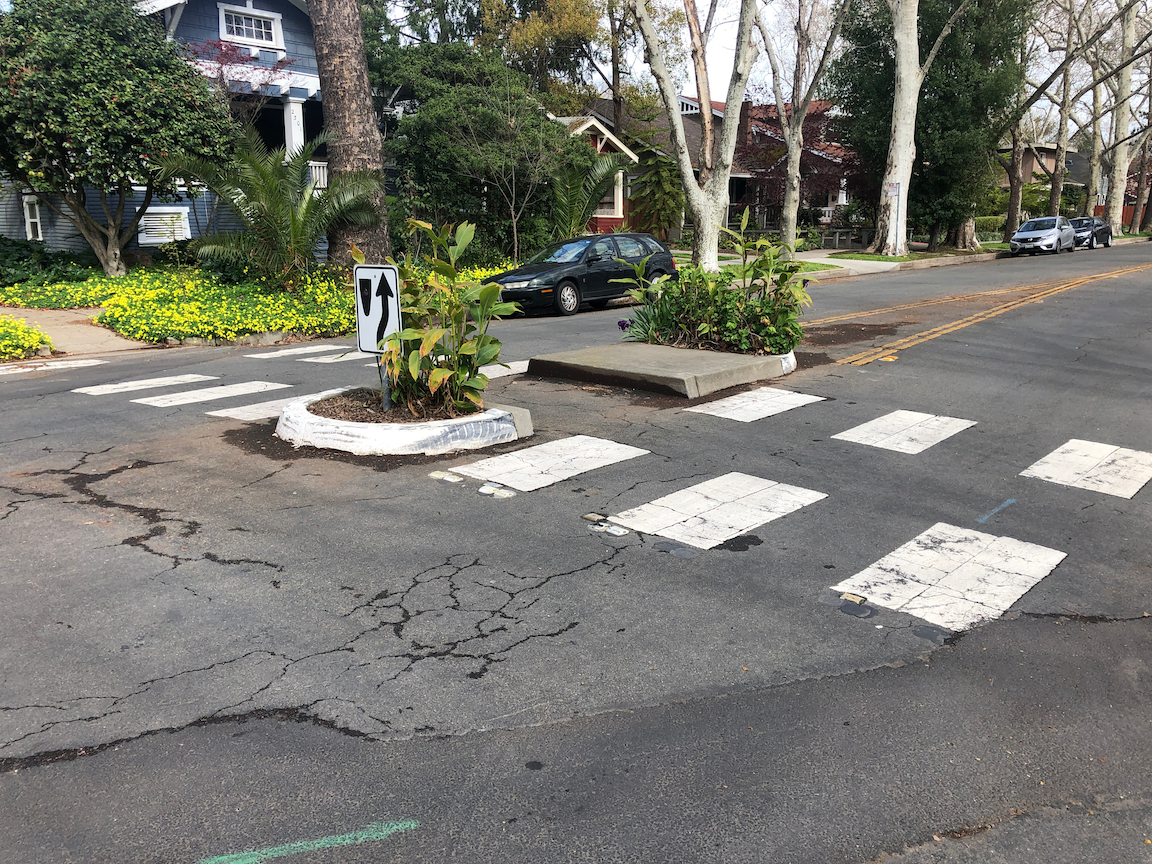
Median islands: These islands, placed at the approaches to intersections, provide some traffic calming effect, offer walkers a refuge in the middle of a crossing (though it does not meet current ADA standards for refuge). Below is a typical setting, this one at D Street & 23rd Street. Though the median does slow some drivers, other drivers use these as slalom courses. On streets with bike lanes, the bike lanes are generally dropped before the intersection in order to accommodate the median, but his is poor practice, leaving bicyclists either feeling vulnerable or actually vulnerable at just the wrong location.
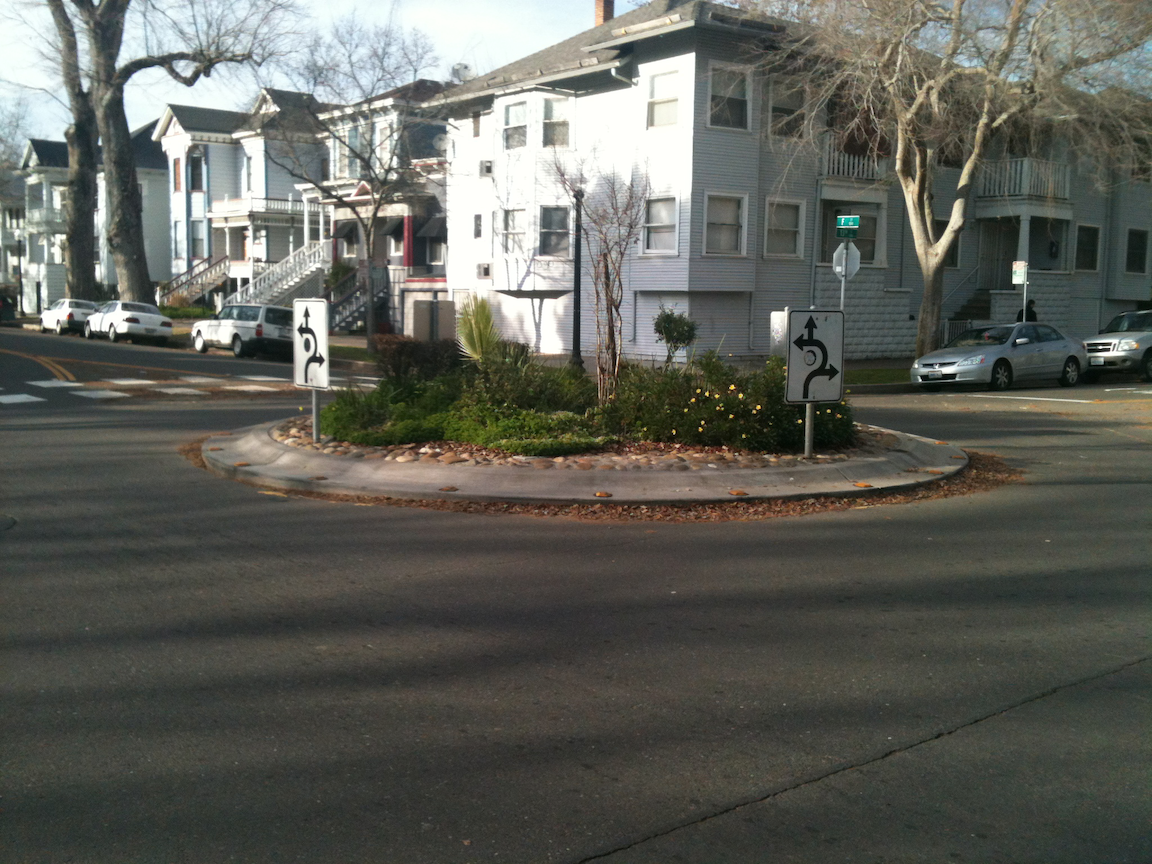
Traffic circles: Traffic circles deflect drivers to the side, a somewhat more effective solution, but have the same problem for bicyclists as the median islands, with bike lanes dropped at the critical point. These traffic circles are NOT roundabouts. A correctly designed roundabout allow the bicyclist to choose between continuing in the general purpose travel lane, or using a sidewalk or sidewalk adjacent bypass. Roundabouts also have a continuous flow, only requiring a driver or bicyclists to yield to someone already in the roundabout, but traffic circles have stop signs on one of the cross streets. Roundabouts also have enough deflection that a driver must slow down to navigate, whereas most traffic circles have only a slight deflection and therefore limited slowing value.
The central city does not have any roundabouts, and they are rare in the region. They can be a reasonable solution at the intersection of two arterial roadways, again, IF correctly designed. The footprint of a real roundabout is bigger than an urban intersection. Below is a typical setting, this one at 13th Street & F Street.
Speed humps: Speed humps slow drivers crossing over them. Many people still call these speed bumps, but the sharp bumps are now illegal on streets and are only found in private parking lots. These can also be speed tables, longer than the humps, perhaps higher, and sometimes hosting a crosswalk on top. There are two problems with humps: 1) drivers with good suspensions can sail over these without slowing, and ironically the drivers of high value motor vehicles are the ones most likely to have good suspensions and to not slow for any reason; and 2) drivers accelerate back to speed immediately after the hump, so it only has a traffic calming effect at that particular point. Often speed humps have cut-throughs for emergency vehicles, so they don’t have to slow, but wide stance pickup trucks can use the same cut-throughs, and the cut-throughs are often placed so as to inconvenience bicyclists.
Stop signs: Stop signs calm traffic somewhat by requiring drivers to slow at intersections. Anyone who thinks that drivers actually stop at stop signs, in the absence of conflicting and risky traffic, has not actually stood at an intersection and observed driver behavior. Almost no one stops at stop signs unless they have to. This includes law enforcement officers. Stop signs are the most commonly requested traffic calming solutions by people who live on or near the street. But they are simply not very effective. Drivers accelerate away from the stop signs and are soon going just as fast as they were before, likely 10 to 25 mph over the posted speed limit. While not a major issue, this stop and go traffic adds to air pollution.
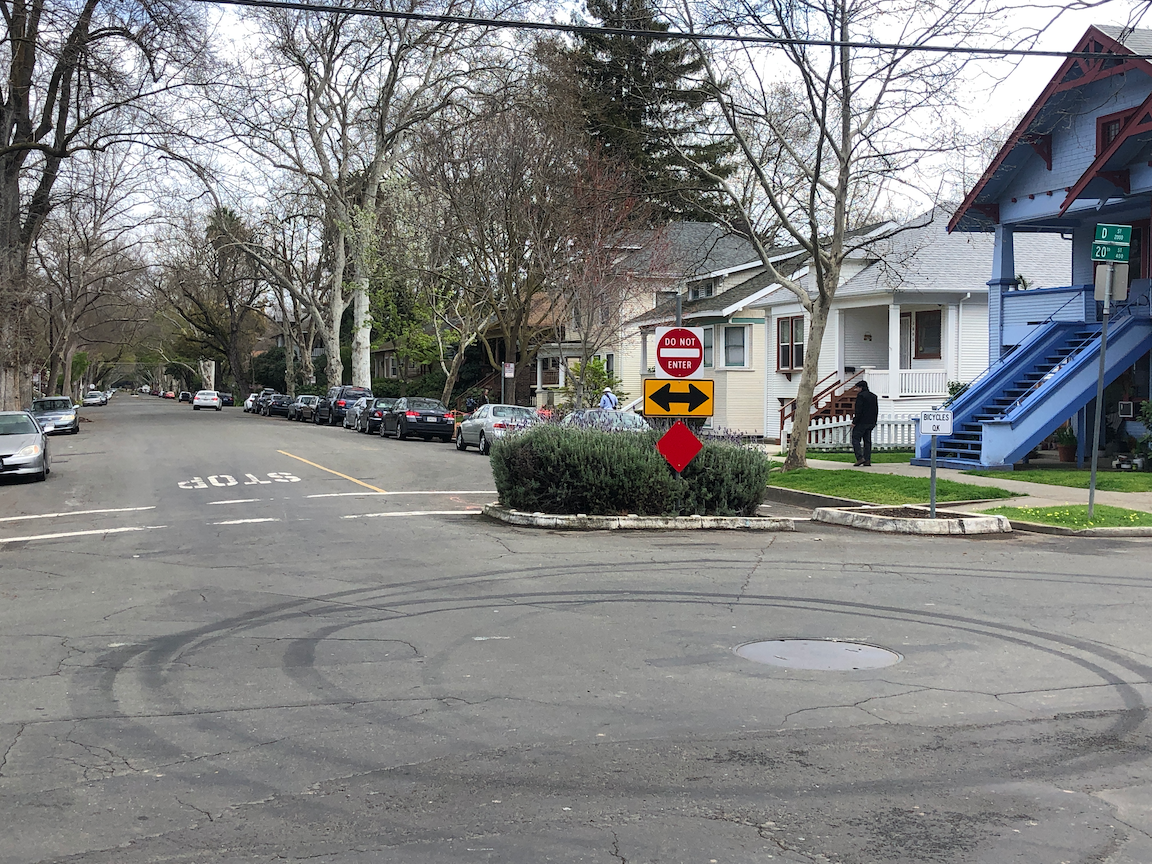
Traffic diverters: Traffic diverters turn motor vehicles off a street, but allow bicyclists through. There are a number of these in the central city, and in my opinion, they work great. The subsequent blocks are quiet and safe, at least until the street has regained traffic from other directions. They make is difficult to continue for long distances in a single line of travel, which is a good effect, as it discourages low value driving trips. My observation is that these also increase compliance with stop signs. It is true that some scofflaw drivers will go around these diverters, but at least they have slowed considerably to do so. Below is a typical diverter, this one at 20th Street & D Street.
There are a number of other traffic calming treatments, but so far as I know none are present in the centra city, so I’ve not addressed them.
I don’t think the city should install any more median islands or traffic circles, due to the negative impact on bicyclists. However, I’m OK with letting those that exist remain, as bicyclists and walkers have grown accustomed to them and mostly know how to deal with them. I’m against more stop signs, except where a stop-controlled intersection replaces a signal-controlled intersection (of which there are a number of candidates in the central city). I don’t think speed humps are effective, and I see a speed hump as an admission of a failed street design.
What I would like to see is more traffic diverters, many of them! Every street that is not a one-way arterial in the central city should have a diverter about every eight blocks. This will make is less pleasant for commuters, who have to zig-zag to get where they are going. It will also cause locals to reconsider driving trips, realizing that bicycle or walking trips are easier and more straightforward. It will ensure that more of our streets are calm and peaceful, with less driver intimidation of walkers and bicyclists.
I hope to find the time to make a map of all the traffic diverters in the central city, and will add that reference here when I do.
 Getting Around Sacramento