again, from the outside in

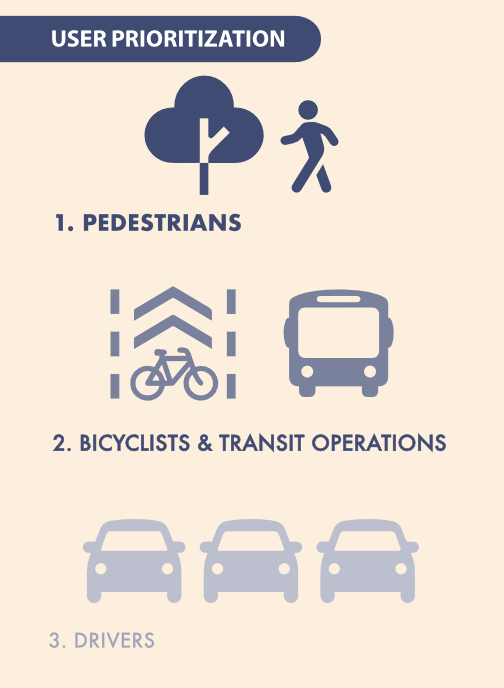
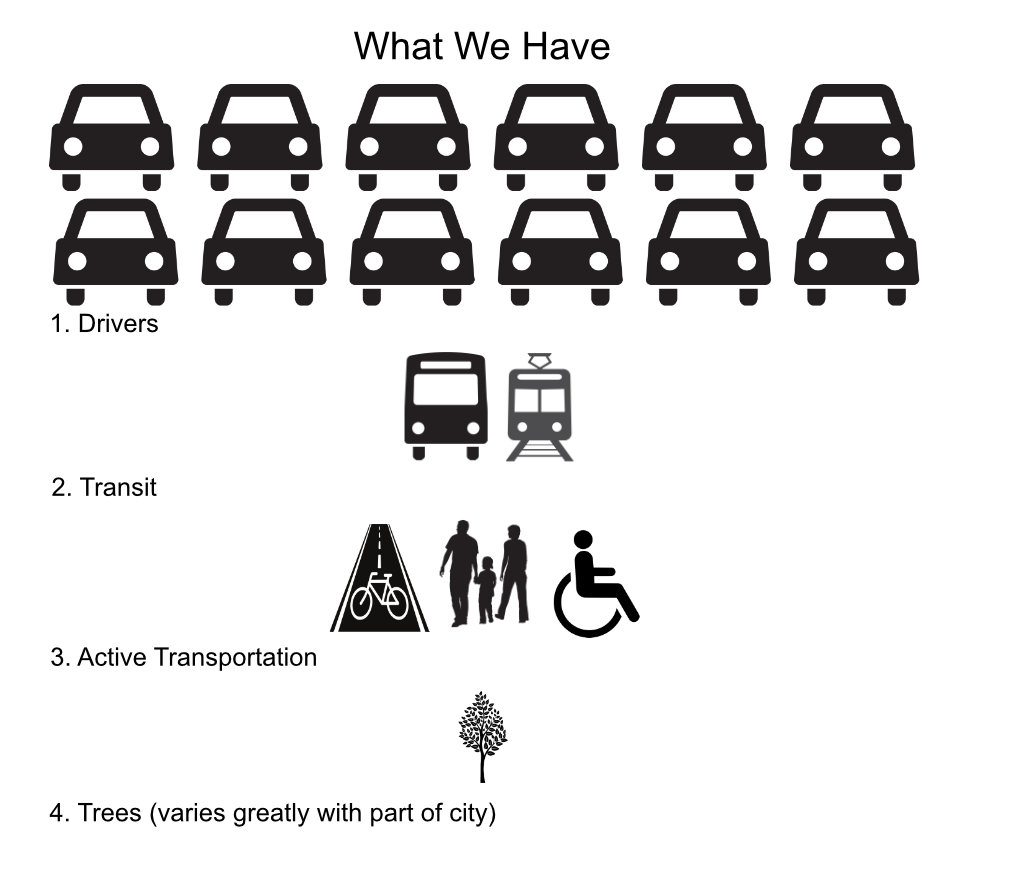
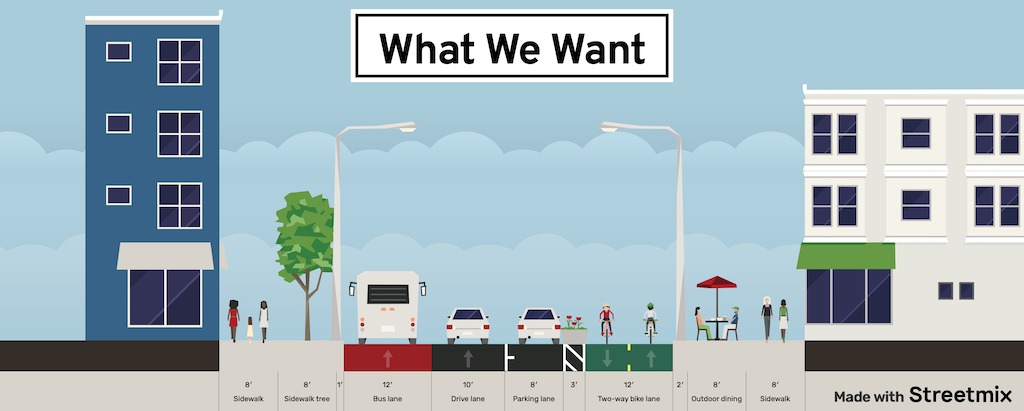
I’ve written before that streets should be planned from the outside in. Nearly every street I travel and nearly every plan I see for changing street width allocation clearly shows that the reverse is what was built, and what is planned.

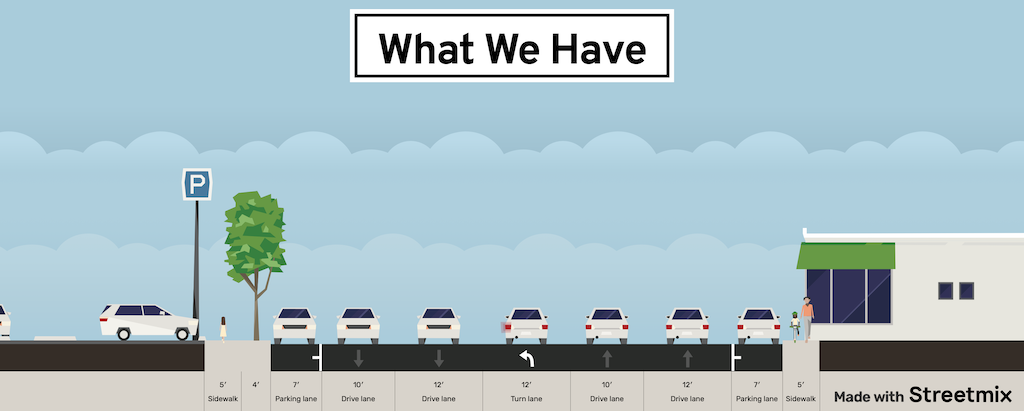
There are a number of streets where center turn lanes are provided in blocks where there are few to no driveways. S Street near where I live is just one example. Many blocks have few to no driveways, yet the center turn lane exists all the way from 3rd Street to Alhambra Blvd. Could the street width be better used? You bet.

The most egregious example, however, is the Broadway Complete Streets project. I’ve written quite a number of posts, about the ways in which the project is successful, and the ways in which is it not. The project is such a disappointment to all the transportation advocates I talk to. Why?

Broadway was planned from the inside out. A center turn lane, all the way, whether needed or not. I’ll point out the expression, “A foolish consistency is the hobgoblin of little minds”, Ralph Waldo Emerson, from the essay Self-Reliance“. Next, two motor vehicle lanes, one each way (which is an improvement over two each way before the project). The lanes are overly wide, 11 feet when they could have been 10 feet (not less than 10, because it is a bus route). Next, traditional bike lanes, mostly five feet wide but sometimes six, sometimes with a painted buffer (no vertical delineators), sometimes without. The bike lanes could have been parking protected, but they were not. They could have been wider, so that two bicyclists could safely pass each other, and accommodate cargo bikes and three-wheeled bikes. They were not. There is a short one block section between 15th Street and 16th Street where these a curb-protected bikeway. But nowhere else.

Then comes the sidewalks. The city apparently had a design policy to not touch the sidewalks, which then engenders ADA requirements, which are somewhat expensive to meet (though a small fraction of the entire project). But they did touch the sidewalks in places, and in each of these places, the sidewalks are narrower than they were before the project. In several locations, the sidewalks do not even meet ADA or PROWAG guidelines. The city has claimed that since PROWAG has not been adopted by FHWA, the requirements don’t apply to the city. In other words, go ahead and sue us, but we aren’t going to do the right thing. That is what city staff said when challenged about this.

Has the city learned its lesson? No. The two additional segments of Broadway to the east have exactly the same design.

The city’s stated objective for this project was to slow and reduce motor vehicle traffic so that people would stop for businesses along the street, increasing economic vitality. Broadway has real problems currently, as you can see by traveling along the corridor. A lot of empty buildings, a lot of parking lots, a lot of low value fast food joints. But is also has a number of great locally owned businesses, many of which were beginning to fail due to the street design and the pandemic. I admire the city’s intent, but mourn their failure to create a street than will accomplish that.

CalBike series on Caltrans complete streets failure

CalBike has published the first two of a series of reports on the failure of Caltrans to follow their own complete streets policy when designing and building streets which are also state highways. It is telling that the first of the series is on the failure of Caltrans District 3, which includes Sacramento county, to actually provide complete streets – Incomplete Streets Part 1: How Caltrans Shortchanges Pedestrians. District 3 is perhaps the worst of the Caltrans districts, which operate as independent (or rogue) agencies and regularly subvert Caltrans policy and direction from headquarters. Though they have a lot of competition for the title of worst.

“District 3 is perhaps best known as the district pushing through the Yolo Causeway highway expansion project. The project, which has been approved despite internal and external opposition, led to the firing of Caltrans Deputy Director Jeanie Ward-Waller after she blew the whistle on improper use of funds for freeway widening and insufficient environmental review.”

I encourage you to read these first two, and to follow CalBike investigative reporting. Caltrans must be held to account, as otherwise they will continue to design projects that kill and injure walkers and bicyclists, will continue to resist fixing the design mistakes they have made in the past, and will continue to commit fraud on the people of California by lying about what they are doing with your tax money.

there are worse places!

Added note below on LA sidewalks.

I’m traveling, first in Las Vegas area, and now in Los Angeles area. Traveling to other places is a good reminder that Sacramento is not all that bad. There are worse places!

In Las Vegas, everyone drives everywhere. I observed a person jump in his Jeep, drive a half block to his mailbox, and drive back home. Walking to and from his front door, and to and from his mailbox (clustered mailbox), I saw no sign of disability. In fact, the prevalence of Jeeps is amazing. Every third suburban house has one. Cause you know, its wild out there. The number of them with dirt on the undercarriage, however, is infinitesimal. I see people leaving their house to drive and get coffee, and drive back home. Not as part of a chain of errands, but a drive just to get coffee, for no other purpose. Of course much of Las Vegas is so spread out, that it may to a long ways to a coffee shop (see coffee shops (tea) on the grid for a contrast). Every new development I saw is a gated community. I’m not aware of any being built or recently built that are anything but gated. Even the apartments are gated. People live in, and want to live in, a world where they don’t have to interact with other people, any more than absolutely necessary. They drive large vehicles with darkly tinted windows. They don’t know their neighbors, nor do they want to. The ‘living in a quiet neighborhood where you know your neighbors’ is a mythology perpetrated by people who want to defend their lifestyle, while preserving their isolation.

The worse thing about the neighborhood where my sister lives is the lack of any real shade. Though I celebrate the end of front yard lawns, trees seem to have been thrown out with the bathwater (‘throw the baby out with the bathwater’). Most front yards do not have trees at all, and the ones that do, they are mesquites and related trees, which are beautiful but provide almost no real shade. Except in the very oldest parts of the Las Vegas area, all sidewalks are attached, meaning no space for street trees. If they aren’t on private property, they pretty much don’t exist. Of course that doesn’t matter, because no one walks, so there is no need for shade. Not quite true. Everyone has a dog, or multiple dogs, and takes their dog for a 10-minute walk every day so they can leave their dog waste in someone else’s front yard. If you haven’t spent time in the Las Vegas area, it is always at least 5 degrees hotter than Sacramento, and up to 20 degrees hotter. It is a place that could really benefit from sidewalk shade, but doesn’t have it. Wait, I haven’t been fair. There are palm trees, everywhere. Shade? Nope. Wildlife value? Nope. Aesthetics? Nope.

There are a lot of bicycle riders in southern Nevada. They drive to the paved trails and to unpaved trails at the edge of the city. They don’t ride in the city.

Now I’m in Los Angeles. I have to say that people are much more friendly here. Complete strangers will start up conversations. And you do see a lot more people walking. There are sidewalks on every street. However, except along the main arterial roads, every block has a major issue the sidewalk, often root heaves that make the sidewalk impassible to people with mobility devices, and sometime even to abled walkers. If not root heaves, then there is just deterioration, big cracks and gaps. Bike lanes are scarce in the City of Los Angeles and unincorporated areas of the county. A few of the cities have really put in bike facilities, but in general, they just don’t exist. Because most of Los Angeles is on a grid, there are often lower speed, lower volume parallel streets to ride, but don’t bother with the major streets, or trying to get somewhere quickly.

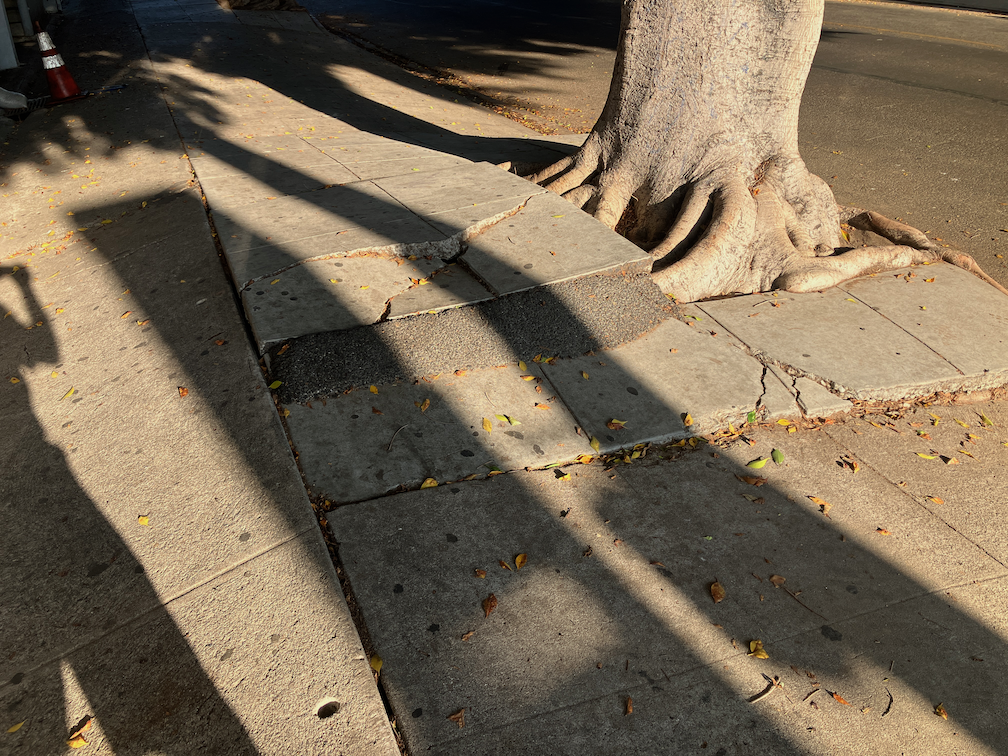
I have been walking around Koreatown this afternoon, refreshing my memory and experience of the sidewalks. It is nearly impossible to walk a block, on any street except the arterial roadways, without running into a sidewalk issue that would make it difficult or impossible for someone in a wheelchair to navigate. The reason root heaves are so prevalent here is that the sidewalk buffers are only three feet, except in richer neighborhoods. Even Sacramento has six feet or more for sidewalk buffers (where they exist). So every tree that is older has root heaved the sidewalk (photo below). If it isn’t a root heave or deterioration, then a motor vehicle is parked across the sidewalk, blocking it. In several miles of walking, I have yet to see anyone using a mobility device, except in the grocery store. Are they staying home? Are they driving? Are they using transit? They aren’t rolling on the sidewalks!

photo of impassible root heave, 9th St in Koreatown, Los Angeles
impassible root heave, 9th St in Koreatown, Los Angeles

I know I complain often about the built environment in Sacramento, and the very slow progress in correcting the mistakes and disinvestment of the past. All of that is true. But…

Sacramento has a great tree canopy in much of the city, and where it does not, everyone recognizes that there is a problem and I believe the city is making an honest effort to correct that (though handicapped by the same issue that lower income neighborhoods were built with attached sidewalks (no sidewalk buffer for trees). Though there are some areas of gated communities, they are mostly in the county, not the city. Other than our governor, most people don’t live behind gates. It seems to me that there is nowhere near as much dislike of other people as is present in southern Nevada.

The central city has good bike facilities, and relatively polite drivers, at least for bicyclists (not walkers), and is flat. Flat. And the central city is getting better, and work is or will be done on some of the arterial roads in the suburbs, though it is many years late and many dollars short. But it is happening.

I really like living in Sacramento. Of course I go to the bay area frequently, and it in most ways does not compare well with that. But it certainly compares well with Los Angeles, and Las Vegas area. Las Vegas is really just a suburb of LA anyway. 75% of the people came from LA, and the rest from Utah. But every place has its challenges, and I know my perception is just one of many.

How about you?

complete streets failure

Summary: Complete streets concept is a failure because it doesn’t address frequent safe crossings. It leaves streets dominated by motor vehicle traffic while not necessarily increasing safety or welcoming design for walkers and bicyclists.

A recent post on Strong Towns (Ager Road: Where Complete Streets Fell Short) shows a street that was converted to a ‘complete street’, and won awards, but is actually less safe and less pleasant than what was there before. A fatality occurred shortly after the conversion, perhaps as a result of the conversion increasing vehicle speeds, perhaps not, but the conversion did nothing to reduce the likelihood.

From the post: “This is a stroad in disguise,” remarked Strong Towns Director of Community Action Edward Erfurt when examining Ager Road in Hyattsville, Maryland. And a Twitter post below.

My response:

The complete streets concept is largely a failure, everywhere it is implemented. I’m sure the original intentions were good, but every complete street project I’ve seen affirms the primacy of motor vehicles over other modes. The greatest failure of all is not what happens along the street, but that the concept does not even address the need for frequent safe crossings of the roadway. No wonder traffic engineers have embraced the concept – it allows them to continue motor vehicle dominance and accept traffic violence.

Dan Allison

So you can see the present ‘complete street’ more clearly:

Google Street View of Agar Rd, referenced on Strong Towns

The complete Streets concept is all about travel ALONG streets. Though it recognizes that crossings of streets are important, and encourages designs that make crossing safer and more welcoming, it does NOT address the frequency of safe crossings. The Complete Streets Coalition, part of Smart Growth America, does not require that complete streets policies include anything about the frequency of safe crossings. And so nearly all polices do not address that. The Caltrans policy, which applies only to state highways but is often applied to other streets, does not mention the frequency of safe crossings.

Traffic planners and engineers have embraced the Complete Streets concept, and tout policies and implementation. But what do we really end up with in most cases? Just more motor vehicle dominated streets, which is what most traffic planners and engineers want anyway, and claiming a complete street isolates them from criticism of the roads being designed and built, while making it more likely that they will be a federal, state, or regional grant for their project. Very few projects are awarded grants these days unless they claim to be a complete streets project. That is good, but the bar is set so low for what can be called a complete street, that the result is just more car infrastructure.

The project shown in the Strong Towns post checks off the following elements:

  • sidewalk, check
  • bike lane, check
  • green paint, check
  • general purpose lane(s), check
  • fence to prevent walkers from crossing any place other than the signalized intersection, check (I put this here with tongue in cheek)

What it does not check:

  • narrow the travel lanes to calm traffic
  • reduce the speed limit or actual speed through design
  • remove slip lanes (ask any bicyclist how they feel about bike lanes that cross high speed slip lanes)
  • reduce the corner radius at driveways
  • install or maintain street trees to calm traffic and provide shade for walkers
  • widen sidewalk buffers to ensure healthy trees and vegetation
  • create a pleasant walking environment
  • provide wayfinding to the nearby Metro station

The next time you hear a planner or engineer mention ‘complete streets’, hold on to your wallet (because, after all, it is your tax dollars that fund ineffective projects), and look around you to identify the traffic violence that will remain or even be increased.

The first step in designing a safe and welcoming streets is top ensure that there are safe and welcoming sidewalks and crossings of the street. Everything else comes after that, if at all. Adding bicyclist facilities that are neither safe nor welcoming, and reducing the the environment for walkers in trade, is going the wrong direction, and will lead to less walking and more traffic violence.

Northgate Blvd Transportation Plan

The City of Sacramento has released the final draft Northgate Blvd Transportation Plan. Appendix F Layout Designs is a key part of the plan. This post reflects my original comments (Northgate Boulevard Emerging Design Concepts) and the new plan. The city’s plan page is at http://www.cityofsacramento.org/Public-Works/Transportation/Planning-Projects/NorthgateMobility. The plan is on the Active Transportation Commission agenda for January 20, 2023, and will go to the city council within the next two months.

Travel Lanes

The most important aspect to the plan is that travel lanes (general purpose lanes) have been reduced from two each direction to one each direction. A reduction of lanes and narrowing of lanes (from 12 feet or more to 11 feet) is probably the single most effective action for calming traffic. When there is a single lane, the prudent driver who is traveling at or near the speed limit controls the behavior of other drivers, many of which would be traveling at excessive and incredibly dangerous speeds.

Trees?

Of the 10 common design elements on page 20 (23 of the pdf), none are about trees. Yet the lack of trees and shade for walking was a major issue in community input. The city has a tendency to minimize trees in transportation planning, because they are a detail beneath the interest of traffic engineers, and the city doesn’t want responsibility for maintaining street trees. Trees are often treated on the standard timeline of it is either a) too soon to address that (which was the response to early plans lack of attention to trees), or b) decisions already made so it is too late to address that (which will be the answer on trees now). Yet trees are a critical element of walkability, and walkability is a critical element of economic vitality. No trees, no walkers, no economic vitality.

On page 26 (29 of the pdf), the proposed cross-section does not show any trees within the public right-of-way, only on private property. Sidewalks are shown as eight feet, which is great, but without trees, many fewer people will walk there than if there were trees for shade. The wide-open viewshed also encourages higher speed driving, counteracting efforts to reduce speed.

Driveways?

One of the unfortunate aspects of the corridor is the prevalence of driveways. In most cases, each and every business has its own driveway or driveways, and its own parking. That is a characteristic of how the area developed, and in some ways it is a strength, because many small businesses make for a more vibrant economy (not to mention higher property tax and sales tax income). But crossing driveways are also the biggest impediment to a safe and welcoming walk, and to bicycling.

The city seems to have decided that it is not worthwhile addressing the number of curb cuts for driveways. The plan acknowledges wide and number driveways, but offers no solution.

Page 28 (31 of the pdf) shows a diagram for Wilson Avenue intersection. In just this short section, three properties are shown as having double in-out driveways for a single business. Not only is this unnecessary interruption of the sidewalk, but an interruption of the bikeway (green color in the diagram).

I believe the city should proactively reduce driveways by eliminating all double in-out driveways. It could be left to the property owner or business to decide if they want to have one in driveway and one out driveway, or a wider in-out driveway, though clearly one in-out is better for walkers and bicyclists.

What City of Sacramento ISN’T doing

The City of Sacramento, that bastion of doing the least amount possible, has failed to notice that progressive cities in the US and worldwide are making changes to their environment to make is safer for people who walk and bicycle, and more efficient and welcoming for people outside of cars.

What the city is NOT doing, that it could:

  • Accept responsibility for maintaining sidewalks, as an integral part of the transportation network. The city continues to shirk its responsibility, spending funds on motor vehicle infrastructure instead of maintaining walker infrastructure.
  • Installing leading pedestrian intervals (LPIs) at every traffic signal in the city. The same eleven have been in place for years; none have been added. The recent legislation, AB 2264, only applies to state highways; it is up to cities and counties to implement on other roadways.
  • Daylighting intersections. This means removing parking from within 15-20 feet of the crosswalk or stop bar, either by painting and enforcing red curbs, or building curb extensions (bulb-outs) at every intersection. Upstream, approaching the intersection, is the big safety feature, downstream, leaving the intersection is much less important. There are interim solutions here, such as painting curb extensions and using soft-hit posts (vertical delineators).
  • Implementing construction zone requirements that accommodate walkers and bicyclists. The current city policy is to provide safe bypasses only if it does not in any way inconvenience drivers. The public has asked that a policy be developed along the lines of the Oakland construction policy, but the city has stonewalled against that.
  • Making transportation improvements that benefit walkers and bicyclists, except with county, state or federal grants. The city simply will not spend any of its general funds on improving transportation safety.
  • Waiting until a roadway is completely repaved to reallocate roadway width to bicycle lanes or separated bikeways, or transit. Compounding this issue is that the city doesn’t share with the public the repaving projects that it intends to do, so the public has no chance to comment beforehand.
  • Lowering speed limits citywide. While it is true that spot reductions have little effect on travel speeds, there are a growing number of cities that have lowered speed limits citywide, with a significant reduction in speed.
  • Enforce traffic laws. The Sacramento Police Department has essentially stopped enforcing laws related to the safety of walkers and bicyclists. This of course is also true in many other places. Police don’t see traffic safety as an issue worthy of concern. Of course so much of law enforcement is used as pretext to oppress, and I’m not in favor of any of that, but if the police won’t even enforce failure to yield to people in the crosswalk, what use are they? We would all be much safer if traffic law enforcement were removed from the police, largely automated, and the money saved diverted to real community needs. Yes, defund the police.
  • Painting marked crosswalks at every intersection. Yes, I know that unmarked crosswalks are legal crossings, but most drivers either don’t know or don’t care, so marking crosswalks is critical.
  • Remove beg buttons. These buttons, which sometimes a walker must press to get a walk sign, and sometimes don’t need to press (this is called auto-recall) are a direct attempt to discriminate against people walking. The city, after much pressure from the public at the beginning of the pandemic, set five crossings to auto-recall, out of the thousands. Of course they didn’t change the signing, so people walking don’t know this. The city it being intentionally obstinate in its defense of this outmoded requirement.
  • Remove pedestrian prohibition signs unless that is a demonstrable safety reason for the prohibition. There are numerous signs all over the city that were placed solely to preference motor vehicle drivers over people walking. The default should be that every one is removed unless the city wishes to do a traffic study to justify them.
  • Install traffic diverters (mode filters) all over the city. These diverters, which allow bicyclists free travel but turn motor vehicle drivers aside, are the single most effective safety measure that city could implement. But the city has decided to take these off the menu of solutions, for no reason that it has ever been made public. The few that exist are in the central city, almost none in other neighborhoods. Another example of privileging the already privileged over lower income neighborhoods.
  • Charge for parking, eveCavrywhere. Residential neighborhoods, where there is usually open parking space, would be charged through permits for the cost of maintaining that portion of the street. Any place where parking is in short supply, market rates for parking should be charged. Giving away free parking is subsidizing drivers and throwing your tax money in the trash.

I could go on with this list for pages. In fact, I have: walking policies for SacCity, and many related posts. But the city is still not taking meaningful action on any of these items, so I will keep reposting. For as long as it takes. And it will probably take quite some while before the city gets over its culture of doing the least amount possible.

Caveat: The city has disinvested in lower income and high minority neighborhoods, probably for its entire history. The first steps should be taken in these neighborhoods, with input from the residents, of course, and not in higher income and non-minority neighborhoods which have always gotten more than their share.

Freeport Boulevard Transportation Plan Emerging Design Concepts

City of Sacramento staff (Drew Hart) presented to the Sacramento Active Transportation Commission last Thursday on the Freeport Boulevard Emerging Design Concepts. The presentation slides are here. The city’s Freeport webpage has a lot of background material. A link to the virtual open house on April 28 (tomorrow!) is available. This project and the Northgate project are being supported by the same consultant, so you will notice similarities in the process and graphics.

The northern section, between Sutterville Road to the east and Sutterville Road to the west, should look exactly like the traffic-calmed, complete street to the north. This project on Freeport was successful. There is no reason for five lanes in this section. One lane northbound, one lane southbound, and one left turn lane southbound is all it needs. If traffic backs up at the Freeport and Sutterville Road to the east intersection, then shorten the signal cycle.

The emerging design document skips over the issue of whether four general purpose lanes are even needed. A concept should be presented that reduces general purpose lanes to two, and reallocates roadway width to other modes.

Dedicated right hand turn lanes should be removed everywhere. Dedicated left hand turn lanes should be provided only where traffic studies have shown a clear need, and should never reduce the roadway width for other uses.

Green lanes are shown behind protection for separated bikeways. Since the protection does or should prevent vehicle incursion, the paint is not needed.

Dedicated transit lanes should be considered. Though SacRT has not identified this as a high frequency route in the High Capacity Bus Service Study (Route 62 is 30-minute frequency), reconstruction of the roadway must consider the possibility of dedicated transit lanes and transit supporting infrastructure. Appendix A, available on the project webpage, provides a lot of detail about existing transit stops, which are mostly quite poor.

Some businesses along Freeport have multiple driveways, more than are justified by the amount of vehicle traffic access. Closure and narrowing of driveways should be considered. Since almost every business has parking fronting the street, no on-street parking is needed anywhere. This is poor urban design, but it is the nature of the corridor and could not be corrected without wholesale reconstruction of the corridor.

While separated bikeways are often a good solution, the frequency of driveways might make for poor quality infrastructure. Unless driveways can be closed or reconfigured, separated bikeways may not be the best solution.

Posted speed AND design speed should be considered for reduction. Posted speed is 30 mph from Sutterville Rd (to the east) to Arica Way, 35 mph from Arica Way to Fruitridge Rd, and 40 mph from Fruitridge Rd to Blair Ave. The section from Sutterville Rd (to the east) to Fruitridge Rd should be posted and designed for 25 mph, in recognition of the density of businesses and driveways. The section from Fruitridge to Blair Ave should be posted and designed for 30 mph, as it has a lower density of businesses and driveways, and is adjacent to the airport for a significant distance.

Prioritization of the modes for Sutterville (to the east) and Fruitridge Rd should be:

  • walking
  • bicycling
  • transit
  • motor vehicle

Prioritization of the modes for Fruitridge Rd to Blair Ave should be:

  • bicycling
  • transit
  • walking
  • motor vehicle

Crash/collision map of the Northgate Blvd corridor for pedestrians (walkers) and bicyclists. Data is from SWITRS for the years 2015-2019. (pdf)

map of Freeport Blvd Emphasis with pedestrian and bicyclist crashes

Northgate Boulevard Emerging Design Concepts

Update: Added a crash/collision map at the bottom. Though prevention of pedestrian and bicyclist killed and severe injury is always a top priority, this is not a high risk corridor as compared to many arterials in the city.

City of Sacramento staff (Leslie Mancebo) presented to the Sacramento Active Transportation Commission last Thursday on the Northgate Boulevard Emerging Design Concepts. The presentation slides are here. The city’s Northgate webpage has a lot of background material. A link to the virtual open house on May 11 is available.

I rode Northgate Blvd yesterday to refresh my memory about the street, as I’d not gone that way in a while. So, some comments:

The section of Northgate from Rio Tierra to I-80 is a standard suburban arterial, with low quality development and a completely uninteresting place to be. Changes to the roadway may make it safer, but won’t make it any more interesting or economically successful. The city should not focus on this area. It is unpleasant, and not particularly safe, but leave it be.

The section of Northgate from Rio Tierra to Garden Hwy has serious issues, but I see it as a place that could be transformed into an interesting, welcoming, and vibrant place. The number of small businesses, each with a driveway, is a challenge, but also an opportunity. At least half of the businesses are locally owned. This is not the home of big box and chain stores like much of the suburbs. It IS a place where people could walk if provided a safe and encouraging environment, and there are multiple destinations used by local residents.

I think that this entire segment should have buffered and wide sidewalks. The bike facilities could provide some buffer, but the sidewalk buffer is critical because it allows street trees. This section desperately needs street trees! Of course to be successful, the buffer/planting strip needs to be at least six feet, and the sidewalk at least six feet, but eight-ten foot buffer and eight foot sidewalk would be better. I think that the walking mode should take precedence over all other modes, even bicycling and transit, so whatever right-of-way the buffer and sidewalk needs, it should get. Don’t compromise this away.

I realize this project is at the gathering community input stage. However, diagrams will be used, and I’d like to see the diagrams include significant improvement to the pedestrian environment, wide sidewalks buffered from other modes, with trees in the buffer.

The presentation resulted in a number of questions from commission members about bicycle facilities. One of the ideas that got support is a two-way separated bikeway (or cycletrack) to provide a connection between the Ninos multiple use trail and the American River Parkway multiple use trail (the ‘special section’ in the presentation). There was less agreement about bicycle facilities north of there. One of the ideas is separated bikeways (protected bike lanes). Though of course separated bikeways are the best solution overall, I’m not sure they make sense for the east side of the street. Separated bikeways work best when there are few or no driveways, but there is a huge numbers of driveways here. The west side of the street has far fewer driveways.

There are some opportunities on the corridor for reducing driveways, and certainly some of the driveways can be narrowed to reduce entry and exit speeds. But short of a wholesale revision of the area, most driveways will remain, so the street design must accommodate this fact.

Transit on the part of the corridor between Arden Way and San Juan Road is provided by SacRT Route 13 Natomas/Arden, with a 45 minute frequency on weekdays. The route has a fairly low ridership, but it is a long route of which the Northgate section is a small part.


Crash/collision map of the Northgate Blvd corridor for pedestrians (walkers) and bicyclists. Data is from SWITRS for the years 2015-2019. (pdf)

Take the information about fault below with a huge grain of salt. It is well known that law enforcement officers assume walkers and bicyclists to be at fault, without any serious investigation, and often on the sole word of the driver involved.

Pedestrian (walker):

  • Northgate near Rosin Ct: killed, 60 yo male, unknown detail, no fault, no alcohol
  • Northgate near Ozark Cir: severe injury, 74 yo female, crossing, at fault, alcohol
  • Northgate at Wisconsin: severe injury, 36 yo female with two children, crossing, driver fault
  • Northgate at Peralta: severe injury, 48 yo, crossing Peralta, at fault (very unlikely)

Bicyclist:

  • Northgate near Winter Garden: severe injury, 49 yo male, left turn, at fault
  • Northgate at Bridgeford: killed, 47 yo male, crossing, at fault, alcohol or drug
  • Northgate at Harding: killed, 31 yo female, left turn, at fault
  • Northgate at Garden Hwy: severe injury, 40-44 yo male, broadside, at fault CVC 21453

The intersections of Northgate and San Juan Rd, West El Camino, and Garden Hwy/Jefferson Ave are particularly problematic because they are flared out to accommodate turning lanes, thereby lengthening crossing distances for walkers and creating a walker-hostile environment. Fixing these intersections would probably do more to improve the safety and feeling of this corridor than changes along the corridor.

a safe and effective transportation system

Many organizations and individuals are deciding to oppose the transportation sales tax measure being proposed for the November 2022 ballot in Sacramento County. The reasons for opposition are many, but previous posts here (Measure 2022) cover significant ones. If the measure does not qualify for the ballot, or does qualify and fails, what then are we to do for transportation? Below are some ideas for a safe and effective transportation system. They are not yet well organized or prioritized.

I acknowledge the contribution of Walkable City Rules by Jeff Speck to this list. If you haven’t read it, please do. I don’t agree with everything he says, but it is the best prescription for correcting our transportation system and healing our cities that I know of. See also Measure 2022: the path not taken.

The realities of climate change and social justice demand a radical redesign of our existing transportation system and radical shift in transportation policies and investments. More of the same, with slight improvements, as the sales tax measure suggests, will not serve our needs now or in the future. See also our racist and classist transportation system.

General

  • all projects must contribute to or be neutral in reaching regional (SACOG) and state goals for reducing VMT and GHG (vehicle miles traveled, greenhouse gas emissions)
  • travel modes will be prioritized as: 1) active transportation (walking and bicycling), 2) transit, and 3) motor vehicles

Equity

  • sales taxes are regressive, and will not be the default mechanism for funding transportation projects
  • travel needs of people who don’t or can’t drive (children, elderly, disabled, choice) will receive at least the same concern and investment as those who do drive
  • at least 60% of transportation investments must serve formerly underinvested communities
  • transportation projects will be selected and designed to meet community needs previously expressed through community engagement; projects will not be selected by transportation agencies or employees
  • anti-displacement measures will be included in all transportation projects
  • no investments will be made in transitioning motor vehicles from fossil fuels to electric or hydrogen, except where formerly underinvested communities need supporting infrastructure; transitioning vehicles away from fossil fuels merely maintains motor vehicle dominance of our transportation system
  • all projects over $10M will require a health impact analysis
  • agencies will educate the public about H+T (housing and transportation) costs as a measure of housing affordability

Policies

  • roadways will be maintained in a state of good repair to serve all travel modes
  • transportation planning will be integrated with land use planning
  • only agencies that acknowledge and plan around induced travel demand will receive transportation funding
  • all transportation agencies must implement a robust complete streets policy which includes frequent, safe crossings of roadways and speed reductions
  • congestion pricing will be considered as a solution in all dense urban areas, to reduce motor vehicle travel and to fund transportation projects; pricing will be based at least in part on vehicle weight, value or emissions
  • cities and counties will not accept responsibility for maintaining local roadways in new developments; therefore, new development must establish reserve accounts to cover ongoing maintenance

Vision Zero

  • all transportation agencies must establish and implement Vision Zero policies in which redesign of roadways is a preferred action
  • at least 25% of transportation funds must be spent on Vision Zero projects
  • all roadway fatalities will be analyzed using a safe systems approach, with required change to the roadway design or use to prevent future fatalities

Roadway Design

  • implement 10-foot or less travel lanes whenever a roadway is repaved; remove striping from local streets
  • all new developments will require a grid street system of one-eighth mile so that the need for arterials and collectors is reduced
  • consider all right-turn-only and left-turn-only lanes for elimination
  • eliminate slip lanes everywhere
  • require signal cycles to be 90 seconds or less
  • eliminate level-of-service (LOS) in transportation planning
  • conversions of one-way streets to two-way streets will be funded; one-way one-lane streets will be considered an acceptable design for local streets and central cities
  • overly wide roadways will be reduced, with unneeded right-of-way returned to adjacent property owners or sold for infill housing
  • rougher pavements such as brick will be considered whenever slower traffic speeds are desired (but crosswalks will be smoother than the pavement)

Traffic Enforcement

  • wherever possible, automated enforcement will be used to enforce vehicle code that protects vulnerable users, rather than direct enforcement by law enforcement officers
  • violations which to do not threaten the safety of other roadway users will be de-prioritized or removed, with reduced fees if maintained
  • temporary or permanent vehicle confiscation will be used for egregious violators of vehicle codes
  • cities and county shall have the authority to do city-wide and county-wide reductions of posted speed limits, with or without corresponding changes to roadway design; redesign is of course preferred

Parking

  • all on-street motor vehicle parking in urban areas will be charged, either through curb metering or though flat fees
  • parking fees will be used to:
    • cover the cost of providing on-street parking construction and maintenance, and parking enforcement
    • improve transportation and economic vitality within the neighborhood that generates them, and therefore will not go into the general fund
  • parking minimums will be eliminated
  • de-couple parking from rent so that car-free renters are not subsidizing renters with cars
  • parking will be managed to maintain a level of availability on every block (similar to the Shoup 85% rule)
  • removal of on-street parking for higher uses such as active transportation, dining, and community spaces will be supported; however, removal of a travel lane rather than removal of parking is preferred
  • remove parking upstream of intersection corners to ensure visibility (daylighting); not needed when curb extensions provide the visibility
  • parking lanes/areas will be maintained to a reduced and less expensive level than roadways

Freeways

  • freeway removal, reduction, or decking will be considered for all freeways
  • new interchanges must be 100% paid for by private development
  • in urban areas, reconnect street networks over or under freeways at no less than one-half mile intervals, and provide pedestrian and bicyclist connections at no less than one-quarter mile intervals
  • managed lanes must be converted from general purpose lanes, not created through capacity expansion

Transit

  • transit performance measures will be developed, with a tentative goal that 80% of the population is served by 15 minute or better frequency bus or rail service, within one-half mile, for at least 15 hours per day on weekdays and 12 hours per day on weekends
  • transit will not be used as a mitigation for roadway expansion or induced motor vehicle travel; transit is a desirable mode in and of itself
  • transit will be funded to at least the equivalent of one-half cent of sales tax
  • dedicated bus lanes or bus rapid transit (BRT) design will be implemented on all high ridership bus routes
  • transit agencies will have flexibility to allocate funds between capital, maintenance, and operations, based on established criteria
  • metered freeway on-ramps serving four or more regular (non-commute) buses per hour will have bus bypass lanes

Sidewalks and Crosswalks

  • sidewalks will be considered an integral part of the transportation network, and therefore maintained by transportation agencies rather than property owners, except where trees or work on private property impacts the sidewalk; buffer strips in which trees are planted will be considered public responsibility
  • sidewalk infill will be considered a primary use of transportation funds, with at least 60% going to formerly underinvested neighborhoods
  • sidewalks with driveway ramps that slope the sidewalk crosswise will be replaced with continuous flat sidewalks, or the driveway eliminated
  • all traffic signals that have a pedestrian signal head will be programmed with a leading pedestrian interval (LPI) of at least 3 seconds
  • required pedestrian-activation will be eliminated (buttons to trigger audible information are acceptable); pedestrian auto-detection will be considered
  • raised crosswalks or raised intersections will be the default design for all reconstructed intersections
  • all crosswalks will be marked, with the possible exception of purely residential areas
  • pedestrian crossing prohibitions will be analyzed and eliminated where not strictly necessary for safety
  • curb extensions, the width of parking lanes and designed to not interfere with bicycling, will be installed whenever intersections are modified or reconstructed

Bicycle Facilities

  • bike facilities on any roadway with a posted speed limit over 30mph must be separated (protected) bikeways
  • bike facilities on any roadway with a posted speed limit over 40 mph must be separated from the roadway
  • roadway design will be used to make bicycle facilities unnecessary on low speed streets
  • design and implement low-stress bicycle networks
  • prioritize filling gaps in the bicycle network
  • re-stripe or re-design roadways so that bike lanes or separated bikeways are not dropped at intersections
  • bike share, and possibly scooter share, will be supported with transportation funds
  • secure, on-demand bicycle parking will be provided at common destinations; bicycle racks will be provided at common destinations and on every block in urbanized areas

Schools

  • school districts will have the authority to close roadways fronting the main entrance to a school, during arrival and dismissal times, in order to increase student safety and protection from air pollutants
  • Safe Routes to School programs or similar will be supported by transportation funds at the local level
  • school districts will be prohibited from building new schools at locations which are not easily accessible via active transportation or transit
  • school districts will prioritize neighborhood schools over magnet schools, in order to reduce travel
  • school districts will develop policies that allow neighborhood schools to remain open under declining enrollment
  • school districts will be responsible for the same transportation demand management requirements placed on any other entity

Thank you if you read all the way through. I realize some of these are radical ideas, but radical ideas make space for more reasonable ideas provided by others. That is part of the purpose of this blog.

thoughts on Sac TPP

Some further thoughts to update my Sac Transportation Priorities Plan update.

I don’t think the five categories should be weighted equally. If the city were starting with a blank slate, it would make sense, but the slate is not blank. Out existing transportation system is profoundly racist and classist, so the city must overcome past harms by focusing improvements on low income and communities of color. Rather than being 20% of the scoring, ‘Provide Equitable Investment’ should be 40%.

I’ve also come to understand this this is a technical document, not a policy document. The only real policy here is that criteria will be used to select projects, not whim. This is acknowledged to be an immense improvement. But it is only one of many needed policies.

What is a policy? A statement that controls how the city designs and operates the transportation network. An existing policy is the goal that all streets will have a pavement condition index (PCI) or at least 72. Examples of new policies:

  • All sidewalks will be maintained in a state of good repair by the city. Adjacent property owners will be responsible only when a tree on private property, not in the sidewalk buffer, creates root heaves, or when construction activity damages the sidewalk.
  • Every crash resulting in a fatality or severe injury will be investigated by a team including a traffic engineer, a planner, a representative of a walking or bicycling advocacy organization (Civic Thread and/or SABA), and a citizen who lives in the neighborhood and regularly walks and/or bicycles. A recommendation for changes will be made, and at least one recommendation implemented. ‘No change’ will not be acceptable.

What is a project? In the city’s understanding, a project is something big, a project that requires a federal, state or SACOG grant, a project that will involve concrete and/or asphalt, and constructors to install it. What is not seen as a project is lower cost changes, many of which could be accomplished with staff time and small expenditures. Examples of lower cost projects:

  • Change every pedestrian signal in the city to have at least a 3 second leading pedestrian interval (LPI) in which the walker gets a head start into the crosswalk. Staff time costs, no materials costs.
  • Remove pedestrian beg buttons from all signals in the city. Leave buttons which trigger ADA audible signals, but label them with that function. Staff time costs, some materials costs (for the new signs).
  • Install temporary curb extensions at the top five fatality or severe injury intersections, every year. Observe usage and transit to refine the design for permanent curb extensions some staff time, some materials costs (paint and posts).

A lot more could be said about each of these policies and projects, and I will, but for now the caution is that the TPP will only be effective if additional policies are implemented, and projects broadly defined to include the small, lower cost stuff, not just big projects.