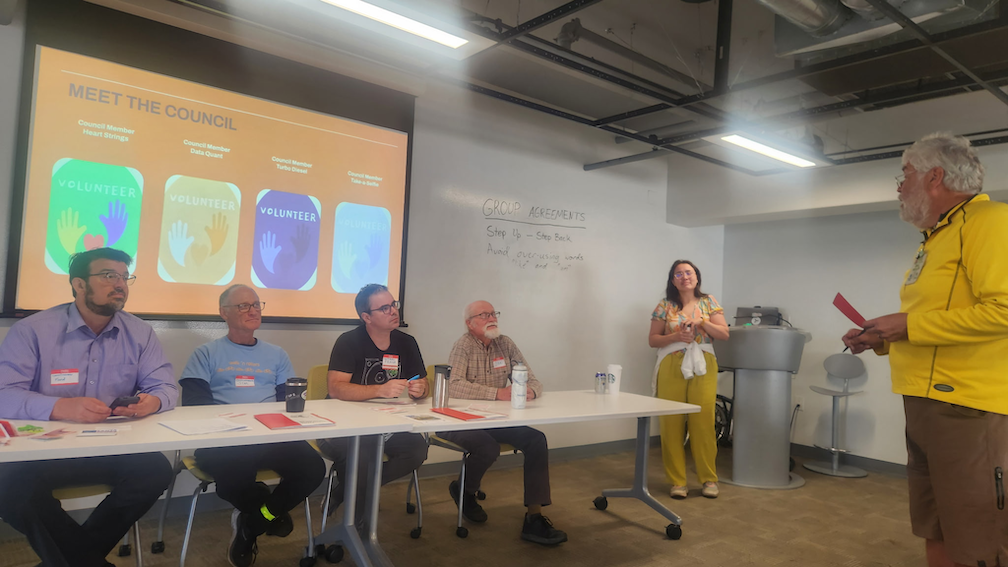
I attended a Bike Advocacy Workshop hosted by the League of American Bicyclists in late March in Santa Monica. This was the third time the League had hosted the workshop, so it is evolving. It is intended to provide professional development for advocates in a similar way to that League Cycling Instructor (LCI) seminar. Though many LCIs and LCI Coaches have been requesting for many years that the League either add advocacy information to the LCI seminar, or create a separate track, apparently this was developed on the initiative of a League staff member, not on those requests.
I took this workshop, not because I necessarily think I need training in advocacy, or need the certification, but curiosity about the League’s approach to advocacy. Most League activities are at the national level, not at the state or local level, with that role taken on by other bicycle advocacy organizations. Santa Monica Spokes, the local advocacy organization, co-lead the workshop.
The workshop was a combination of presentations by advocates, field trips to look at bike facilities in Santa Monica, or which there are many, some role-playing exercises, and of course evenings outings for beer and pizza. Many of the participants work for bicycle advocacy organizations, mostly local in southern California, but with others not directly affiliated and from other regions.
The workshop was good. It would benefit from more role-playing and discussion to address the objections to bicycle facilities that often crop up, not just from an infrastructure perspective but from a livability perspective.
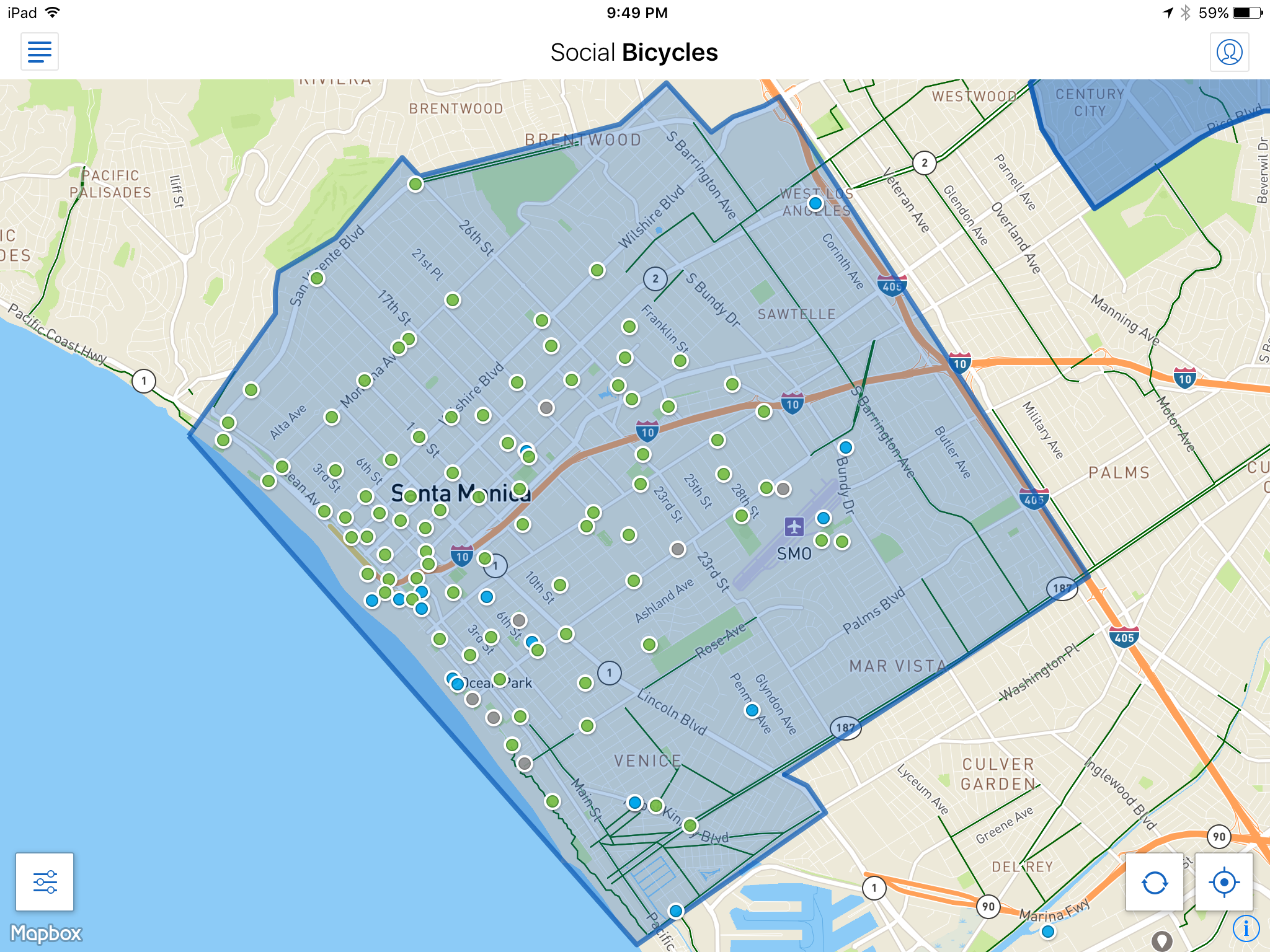
Santa Monica does have a lot of bicycle facilities, focusing now on physically separated bikeways on arterials and collector streets. There is a multi-use paths associated with the E/Expo light rail line. In a few places there are bicycle-only connections between streets. Some of the separated bikeways feel squeezed in, installed on relatively narrow streets without removing parking. It is better, in my view, to either remove parking from one side to create enough space for a comfortable bikeway, or just do a regular bike lane. The new NACTO Urban Bikeway Design Guide makes clear the importance of wider separated bikeways to accommodate all types of bikes, and to allow safe and comfortable passing of wider bikes such as cargo bikes and three-wheeled bikes.
A few times during the workshop the ghost of John Forrester, Effective Cycling, and vehicular cycling was trotted out to beat the dead horse. This horse has been beat for so long by so many that it is not recognizable as a horse. Advocates of bicycle infrastructure keep bringing this up, though I know of no advocates who advocate against infrastructure, though there are still, and should be, voices for the right to use the roadway.


 Getting Around Sacramento