transit frequency in Houston and Sacramento

Houston has been in the news recently, and will certainly be today, opening day, for their revised transit system which created a network of high frequency (service every 15 minutes or better, 15 hours a day, 7 days a week) transit lines. The map below left shows this new system, only, and clicking goes to the high resolution image on the Houston METRO website. The map below right shows the entire system, with lines that don’t meet the high frequency definition. The system was redesigned with the help of Jarrett Walker, transit consultant and author of Human Transit, which I posted on yesterday and will be posting a lot more in the near future.

Houston METRO Frequent Network

Houston METRO System

So, what’s the story in Sacramento?

Read More »

deaths per 100K

I just ran across an interesting piece of data that I was not aware of before, in Motor Vehicle Crash Deaths in Metropolitan Areas — United States, 2009. Sacramento area ranks 8.3/100,100 for motor vehicle related crash deaths, but 14.4 for the city, which is in the middle of pack for the US, but worse than most of California. Riverside area is 10.6 and city 11.9, San Diego area 7.8 and city 5.6, San Francisco area 5.6 and SF 4.0 and Oakland 5.0, Los Angeles area 6.6 and Los Angeles city 7.7 and Long Beach 6.1 and Anaheim 7.8. This 2009 data, and I could not find anything from CDC more recent. For contrast, London is 1.6 and New York is 3.2, both considered dangerous places in the mis-informed public mind.
The Keys to Designing Cities With Fewer Traffic Fatalities (CityLab 2015-07-23)

Sacramento does well on economic segregation

A recent report Segregated City: The Geography of Economic Segregation in America’s Metros indicates that Sacramento is better than most cities in economic segregation. Unfortunately the full data set has not been released, and Sacramento shows up in only two of the tables and one text location. The paper is highlighted in a CityLab post America’s Most Economically Segregated Cities.

“Interestingly, the large metros where the wealthy are least segregated (Exhibit 2.3) are mainly on the East and West Coasts and include some of America’s leading high-tech knowledge centers, which have some of the highest income levels in the nation. San Jose is the metro where the wealthy are the least segregated from other segments of the population, followed by nearby San Francisco, Washington, D.C., Seattle, Hartford, Boston, Providence, Portland, Oregon, Minneapolis-St. Paul, and Sacramento. The relatively high wages that knowledge and professional workers receive enable them to share some neighborhoods with the super-wealthy, even though the gap between rich and poor may be substantial in these places.” (page 17)

In Exhibit 2.3: Large Metros where the Wealthy are Least Segregated (page 17), Sacramento (Sacramento-Arden-Arcade-Roseville, CA) is ranked number 10. In Exhibit 3.3: Large Metros with the Lowest Levels of Income Segregation (page 24), Sacramento is ranked number 6.

update on I Street

"bicycles must turn right" sign, I Street between 6th and 5th
“bicycles must turn right” sign, I Street between 6th and 5th

I wrote previously about the The I Street Mess. A small change has taken place here, with a new sign that says “Bicycles Must Turn Right” on the bike lane midway between 6th and 5th. Basically, this is a warning to bicyclists who missed the “Thru Bikes Merge Left” sign at the beginning of the block that they are truly screwed. By this point, bicyclist will have a very hard time merging across four lanes of high speed traffic to reach the left side bike lane that takes one to Old Sacramento or 3rd Street. At a minimum, the warnings need to occur earlier, in the block between 7th and 6th. Better yet would be slowing the traffic on I Street so that a bicyclist could actually maneuver through the traffic lanes. Best would be an alternate route for bicyclists who don’t wish to ride vehicularly, that avoids the I Street Mess completely.

walking the streetcar route

K Street pedestrian plaza between 11th and 12th

Today I walked the route of the proposed Sacramento Riverfront Streetcar. No, this is not part of the argument about whether pedestrians or streetcars are faster, going around the Internet recently, but I just wanted to see it all from a walking viewpoint, not on my bicycle. There is a map of the probable route on the website above, though oddly it leaves out some streets.

I picked up the route at L and 16th, just two blocks from my home, and headed west between Capitol Park and the brutalist Community Center Theater. The route turns north on 13th Street and apparently goes through the pedestrian plaza over to 12th where is would then use the SacRT light rail tracks (light rail would be routed to the north along H Street). The further west on K Street, the more depressing things are, with most buildings not only empty but abandoned. But, this is part of the reason for the streetcar, to support the economic redevelopment of this area. At 6th it heads north along the existing light rail tracks to H, and then west to Sacramento Valley Station (Amtrak).

Read More »

Protected Intersections

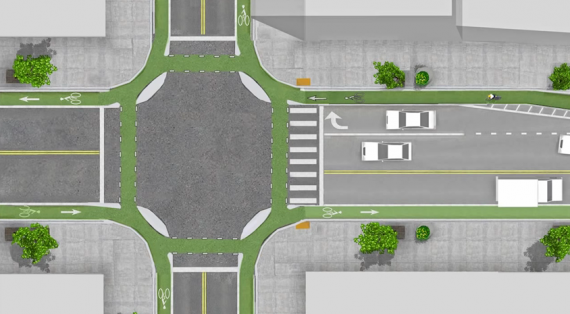
When I posted on the North 12th Street Complete Street Project, I expressed concern about how the  cycle track to the north would transition to the bike lane to the south, and how bicyclists northbound would access the cycle track. On Wednesday I attended the project open house at City Hall. Preliminary designs presented by the contractor Echelon Transportation Group indicate one possible design for the intersection of 12th Street and C Street, a protected intersection. These conceptual design drawings are not yet available on the North 12th website, so I don’t have a drawing to share here. Comments from the open house and online will be used to revise the concepts, and they should then be available on the website for further review and comment.

The protected intersection is a design new to the United States, and so far not built anywhere in its entirety. The design is fairly common in bicycling friendly countries in Europe. The Protected Intersections for Bicyclists website provides a great video showing how the design works by providing a higher level of safety for bicyclists and pedestrians without much impact on motor vehicles. The design has not yet been included in the NACTO Urban Bikeway Design Guide, but I would guess it soon will be.

protected intersection

The diagram at right shows the general outline of a protected intersection. The intersection at 12th and C would look like the right half of the diagram on the west side, with the almond shaped corner medians, but would not look like the left half on the east side. Bicyclists heading south out of the cycle track would either continue south in the bike lane or use the protected intersection to turn east and then continue south on lower traffic streets. Bicyclists coming from the east would use the protected intersection to get to the west side and the cycle track.

Active Transportation Program (ATP) in region

This is not fresh news, but I just realized that I had not posted about grants in the Sacramento region under the Active Transportation Program cycle 1 awards in 2014.

Regional grants from the statewide program:

  • PLA, Roseville, Downtown Roseville Class 1 Trails, $2,547K
  • SAC, Elk Grove, Lower Laguna Creek Open Space Preserve Trail, $1,778K
  • SAC, Sacramento County, Howe Ave Sidewalk Infill and Bike Lane Improvements, $1,853K
  • SAC, San Juan USD, SRTS, $250K
  • YOL, Davis, SRTS Program, $562K
  • YOL, Woodland, 2014 SRTS, $539K
  • YUB, Marysville, SRTS Project & Programs, $489K

SACOG region grants:

  • ELD, El Dorado County Transportation Commission, Western Slope Bicycle Travel Opportunities Map $50K
  • PLA, City of Auburn, Nevada Street Pedestrian & Bicycle Facilities $799K
  • PLA, City of Colfax, North Main Street Bike Route Project $264K
  • SAC, City of Galt, South Galt Safe Routes to Schools $1,800K
  • SAC, City of Rancho Cordova, Mather Rails to Trails Project $2,235K
  • SAC, Sacramento County, El Camino Avenue Phase 2 – Street and Sidewalk Improvements $1,692K
  • SAC, City of Folsom, Oak Parkway Trail Undercrossing and Johnny Cash Trail Connection Project $992K
  • SUT, City of Yuba City, Franklin Road Improvements $313K
  • YOL, City of West Sacramento, Citywide Bike Lane Gap Closures $525K
  • YUB, Yuba County, Ella Elementary School Safe Routes to School Project $1,195K

There are also three projects on the SACOG contingency list.

Free holiday parking? Why not free transit?

The City of Sacramento has announced free holiday parking (on the Downtown Sacramento Partnership website), stretching from Old Sacramento through midtown, to attract shoppers. This is done in order to attract people who might otherwise shop at suburban big box stores and malls that offer acres of free parking, as this free parking in the suburbs puts downtown businesses at a disadvantage. (There is, of course, no such thing as free parking, someone has to pay, but that is another argument for another day.)

However, why no benefits for people who use transit to reach downtown, either by choice or necessity? I think there should be free transit tickets for people who shop downtown during the same times and places as the free parking is in effect. Businesses would give out a SacRT single ticket (normally $2.50) to each shopper for the trip back home. There might be a minimum purchase requirement, just to prevent someone from accumulating a large number of tickets by making small purchases at several businesses. However, since one free ticket doesn’t cover the trip to the business, nor trips requiring a transfer, nor family members, I think overall it would be more than fair to the city.

The free tickets would cost the city money, since they’d have to be purchased from SacRT. I’m sure a volume discount could be worked out, but there would still be real costs. The free parking offer means that the city is foregoing a considerable amount of parking revenue in order to support local business. Whether the increase in sales tax revenue from holiday shopping balances the lost parking revenue, I don’t know, but the city obviously considers it an overall benefit whether the balance sheet works or not. The same benefit could be obtained through free transit tickets.

Fare is fair! Let’s see free transit tickets!

Strong Towns strength test for Sacramento grid

The latest Strong Towns blog post is on the Strong Towns Strength Test. Ten simple questions. A Strong Town should be able to answer “yes” to each of these questions.

Here are my answers for the grid portion of Sacramento, downtown and midtown.

  1. Take a photo of your main street at midday. Does the picture show more people than cars? I picked J Street at 16th; others might pick other streets. No, more cars than people. However, there are a few intersections in downtown and midtown that probably have more people than cars, due to state workers walking to lunch.
  2. If there were a revolution in your town, would people instinctively know where to gather to participate? Probably yes, at Cesar Chavez Plaza, where Occupy Sacramento started.
  3. Imagine your favorite street in town didn’t exist. Could it be built today if the construction had to follow your local rules? My favorite street is actually an alley, Liestal Row, with Edible Pedal bike shop and Old Soul coffee. It has a woonerf-like design more welcoming to pedestrians and bicyclists than cars. Unfortunately, only one block long, and there aren’t any other alleys or streets like it. Yes, I think it could be built today. In general, developers can build what they want, but if it is outside the norm, it takes a long time and a lot of money.
  4. Is an owner of a single family home able to get permission to add a small rental unit onto their property without any real hassle? Not easily, and often not at all.
  5. If your largest employer left town, are you confident the city would survive? In Sacramento County (much larger than midtown/downtown, but I could not find city data), the largest employer is the state (Sacramento is the state capital), followed by the county itself, then health care organizations in 3rd, 4th, 6th and 7th, followed by three school districts, and then the city itself. The largest private employer is Intel at 5th. Except for Intel, none of these are leaving town, though some or all could shrink. I don’t know what the statistics are for midtown/downtown, but since the state capitol and most government buildings are in downtown, the state would be even more prominent. One of the blog post commenters suggested that the measure should be largest industry rather than largest employer. I would answer yes, just because so many employers would not leave that a private employer would not make that much difference.
  6. Is it safe for children to walk or bike to school and many of their other activities without adult supervision? Moderately safe, so yes. Since Sacramento City School District eliminated most of the neighborhood schools, children are now largely bused or delivered to school in parent’s cars. So a question I’d add is, are there neighborhood schools?
  7. Are there neighborhoods where three generations of a family could reasonably find a place to live, all within walking distance of each other? Yes, in midtown, no in downtown, so somewhat.
  8. If you wanted to eat only locally-produced food for a month, could you? Yes, if you define local as including Capay Valley and the foothill farms and ranches.
  9. Before building or accepting new infrastructure, does the local government clearly identify how future generations will afford to maintain it? No. I’ve never heard the government even raise the issue.
  10. Does the city government spend no more than 10% of its locally-generated revenue on debt service? The city budget of $873 million indicates that 10.8% is for debt service. However, the city has $2.1 billion in unfunded long-term debt (before the arena and any of the proposed civic projects), so if the city were actually paying down debt rather than accumulating it, the percentage would be higher than this. So, no.

Score on these ten questions = four no, one somewhat, and five yes.

Read More »