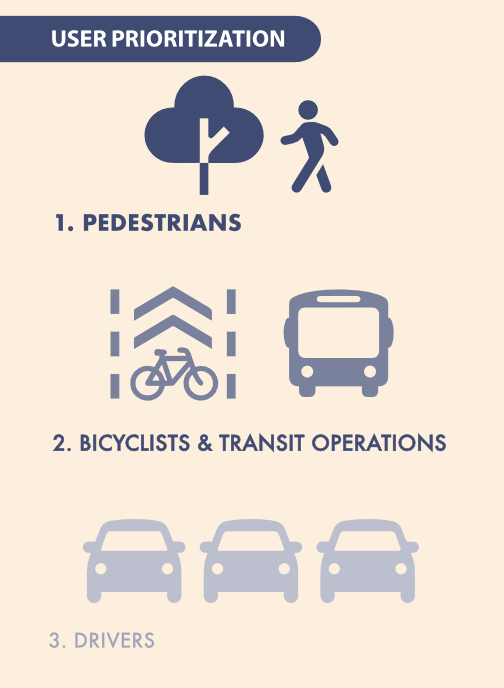
I’ve written before that streets should be planned from the outside in. Nearly every street I travel and nearly every plan I see for changing street width allocation clearly shows that the reverse is what was built, and what is planned.
There are a number of streets where center turn lanes are provided in blocks where there are few to no driveways. S Street near where I live is just one example. Many blocks have few to no driveways, yet the center turn lane exists all the way from 3rd Street to Alhambra Blvd. Could the street width be better used? You bet.
The most egregious example, however, is the Broadway Complete Streets project. I’ve written quite a number of posts, about the ways in which the project is successful, and the ways in which is it not. The project is such a disappointment to all the transportation advocates I talk to. Why?
Broadway was planned from the inside out. A center turn lane, all the way, whether needed or not. I’ll point out the expression, “A foolish consistency is the hobgoblin of little minds”, Ralph Waldo Emerson, from the essay Self-Reliance“. Next, two motor vehicle lanes, one each way (which is an improvement over two each way before the project). The lanes are overly wide, 11 feet when they could have been 10 feet (not less than 10, because it is a bus route). Next, traditional bike lanes, mostly five feet wide but sometimes six, sometimes with a painted buffer (no vertical delineators), sometimes without. The bike lanes could have been parking protected, but they were not. They could have been wider, so that two bicyclists could safely pass each other, and accommodate cargo bikes and three-wheeled bikes. They were not. There is a short one block section between 15th Street and 16th Street where these a curb-protected bikeway. But nowhere else.
Then comes the sidewalks. The city apparently had a design policy to not touch the sidewalks, which then engenders ADA requirements, which are somewhat expensive to meet (though a small fraction of the entire project). But they did touch the sidewalks in places, and in each of these places, the sidewalks are narrower than they were before the project. In several locations, the sidewalks do not even meet ADA or PROWAG guidelines. The city has claimed that since PROWAG has not been adopted by FHWA, the requirements don’t apply to the city. In other words, go ahead and sue us, but we aren’t going to do the right thing. That is what city staff said when challenged about this.
Has the city learned its lesson? No. The two additional segments of Broadway to the east have exactly the same design.
The city’s stated objective for this project was to slow and reduce motor vehicle traffic so that people would stop for businesses along the street, increasing economic vitality. Broadway has real problems currently, as you can see by traveling along the corridor. A lot of empty buildings, a lot of parking lots, a lot of low value fast food joints. But is also has a number of great locally owned businesses, many of which were beginning to fail due to the street design and the pandemic. I admire the city’s intent, but mourn their failure to create a street than will accomplish that.


 Getting Around Sacramento