Additional posts on Broadway Complete Streets are available at category ‘Broadway Complete Streets‘.
The section of Broadway from just west of 3rd Street to 19th Street has been repaved, and marked for striping, but no striping has been done yet. The section from 21st St to 24th Street has been ground down in preparation for paving, but no paving has occurred.
There are construction vertical delineators scattered all over the street, along with delineator bases without the vertical. Most of the delineators were placed in what will be the bike lane, not in what will be the bike lane buffer. Presumably the construction company wishes to keep them further away from motor vehicles, which is sort of understandable since more than one-third of the delineators have been hit by drivers.
I’ll post again when there is actual striping installed.
On Wednesday afternoon, the sign below was on 21st Street approaching I Street. The sign was not there on Tuesday morning. If a bicycle signal was intended at this intersection in the design, why was it not signed earlier? Why wasn’t the signal already installed, since there was signal communications infrastructure installed at this intersection several weeks ago? Or was this a design oversight that the city decided to fix after being called out on it? And when is ‘coming soon’?
21st St at I St, sign for future bicycle signal
I observed bicyclist behavior at this location for a while on Tuesday. Every single bicyclist who was headed north on 21st Street crossed against the red light, so as to not be hit by left turning drivers who generally do not yield to anyone in the crosswalk, and then onto the sidewalk on the west side of the street, continuing through the area at Old Soul Weatherstone which is congested with tables and walkers. So the city has trained bicyclist to ride on the sidewalk. Those who have been so trained will be likely to continue sidewalk riding even after installation of the signal. Ouch!
Useless Turn Wedges
I have ridden 21st Street a number of times, to see how the project is progressing and to see how drivers are responding to the new layout. Most drivers are parking correctly in the parking that provides parking-protection for the bikeway, but a few continue to park against the curb. I’ve reported these to 311 for parking enforcement, but of course as always, parking enforcement reports that the vehicle is no longer there, whether it is or not.
Several times in a row drivers have turned across my path at high speed, left from 21st Street to L Street, over the green paint and the white turn wedge paint. At the times of day I was there, there were few to no parked cars, so I was clearly visible to the drivers, not in any way hidden. In both cases I had to slam on my brakes to avoid being hit by the drivers. They did not slow. The turn wedge diagram provided on the Central City Mobility Project page, shown below, clearly shows bumps and posts (vertical delineators) in the wedge. Without more detail, I can’t say whether these will actually affect driver behavior, but in general only hard curbs or real bollards (steel or concrete) actually affect driver behavior. In the meanwhile, drivers are being trained to turn across bicyclists, with impunity, and will not likely change their behavior when and if something is installed in the turn wedges.
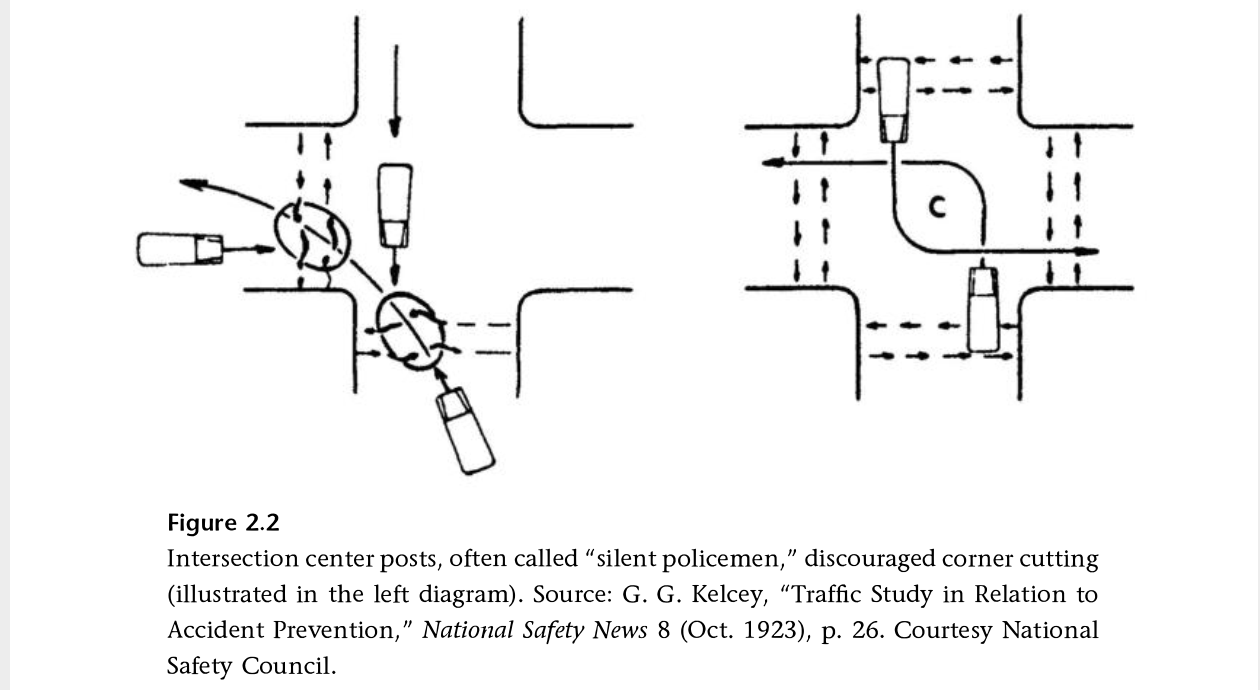
I have been reading Fighting Traffic by Peter Norton, and in Chapter 2 he introduces the concept of the outside left turn, which worked to prevent drivers from cutting the corner on left turns, and was later enforced with ‘silent policemen’, hard structures that provided serious consequences for drivers who insisted on cutting corners. Later, when motor vehicles were given dominance on the roadway, these were removed. It is time to bring these back!
Other
Striping and green paint is very nearly complete on 21st Street. 19th Street has been repaved and preliminary marking installed (the dashed white lines). P Street was just stripped for new pavement (I’m not sure what this process is called, removing 2 to 3 inches of old pavement so that new pavement can be laid), and is being repaved today (Thursday). Q Street has been patched but not stripped. I’m not noticing any active work on I Street, 5th Street, 9th Street, or 10th Street, though I Street has had ‘no parking’ signs up for some while.
The repaving is being done to the full width of the roadway, including the parking lane. This is a waste of materials and money. The parking lane does not need to be repaved, except in a few circumstances where it has been damaged. Nor does it need to be paved to the same standards as the general purpose travel lanes, which receive far more traffic and wear and tear. But the city loves pavement, and loves to add on unnecessary work to projects, ensuring that less is left for actual improvements to the street that would help walkers and bicyclists.
10th Street northbound at Roosevelt Park, three lanes reduced to two
As part of a recent repaving project, now mostly complete, bike lanes were added to several streets in the downtown area, sometimes by converting three travel lanes to two, and sometimes just by narrowing the travel lanes. As an example, 9th Street (one-way southbound) and 10th Street (one-way northbound) were converted from three lanes to two, which freed up space for bike lanes. 10th Street is shown at right. A reduction in the number of travel lanes is sometimes referred to as a road diet. However, the amount of right of way is the same, it has just been shifted to serve all modes of travel more effectively. The reduction in motor vehicle lanes reduces the motor vehicle road capacity slightly, but far less than many people think it will. In fact, with more space for bicycles, more people will bicycle and the motor vehicle traffic drops somewhat, lessening congestion for everyone.
I Street westbound just past 7th St; sharrow in time restricted lane
Sharrows (shared lane markings) were also used liberally throughout, particularly on east-west streets. Along I Street westbound, bike lanes are present in some blocks and sharrows in others. The photo at right shows the sharrows placed within a time restricted travel lane in front of the courthouse on I Street. When parking is allowed, the sharrows form a defacto bike lane adjacent to parked cars. This lane is a bit wider than it was before. During no-parking times, the sharrows define their usual meaning, that “Bikes Can Use Full Lane”. The MUTCD R4-11 sign is used at times to provide the same indication. Sharrows are placed in lanes which are too narrow for a motor vehicle and a bicycle to share side by side, which is less than 14 feet. In any lane narrower than 14 feet, the bicycle not only can be should occupy the middle of the lane to prevent motor vehicles from passing too closely.
Some criticisms of the project:
Sharrows are placed inconsistently within the travel lanes. They should always be centered in the travel lane, but it looks like in some cases they were placed a certain distance out from the curb. Placement too far to the right encourages motor vehicle drivers to try to squeeze by, which is what creates the hazard.
The alternating of bike lanes when there is space with sharrows when there is not space is an understandable effort to create the best solution to a challenging situation, but in my mind, it fails. Regular bicyclists often take the travel lane anyway, in order to create the necessary distance from parking cars and their dooring hazard, to bypass slow traffic, and to prepare for left turns. It is the less confident bicyclists who would benefit most from the new bike lanes, but I think they will be quite confused with the change back and forth between bike lanes and sharrows.
I think that all three lane streets in downtown should be converted to two lanes. Three lane streets encourage high vehicle speeds. It is not unusual during non-congested times to see vehicles going 40 mph on these streets, where the posted speed limit is 25. An opportunity was missed to make these conversions.
I also think that one-way streets should be converted to two-way streets. Again, one-way streets encourage high vehicle speeds, and in fact they are designed to do this, to flush cars in and out of downtown twice a day. They are called traffic sewers for a reason. Two-way streets create an environment where drivers are much less likely to speed. Of course once a street has been road dieted to two travel lanes, a conversion to two-way is much easier.
Despite these criticisms, though, I am pleased to see the new bike lanes freshly painted. I suspect this project has doubled the number of sharrows in Sacramento, and as people see them used more and more, they will become more effective. It was a pleasure riding on Sunday from my residence in midtown south to the farmers marked on 9th Street, and then back north on 10th Street.



 Getting Around Sacramento