Rapid Response Program for SacCity

Note: This is a major revision of a post from 2024-01-31. The OakDOT Rapid Response Program is now in a separate post.

When a fatality or severe injury occurs for walkers and bicyclists, people often ask, what can we do right now to prevent or reduce the severity of the next crash? This topic has come up a number of times at the Sacramento Active Transportation Commission (SacATC), and communication from Slow Down Sacramento and the Safety ForumCivic ThreadSABA, Strong SacTown and other organizations.

Based on the successful program from Oakland, I am proposing that the City of Sacramento develop a similar rapid response program.

The City of Sacramento would establish a pilot Rapid Response Program with an initial budget of $100K. The pilot program would address only fatal crashes. The budget will likely be insufficient, as Sacramento has a state-leading level of fatal crashes, but the pilot would allow the city to develop expertise and program structure, and formulate a future budget. The city might respond only to fatal crashes on the high injury network, in order to extend the budget.

A Rapid Response Team will include a city planner and city traffic engineer, and may include responding law enforcement officer and walking or bicycling advocate (Civic Thread for walking and SABA for bicycling, paid for their time). I intentionally say the law enforcement officer who responded to the crash. Other law enforcement officers would likely offer only uninformed opinions and victim blaming, though the experience could be useful for educating officers about street design.

The team will review existing documents and data, and then visit the fatal crash site within two work days of the crash, or the death of a person resulting from an earlier crash.

The team will make a report within five working days which identifies and proposes quick-build features (countermeasures) to reduce or eliminate infrastructure hazards, with prioritization based on effectiveness.

The quick-build features (countermeasures) may include:

  • Refreshed crosswalk
  • Refreshed pavement markings
  • Temporary curb extension with flex posts
  • Temporary modal filter (traffic diverter) with flex posts
  • Temporary traffic circle with flex posts
  • New marked crosswalk
  • Changed or added signing
  • Temporary new stop sign; permanent stop sign would require additional analysis
  • Changed signal timing

At least one quick-build feature (countermeasure) will be installed within 10 work days of the site visit. Additional temporary features will be designed and scheduled.

I had previously mentioned mapping of crashes and related data by the city, because the state SWITRS system is always too far behind. I had previously mentioned a dashboard on crashes. However, these would probably best be implemented after the pilot year.
OakDOT Rapid Response Program

The City of Oakland Department of Transportation (OakDOT) Safe Streets Division has developed a Rapid Response Program to immediately address street infrastructure that contributes to fatal crashes.

The City of Oakland Department of Transportation (OakDOT) seems to have the best program I could find on the Internet. This is not surprising – since being formed in 2016, OakDOT has led on developing programs for safer streets that are informed by equity. Unfortunately, no single document on the program is available from OakDOT, but several presentations, case studies, and examples serve. Safe Oakland Streets (SOS) is Oakland’s version of Vision Zero.

Rapid Response Projects: OakDOT seeks to eliminate traffic fatalities and severe injuries while promoting safe, healthy, equitable mobility for all. OakDOT’s efforts to make streets safe include rapid responses to fatal and severe crashes involving the most vulnerable users of Oakland’s roadways. A Rapid Response is a coordinated effort in the days and weeks following a traffic tragedy that may include investigations, targeted maintenance, near-term improvements, and the identification and prioritization of longer-term capital needs.”

The two elements most relevant to rapid response are:

  1. Maintenance Treatment: If the crash location has a maintenance issue that may be related to traffic safety e.g., pavement defect, faded striping, missing sign), the maintenance issue will be rectified by field staff.
  2. Quick-Build Improvement: If there are design treatments that could be implemented quickly at low cost, engineering staff will prepare the design and issue a work order for field staff to construct.

A presentation to Oakland BPAC summarizes the program well and provides some examples.

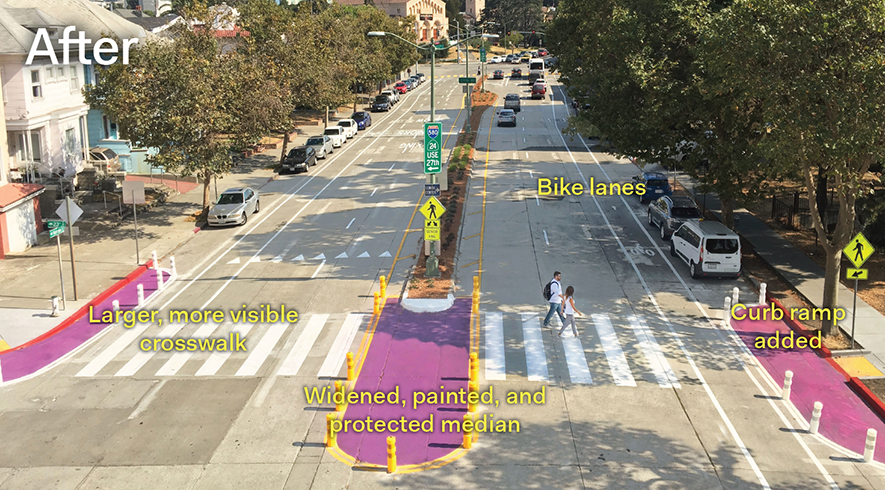
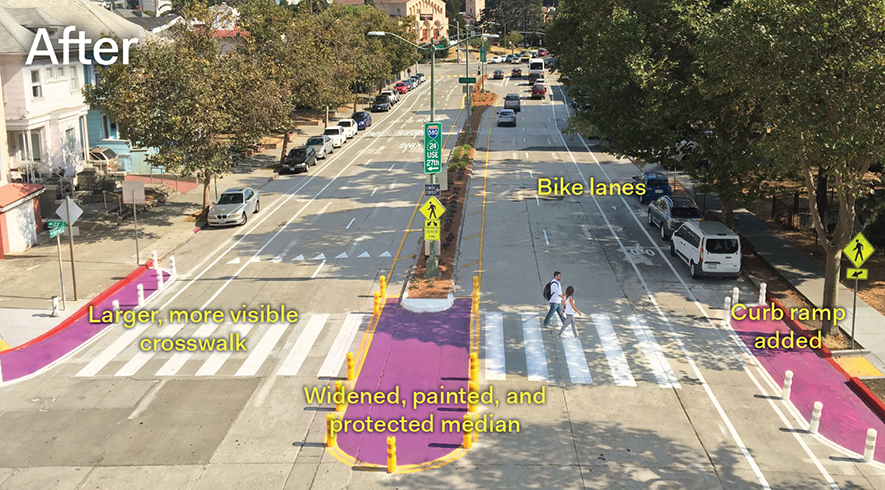
Two examples are below, Harrison Street and the streets surrounding Garfield Elementary School.

OakDOT photo Harrison St & 23rd St showing quick build improvements resulting from Rapid Response
OakDOT graphic of safety improvements at Garfield Elementary School

OakDOT has a Crash Prevention Toolkit with photos of solutions, most of which are inexpensive and quick to implement.

OakDOT Crash Prevention Toolkit excerpt

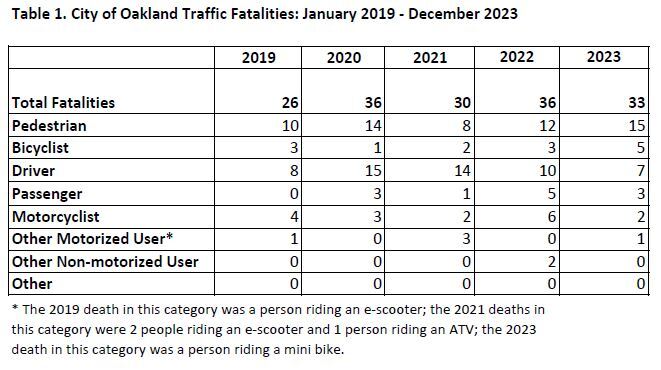
OakDOT offers a map with locations of fatality crashes and relevant features such as high injury network and equity, Traffic Fatalities, City of Oakland. A chart, below, also shows yearly data for modes of travel. A Crash Analysis Infographic also communicates data visually.

OakDOT chart of traffic fatalities by mode over time

Crash Rapid Response Program for SacCity

Note: This post has been significantly revised and published as two separate posts, one on OakDOT’s Rapid Response Program, and the second a proposal for a City of Sacramento program.

When a fatality or severe injury for walkers and bicyclists, people often ask, what can we do right now to prevent or reduce the severity of the next crash? This topic has come up a number of times at the Sacramento Active Transportation Commission (SacATC), and communication by Slow Down Sacramento, Civic Thread, SABA, and other organizations. I believe now is the time for the City of Sacramento to establish and fund a crash rapid response program.

OakDOT Rapid Response Program

The City of Oakland Department of Transportation (OakDOT) seems to have the best program I could find on the Internet. This is not surprising – since being formed in 2016, OakDOT has led on developing programs for safer streets that are informed by equity. So far I have not found a single document that describes the program and procedures, so I’ve selected some information from the Safe Oakland Streets (SOS) and related pages and documents. Safe Oakland Streets is Oakland’s version of Vision Zero.

Rapid Response Projects: OakDOT seeks to eliminate traffic fatalities and severe injuries while promoting safe, healthy, equitable mobility for all. OakDOT’s efforts to make streets safe include rapid responses to fatal and severe crashes involving the most vulnerable users of Oakland’s roadways. A Rapid Response is a coordinated effort in the days and weeks following a traffic tragedy that may include investigations, targeted maintenance, near-term improvements, and the identification and prioritization of longer-term capital needs.”

“A Rapid Response may be activated for traffic crashes resulting in pedestrian or bicyclist fatalities, or severe injuries to pedestrians or bicyclists who are youth or seniors. A Rapid Response may be activated for additional crashes based on the individual circumstances of a crash.”

The two elements most relevant to rapid response are:

  1. Maintenance Treatment: If the crash location has a maintenance issue that may be related to traffic safety e.g., pavement defect, faded striping, missing sign), the maintenance issue will be rectified by field staff.
  2. Quick-Build Improvement: If there are design treatments that could be implemented quickly at low cost, engineering staff will prepare the design and issue a work order for field staff to construct.

The following photos shows the setting after rapid response to a fatality that occurred at Harrison & 23rd. See Harrison & 23rd St Crash Response for more information.

photo of OakDOT rapid response project at Harrison & 23rd

OakDOT has a Crash Prevention Toolkit with photos of solutions, most of which are inexpensive and quick to implement.

OakDOT offers a map with locations of fatality crashes and relevant features such as high injury network and equity, Traffic Fatalities, City of Oakland. A chart, below, also shows yearly data for modes of travel. A Crash Analysis Infographic also communicates data visually.

OakDOT chart of traffic fatalities by mode over time

SacCity program outline

The city program should start small to make sure that there are sufficient resources of staff time and funding to do a good job. I would suggest in the first year responding only to crashes on the high injury network. Yes, those will get fixed with grants, but those are very long term projects, whereas quick fixes are also needed. An alternative would be to do only fatalities, not severe injury crashes.

A rapid response team should be composed of at least three people. One must be a traffic engineer. Others could be planners, law enforcement, and a member of an advocacy organization (Civic Thread for walkers and SABA for bicyclists). Though the participation of law enforcement may not be useful to the outcome, it is useful for educating police about street design.

It is important that the team review existing documentation and make a site visit. The full law enforcement incident report will not be available within the rapid response time frame, but sufficient detail should be available to determine the movements of the people involved in the crash.

The team should make a report within five working days of the crash, listing obvious and inexpensive fixes, prioritized by effectiveness. One or more of the fixes should be implemented within 20 working days of the crash.

Public Works staff should report to SacATC on a yearly basis on the rapid response program, the projects undertaken, staff time, and money spent. After the first year, this information should be used to develop a budget request for future years.

City of Sacramento should create a fatalities map similar to Oakland’s, with frequent updates, from SacPD information. The state SWITRS database always lags too far to be useful.

A dashboard should be developed that includes fatalities and severe injuries by type of mode and trends. SacATC has already requested a dashboard that would also show projects applied for, in progress, and complete.

As with any new program, this one would and should evolve as experience is gained and the public sees the value of the program in reducing or eliminating fatalities.