Slow Down Sacramento recently sent a ‘Mid-Year Check-In: How Far We’ve Come (and Where We’re Going)’ email that very well summarizes ways in which the City of Sacramento has made progress, and has not, on the Slow Down priorities. As always, I encourage you to ‘join‘ so you don’t miss informative emails.
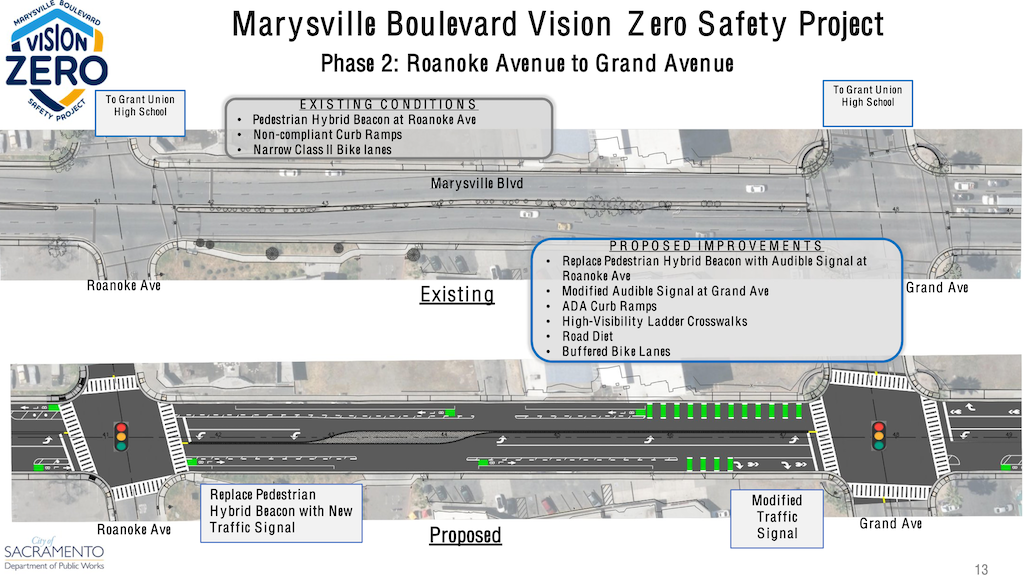
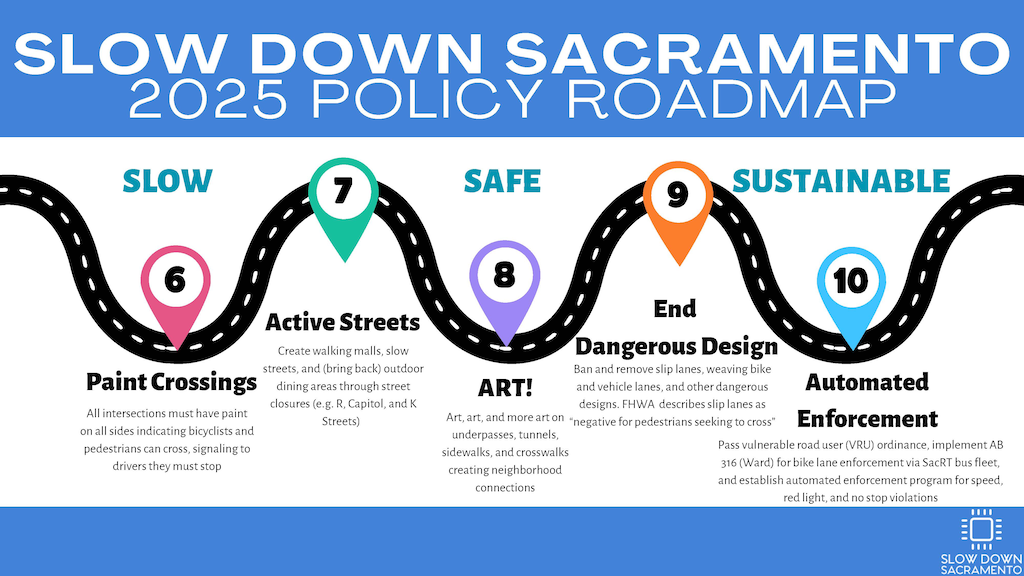
The email goes through each of the ten policies that Slow Down set at the beginning of the year, shown in the graphics below. Significant success has been made in:
Quick Build (1): The city has established a program, with budget and staffing. This was both a city initiative and strongly supported by the advocacy community including Slow Down.
There has been progress in Twenty is Plenty (2), Daylight Now (5), Art! (8) and Automated Enforcement (10). The others have been advocated for but no significant progress has been made. For End Dangerous Design (9), the city is undertaking an update of its Street Design Standards, which Slow Down, Strong SacTown, and other have been involved in, but the outcome has not been released. Of course the important thing is not just better designs to not repeat the same mis-design mistakes, but to correct the mistakes already made which make our streets less safe for everyone.
Thank you, Isaac Gonzalez and all the others on the Slow Down Sacramento team.
Slow Down Sacramento 2025 Policy RoadmapSlow Down Sacramento 2025 Policy Roadmap
This quick build proposal is worth supporting, whether in person at the council meeting, or ahead of time using the eComment capability on the Upcoming Meeting Materials page. Transportation advocates have been asking for a quick build program (also called tactical urbanism, though they are subtly different) for years. When Councilmember Caity Maple and others proposed an emergency declaration over traffic violence, advocates pushed for quick build to be the top element of that proposal. The city has done a few such projects, such as the closure of a block of 2nd Avenue at Broadway and 34th Street to increase safety for bicyclists and simplify complex intersections. Photo below. But this new program would greatly accelerate the implementation of quick build projects. Some will be at the location of major crashes, while others will be at locations where crashes might be expected and where prior city neglect of lower income neighborhoods has resulted in more unsafe walking and bicycling.
Sac_2nd-Ave-Broadway_delineators
The program would have a Traffic Safety Team staff of six FTE (full time equivalent), paid with funds from existing budget categories in Public Works. The program would suspend competitive bidding requirements so that projects could be implemented quickly.
The Vision Zero or Safe Systems approach to roadway safety is to immediately change the street design with temporary fixes that slow or channelize traffic, and then to eventually replace these with permanent design changes. The Street Design Standards update (category: Street Design Standards) and Strong SacTown (tag: Street Design Standards), the Active Transportation Plan, Neighborhood Connections and Streets for People Active Transportation Network, and many other efforts align with the quick build program. Most of the traffic calming measures in Neighborhood Connections (SacCity Neighborhood Connections) and and many of the traffic calming measures in Streets for People Active Transportation Network visual gallery – pedestrian and visual gallery – bikeway can also be implemented in quick build, as the photo below shows, a temporary curb extension with vertical delineators.
Land Park Dr & 8th Ave curb extension
The SacATC 2024 Annual Report is also on the agenda, item 1 on the consent agenda. It is not expected to be controversial, but it would be nice if a couple of people spoke in support, just to remind council that advocates are interested and supportive.
Note: Added letters of support from four organizations, below.
The Budget & Audit Committee of the Sacramento City Council meets tomorrow (!) Tuesday, February 25, 2025, 11:00 AM in city hall council chambers. The Budget & Audit Committee members are Roger Dickinson, Chair, District 2; Karina Talamantes, District 3; Caity Maple, District 5; and Eric Guerra, District 6.
On the agenda is item 10 SacATC 2024 Annual Report. The discussion, however, will include more than just the annual report. It will include the city’s proposed quick build program. Quick build, sometimes called tactical urbanism, is a concept related to Vision Zero, that rather than just accepting traffic violence, the city would take action to reduce or prevent future crashes at that location. What makes it unique, and different from the long term roadway redesign that the city undertakes when they can get grant funding, quick build analyzes the issue now, and takes action soon to correct it.
The city is calling this effort TAG Team (tactical action group), and it would be implemented from existing budget and staffing limits with six staff dedicated to the project.
If you can’t make daytime meetings, you can submit an eComment on the city meetings page. The earlier you submit eComments, the more likely committee members are to see them before the meeting.
Three examples of quick builds: the street closure and bikeway improvement at Broadway and 2nd Avenue and 34th Street, with yellow vertical delineators; the corner curb extensions that have been installed at some corners with paint and/or white vertical delineators, and lane channelization delineators on 15th and 16th Streets. Vertical delineators are much less expensive, and also somewhat less effective, than concrete curbs, but they do reduce the likelihood and/or severity of crashes.
The City of Oakland Department of Transportation (OakDOT) Safe Streets Division has developed a Rapid Response Program to immediately address street infrastructure that contributes to fatal crashes.
The City of Oakland Department of Transportation (OakDOT) seems to have the best program I could find on the Internet. This is not surprising – since being formed in 2016, OakDOT has led on developing programs for safer streets that are informed by equity. Unfortunately, no single document on the program is available from OakDOT, but several presentations, case studies, and examples serve. Safe Oakland Streets (SOS) is Oakland’s version of Vision Zero.
“Rapid Response Projects: OakDOT seeks to eliminate traffic fatalities and severe injuries while promoting safe, healthy, equitable mobility for all. OakDOT’s efforts to make streets safe include rapid responses to fatal and severe crashes involving the most vulnerable users of Oakland’s roadways. A Rapid Response is a coordinated effort in the days and weeks following a traffic tragedy that may include investigations, targeted maintenance, near-term improvements, and the identification and prioritization of longer-term capital needs.”
The two elements most relevant to rapid response are:
Maintenance Treatment: If the crash location has a maintenance issue that may be related to traffic safety e.g., pavement defect, faded striping, missing sign), the maintenance issue will be rectified by field staff.
Quick-Build Improvement: If there are design treatments that could be implemented quickly at low cost, engineering staff will prepare the design and issue a work order for field staff to construct.
A presentation to Oakland BPAC summarizes the program well and provides some examples.
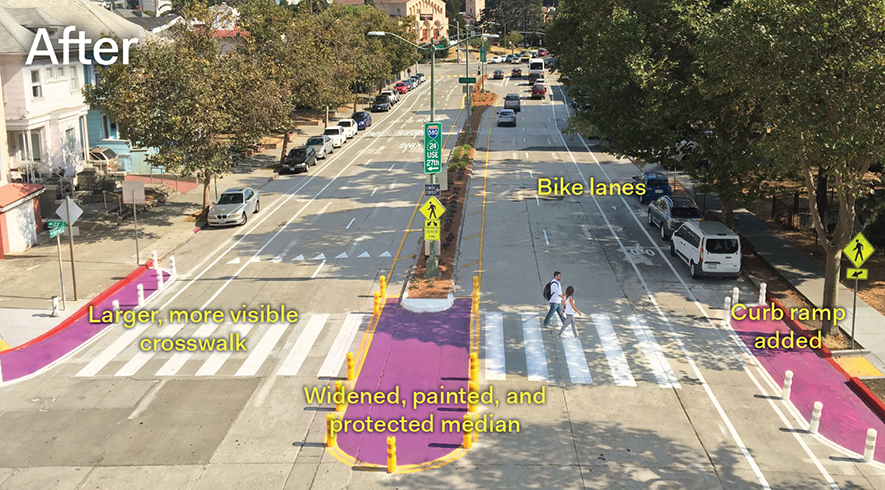
Two examples are below, Harrison Street and the streets surrounding Garfield Elementary School.
OakDOT photo Harrison St & 23rd St showing quick build improvements resulting from Rapid ResponseOakDOT graphic of safety improvements at Garfield Elementary School
OakDOT has a Crash Prevention Toolkit with photos of solutions, most of which are inexpensive and quick to implement.
OakDOT Crash Prevention Toolkit excerpt
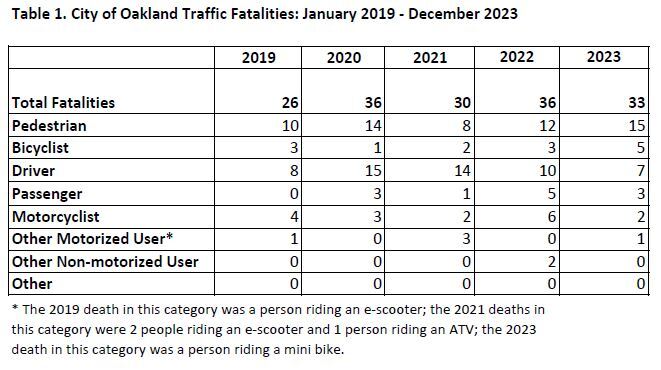
OakDOT offers a map with locations of fatality crashes and relevant features such as high injury network and equity, Traffic Fatalities, City of Oakland. A chart, below, also shows yearly data for modes of travel. A Crash Analysis Infographic also communicates data visually.
OakDOT chart of traffic fatalities by mode over time