more on Steinberg’s transportation and housing proposal

My previous post on Mayor Darrell Steinberg’s transportation measure proposal was based on the August 25 press conference and panel discussion which included Elk Grove Mayor Bobbie Singh-Allen, Steve Cohn of SMART (Sacramento Metro Advocates for Rail and Transit), Cathy Creswell, Chair of Sacramento Housing Alliance, Luke Wood, President of Sacramento State, and Gabby Trejo of Sacramento Area Congregations Together (SacACT).

A ten page summary of the proposal offers more detail on ‘The Climate, Clean Transportation, and Affordable Housing Act of 2024‘. The proposal offers three major program areas, each of which would receive about one-third of the revenue generated.

  1. Affordable housing and displacement prevention
  2. Investing in public transportation
  3. Safe streets and active transportation

For affordable housing, there are three sub-programs:

  • Creation of new affordable housing on vacant or underused infill sites and along existing commercial corridors and/or transit lines: infill housing rather than greenfield development (which can never be affordable because lower housing costs are more than counterbalanced by higher transportation costs)
  • Preventing displacement and homelessness: keeping people in their homes so they don’t become homeless
  • Green Means Go: enhancing infrastructure needed to support affordable infill housing

For public transportation, it would fund high priority public transit improvements, with four elements:

  • Bus rapid transit countywide. This element was important enough to Steinberg that he highlighted it on his webpage, table below. Note that light rail extension is a possible future enhancement to BRT to Elk Grove and the airport, but it does lock in these extensions are other proposals have.
  • Expanding service & frequency on existing transit lines
  • Light rail fleet replacement and station renewal
  • Regional (Intercounty) Transit Network/ express bus services
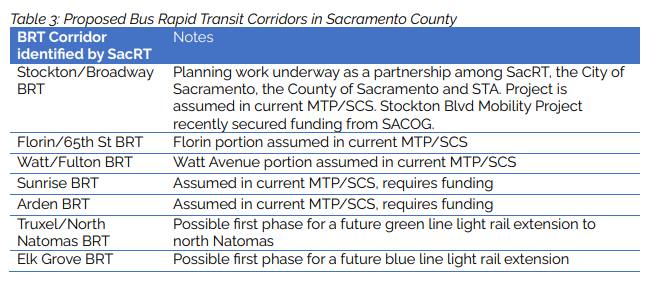
table of Proposed Bus Rapid Transit Corridors

For safe streets and active transportation, there are two sub-programs:

  • Fixing the roads and active transportation
  • Innovative mobility: unfortunately, the focus is on motor vehicle electrification, and not e-bikes and shared mobility devices

Note that though the documents calls for a half-cent sales tax, Steinberg said he is open to other funding ideas including property tax. He also implied that if the rest of the county is not on board with an innovative investment strategy or tries to water it down with the traditional road building and widening methods, the city would go its own way.

Certainly we need more detail, but I support the vision that Steinberg’s proposal puts forth. Almost of all of our transportation expenditures in the past have disinvested in, or active harmed, communities of low income and people of color. They have continuously widened and extended roadways, mostly for the benefit of high income suburban commuters. They have built and over-built transportation infrastructure that we will never have enough money to maintain, and insisted on building more rather than taking care of what we have. They have actively discriminated against people who walk and bicycle. They have ignored the established fact that adding roadway capacity induces more travel, so that ‘congestion relief’ is always out of reach.

It is time for a new approach, and I believe that Steinberg’s proposal is an important step along the way to a better future.

Sacramento has stalled

Jim Brown wrote recently in the Sacramento Bee about underfunding for the city’s contractor to develop a new bike plan, and the plateauing of progress on bike mode share in the city. Please read! However, the issues go well beyond bicycling. Sacramento has stalled, period. We are no longer making forward progress towards livability.

There are three additional major issues, as I see them:

  1. Our public transportation system (SacRT) is woefully underfunded, and despite a lot of discussions recently about how to improve the system, not one of our political leaders seems to have the courage to state the obvious, that we cannot have a successful and efficient system unless we devote more tax revenue to it. Putting bandaids on the system will not make a significant difference. Sacramento needs to fund SacRT at a level comparable to other cities of our size, which means tripling our tax base.
  2. Sacramento is not becoming more pedestrian friendly, in fact it seems to me to be becoming less so. There is an almost universal failure among drivers to recognize the rights of pedestrians to cross the roadway (CVC 21950). I find that almost no drivers yield to me when I am walking. Apparently the Sacramento Police Department accepts this situation, because so far as I know they make no effort to enforce the law. I have never seen someone pulled over for failing to yield to a pedestrian, and in fact I’ve had several SacPD officers fail to yield to me. Pedestrians, not bicyclists, are the indicator species for our city, and until we treat people walking as the highest form of transportation, we will never be anything but a sad city. [As an addendum to this, Chris Morfas reminded me that the conversion of one-ways streets to two-way streets has also stalled. The city made a decision to start these conversions years ago, and then lost courage. Nothing has happened on this critical change in years.]
  3. The city is going to focus much of its attention on Natomas, now that the building moratorium has been removed. I think that no effort and no money should be spent there until the city develops a new vision for Natomas. The sprawl suburbs are a dead end, and we should not be spending any money on them until we have a plan for how to make them financial viable and livable. Meanwhile, the two truly needy parts of the city, South Sacramento and North Sacramento/South Natomas, are neglected. These are the areas where the most people are walking, bicycling, and using public transit, but yet the city continues to throw money at the “rich” areas that it hopes will provide sales tax and property tax revenue to save the city from its debt problem. The fact is, however, that it always costs more in infrastructure to support new developments than they ever generate in sales and property taxes. It is the small businesses in South and North Sacramento that actually support this city.

There is also much to celebrate in Sacramento. I live in midtown, and I am so impressed with the new development happening, with the richness of opportunity here, and even impressed with the improvements to bicycle facilities that have happened. But most of this is driven by economics, and will happen with or without the help of the city. What won’t happen without the help of the city is livability in South and North Sacramento. Indeed, to say something controversial, I think the city needs to pay way less attention to downtown/midtown, and much more to the neglected areas north and south. I am not saying that every area of the city can be saved – we will have to prioritize and triage – but to keep acting as though downtown/midtown are the whole of Sacramento indicates a complete lack of leadership on the part of the city council.