observations on Philadelphia

I just spent five days in Philadelphia. As always, most of my observations are about transportation, but I notice other things as well.

  • transit is about average for amajor city; most is run by SEPTA
    • an old trolly line (1906) runs above ground and in subway to city hall, using old trolley cars
    • several rapid transit lines run within Philadelphia; I have used L, B, and T lines
    • bus and rail use CharlieCard or contactless credit card payment for city rail and buses
    • commuter rail (regional rail) to several distant suburbs in the region, and ferries, use mTransit app
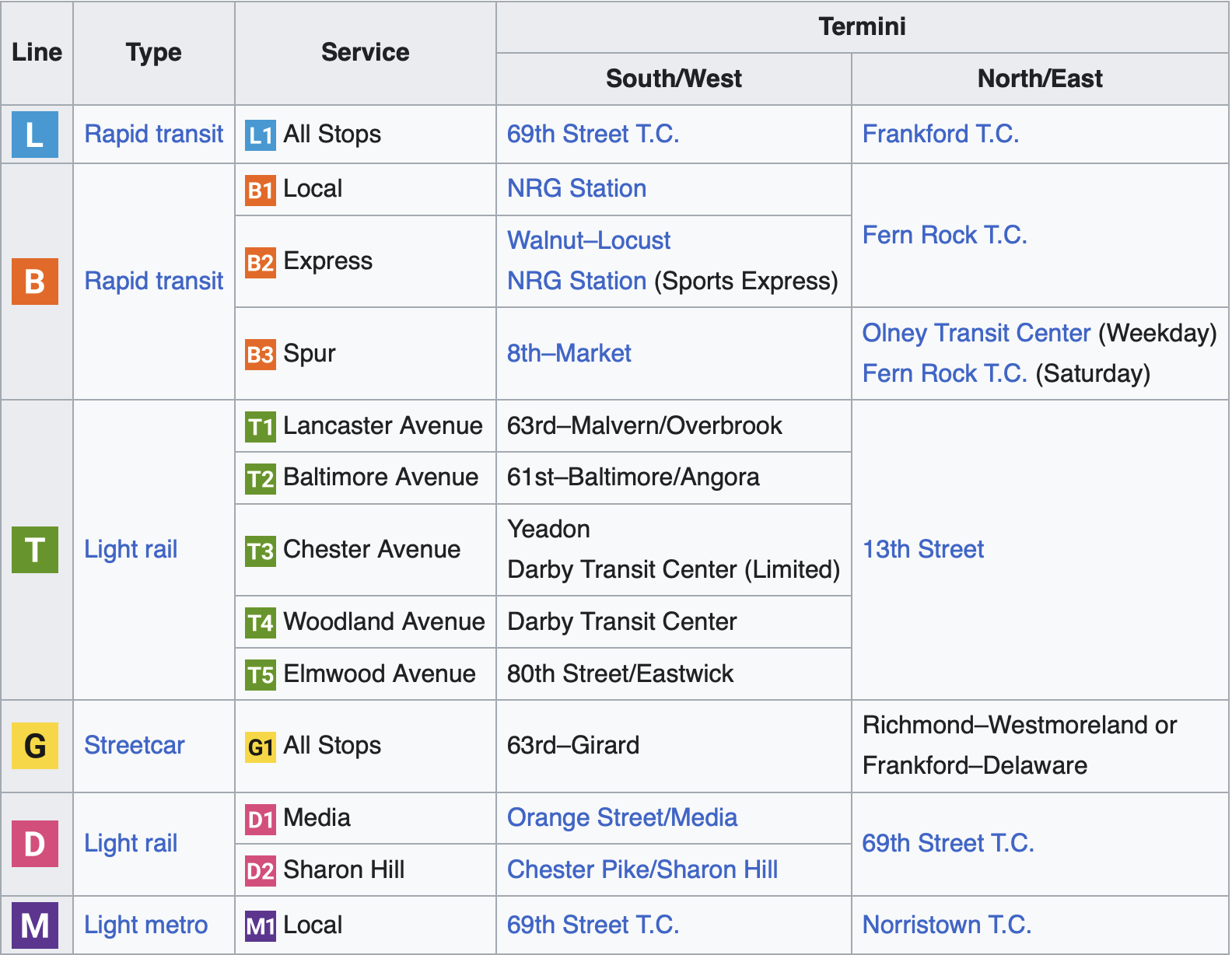
table of SEPTA Metro services, from Wikipedia
SEPTA Metro services, from Wikipedia
  • transportation and street design
    • most streets in Philadelphia are one-way, but many are single lane, so this is better than it sounds; one lane, one-way streets are safer than other streets
    • typical residential streets are narrow one-way with parking on both sides, but wide arterial streets do exist, and Philadelphia is sliced and diced with freeways, as are most cities
    • several streets in the historical sections of town have a cobblestone or brick paver surface, which slows motor vehicles considerably; not sure if these are original or restored
    • though there is quite a bit of bicycling in Philadelphia, drivers have not responded by being more careful, in contrast to the transition that has happened in other cities
    • all kinds of bicycle facilities are present: none, bike lanes, separated bike lanes, parking protected bike lanes, sidewalk level bike lanes, and two-way bikeways (cycletracks)
    • a bike-share system, Indego, is present in much of the city, and is quite usable with pedal bikes and e-bikes; however, the app (bcycle) map sucks – attempted to zoom in results in zoom out
    • there is street and utility construction everywhere!
    • people walk a lot, and other people drive a lot
  • other
    • Philadelphia has a lot of parks, particularly in the older part of town and along the Schuylkill River, but has a paucity of street trees; I had an enjoyable walk along the Schuylkill River from downtown to the south end
    • the city seems typical for trashiness; I did not notice any business improvement districts doing cleaning, but they may exist
    • the city hall is an amazing building, but better viewed from Market or Broad rather than up close
    • there are a lot of universities in the city, with the largest being University of Pennsylvania (UPenn)
    • pizza seems to be the fast food of choice; there are pizza places almost every block
    • the hostel, Apple Hostel of Philadelphia, is nice and a good deal, but the 24×7 pop music radio in the common room is offensive
    • I visited the Shofuso Gardens and House in Fairmount Park; it is small but quite nice
    • my favorite coffee shop, of the ones I visited, is Habitat Coffee, Spruce & 11th

I enjoy Philadelphia and will visit again.
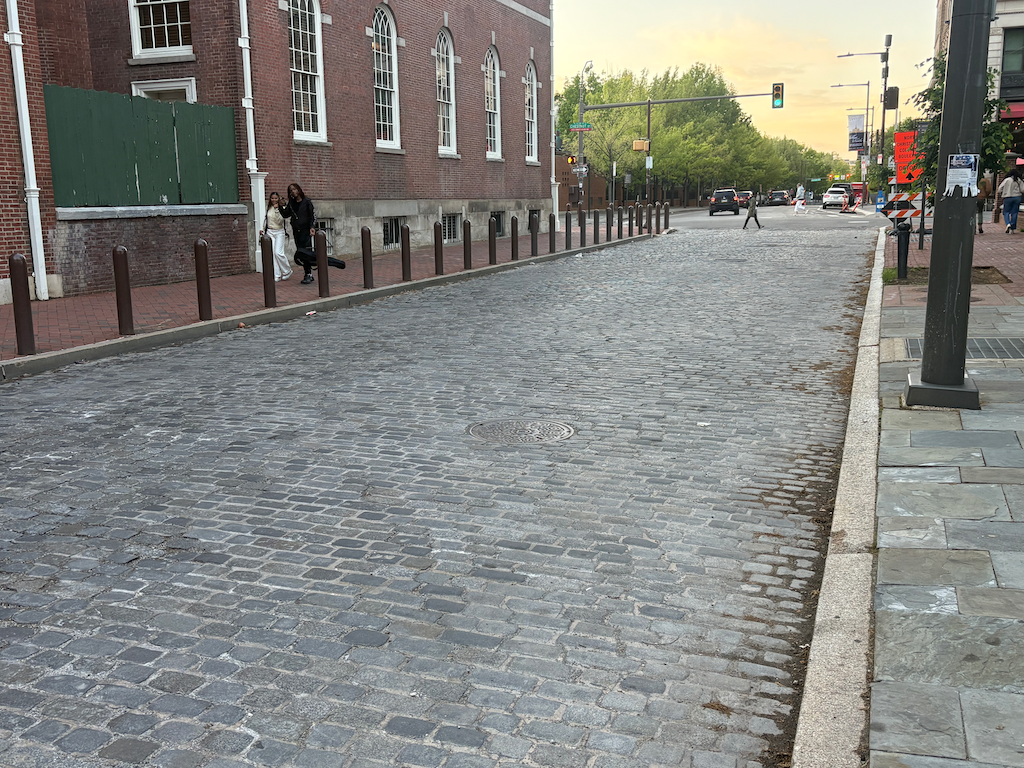
a real street

I’m still in Philadelphia today, and will post some thoughts about the city tomorrow. But for today, I want to say again that smooth streets are dangerous streets. They encourage motor vehicle drivers to drive fast, too fast for conditions, and fast enough to kill any walkers or bicyclists they hit because they are driving too fast. Our street design encourages speeding, and rewards it. But we can design streets that discourage or even prohibit speeding.

The street below, 5th Street in the historical and old city part of Philadelphia, is a street with an appropriate surface, cobblestone pavers. Of course it is so for historical reasons, it has been preserved, and probably reconstructed, to preserve the historical feel of the area. Independence Square is to the left. I watched traffic on this street for quite some time. I saw absolutely no one speeding. The cobble surface enforces reasonable speeds. Of course the width of the street is not optimal. It is not clear whether it is two lanes or one, and it is not clear whether parking on the right side is permitted or not. But that is actually part of the benefit, by leaving drivers a bit confused, they drive even more slowly and carefully.

And if a driver does error, there are metal bollards separating the street from the sidewalk. Why is the ‘old’ way to protect walkers from errant drivers, while the ‘new’ way is to leave walkers at the mercy of errant drivers.

I’m pretty sure that all the streets in the old part of Sacramento, both ‘Old Sacramento Waterfront’ and the western part of the central city up to the Capitol, were cobblestone. I’ve seen utility projects digging up streets reveal the cobblestone beneath the asphalt. People think of asphalt as being the modern thing, and cobblestone as being old fashioned, but the fact is, cobblestone is the advanced street design, because it keeps motor vehicle drivers to safe speeds. We need to get back to the ‘old’ and safe ways.

photo of 5th St cobblestone between Walnut and Chestnut, Philadelphia
5th St cobblestone between Walnut and Chestnut, Philadelphia

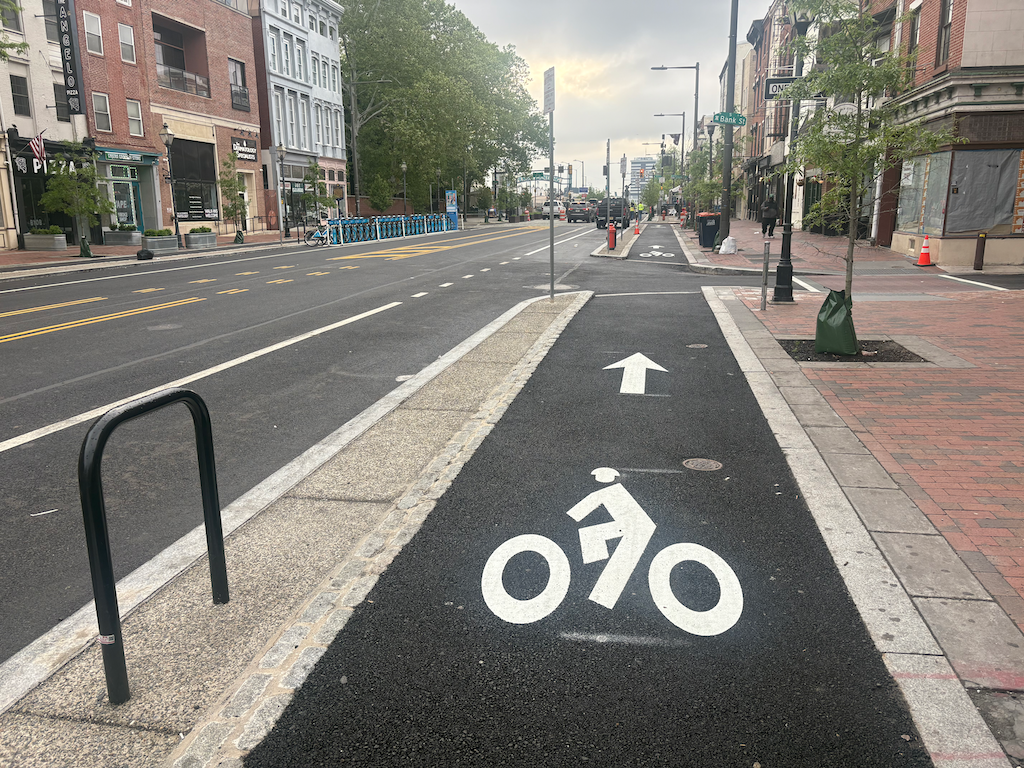
sidewalk-level bikeway in Philadelphia

One of the many reasons that I travel is to see transportation facilities in different places, ways in which cities have made active transportation and transit better, or worse. I’m in Philadelphia at the moment, and one of the features that has been implemented is…

photo of sidewalk-level bikeway on Market St in Philadelphia
sidewalk-level bikeway on Market St in Philadelphia

These sidewalk-level separated/protected bikeways are on several blocks of Market Street, the main east-west street in Philadelphia. These are new, and were under construction during my last visit a year ago. NACTO calls these Raised Protected Bike Lanes, with designs on the Separating Protected Bike Lanes page (scroll down for this design section).

These bikeways are visually distinctive from the adjacent sidewalk, composed of different materials and colors, red brick for the sidewalk (many sidewalks in Philadelphia are brick), grey granite for the separation, and black asphalt for the bikeway. NACTO recommends a tactile warning delineator (TWD) between the sidewalk and bikeway. The granite separator and change of texture may or may not meet this criteria for visually impaired people. Though

Philadelphia downtown has a significant bicyclist mode share, but it mostly seems to be on the north-south arterials and collectors, not on east-west streets. But this may be an artifact of the time of day I observed. It has a wide variety of bike facilities: traditional bike lanes, vertical delineator ‘separated’ bikeways, two-way separated bikeways (cycle tracks), parking protected bikeways, bikeways along transit islands. I don’t know the criteria, but I suspect that available roadway width is a determinant.

Sacramento is proposing a sidewalk-level bikeway (2-way cycle track) on H Street between 9th Street and 10th Street, at City Hall. I believe the design is for paint on the existing sidewalk, not reconstruction of that section. It will be interesting to see if this design works.