While attending the Sacramento Transportation Authority meeting last Thursday, and hearing the long painful discussion about how there isn’t, and never will be, enough money to fix our roads to the level that the public desires, a thought occurred to me. Keeping roads in good shape is often called ‘fix-it-first’ or ‘state of good repair’.
What about a sales tax of a quarter cent, JUST for maintaining roads? It would have a short term, perhaps 10 years, with language included that it could not be extended. It would only be for fixing pavement. It would not includes complete streets or sidewalks. It could include the addition of regular bike lanes as the street is re-striped after paving, but would not include high quality bike facilities. It would include language to ensure that it is not used to expand roadway capacity or to build new roads.
I know that many of my transportation advocacy friends are cringing. What about all the other things that need to be fixed? What about missing sidewalks? What about complete streets? What about traffic calming? Yes, all of those are important, and must be funded in some way. But useable streets are the base of everything else we do for mobility and access. Sacramento area streets are certainly not the worst in California. I know that Los Angeles, and San Francisco, and parts of Oakland, are much worse.
There would also be a tremendous question of fairness. The tax would be collected from all citizens of the county, but most of it would be spent in unincorporated Sacramento County. The county has a long, long history of underinvesting in its roads, building new but not maintaining. That keeps taxes lower, which is in part why there are so many anti-tax people in unincorporated county, but it does not create useable roads. Should the rest of the county be responsible for fixing the county’s underinvestment? Its a fair question.
A report on pavement condition in Sacramento County was presented today to the Sacramento Transportation Authority (SacTA): 2023 Regional Pavement Analysis, written by consultant NCE, agenda item 12.
The report has two main sections:
What are the existing pavement conditions, countywide, and by each agency (city or county).
What are funding scenarios and how would the allow, or not allow, substandard conditions to be improved.
Existing conditions are summarized in the chart below. The countywide PCI (pavement condition index) is 53, out of a possible 100, with a target of at least 70 for ‘good condition’. Only Elk Grove has the target 70 or better, in large part because their roadways are newer than most of the county.
The second section presents five possible funding scenarios, and how pavement condition would vary over time. In each of the scenarios except the first, ‘improve PCI to 70’, pavement condition declines, sometimes slowly and sometimes quickly. SacTA already recognized that there is no likely funding source that would allow scenario one. Scenario four includes new sales tax income, but still does not keep pavement conditions from declining.
Many people question where SB 1 Road Repair and Accountability Act of 2017 funding (mostly gas tax) is going and why it hasn’t fixed our roads. SB 1’s main intent was to allow Caltrans to maintain freeways and other state-owned roads. It had only minor funding, a fraction of what would be needed, to maintain local roadways.
Why are we in this crisis of pavement condition? Because we have built roadways (and bridges and freeways) that we will never be able to maintain. It would take a tax rate many times higher than it is today to actually maintain all we have. That isn’t happening. We’ve built ourselves into a corner. But that doesn’t mean we can’t address the problem. We can shift funding from road building to road repair. This is called ‘fix my pothole’ or ‘fix-it-first’ or ‘state of good repair’.
I made these comments today about the issue:
I’m a active transportation and transit advocate, but what everyone in the county wants is to have good streets.
Under no reasonable funding scenario does pavement quality improve
There will be less money coming through the state, as demonstrated by the LAO presentation (the previous agenda item, 11)
$8.3B roadway ‘asset’ is really a $8.3B ‘liability’, requiring a significant investment to maintain
Every new pavement mile is an additional liability
Authority funding should shift from creating new pavement to maintaining and rehabilitating existing pavement
This shift is even more important for the member agencies, cities and county
Each potential infrastructure project should be evaluated on the question “Does this project add enough economic activity to pay for maintenance?” If the answer is not, they should not be built.
If the authority is going to voters for increased sales tax in the future, it will be necessary ahead of time to show that the authority and agencies are already working to solve this issue, not just waiting for more money
Two bicycle advocates spoke after me, pointing out that safety for bicyclists is actually a very high priority. I agree, even above economic productivity. But economic productivity must be considered. I roadway projects don’t create enough income to pay for them, and maintenance and rehabilitation of them, we are sliding further down the slope of pavement deterioration.
Board comments were mostly in recognition that we must invest differently than in the past, we must keep our existing roads in better condition, and that includes consideration not doing projects which increase future liability.
The proposed transportation sales tax measure includes several paragraphs on fix-it-first. The concept is that our transportation network should be maintained in a state of good repair, and that existing infrastructure should be maintained before new stuff is built. It is clear that we are not there. In fact, we can never get there. We have built more infrastructure than we can possibly maintain. There is no amount of money or taxation that can maintain what we’ve built. That is true everywhere, not just Sacramento County.
Many people were disappointed that SB 1 increase in gas tax didn’t fix very many streets. The legislation was directed mostly to state highways, and only partly to local streets and roads. Even at the state highway level, it is not enough money. At the local level, the amount of funding is a tiny fraction of what would be needed.
The proposal acknowledges the need for maintenance, beginning with the second paragraph of the Local Street and Road Repair and Transformative System Improvements section. The sales tax proposal is in part an attempt to overcome the local maintenance deficit with local funds.
For the first five years following implementation of this Measure (April 1, 2023, to March 31, 2028), not less than 90% of the funds identified for the Local Street and Road Repair and Transformative System Improvements program shall be used exclusively by all cities and the County of Sacramento for “Fix It First” road and bridge preventative maintenance and rehabilitation, including safety improvements, so as to bring these facilities throughout Sacramento County to a pavement condition index (PCI) of at least 70 at the soonest possible time, and bridges to meet acceptable state and federal standards.
Exhibit A: Transportation Expenditure Plan
This commitment is good. Every survey has indicated that fix-it-first is the highest public priority, and this interest probably accounted for much of the yes votes for the 2016 Measure B.
At the end of the five-year period following the date of implementation of this Measure (after March 31, 2028), not less than 50% of the funds identified for the Local Street and Road Repair and Transformative System Improvements program shall be used exclusively by all cities and the County of Sacramento for “Fix It First” street, road, and bridge preventative maintenance and rehabilitation so as to continue efforts to bring these facilities throughout Sacramento County to PCI of at least 70, and bridges to meet acceptable state and federal standards.
Exhibit A: Transportation Expenditure Plan
So, for the next 35 years of the measure, the allocation to maintenance can be much lower, or zero if PCI 70 is achieved. This seems reasonable, in the sense that if every cent were spent on maintenance, nothing new would ever be built. Of course, when it comes to motor vehicles, that would be just fine with me. But probably not with the public.
Notwithstanding these allocation restrictions, the percentage commitments to “Fix It First” maintenance and rehabilitation may be reduced, and any city and the County of Sacramento may direct a higher percentage of those funds to new transformative system improvements, provided the following conditions have been met:
The public agency manager responsible for road maintenance has certified in writing to the City Council and City Manager in a city and the Board of Supervisors and the County Chief Administrative Officer that the road facilities under their management have met or will meet within the next 12 months a 70 PCI rating.
The public agency manager responsible for road maintenance has submitted a written plan to the City Manager or County Chief Administrative Officer clearly demonstrating how the 70 PCI rating will be sustained in the future. Any diversion of the funds committed to maintenance and rehabilitation can only continue as long as ajurisdiction maintains an average PCI of 70 or above for its street and road system.In addition, local jurisdictions must maintain current levels of funding for maintenance and rehabilitation and shall not use funds from this allocation to offset existing funding planned or allocated for this purpose.
Exhibit A: Transportation Expenditure Plan
What concerns me is that there are exceptions offered. The transportation agencies have gamed the system before, building new while not maintaining existing, and in fact that is the pattern of tranportation spending ever since World War II. It seems unlikely that they will immediately change their approach to infrastructure maintenance. What if it becomes obvious that our roads, bridges and other transportation infrastructure are continuing to deteriorate? Will the engineers and planners and politicians be willing to forgo the big new projects and ribbon cuttings?
Search for category Measure 2022 to see posts as they are added.
I started wondering about other variables that might affect pavement condition index (PCI) in the council districts, so here is a little more exploration. See the previous post: pavement condition in Sac City.
First, the council district map, for those who may not be familiar with boundaries.
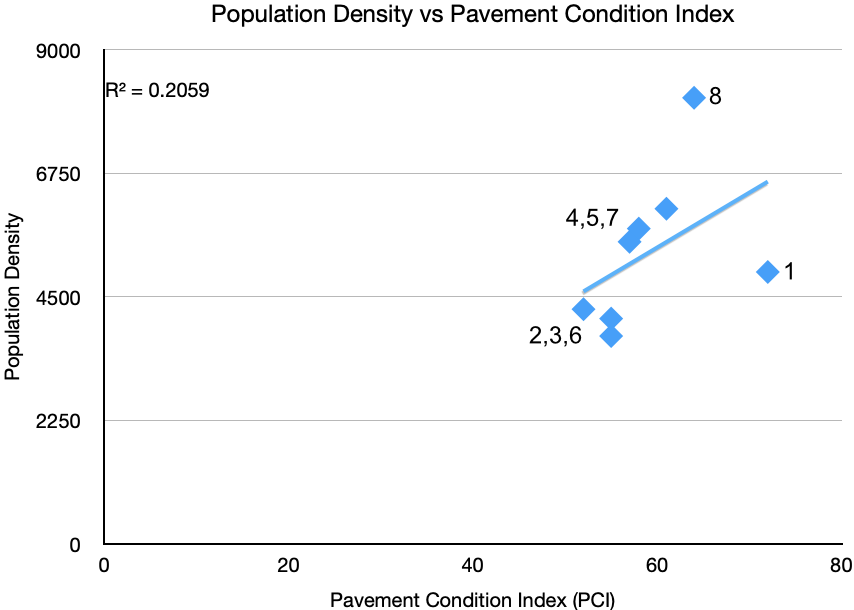
I wondered about the relationship between population density (people per square mile) and PCI. There isn’t any correlation, though again, the district 1 and 8 outliers may be interesting. I did not realize that district 8 has the highest population density of the districts.
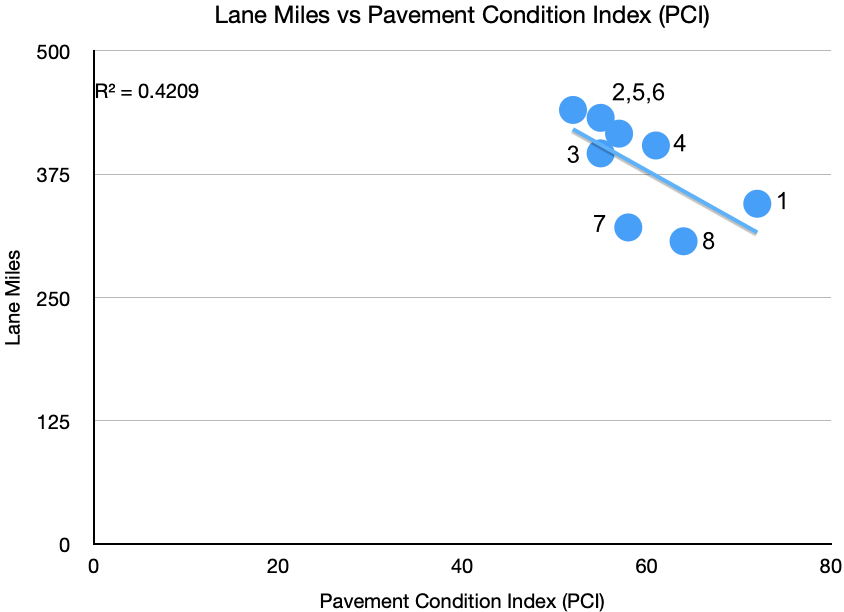
I wondered about the relationship between lanes miles and PCI. There is a weak correlation.
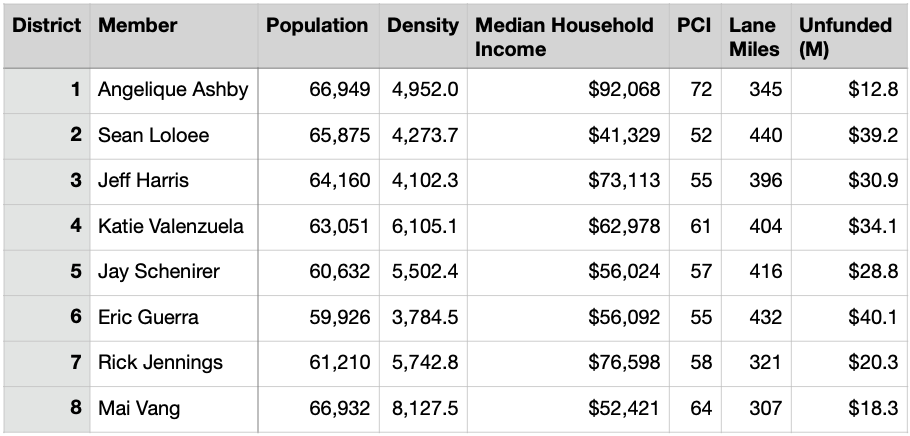
And finally, here is my current data table, in case you want to play with data or suggest insights. Note that the population of each district is roughly the same, as it should be. The unfunded column is the amount (millions of dollars) of backlog, to bring roadways up to PCI 75, but it does not include the ongoing yearly expense of maintaining them at that level.
In the search for other information, I came across the City of Sacramento Pavement Condition Report, dated March 2020, and it has some interesting things to ponder. The city has 3000 lane miles of streets. The county reports road miles instead of lane miles, so I can’t directly compare the city and county, but the city does say it has the fifth largest roadways network in California.
The report has maps for each council district, showing the PCI for each (PCI = pavement condition index, a measure of how well the roadway has been maintained, higher is better). I wondered whether the PCI correlated with income, as many things do, so I plotted 2020 median household income of each district against PCI, table and chart below.
There is not a strong correlation between income and PCI, R = .42, but district 1 and 2 are clear outliers, with 1 being the highest income and highest PCI, and 2 being the lowest income and lowest PCI. The city report says that the reason district 1 has a high PCI is that the roads there are newer, but I’m a little doubtful this explains it all, since many of the roads in that area are now old enough to need maintenance.
The target score for ‘roads in good condition’ is at least PCI 75, so Sacramento is falling far short of that because it is not spending enough on roadway maintenance. Part of the reason for this is that money is spent on building new roadways and widening roadways instead of maintaining roadways. But the underlying reason is that the city has allowed to be constructed, and then taken on maintenance responsibility for, roadways which it does not have the income to maintain. In new developments, construction of internal roadways is paid by the developer, but arterials and collectors, which often must be upgraded to handle increased traffic, and the interchanges with freeways, are largely paid by the city, or grants, and are maintained by the city. But low density development, of which the city was formerly very fond and still has some attachment to, cannot ever generate enough income in property or sales taxes to maintain the roadways. This is one of the great suburban subsidies that so hurts our cities and counties.
The report lays out three funding level scenarios:
current funding levels: The PCI will deteriorate over 10 years to 42, which is rated ‘poor’, and if ever corrected, would cost about ten times as much to correct as it would to maintain. I doubt that most people in the city would find this in any way acceptable.
maintain current conditions: To keep the PCI level at 60, the city would need to spend $35.7 million per year, but it is currently only spending $9.7 million per year. This is 3.7 times current expenditures. Though the PCI would be stable, there would be a continuous increasing backlog of maintenance because the PCI would not be improved to the desired 75.
improve conditions to state of good repair: To bring PCI to 75 would cost $58.5 million per year. This is 6.0 times current expenditures.
What to do? I’m sure if the city knew, it might never have gotten into this bind. This is a pattern with nearly all cities, that they cannot under any reasonable current taxation scheme hope to maintain their infrastructure. This post is about roadways, but the same is true of water supply and sewer and electric and gas. And services such as fire and police, for that matter. And it doesn’t even touch on the need for sidewalk maintenance, which is only addressed in terms of adding ADA structures at intersections. For much greater insight on the problem and possible solutions, I refer you to Strong Towns and the book Strong Towns: A Bottom-Up Revolution to Rebuild American Prosperity (from your local bookstore or library).
But I will suggest some things:
a moratorium on accepting any new roadways into the city, until the city has identified a mechanism for maintaining them, which would probably entail the developer paying into a trust fund for maintenance
paving of parking lanes to a lower level of maintenance than travel lanes; adjacent areas do not need the load bearing capacity of travel lanes nor receive as much wear and tear; the city has already done this in a few locations
reducing excess travel lanes; for most roadways in the city, three travel lanes per direction are excess capacity, rarely needed except for brief periods of time or in uncommon circumstances; though re-allocation to bike lanes, separated bikeways, or sidewalks (or in a few cases, parking) should be the ultimate fate of these excess areas, in the meanwhile they can just be blocked off from use and therefore remove the need for maintenance; in many cases two lanes per direction are also excess
evaluate whether a lower PCI than 75 might be just fine for residential streets and collector streets; after all, poor pavement does have a traffic calming effect, and we need traffic calming everywhere, so maybe PCI 60 is OK for many roadways
I believe that funding to maintain local streets, most of which are residential streets, and probably collector streets, should come from the city or county level, not from the state or federal government. The closer to the roadway the funding is, the more likely the city or county is to make rational and sustainable decisions about roadway maintenance responsibilities and funding. I think an argument could be made that arterial maintenance should be funded by the state since these roadways serve traffic beyond the city and county boundaries.
As a car-free person, you might assume that I don’t care much about pavement condition, but buses and bikes operate on the same streets as private motor vehicles and commercial vehicles, so acceptable pavement condition is important to me as well.




 Getting Around Sacramento