The River Cats recently announced that they were going to make parking free and have expanded parking space for the upcoming season (SacBee). And they are raising ticket prices.
Free parking? There is no such thing as free parking. The car drivers are now receiving a subsidy to drive, at my expense. Have the River Cats not heard there is a trend away from free parking and towards motor vehicle drivers paying the true cost of that choice? This is not a good sign for livability in West Sacramento, or traffic management on both sides of the river, or greenhouse gas reduction. Just when West Sacramento seemed to be overtaking Sacramento in interest and progressive ideas comes this regressive idea.
Many game attendees have been walking across the Tower Bridge from Sacramento, some because they’ve parked in downtown or old Sacramento, and some walked from their homes or light rail. These people will now be paying for parking that they aren’t using. I won’t be subsidizing car drivers, and I won’t be attending.
The map above shows the areas I think are available for parking around Raley Field, though this needs to be field checked. Of course much of this area will eventually be developed with housing and other development, but for the time being there hardly seems any shortage of parking.
Several Sacramento area people have referenced the article “12 Strategies That Will Transform Your City’s Downtown” on the UrbanScale blog by John Karras. I’d like to look a little more closely at some of the strategies. If you have information or thoughts about any of these, please contribute.
#1 Turn one-way streets into two-way streets. Sacramento, and specifically downtown/midtown, has most of the one-way streets in the region. The city does have a policy to convert some of these streets, but the effort stalled, and no one seems to know why or be willing to admit why. Several streets have been resurfaced recently without being converted, though this would be the perfect time to do it. These include H, I, 9th, and 10th. There are some costs to conversion, turning signals around or installing new signals in some cases, the the reward in walkability and retail success is worth it. The post says “One-way streets are great if your only goal is to channel traffic through your downtown, but they are bad for pedestrian activity and retail opportunities. Two-way streets create a more comfortable pedestrian environment and have been shown to increase property values.” J Street in Sacramento is a classic example of how one-way streets reduce retail business. All those thousands of cars streaming by the most dense retail street in the region, and only small bubbles of successful retail to show for it. I’m glad Karras has this one on the top, because it is one of my strongest desires, with many blog posts: Two-waying streets in SF, New bike lanes, diets and sharrows downtown, street changes, more on conversion to two-way streets, and Choosing streets to walk.
There is a bill before Congress to restore the parity between parking tax breaks and transit tax breaks. Most of the media, unions and environmental organizations are arguing to achieve parity in the tax subsidy, by raising the transit benefit to that of the parking benefit. Some have questioned whether it might not be better to reduce the parking benefit to that of the transit benefit (Level the Commuter Playing Field By Reducing the Tax Break for Parking, Streetsblog DC 2014-01-02). I’ll argue that there should be no tax benefit whatsoever for parking. As Shoup says, there is no such thing as free parking. Any parking subsidy at all encourages drivers to make poor economic choices, which means in this case that they are more likely to drive to work than they otherwise would be. Ultimately, there shouldn’t be any direct tax benefit for any modes of transportation, not even bicycles. We can better express societal priorities by rational expenditure decisions than by subsidies. In the short term, however, it might make sense to continue transit (and bicycling) subsidies in order to make up for the past perturbations that we forced into the system with parking subsidies.
We should be arguing for the complete elimination of the parking tax benefit. Period.
When people, and their employers, come closer to paying the real costs of parking, we will have less parking and fewer people commuting by motor vehicle. That is a benefit that doesn’t require a tax subsidy.
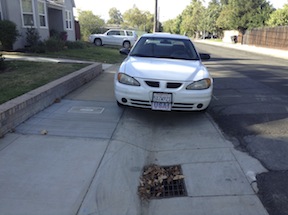
Rolled curbs slope up from the gutter pan to the sidewalk, whereas standard curbs have a more vertical face. Standard curbs are both old and modern, but there was a period of time in the 1950s through 1970s when rolled curbs were very popular, seen as a sign of the new suburbs. In the grid area of Sacramento, including the first ring suburbs, standard curbs are quite common. In the second ring suburbs and the sprawl suburbs, rolled curbs are quite common, not only being found in residential neighborhoods but even on arterial roads.
parking up on the sidewalk with rolled curb
So, what’s the problem with rolled curbs? Drivers use rolled curbs to drive up on the edge of the sidewalk, constraining the sidewalk width, reducing walkability, and not infrequently causing blockage of the sidewalk for people in wheelchairs. ADA regulations require at least 36 inches of clear width. Combine the narrow 4-foot sidewalks that were popular in the suburbs with this driver behavior, and the car-influence zone is expanded to the complete width of the right of way, leaving no place for pedestrians. [Note: This photo is for illustration purposes only, not to give this driver a hard time. This is common practice, and I’ve seen many instances where much more of the sidewalk was blocked.]
A side affect of parking up on sidewalks is that it leaves more of the street width for moving motor vehicles, which then increases the speed at which people drive. By trying to get their vehicles out of the way of the “speeding drivers,” they are actually making it easier for drivers to speed.
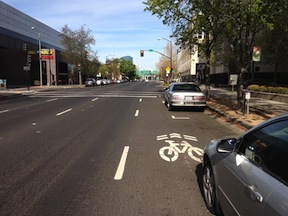
On I Street between 7th and 6th streets, there is a floating bike lane on the north side. A floating bike lane, also called a part-time bike lane, is one that is designed to be a parking lane for part of the day and a motor vehicle travel lane for part of the day.
The first photo below is the lane when parking is prohibited, and it is a shared motor vehicle travel lane. The signing indicates that parking is prohibited from 4 to 6PM on weekdays. This is in order to provide more lanes for the flush of traffic heading to the freeway during the afternoon rush hour. There are sharrow markings at the beginning and near the end of the block, to reinforce the “bikes may use full lane” sign (MUTCD R4-11).
The next photo shows the same floating bike lane when parking is allowed, the rest of the time. As you can see, the sharrows are partly covered by parked cars. The remaining width of the lane, which forms a de-facto bike lane, is too narrow for a lane adjacent to parked cars and is unsafe. In this particular location in front of the county jail, it is doubly unsafe because frequent turnover in cars (one hour limit) and the type of people who park here, not the sort to be thinking of bicyclists before they open their car door. In fact, guidance on floating bike lanes recommends against their use in situations with high-turnover parking.
I Street floating bike, parking prohibitedI Street floating bike lane, parking permitted (Elle Bustamante)
I never ride in this floating bike lane when there are parked cars, I always ride in the full travel lane to the left, but I often get honked at by drivers who think I should be in the “bike lane,” and don’t realize it is not a safe place to ride.
There is nothing inherently wrong with floating bike lanes. A number of cities use them in cases where they perceive a need to carry high volumes of motor vehicle traffic at certain times of day, but want to accommodate bicyclists at other times. They are always seen as a compromise that doesn’t make anyone completely happy. However, this is the only instance that I’m aware of in Sacramento, and it is not signed and marked in such a way as to communicate its purpose and use to either drivers or bicyclists. It needs to be crystal clear for everyone, or be removed. Maybe it is time for this floating bike lane to sink.
This section of I Street is the logical main access route for bicyclists to the train station. Rush hour for cars is also rush hour for bicyclists. What I see during this time of day (4-6PM) is a lot of bicyclists riding the wrong way, or on the light rail tracks, along H Street in order to access the train station. It is worrisome to me that that I Street was not designed with bicyclist safety in mind. Bicyclists feel that it is safer to ride against traffic on H Street than with traffic on I Street, despite the fact that wrong way riding is the leading cause of bicycle-motor vehicle crashes, or to risk spills getting caught in the light rail tracks, anything to avoid I Street. I have seen several bicyclists fall on the light rail tracks here.
I Street in this section could be made safe for bicyclists in two ways:
Remove parking from the left side of I Street and shifting travel lanes to the south so that a full 6.5 foot bike lane could be installed. The sharrows would not then be needed. Or,
Make the right hand lane a full-time parking lane and move the sharrows into the next travel lane to the left.
Given that there are bike lanes both east and west of this block, option one is probably the best because it would create a continuous bike lane, but option two is workable.
On Monday evening, I observed an altercation over a parking spot in front of my apartment on O Street in Sacramento. There are several restaurants on 16th Street that are popular and generate a desire for parking, and there is already a lot of local resident parking, so spots are hard to find at times. I had noticed that cars were backed up on the street as people were waiting for others to leave, but was not paying close attention until I heard yelling. A driver of a car stopped in the middle of the street was yelling at two people who had parked and were walking towards 16th Street, claiming that they had “stolen” his parking spot and demanding that they move. He escalated into threats against their car (breaking out all the windows) and against their persons (“I’m going to take you down”). The angry driver pursued the other two, and ended up shoving and slapping the male of the couple. He also made threats against the female. He continued the confrontation even when the others were trying to end it, and he taunted the male with “I slapped you in front of your girlfriend and you were too much of a wussy to do anything about it.”
My point is not to document the assault and battery, and given that it did not show up on the SacPD daily activity log, I presume the police, when they eventually responded, did not think it important. My point, rather, is to talk about the sickness of someone threatening to harm another over a parking spot. Over a parking spot! The perpetrator was completely prepared to do harm to the other two just because he felt unjustly deprived of his parking spot. Whether he was unjustly deprived or not, I can’t say, because I didn’t observe the taking of the parking spot.
What kind of world view leads one to think that it is justified to harm others over a parking spot? Only an angry sociopath would view things that way.
As I have said before, driving causes brain damage. But let me be more specific now. Driving not only encourages and brings out sociopathic behavior, it IS sociopathic behavior. Driving is sociopathic behavior. There, I’ve said it.
 The River Cats recently announced that they were going to make parking free and have expanded parking space for the upcoming season (SacBee). And they are raising ticket prices.

 Getting Around Sacramento