I had intended to do a comparison of management and non-management positions in SacRT compared to peer agencies. The data below is from the National Transit Database (NTD), operating expenses tables and employee tables, for the year 2024. I picked some other transit agencies for comparison. Please note that these numbers do no agree with the numbers presented in agency budgets, nor other online sources, but for comparison purposes, they serve. For the operations positions and the operations expenses, operations and operations maintenance are combined.
For the percentage of positions in operations, and the percentage of expenses in operations, a higher number is good, since operations are why the transit agency exists.
The Capitol Corridor, running regional train service between Sacramento and San Jose (and Auburn, once a day) is updating its vision plan, from the last one in 2016. Tonight (2026-07-23) there will be a webinar at 6:30, and comments are open until August 7. See the Capitol Corridor Vision Plan webpage for more information.
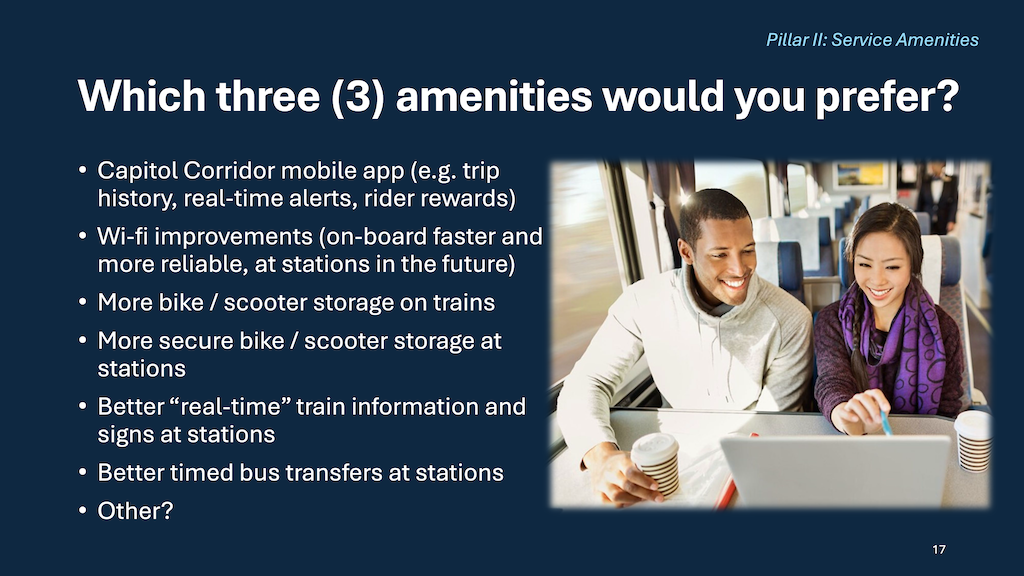
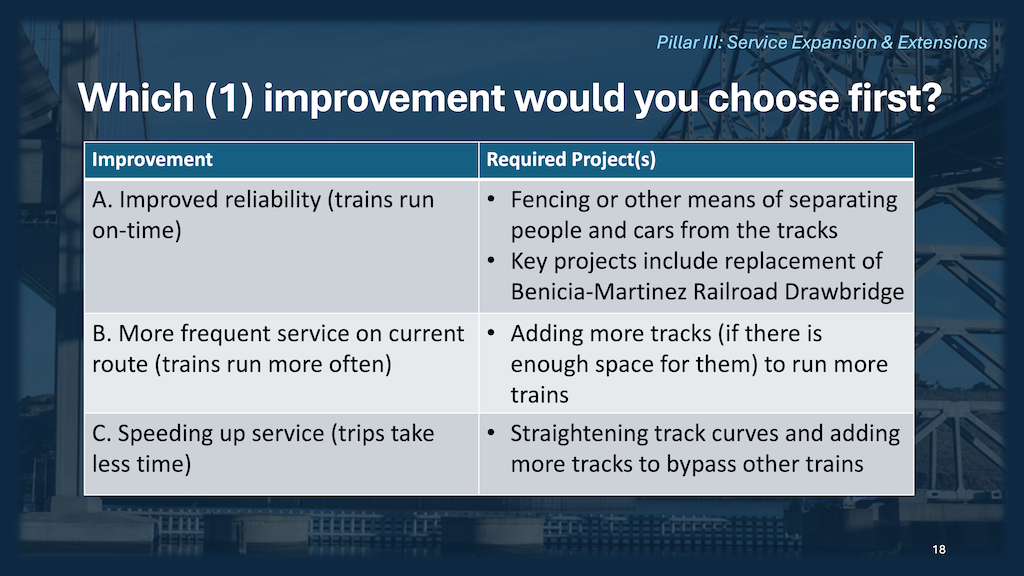
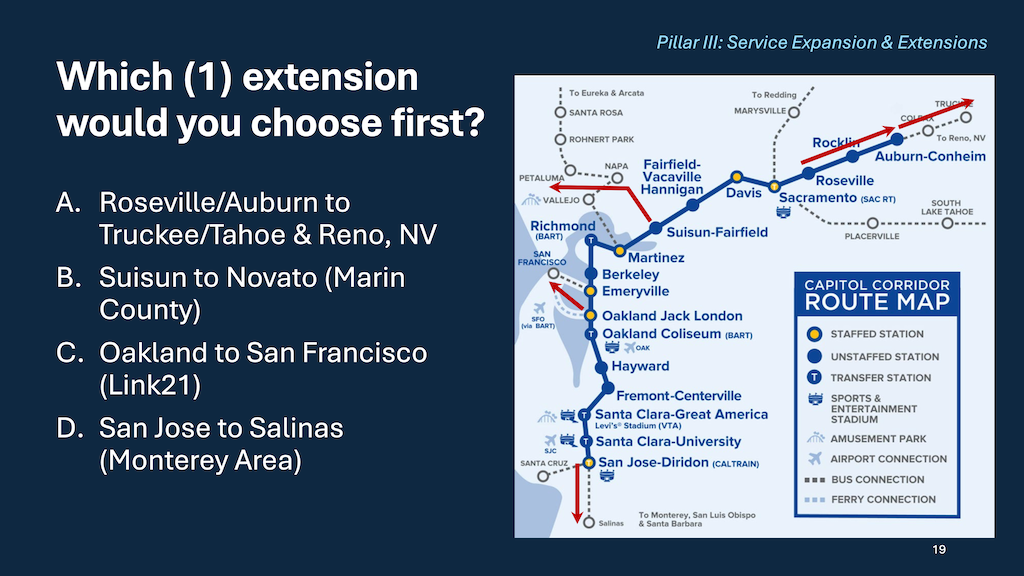
There is a slide deck for this webinar, but no draft plan as of yet. The heart of the presentation seems to be three slides which ask for input on amenities, improvements, and extensions. There are below.
Though it is not possible to tell from the slide deck exactly what will be emphasized in the plan document, it seems as though some actions are under-emphasized. As the saying goes, “the devil is in the details”.
electrification: the corridor from Sacramento to Oakland Jack London should be electrified, and is identified in the 2024 State Rail Plan/electrified corridors; though the new Siemens locomotives are about 10 times cleaner than the old F59 locomotives, there isn’t any near-term plan to replace the dirty locomotives, and in fact, used Caltrain diesel locomotives have been added to the fleet
level boarding: though this would be expensive and difficult at some stations, it would be easy at others, but this seems to be deferred; level boarding is key to accessibility for all users; sometimes another track would be added at a station, sometimes gauntlet tracks would be used, as was done for the SMART stations
ownership: most of the operational and infrastructure constraints are due to ownership by private railroads, whose objectives rarely align with passenger rail; consideration of transfer (willing or condemnation) to the state should be included
operations: operations by contract with Amtrak is less than optimal; consideration of a different operator should be included; most of the surly conductors have been moved off Capitol Corridor, but some remain
Capitol Corridor seems to want to defer planning for electrification off into the future, but somehow that future never arrives. Planning for electrification must start now. I realize that electrification would be very expensive, but probably no more so than a new Carquinez bridge or second by crossing (Link 21). It has been and will be resisted by UP, but see bullet three above. If UP is not willing, then they should lose control of the corridor.
Capitol Corridor Vision Plan 2026 slide “which three amenities”Capitol Corridor Vision Plan 2026 slide “which improvement”Capitol Corridor Vision Plan 2026 slide “which extension”