The Federal Highway Administration (FHWA) is revising the Manual on Uniform Traffic Control Devices (MUTCD) and is seeking public comment. You can view the revised document at https://www.federalregister.gov/documents/2020/12/14/2020-26789/national-standards-for-traffic-control-devices-the-manual-on-uniform-traffic-control-devices-for (scroll down until you see Supporting/Related Materials in the green box, and you may make comments on this same page (Submit a Formal Comment is a big green button).
The MUTCD is an incredibly complex document, with cross-references everywhere that require you to jump around through the document, terms used but never defined (though 287 terms are defined), incredible detail on some topics while pretty much ignoring other topics (like bicyclists and walkers). The document is intended to cover signs and markings (the paint on roadways) but does not address roadway design except in a very minor way. That is deferred to private organizations such as Association Association of State Highway and Transportation Officials (AASHTO). Many people have suggested that the main reason FHWA is updating MUTCD is to add the section on automated vehicles, and the other changes are an afterthought.
One could devote their life to reading and understanding the MUTCD, and probably would not, in fact I’m not sure that anyone in FHWA has ever read the entire document. The reason it is so important, however, is that it is the document to which transportation engineers constantly refer to as the reason they can’t do the right thing, or must do the wrong thing.
My comments so far are below.
The MUTCD should be separated into two documents, one for highways and another for streets. Local engineers continually refer to items that should only apply to highways in designing or refusing to design facilities for streets.
Section 1C.02
Definitions of Words and Phrases Used in this Manual
106. Intersection—intersection is defined as follows: (b) The junction of an alley, or driveway, or side roadway with a public roadway or highway shall not constitute an intersection, unless the public roadway or highway at said junction is controlled by a traffic control device.
The definition uses the term ‘side roadway’ but this term is not otherwise defined. If used, it must be defined.
2B.59 Traffic Signal Pedestrian and Bicycle Actuation Signs (R10-1 through R10-4, and R10-24 through R10-26)
Figure 2B-26. Pedestrian Signs and Plaques of the signs document
The activation signs in 2B-59 should be greatly simplified. There should be a sign for signal heads that count down, a sign for symbols only, a sign to activate audible message, and a sign to extend crossing time. Having 18 signs does not help pedestrians in any way. Signs reflecting old pedestrian signal heads should be phased out in five years, along with changing all pedestrian signal heads to reflect the current standard.
4I.05 Pedestrian Detectors
Push button pedestrian detectors which are not required (the signal is on auto-recall) SHALL be removed, or converted to accessible pedestrian detectors, within five years of the date of publication. Accessible push button detectors will have associated signing which clearly indicates the purpose of the button, and that a button press is not required to cross. The existence of push buttons which serve no purpose is confusing to pedestrians and indicates a bias against people who walk.
Figure 4I-4
Pedestrian Intervals In the Relationship to associated vehicular phase intervals: diagram, the third option (Part of Yellow Change Interval + Red Clearance Interval = Buffer Interval) and the fourth option (Red Clearance Interval = Buffer Interval) should be removed. These two options may significantly reduce safety for pedestrians while having only minor impact on traffic throughput. These types of signal setups discourage people from crossing streets.
Part 6: Temporary Traffic Control
The entire Part 6 Temporary Traffic Control is extremely weak in the accommodation and protection of pedestrians and bicyclists.
Bicycles
Figure 6P-48. Bicycle Lane Closure with on-Road Detour (TA-48)
Whenever construction signs are placed in a bike lane, as they often are, the ‘bike lane closed ahead’ sign should precede the ‘road work ahead’ sign, since bicyclists will be forced into the roadway by the sign and motor vehicle drivers need the warning of bicyclists before they need the warning of road work.
W11-1/W16-1P assembly is shown on the figure, but the sign is not in associated sign document. The ‘bike lane closed ahead’ sign is not in the associated sign document, nor does it seem to exist anywhere in the current MUTCD.
The ‘bikes may use full lane’ (R4-11) and the ‘share the road’ assembly are shown as optional. They should not be optional, since the detour roadway does not have a bike lane, whereas the construction roadway did.
Figure 6P-47. Bicycle Lane Closure without Detour (TA-47)
Again makes the ‘bikes may use full lane’ and ‘share the road’ assembly optional. It should not be. Signing in this situation must communicate to both the bicyclist and the motor vehicle driver. The ‘bikes merge’ sign is not in the TTC signs document, nor anywhere else in the MUTCD.
There is no diagram that shows signing and marking for a temporary separated bicycle pathway placed in the roadway. There must be a diagram for this situation.
Pedestrians
Almost nowhere in the TTC sign diagrams are sidewalks shown nor the appropriate treatment of temporary closures, whether through detour or added pathways. The implication is that pedestrians don’t exist and need not be accommodated.
Figure 6K-2. Pedestrian Channelizing Device shows how a channelization should be constructed, but says nothing about where that channelization might occur.
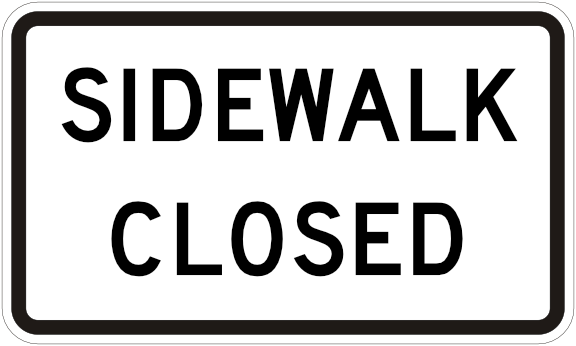
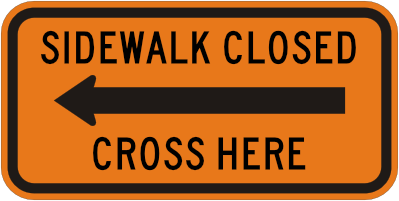
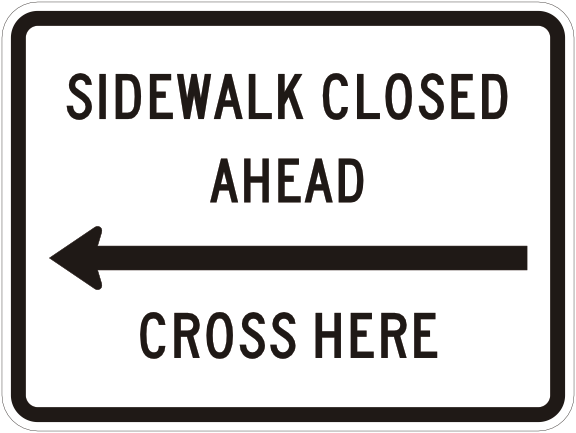
Figure 6P-29. Crosswalk Closures and Pedestrian Detours (TA-29) shows sidewalk closures, with a mid block temporary crosswalk, but it does not show the barriers themselves, nor are these sidewalk barriers shown anywhere in the MUTCD so far as I can determine. Transportation agencies routinely use inconsistent signing and barriers for sidewalk closures, which is just as much of a hazard as inconsistent roadway signing, so this must be addressed in the MUTCD.
A diagram should be added that shows a pedestrian channelization placed in the roadway to provide safe and direct travel for pedestrians, in addition to the detour situation.




 Getting Around Sacramento