HOV lanes are a failure. They save time for the drivers using them, but always less time than was asserted when the project was designed, funded, and built. And they do not save average drivers any time at all. But when added to existing freeways, they certainly cost a lot of money. And they certainly induce a lot more travel, exacerbating climate change, motor vehicle pollution, and damage to the communities through which they pass.
Hwy 50 in Sacramento
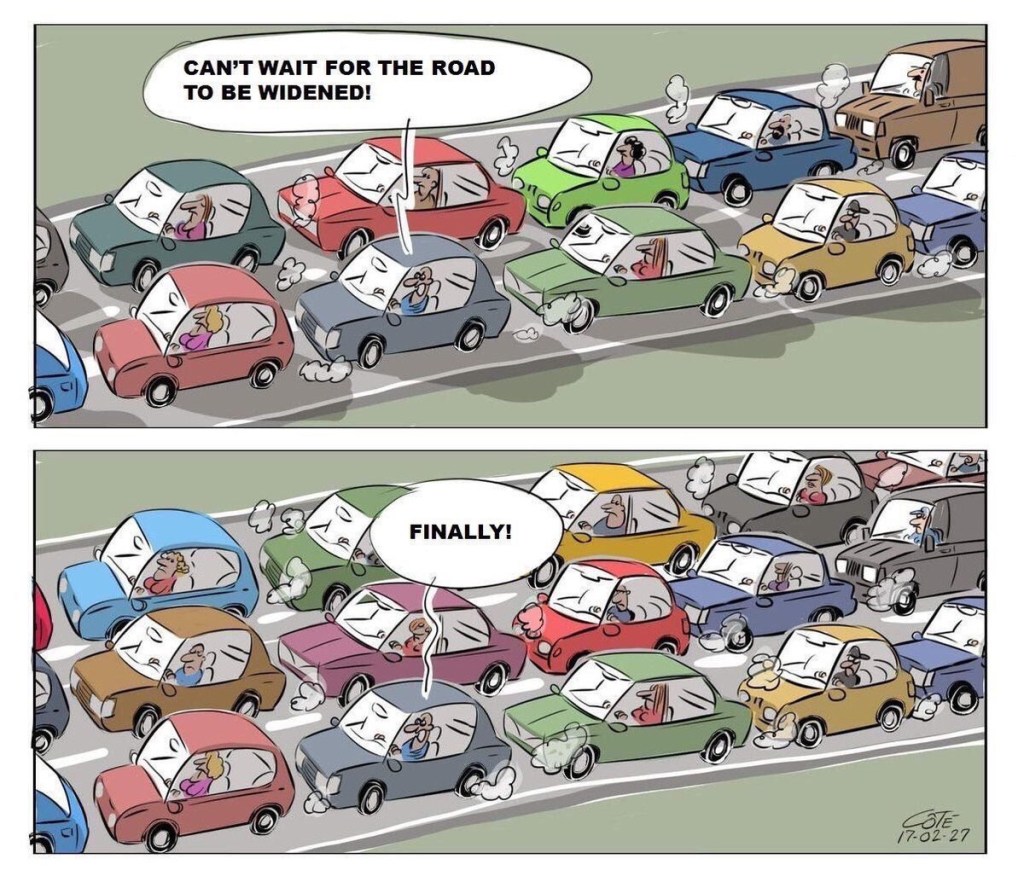
Despite this fact, the Hwy 50 project in Sacramento is adding HOV lanes in order to widen the freeway, which will induce more travel, and return traffic to previous or greater levels within a few years, or less. That means accelerated climate change, motor vehicle pollution and noise in the areas through which they travel, and for this particular project, strong discouragement to walkers and bicyclist passing under the freeway, since the undercrossings are very dark and very scary.
Hwy 50 HOV lanes (Fix50) project includes: “Adding Carpool [High-Occupancy Vehicle (HOV)] lanes in each direction on U.S. Highway 50 from east of Watt Avenue to Interstate 5”. HOV lanes would also be added on two on-ramps at 65th Street. I haven’t been able to locate any operational information. Will HOV be weekdays daytime, as in the Bay Area, or full time, as in Southern California?
When CTC (California Tranportation Commission) member Darnell Grisby raised questions about the project, the project representative tried to gaslight Grisby and the commission by saying the JPA did not have land use authority and the development to be induced is not their problem. But the JPA does, indirectly, because highway projects promote sprawl and directly reduce the effectiveness of walking, bicycling, and transit projects.
Having been shot down in the recent Measure A sales tax, which failed in large part because it included controversial Capital Southeast Connector projects, the JPA (joint powers authority) is trying other back-door methods. The ultimate outcome desired by the JPA is a full freeway from El Dorado Hills and Highway 50 to Elk Grove and Interstate 5. The public has rejected this idea, so the JPA is working to sneak the project through in segments, by nickel and dime-ing the taxpayers until it is ultimately finished. In case you aren’t aware of the Capital Southeast Connector, I have written about it many times: Measure 2022: Southeast Connector exceptionalism, No to the southeast connector, Measure 2022: greenfield developer sponsors, and many others on the failed Measure A 2022.
SACOG has repeatedly refused to put the project as a whole into the regional MTP/SCS (metropolitan transportation plan / sustainable communities strategy) updates and specifically said it will not be in the upcoming Blueprint.
The Capital Southeast Connector JPA is a rogue agency. It serves the needs of greenfield developers and politicians who see the future as even more motor vehicle dominated than the present. The JPA should be disbanded. This probably wouldn’t completely kill off the project, since the county and cities might continue to waste taxpayer dollars on inducing sprawl and travel, in order to gain campaign contributions, but it would certainly help.
No Capital Southeast Connector highway, now or ever, in pieces or as a whole!
Note: I had said I was pausing on the proposed transportation sales tax Measure 2022, but I’d forgotten to write about interchanges.
The proposed transportation sales tax measure Exhibit A: Transportation Expenditure Plan includes 31 instances of ‘interchange’. If you aren’t familiar with the term, it means the intersection of freeways and expressways with other sorts of roadway, or with other freeways and expressways. Two examples, one of a freeway interchange, and one of a freeway and arterial interchange:
Hwy 50 & Business 80 & Hwy 99 interchangeHwy 5 & Cosumnes River Blvd interchange
Interchanges are very popular in the proposal.
location
#
Citrus Heights
2
Elk Grove
2
Folsom
5
Galt
1
Rancho Cordova
4
City of Sacramento
5
County of Sacramento
2
Highway Congestion Improvements
4
interchanges in the TEP
Interchanges are very expensive. Miles of sidewalk or bike lanes could be constructed for the cost of one single interchange. Or new buses or bus-only lanes, or new light rail cars, or a bike-share program. Interchanges are far more expensive than the straight sections of freeways. Interchanges take a good deal of land, removing it from productive use and leaving wastelands in between that are not accessible and not usable for anything else. Interchanges are complex for drivers, so have many far more crashes than the straight sections.
Probably most important, freeway on-ramps and off-ramps create the most hostile and dangerous points for people walking and bicycling. Though interchanges can be build with right angle turns to enter from and exit to surface streets, and can be signalized so as to allow safe passage by walkers and bicyclist, they were never built that way in the past, and are only sometimes built that way now. Instead, there are swooping on-ramps that encourage drivers to reach freeway speeds while still on the surface street and ramp, and off-ramps that encourage drivers to maintain freeway speeds coming off the ramp and continuing on the surface streets. If you don’t believe this, please watch a freeway off-ramp for a while, for example, if you live in central city Sacramento, I-5 to P Street off-ramp, or I Street to I-5 on-ramp. You will see people going 55 mph or more on the surface street, slow to decelerate and quick to accelerate. Freeway on-ramps and off-ramps kill hundreds of walkers and bicyclist a year.
Our freeway system was essentially complete years ago, with the 1972 completion of the I-80 (then I-880) northern bypass. Freeways provide quick travel from point A to point B. As earlier explained in the streets – stroads – roads post, roads that imitate railroads, for quick travel between productive places, are a good thing. The original idea of Interstate highways was, for the most part, a good idea. Of course then they were driven through the heart of cities, including Sacramento, lost most of their value as travel routes, and destroyed the value of the cities they went through.
So why, now, do we need more interchanges, more points of access to and from freeways? The answer is almost entirely greenfield development, and the promotion of car trips for commuters from those greenfield developments. Interstate 5 and Interstate 80 could easily handle all the freight and long distance travel demands with two lanes in each direction. So what are all the other lanes for? Commuters. And what are all the new interchanges for? Commuters. Note that in this use of ‘commuter’, I’m including not just home to work trips, but all the other trips that are induced by having more lanes and more interchanges. Job-related trips are now only about 20% of all trips, even before the pandemic. For the existing interchanges proposed to be improved, the reason again is primarily the induced travel through greenfield development. If there weren’t new greenfield development, there wouldn’t be increased traffic.
Each interchange reduces the safety and speed of the freeway. Each interchange encourages motor vehicle trips that would otherwise not occur, by allowing people to travel longer distances more quickly, therefore considering living and working and shopping and recreating in places they would not have otherwise considered. Of course the convenience is illusory. It makes sense right after the new lanes and interchanges are added, but the law of induced travel quickly fills those lanes and those interchanges, generating calls for more lanes and ‘improved’ interchanges. Which induces more travel, which…, well, you get the idea.
If you haven’t, please walk or bike to any of the freeway overpasses in the Sacramento region, and spend some time observing the traffic below. You will see freight traffic, trucks trying to get through the area on their way somewhere else, stuck behind commuter traffic, crawling along. You will see most vehicles carrying a single person, what are called single-occupant vehicles (SOVs), but taking up the space that could be serving multiple individuals. Though there are only a few freeways where buses also run (I-80 towards Davis and I-5 towards the airport), you will see those multi-passenger vehicles stuck in traffic with SOVs.
The second Google map above, showing the new interchange at I-5 and Cosumnes River Blvd, is instructive. Why is the interchange here? To serve the Delta Shores development, which is currently just a suburban big box store shopping area, though it was intended to and may eventually serve new housing. This area was greenfield before, agricultural farming or ranching. The purpose of the interchange is not to serve existing drivers or residents or city, but to create new drivers, new customers in this case. It is true that a portion of the cost of the interchange was paid for by the developers, but there was still a huge cost to us, the taxpayers.
If you want a lot of new and improved interchanges, which induce more motor vehicle trips, pave over greenfield areas, and create serious hazards for walkers and bicyclists, then the proposed measure may be to your liking. If not, then I hope you see it as the wrong road to travel.
Search for category Measure 2022 to see posts as they are added.
A group calling themselves A Committee for a Better Sacramento is sponsoring a citizen-initiated ballot measure for the November election, titled “Sacramento County Transportation Maintenance, Safety, and Congestion Relief Act of 2022—Retail Transactions and Use Tax”. (Note: Some people are referring to this as Measure A, but measure letters are assigned by county elections, not by the sponsors. I’ll continue to refer to it as Measure 2022, for now.)
As pointed out in Measure 2022: words have meaning, the word congestion or the term congestion relief is used 24 times in the proposal. It is in fact the major theme of the Transportation Expenditure Plan. 22.4% of the measure is set aside specifically for major congestion relief categories. Since most projects are not individually costed, it can’t be determined how much of the 47.3% for local roads and streets is for congestion relief, but Citrus Heights has two and Elk Grove four called out. The 3.7% for Capital Southeast Connector is also congestion relief.
Not acknowledged, but likely true, is that many of the projects could be considered ‘congestion prevention’, meaning that if roadways and freeways and interchanges are expanded now, future congestion can be prevented.
The committee and supporters seem to have bought into the falsehood that capacity expansion solves congestion. It does not, or rather, solves it for a short period of time, then induced travel returns congestion to previous levels, or higher. It is a never ending cycle. Congestion is not a major contributor to air pollution. It does have an effect, but the effect is very limited in time and space. The big contributor to air pollution, and of course greenhouse gas emissions, is vehicle miles traveled. The measure will increase, not decrease, VMT.
Twenty-eight lanes on the Katy Freeway in Texas have not solved congestion, nor reduced air pollution in Houston. The 405 freeway over the Sepulveda Pass in southern California was widened to the tune of $1 billion dollars in 2011-2012. Traffic is now much worse on the freeway than it was before the widening, and air quality is of course also worse.
Induced travel or induced demand is broadly accepted by researchers in transportation both on a theoretical basis and with many, many case studies, but there is still resistance among some traffic engineers and politicians. The question for me is why those who resist the obvious are writing transportation sales tax measures.
Induced travel says that after spending billions to try to reduce congestion, our roadways will be as congested, or more congested, than they were before.
But over many years of observation and analysis, we have learned that adding supply has a paradoxical outcome. It generates more driving, which is both costly to personal budgets and the environment, and which often re-congests the very roadways we built or expanded.
Empirical research shows that expanded roadway capacity attracts more vehicles. However, environmental impact assesments of roadway expansion projects often ignore, underestimate, or mis-estimate this induced travel effect and overestimate potential congestion relief benefits.
Induced demand is “the great intellectual black hole in city planning, the one professional certainty that everyone thoughtful seems to acknowledge, yet almost no one is willing to act upon.”
Speck, Jeff (2012). Walkable City: How Downtown Can Save America, One Step at a Time. New York: North Point Press. ISBN978-0-86547-772-8.
Induced traffic occurs when new automobile trips are generated. This can occur when people choose to travel by car instead of public transport, or decide to travel when they otherwise would not have.


 Getting Around Sacramento