Sac missing middle housing project

From the City of Sacramento Missing Middle Housing Project page:

“Missing Middle Housing (MMH) is a range of small multi-unit housing types that are similar in scale to a single-family house and are often found in walkable areas. This study focuses on duplexes, triplexes, fourplexes, ADUs, and bungalow courts. MMH types are ‘middle’ in form and scale between that of small single-family houses and larger apartment buildings, enabling them to blend into existing residential neighborhoods. With smaller units, MMH can provide housing at price points attainable to many middle-income households.”

If you would like to see what missing middle housing looks like, head to midtown Sacramento, where missing middle is mostly NOT missing. Midtown has a mix of building uses and housing types. There are corner grocery stores, single family houses, bungalow courts (cottage court, in the MMH documents), multi-unit apartments, and large apartment buildings, with clusters of commercial areas hosted small locally owned businesses.

Midtown was created before the city decided (along with most governments) that uses should be far separated, jobs downtown and housing in the far suburbs. It prohibited most of the kinds of buildings that exist today in midtown. Some of this was through exclusionary zoning, and some through parking mandates that made affordable housing almost impossible. Most, though not all, of midtown escaped the city and state’s urban renewal travesty of the 1960s and 1970s. The city and state replaced missing middle, and lower income, housing, and the people who lived there, with state buildings and parking lots throughout downtown Sacramento (west of 15th Street). But the urban renewal project had just bitten into the edge of midtown, to 17th Street, before urban renewal was stopped, and the housing that had been purchased and not yet torn down was transferred to Capitol Area Development Agency (CADA). And parking mandates were removed from the central city (midtown and downtown).

The Missing Middle Housing Project will become part of the 2020 General Plan update. Four reports will be produced, and the first two are done: MMH Informational Report, and MMH Attainability & Livability Analysis. The analysis was the topic in front of the city council on October 24. All the public comments were in favor of the concept, and requested strengthening the project by removing some of the remnants of the old zoning regime such as tiers matching existing zoning patterns, and unnecessary dwelling unit limits. Floor area ratio (FAR) should be the only built environment limit. The council was also very much in favor of a stronger program, and clearly favored removal of dwelling unit limits. All the attendees were pleased at the support of the council for a strong MMH plan.

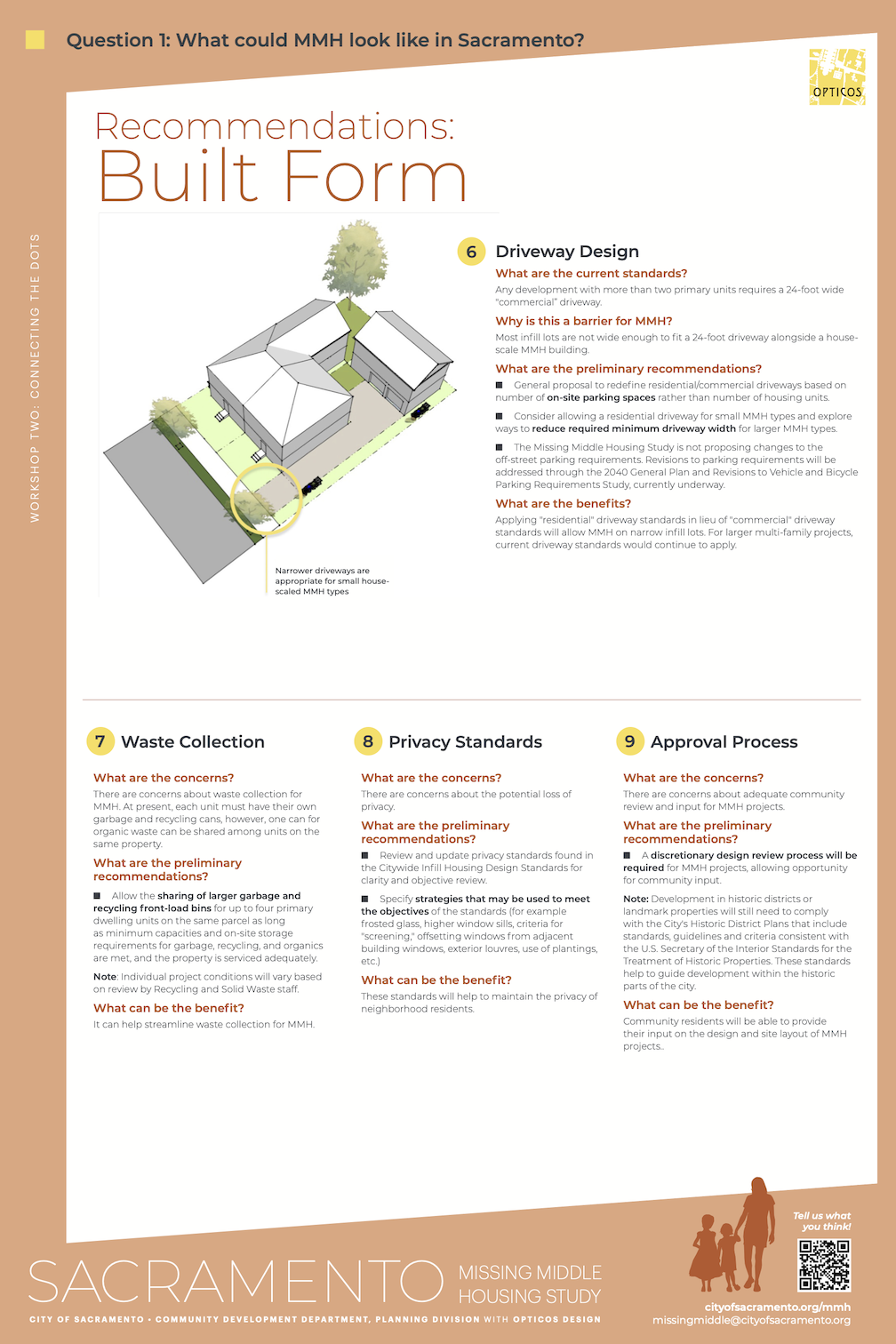
My point of concern was recommendation 9, Approval Process – “A discretionary design review process will be required for MMH projects, allowing opportunity for community input.” in the staff presentation. This page is below, and pdf. This type of community review, where NIMBYs are able to kill housing of any density greater than current density, and housing for people of color and lower income, is what got us into this fix to begin with, it is largely the reason missing middle housing is missing. It included in the final proposal, this one item could potentially kill any new housing, by allowing the same exclusionary policies to continue.

City staff tried to clarify that design review would be by city staff, and not public hearings, but that is not what the text says. It says ‘community input’. I’m certainly not opposed to community input, but it should be up front, at the level of policy review, and not review of individual projects. Review of individual projects would force middle housing to continue to be missing.
Sac General Plan & street design update

City of Sacramento Public Works staff has told the Active Transportation Commission that an update to the Street Design Standards will start soon. But the General Plan says otherwise. From the plan, Implementation Actions, pages 8-28 to 8-29:

M-A.10: Street Design Standards Update. The City shall review and update City Street Design Standards as needed to ensure they adequately support objectives for prioritizing people throughput, safety, and efficient transportation management.
Responsible Entity: Department of Public Works
Timeframe: Mid-term (2030-2035)

This timeframe indicates that the update will not even start until 2030, six years after the adoption of the plan in 2024. Six years of Public Works enforcing outmoded and dangerous street designs on the public and on developers. Hopefully the plan is out of date, and staff is correct that it will start soon.

Yes, I had promised quite some while ago a summary of my many blog posts on the Street Design Standards update. Coming soon to a blog near you.

Sac General Plan at ECOS 2023-06-27

At the meeting of the ECOS Climate Committee on Tuesday, June 27, there was a presentation on the City of Sacramento General Plan 2040 Update by city staff Remi Mendoza. The presentation gave an overview of the plan, which is pretty much available on the city website, but the questions and comments were interesting.

Heather Fargo raised issue of language to address disability transportation concerns; does plan address sidewalk maintenance? Staff did not really answer about disabled mobility, rather, the answer was about walking and bicycling for other people. Heather said she is dissatisfied with bicyclist improvements which make things harder for disability. I will ask Heather for clarification on her concerns. Heather also expressed a number of concerns about the lack of a commitment to protecting agricultural and wildlife lands in the Natomas Basin and Natomas area, both in the main general plan and in the specific North Natomas Community Plan.

I asked two questions:

  • Why is the council commitment to removing parking mandates now a weak ‘could include’? Staff answered that a consultant is working on this, and if council wants stronger language, it can reinstitute it. This is a very dissatisfying answer. If the council wanted weaker language, they could asked for it, but they have not. I suspect that some politically powerful people (more powerful than you or I) asked for the language to be weakened, and staff complied. Was this City Manager Howard Chan, or was it one of the powerful who is not on the council?
  • Map M-3 emphasizes light rail and arterials for transit oriented development. These are both NOT the best locations due to surrounding land use (often industrial and toxic), poor accessibility to transit (long distances to safe crosswalks over high speed, high volume, very wide arterials), lack of existing neighborhoods to build on in several cases, and the pollution created along these freight routes and motor vehicle traffic sewers. This question was brushed off.

A number of others asked questions about the plan, which were only partially answered. It appears that the transportation and climate community are very concerned about the general plan. And they should be.

The members of city Community Development Department, which initially seemed to be on board with very innovative and future-looking goals and policies, seems to have backed way off, and are now proposing something not remarkable different from the current 2035 plan, which was outdated before it was even adopted.

I appreciate ECOS (Environmental Council of Sacramento) for their willingness to stand up to the powers that be. I’m a member of a number of other groups that are not willing to stand up. The city and the county, and the other cities in the county, get away with the status quo and gaslighting because no one is calling them out on their poor decisions and lack of attention to the needs of the people who live here.