SacRT issues and solutions

Another list of ideas for improving SacRT. This was developed as part of my work with 350Sac Transportation Committee, but again, the ideas are mine and not the committee’s.

SacRT issues

  • funding
    • SacRT is the most poorly funded transit system of its size in California; the limited amount provided by Sacramento Measure A (through the Sacramento Transportation Authority) is insufficient to operate a transit system
    • dependence on federal funds from most system enhancements and extensions means that the system has not kept up with either population growth or increased demand
  • leadership
    • the board, composed of only elected officials, provides poor oversight and leadership
    • management is weak, unwilling to explore innovative solutions and accepting of current limitations as permanent
  • light rail
    • has a poor reputation among many commuters
    • no evening service to Folsom
    • no service to American River College
    • high-floor rail cars are inaccessible to many people
  • bus network
    • buses are too infrequent to provide effective service, with no routes meeting the definition of high frequency and only four routes meeting the definition of medium frequency
    • routes deviate into neighborhoods in an attempt to maximize coverage, but the result is a loss of functionality and timeliness
  • land use
    • SacRT is ineffective in large part becuase land use decisions have resulted in an urban/suburban/exurban pattern that cannot effectively be served by a transit system
    • SacRT has little to no input into land use decisions
  • fare card system (ConnectCard)
    • the fare card system has been delayed for more than a year
    • there is no evidence that the fare card system will address equity issues such as low-income users without bank accounts and credit cards being able to purchase cards and passes
  • bike parking
    • the lack of secure bike parking at light rail stations and major bus stops reduces transit use and usability
    • SacRT has refused to provide on-demand bike lockers at stations, though Folsom has provided them at stations within the city

SacRT solutions

Read More »

I don’t want a transportation bill

As the “deadline” approaches for passage of a transportation bill, and the balance in the highway trust fund is in free fall, everyone seems to be falling in line behind the idea that we must pass a bill. I disagree.

The federal transportation funding system strongly favors motor vehicles, with a small amount set aside for transit, and a pittance for walking and bicycling. Patching up funding for the existing system will only serve to prolong its life, and prolong the damage it does to our communities and our economy. I think a failure of the highway trust fund is in order. Before we can figure out what sort of transportation system we need, we have to stop funding the one we have. Yes, I agree that maintenance is important, but we already seriously underfund maintenance, and continuing to do so for a little while will be no worse a crisis than what we already have. I think the preference for passing a transportation bill, any bill, is akin to what a drug addict thinks – just one more hit and then I’ll be able to figure out how to get off this stuff.

What if we don’t pass a bill, or an extension, and federal funding stops? Well, then we have the opportunity to do the following:

  1. Institute a moratorium on all construction and widening on the federal aid highway system.
  2. Agree that our highway system is built out and that not a single lane mile will be added with federal funding, ever again.
  3. Develop criteria for determining the economic productivity of roads and highways. Since the system has never been challenged to do this before, it will take some time, bringing together expertise and data that has not been part of transportation decisions.
  4. Determine the size (in lanes) necessary for the Interstate and federal aid highways to carry traffic between economically productive places, and then fund maintenance of that minimal system from the federal level. The states, therefore, would have to fund maintenance of excess lanes, those that were built to accommodate commuting and do not serve to connect economically productive places. All roads and highways that are not part of the minimal system would be returned to the states who would then be fully responsible for maintenance. That means that many freeways would no longer be a federal responsibility.
  5. Develop criteria for determining the economic productivity of the freight and passenger rail network. We know somewhat more about this, but it will still take time.
  6. Designate a national rail network similar to the federal aid highways system that serves economically productive places and uses, and funds both construction and maintenance. Over time, right of way and tracks would be transitioned to public ownership, and both passenger and freight would rent space on that network, paying fees that fund all necessary maintenance, and expansion to meet national needs. This does not mean that rail could not or would not be subsidized, but that it would be done in a transparent manner that would allow us to adjust subsidies based on productivity and the national interest in a connected passenger network. (Note: Amtrak is subject to the same soviet-style thinking that plagues the rest of our transportation network, the difference being that they never received the huge subsidies that motor vehicles and airlines did.)

Would the temporary cessation of federal funding to public transit have a negative impact. You bet it would. There would be no new projects for several years, just when we need new projects to shift our transportation to more economically and ecologically (carbon) modes. Projects already underway might have to be modified, dropping some elements or shortening routes. I’m not oblivious to this impact, and it would impact me directly in a number of ways, including the local light rail expansion and improving capacity on the Capitol Corridor trains.

None of this would impose anything on the states. However, the states, long accustomed to  “free” money (our tax money) from the federal government, would start making different decisions once the gravy train stops.

I’ve written many times before about the disfunction in our transportation system, but my post today was triggered by a post from Kaid Benfield, Do Freeways Belong Inside Cities? on HuffPost Green.

The Active Transportation Program petition

The Safe Routes to School National Partnership, along with a number of coalition partners, has offered a petition to increase the amount of funding for California’s Active Transportation Program (ATP). Information on the petition is at Safe Routes to School California and California Walks. What follows is not intended to discourage you from signing the petition. Rather, I’m suggesting that it doesn’t go far enough.

The petition asks for an increase of $100 million per year in funding. With the existing funding of about $120M, this would be just less than double the current funding, a not insignificant increase.

However, the amount is a tiny fraction the roughly $28 billion spent yearly on transportation in California. The majority of this expenditure is through Caltrans, and the majority of that is to expand the highway and road network. Those expenditures work directly against the goal of walkable, livable communities. Yes, expansions often now include some sidewalks and some bicycle facilities, but the preponderance of the project is not on these afterthoughts, but on increasing lane miles by extending and widening highways and roadways. Of the money expended on the road transportation system, about half comes from cities, counties and regions, about one-quarter from the federal government, and about one-quarter from the state. But because the state controls the federal and state portion, and state standards determine or strongly influence how the rest is spent, things must change at the state level.

Marketing for the petition includes: “Nearly $800 million in shovel-ready walking, bicycling and Safe Routes to School projects and programs were left unfunded in the first ATP awards cycle.” I imagine now that many agencies have started to figure out how ATP works, there will be even more applications this cycle, with an even bigger gap between applications and available funding. So would the addition of $100 million really make much of a difference? We have a long term deficit in active transportation of trillions of dollars. $100 million is not that significant.

The graphic below shows the portion of the state transportation budget (in red) going to the ATP program (in green) and which would be added (blue) if the petition resulted in supportive legislation. You may need to squint.

budget

Read More »

SHSP Update

shsp-logoThis is one of the nerdier posts I’ve written in a while, and much of it probably won’t make sense to anyone who has not been involved in SHSP. Why is it important? Because all of the safety funds in California, some of the transportation budget, and much agency effort go to the priorities identified by SHSP. In the past, that has meant a focus on the safety of motor vehicles drivers, focus to issues such as distracted and drunk driving (which are important but not everything), and in a perversion of priorities, stings on pedestrians and bicyclist funded by OTS.

On November 14, 2015, the SHSP (Strategic Highway Safety Plan) Safety Summit was held on the CSU Sacramento campus, part of the SHSP Update process that seeks to revised the Strategic Highway Safety Plan for California. The summit was very well attended, nearly filling the ballroom. After some introductions from various agencies (Caltrans, Office of Traffic Safety, and California Highway Patrol are the main partners in the program, but several other agencies participate), there were six breakout sessions to provide input on different topics, and an opportunity to participate in two of the six.

I participated first in the Active Transportation (bicycling and walking) breakout, which was facilitated by Katherine Chen & Jill Cooper. Issues identified: we really don’t know why there has been an increase the last few years in bicyclist and pedestrian injury and fatality, whether due to increased mode share or some other reason; the CHP 555 form and SWITRS database do not offer all the information we need; there is almost no injury/fatality rate data available because agencies are not collecting counts; rather than transportation funds being allocated based on injury/fatality rates, bicycling and walking receives a tiny portion construction and safety funds. The session went well, with good discussion and a lot of good information gathered onto charts by Katherine.

I also attending the Infrastructure and Operations breakout session, which was facilitated by two individuals from Cambridge Systematics, the contractor being used for the update process. This session did not go well. The participants provided thoughtful input, but much of it was rejected by the facilitators, either not written onto charts, or crossed out because they didn’t agree with it. The group wanted to use rates rather than counts, education is needed to create a culture of safety, distracted driving is epidemic, automated enforcement of red lights and speed are critical to changing behavior, and we need to focus on intersections since that is where most problems occur. The facilitators wanted to hear none of it, and were disappointed that no one seemed interested in spending money on “improving safety” for motor vehicle drivers by building more highways.

We were promised at the summit that the breakout session notes would be tabulated and made available to participants “soon.” As of today, 11 weeks later, no information has shown up on the SHSP Update web page. I doubt that the information will show up before the process is complete. I would guess that the contractor and Caltrans didn’t like what they heard and decided to suppress the information.

Despite the lack of input from the SHSP Safety Summits (there was one northern and another in southern California), the SHSP Steering Committee has been pushing forward with updating the SHSP strategies. The SHSP Bicycling committee (formerly Improving Bicycle Safety) on which I serve, and the other committees, were given a very short deadline to provide a new short set of strategies (up to five). It seems as though we will be locked into these for several years. In the committee’s January meeting we made remarkable progress on coming up with strategies, coming to consensus on a number of issues that we’ve discussed for years and never quite come to common understanding or agreement. When we ask where the Safety Summit information was, we were told by Pamela Beer of Cambridge Systematics that she had all the information we needed, that the printed notes that we were given at the meeting but not beforehand where all we would get, and that we should not expect to see any outcomes from the summit before the strategies finalized. Somehow she had inserted herself into our committee meeting as a facilitator/controller, without the knowledge of anyone on the committee.

The strategies adopted by the Bicycling committee, pending some wordsmithing, are:

  1. Improve roadway and bikeway planning, design, and operations to enhance bicycling safety and mobility while supporting  bicycling to and from all destinations.
  2. Improve data collection regarding bicyclist trips, injuries and fatalities on California roadways and bicycle paths.
  3. Improve education and enforcement based on the protection of everyone’s right to travel by lawful means.
  4. Encourage more bicycle travel by improving public attitudes about bicycling safety and the need for safe and courteous behavior toward all roadway users.
  5. Develop safe, direct, and connected routes on which bicycling is a priority mode of transportation.

improving SacRT

The condition and future of Sacramento Regional Transit (SacRT), particularly the light rail system, has been much in the news recently:

Everyone these days seems to want a better transit system. The problem is that no one wants to pay for a better transit system. The business leaders who suddenly want a modern, appealing, well-maintained light rail are the same ones that have worked over the years to suppress efforts at increasing the tax base for operation of the system.

Read More »

Foxx challenges mayors, but not funding

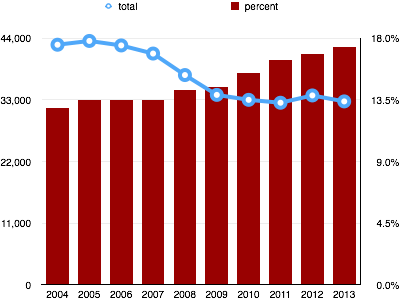
Secretary of Transportation Anthony Foxx challenged the nation’s mayors to reduce pedestrian and bicyclist fatalities and injuries on his Fast Lane blog and detail. The challenge has been repeated many places, including Streetsblog USA. Though I’m happy that the secretary is bringing attention to the issue of rising pedestrian and bicyclist fatalities (while motor vehicle driver fatalities are declining), I have to see this campaign as disingenuous. Of his seven challenge activities, not one of them mentions funding. Yet a significant contribution to pedestrian and bicyclist fatalities and injuries is that we continue to spend transportation dollars on motor vehicles and not on pedestrians and bicyclists. Though pedestrian and bicyclist fatalities are now 17.3% of the total, we spend only about 2% of our transportation funds on protecting pedestrians and bicyclists.

FARS-trends-chartFoxx says “Unfortunately, in the five years from 2009 to 2013, bicyclist deaths were up 15 percent and pedestrian deaths are up 16 percent. In 2013, more than 5,000 pedestrians and bicyclists were killed, and more than 100,000 were injured.” More significant is that pedestrian and bicyclist fatalities are have continued to be an increasing portion of total fatalities. In the chart at right, the blue trend line, of total fatalities is clearly down, and NHTSA (National Highway Traffic Safety Commission)  and others have tooted this horn at every chance. What they rarely talk about, and in fact try to hide in their reports, is the other trend, shown by the red bars, that the percentage of fatalities for pedestrians and bicyclists has continually climbed. These are not two unrelated trends. We have spent tremendous amounts of transportation money, and imposed increasing requirements on car manufacturers, in order to reduce the fatality and injury rate of motor vehicle drivers. But this reduction has led to an increase in pedestrian and bicyclist rates. They are inversely correlated to a remarkable degree. This data in the chart is from the NHTSA Fatality Analysis and Reporting System (FARS).

If Foxx were serious in his commitment to pedestrian and bicyclist safety, he would do everything in his power (considerable but not complete) to shift transportation funding to the protection of pedestrians and bicyclists, and would be before Congress daily supporting this change (for the portions he cannot control).

So, here is Dan’s challenge to Secretary Foxx: Take pedestrian and bicyclist fatalities seriously by immediately shifting the federal portion of transportation funds to match the fatality rate of 17.3%.