SacCity VZ Action Plan: focus on disadvantaged

In an earlier post on City Council discussion of the Vision Zero Action Plan update, which happened on March 17, I did not identify which if any of the vulnerable users and locations of concern I would support, but implied that the criteria should simply be the incidents of fatality and serious injury.

I’ve been reflecting on this over the last week, and have spent time in a disadvantaged, low-income community in Del Paso Heights, and some moderate to high income communities in other parts of Sacramento, as well as several other cities in Northern California. As a result I am not going to clearly say that I think the primary, not only, criteria should be disadvantaged communities, which is item 6 on the list, under ‘in sensitive areas’.

Use of the term ‘disadvantaged communities’ doesn’t really get at the issue. The term implies that there is something innate to these places that causes them to be naturally disadvantaged, and even more insidious, that the people there have made themselves disadvantaged. I’m not saying this is the prevalent attitude, but I have certainly heard if from many people.

However, I think the more accurate term is ‘disinvested communities”. The City of Sacramento has, over many years, spent significantly less money in the low-income and high-minority communities of south Sacramento and north Sacramento, which includes Del Paso Heights. The city has allowed public resources, including but not limited to roadways, to deteriorate. Instead, the city has widened roadways from neighborhood streets to wide arterials, for the benefit of higher-income and whiter commuters passing through. These wide streets are where the highest crash rates are, and where people do not feel safe walking and bicycling, or even in their cars. The neighborhoods suffer from higher air pollution levels attributable to these wide roads, and the concentration of pollution-generating land uses. These neighborhood are now host to abandoned and deteriorated building, and empty lots where there used to be buildings – homes and businesses. The city shrugged its shoulders and allowed this to happen, rather than investing in these places. The city has expressed concern about this decline, and made plans to mitigate it, but has done almost nothing. And it shows.

So, yes to the ‘disadvantaged communities’ focus area. Yes to undoing at least some of the damage of past disinvestment.

SacCity SB 535 disadvantaged communities and density

The City of Sacramento General Plan 2040 update draft offers a map of the SB 535 disadvantaged communities (DAC), on page 7-6, reproduced below. The areas are census tracts, and their number is labeled. Census tracts do not necessarily follow city boundaries, some overlap with county areas.

The general plan text states “Under SB 535, a DAC is defined as an area scoring in the top 25 percent (75th – 100th percentile) of all California census tracts for pollution burden and socioeconomic factors as measured in CalEnviroScreen.” You can read more detail about how DACs are determined, and the relationship to CalEnviroScreen, on page 7-3.

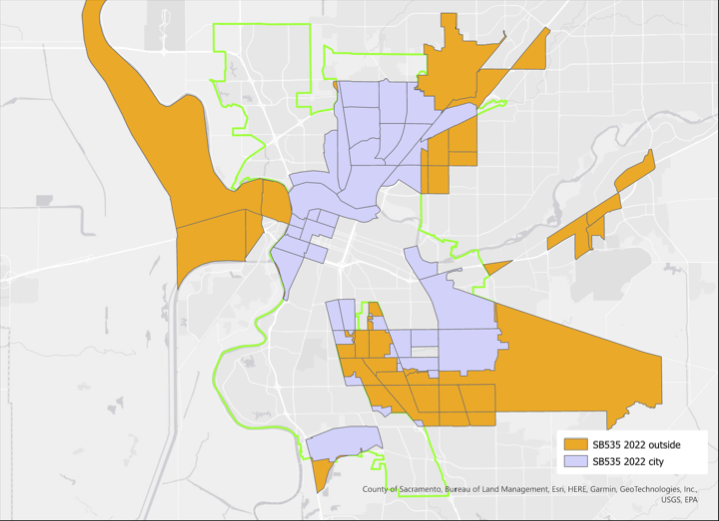
It is good that the area of ‘the finger’ (also known as the Fruitridge/Florin study area), disadvantaged communities in south Sacramento, are included, but it also makes the map hard to read. What areas are actually within the city, where the city might invest to overcome the past disinvestment that created these disadvantaged communities? To look at this question, I created the map below, which distinguishes city from county, blue being city and orange being county. It is clear that ignoring that significant areas of south Sacramento are in the county would be a mistake, but it is important to note where the city disadvantaged areas are, because that is where the city could spend money.

But these type of maps, where an area is mapped without reference to other characteristics, can be misleading. For example, the large area on the southeast side is indeed disadvantaged, but it is also mostly low density and even agricultural. The Census Bureau indicates that census tracts range between 1200 and 8000 people, with an average of 4000. Sacramento does not have such a wide range, but nevertheless, there are significant differences in the number of people residing in each census tract. The table ‘Table EJ-1: CalEnviroScreen Scores of DACs in the Planning Area’ (pages 7-4 & 7-5) lists the population density of all the tracts in the city, but unfortunately this data is not mapped. Of the disadvantaged census tracts, the population density (residents per acre) in the table range from 3.71 (6067006900, north area) to 20.71 (6067000700, northwest downtown)

So I developed a map that shows the range of densities (this is calculated for my map from area of census tract and population in 2022, not from the city’s table; the city does not indicate the date of the table data). A higher intensity of blue indicates more dense census tracts in the city, and for the county, a higher intensity of orange. As you can see, some of the city census tracts that are indicated as disadvantaged are very low density.

Why is density important? The city will never have enough money, from its own budget or other sources, to overcome past disinvestment. So investments must be prioritized. I believe the most important criteria is population density. A dollar of investment in a higher density area reaches more people. Conversely, investment in a low density area reaches fewer people. This fact is glossed over in the general plan.

There are additional maps of the disadvantaged census tracts in the general plan, focused on particular areas of the city, and addressing such issues as healthy food resources, environmental justice issues, parks, and light rail transit. It should be noted that SB 535 disadvantaged communities are only one criteria for looking at an area. The state offers Low Income High Minority (LIHM), and SACOG uses that criteria among others. All of these criteria are important, but I believe density to be one of the most important.

You may comment on the General Plan under the ‘Self-Guided Workshop‘. For a good explanation of how to use this resource, see my previous post relaying the House Sacramento guide. For my earlier posts on the General Plan, see category: General Plan 2040.

PDF versions of the maps are available: SB 535 census tracts from General Plan; SB 535 city/county; SB 535 weighted for population density.