Strong SacTown quick-build street safety

Strong SacTown has created a great visual introduction to quick-build fixes for street safety, posted to Instagram. I encourage you to take a look. The series includes curb extensions and modal filters (traffic diverters), both quick build with temporary materials, and permanent installations. Of course temporary materials should eventually be replaced with permanence, but it is better to get something on the ground now rather than waiting for the planning and money it takes for permanent installations. We are experiencing an epidemic of traffic violence, and even small actions can reduce fatalities and injuries. These installations are also called tactical urbanism, though the definition of quick-build and tactical urbanism is not identical.

Some additional ideas that are not always thought of as traffic calming.

Street Design

We can design better streets to begin with so that the need for traffic calming is reduced. Example one is the wide medians in Boulevard Park, which reduces turning movements to the intersections while providing a pleasant environment. Example two is wide sidewalk buffers in the Poverty Ridge area, where narrow streets reduce vehicle speeds, and the sidewalk buffers provide a pleasant environment. I have watched motor vehicle drivers passing each other on these narrow streets in the Poverty Ridge area. They are slowing to about 5 mph to pass. This is a traffic violence reduction design in action!

wide street median, 22nd St at C St in Boulevard Park
photo of narrow street with wide sidewalk buffers, V St at 21st St
narrow street with wide sidewalk buffers, V St at 21st St in Poverty Ridge
Read More »

parking and bikeways

A number of people have commented, here and other places, that my idea of converting parallel parking to diagonal parking is wrong. There should be bike lanes instead. These comments come from a misunderstanding of context. I’ve written some while ago about diagonal parking, and it is mentioned in many of my posts about parking and street design, particularly sidewalk-level bikeways and bike lane widths.

What I intend is a transportation system where:

  1. Streets designed for 20 mph and under don’t need any bike facilities, as they are naturally traffic calmed. Bike lanes would be a waste of space. Where these streets are too wide, diagonal parking is a great solution for narrowing the street.
  2. Streets from 21 to 30 mph need standard Class 2 bike lanes. Visual separation from motor vehicles is needed.
  3. Streets from 31 to 40 mp need separated bikeways. In most cases these should be at sidewalk level, not at street level, but street level bikeways can be a temporary measure until the street is redesigned. These bikeways need to be sufficiently wide to accommodate passing and all types (widths) of bicycles and mobility devices.
  4. Streets 41 mph and above are NOT streets, they are roads, and should be designed as such. No driveways, no street facing retail or commercial, few intersections. These are for getting someplace fast. These roads do not need bicycle facilities at the edge of the road. What is needed is a completely separate transportation system that keeps bicyclist safe and completely separated from motor vehicle traffic.

Is any of this real right now? No. Nothing like this exists in the Sacramento region. But I strongly believe it is the goal we should be moving towards, with haste. And diagonal parking on slow but overly wide streets provides traffic calming and more efficient use of space.

diagonal parking

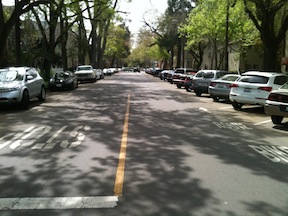
I’ve suggested using up excess street width with diagonal parking. Below are two photos of 17th Street in midtown, one of the section between N and O, which has parallel parking, and a much-too-wide street width. The second is between O and P, which has diagonal parking on the west side. Since these are right next to where I live, I get a regular chance to observe the behavior of drivers on these two sections. On the parallel parking section, drivers are almost always moving above the speed limit, about 30 mph, particularly since most of them have come from an overly-wide section of 17th north of N Street. On the diagonal parking section, drivers are almost always moving at less that the speed limit, about 20 mph. A more subtle difference is that northbound drivers, from the diagonal parking section, seems more willing to yield to pedestrians at the unmarked crosswalks at the intersection of 17th and O streets, whereas southbound drivers, from the parallel parking section, seems to be less willing to yield. Narrowing streets with diagonal parking really does make a difference!

17th St parallel parking
17th Street parallel parking

17th Street diagonal parking