cycletrack in West Sacramento Bridge District

Note: I’ve added text and a photo of the approach from the north.

The City of West Sacramento has installed a section of cycletrack (a two-way Class 4 separated bikeway) on South River Road and 5th Street in the Bridge District. Apparently completed late 2023 (shows how long since I’ve ridden that way), it is part of the Riverfront Street Extension and 5th Street Widening Project.

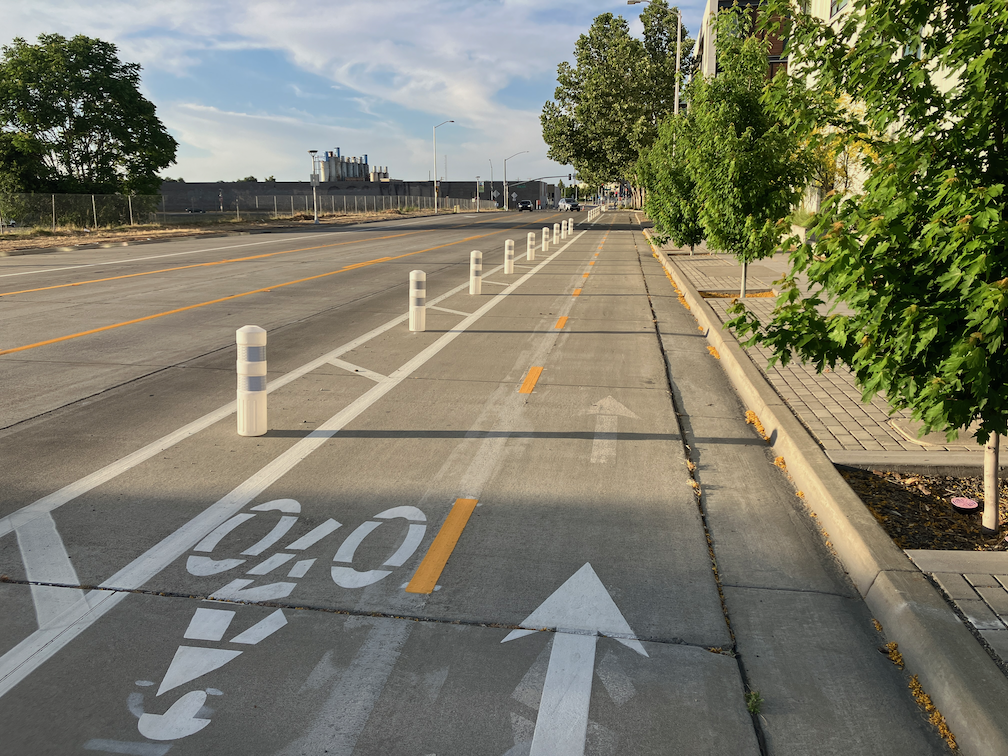
From 15th Street (the connection to Jefferson Blvd) north to almost Mill Street, the bikeway is separated from motor vehicles by a hard curb divider. The on-street bike lane southbound still exists, but this bikeway provides a much safer alternative. The onramp to Hwy 50 east (or Business 80 as it is designated), was an extreme hazard for bicyclists due to drivers turning at high speeds. See two photos below.

South River Rd cycletrack / separated bikeway at 15th St
South River Rd cycletrack / separated bikeway

From Mill Street north to Bridge Street, the cycletrack is separated by a buffer and vertical delineators (K-71). At Bridge Street and north, the roadways returns to traditional Class 2 unprotected bike lanes. Though it would have been great to extend the curb-protected cycletrack all the way north to West Capitol Avenue, at least the truly dangerous section at the freeway onramp was fixed.
To the south of 15th Street, South River Road has more traditional bike lanes, with buffers in a few locations, as it crosses the ship channel and goes through two roundabouts.

The transitions to and from the bikeway seem a little awkward as they swoop through the intersection, but are probably not unsafe. I observed several bicyclists heading westbound to 15th Street who were not following the skip green bicycle markings, but the maneuver was not unsafe. I did not observe any bicyclists at the Bridge Street intersection.

Approaching the cycletrack from the north, the southbound traditional bike lane on the west side of 5th Street transitions to the cycletrack on the east side of 5th Street at Bridge St. Though the transition does not feel safe, I think it actually is, with signals preventing inappropriate motor vehicle movements.
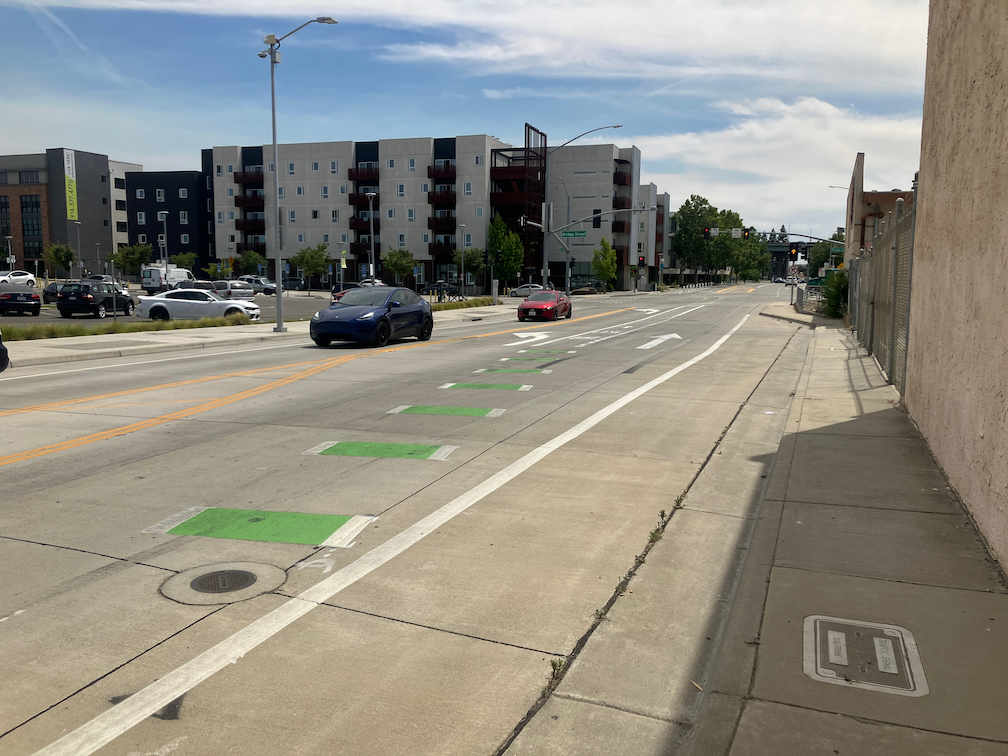
5th St bike lane transitioning to cycletrack approaching Bridge St
signs and signals for bicyclist on 5th St at Bridge St

real turn wedges

This is Central City Mobility Project update #16.

A post today on Streetsblog LA (Santa Monica’s New 17th Street Curb-Protected Bike Lanes are Amazing) is about new bicycle facilities on 17th Street in Santa Monica. I think you will find some of the photos interesting. At first glance, it looks like some of the ones being installed as part of the Central City Mobility Project, but looking more closely, two differences really stand out. Most of the separated bikeways in Santa Monica are curb-protected. Bikeways that are solely parking protected only are protected when cars are parked. Otherwise, they are really just buffered bike lanes. And the turn wedges are hard curbs with additional markers, not paint-only, and definitely superior to the Sacramento’s suggested turn wedges which might have vertical delineators or other markers, but won’t have curbs.

curb turn wedges in Santa Monica (from Streetsblog LA)

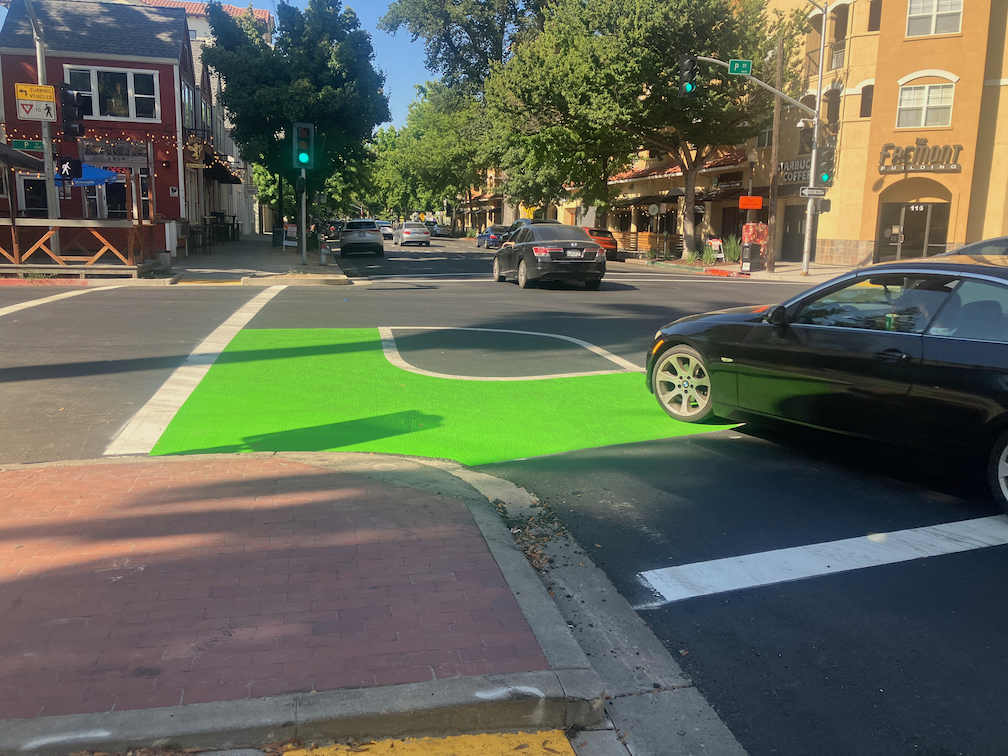
To illustrate the problem these curb turn wedges solve, see the photo below of a motor vehicle making a high speed dangerous turn over a painted parking wedge at P Street and 15th Street.

16th St & P St, Sacramento, high speed turn across painted turn wedge

Other

  • P Street markings including green paint are nearly complete. In two blocks, the green paint is nearly the entire block, for unknown reasons. There is nothing unique about these blocks. While green paint is useful to mark conflict areas, excessive use will just lead to maintenance expense over time.
  • Q Street has preliminary markings, but the temporary lane tabs still indicate overly wide and dangerous general purpose lanes.
  • 19th Street is nearly complete from H Street to Q Street, but there is no marking south of Q Street. South of Q Street, the old bike lanes show in some places, but otherwise have been erased in favor of overly wide and dangerous general purpose lanes. Several blocks of the new bikeway are in the gutter pan, making an unacceptable rough and dangerous surface.
  • 21st Street is complete except for a few spots that were missed and have not been picked up. The confusing arrow at 21st Street and W Street has been corrected. There is still accommodation or signal for bicyclists at 21st Street and I Street.
  • I Street work has begun, with the last few ADA ramps complete and some repaving.
  • 10th Street has the last few ADA ramps complete.
  • 9th Street doesn’t have any work in evidence.
  • 5th Street has not progresses past installation of signal bases.
  • Overall, no vertical delineators have been installed at any locations.
  • Delivery vehicles are parking in and blocking the separated bikeway on P Street approaching 16th Street. The city did not mark any of the parking spaces for delivery use. Cones and barricades have been placed in the buffer to reduce this hazardous driver behavior, and have been removed by someone, and replaced by citizens, and removed by someone, and …