SacCity crash dashboard

Corrections: Crash data is from Sacramento Police Department, not SWTRS, but does use the SWITRS selection categories. Demographic data is from the Transportation Priorities Plan.

The City of Sacramento has released a VZ Crash Dashboard with an interactive map and charts. The dashboard apparently uses data from SWITRS for crash data (which means that it will never be up-to-date, as SWITRS is never up-to-date, but patterns don’t depend on up-to-date data), but is selected for the City of Sacramento, and also has demographic data layers for ‘SB 535 disadvantaged communities’, ‘neighborhoods that lack transportation infrastructure’, and ‘communities that have been recipients of racism and bias’. You can turn on and off layers, and can select for crashes on a wide variety of criteria, such as ‘severity’ (fatality, severe injury, etc.) and ‘involved with’ (bicycle, pedestrians, etc.), which are criteria from the SWITRS database.

I have only explored the data in a superficial manner, but noticed some interesting geographic patterns. If you look at crash density, the central city looks bad, but for fatalities only, it looks better than many parts of the city. There are several arterial roadways that were identified as high injury network (HIN) corridors but were not in the Vision Zero Action Plan. However, a visual representation does not necessarily reflect the details of data.

What patterns do you see in the crash dashboard?

VZ crash dashboard map, selected for severity = fatal

SacBee: city response to crashes

The SacBee published an article yesterday: After a deadly crash, Sacramento fixed a dangerous road. Why isn’t this the norm? Apologies for linking to a firewalled article; if you have a subscription or access to a printed newspaper, it is well worth reading.The article is quite in-depth, more like the investigative reporting that the SacBee used to do, but rarely does any more. The author is Ariane Lange.

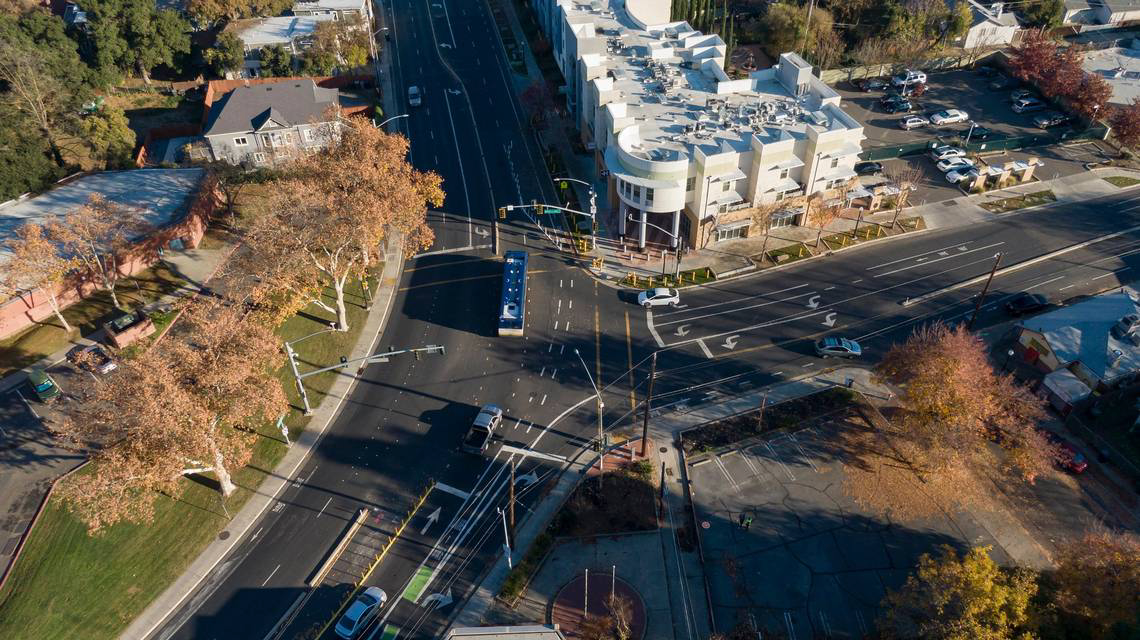
The article highlights changes made to the intersection of Broadway and Martin Luther King, Jr. Blvd (MLK) after a fatal crash single-vehicle crash in 2021. Though the article did not make clear, the driver was likely eastbound on Broadway and continued straight into the building. Google maps, below, does not show the changes, but a photo from the article does (second).

Broadway & MLK intersection, Google Maps (not up to date)
Broadway & MLK, SacBee photo (more recent)
Read More »

red light running consequences

I’ve written recently about red-light-running bullies. On Wednesday morning I got to observe the logical consequences of this behavior.

red light running crash at P St & 15th St

The driver of the SUV heading south on P Street intentionally ran the red light, colliding with the passenger car that was heading west through the intersection. The red light running was well after the light had turned red. Fortunately the red light running driver slammed on his brakes and the resulting collision was low speed, or the other driver might well be dead. I might well have been dead if the other car had not been in the way, since I was using the crosswalk over 15th St, west to east, and would quite possible have been run over by the SUV driver. The driver would have been much less likely to see me than to see the other car.

Really all the red light running driver had to say is that we was in a hurry.

Perhaps most interesting is that law enforcement refused to come to the crash. The passenger car driver had called 911 shortly after the crash, as did at least one bystander. I waited 45 minutes so that I could give a statement. The passenger car driver said that he had finally gotten a text message back that no one would respond. So the crash will not get recorded anywhere. The SUV driver will not get a ticket. Apparently the 911 operator had transferred the caller to CHP, and it is CHP that refused to respond. Perhaps they were busy attending a white supremacy meeting somewhere and couldn’t be bothered. No one died – what’s the big deal?

Just more traffic violence. Nothing to see here. Let’s move along.

Walkable Sacramento #5: speed

This one is pretty simple, but of utmost importance. Speed kills, but the increasing share of fatalities is walkers. The chart explains why.

Though the primary beneficiaries are walkers, bicyclists and motor vehicle drivers will benefit as well. As with many policies and actions related to walking, this is an interim measure to keep people alive until roadways are redesigned. Roadways design should enforce a desired speed, not allow and encourage a higher speed.

Policies:

  • Any roadway with a history of crashes resulting in serious injury or fatality will have the speed limit reduced by 5 mph until this pattern ceases, and each such crash will result in further reduction, but not below 15 mph. 
  • Speed limits on all roadways will be set at the desired speed, not the design speed and not the actual speed. It will be illegal to consider the 85% criteria for setting speeds.
  • Implement a city-wide base speed of 20 mph, and allow higher speed limits only where the roadway design ensures safety at higher speeds. Safety means no fatalities or serious injuries. The sign below is from the UK (United Kingdom), but many places around the world have now made 20 mph (32 kph) the baseline speed.

Don’t use the ‘A’ word

I attended the community meeting hosted last evening by Jay Schenirer, Steve Hansen, and the school district, called as the result of the recent fatality and severe life-threatening injury on Freeport Blvd. I’ll write more soon about the meeting itself, but for today, a comment about use of the ‘A’ word, accident. Every public official that evening, with the exception of Jennifer Donlon Wyant, used the word accident. Some of them repeatedly, with Ryan Moore, the Interim City Traffic Engineer, being the worst offender. Many of these uses were made while standing in front of the Vision Zero slide that states “Vision Zero ~ a traffic safety philosophy that rejects the notion that traffic crashes are simply “accidents,” but are preventable incidents that can and must be systematically addressed.” Oh, the irony.

Not the time to go into a detailed explanation of the harm that using this word causes, but you can check out http://droptheaword.blogspot.com, or #CrashNotAccident on Twitter. Basically, the common understanding of the word in traffic violence conversations is to excuse motor vehicle drivers (and engineers) of responsibility for their actions, implying that nothing could have been done, when in fact many things could have been done.

So, a modest proposal. Every time a public official uses the ‘A’ word, they make a contribution of $20 to a local transportation advocacy organization. Eventually, people will cure themselves of using the word, but in the meanwhile it will be an important source of income for nonprofits working to overcome the bias inherent in use of the word, and the underlying windshield perspective that accepts traffic violence as inevitable.

deaths per 100K

I just ran across an interesting piece of data that I was not aware of before, in Motor Vehicle Crash Deaths in Metropolitan Areas — United States, 2009. Sacramento area ranks 8.3/100,100 for motor vehicle related crash deaths, but 14.4 for the city, which is in the middle of pack for the US, but worse than most of California. Riverside area is 10.6 and city 11.9, San Diego area 7.8 and city 5.6, San Francisco area 5.6 and SF 4.0 and Oakland 5.0, Los Angeles area 6.6 and Los Angeles city 7.7 and Long Beach 6.1 and Anaheim 7.8. This 2009 data, and I could not find anything from CDC more recent. For contrast, London is 1.6 and New York is 3.2, both considered dangerous places in the mis-informed public mind.
The Keys to Designing Cities With Fewer Traffic Fatalities (CityLab 2015-07-23)

Crash, crash, crash

NotAnAccidentI don’t know whether the term accident has a new-found popularity, or whether I’m just more sensitive to it the last week, but it seems like everywhere I look in the news media, there it is, the term accident. I’m talking here about use for motor vehicles, bicycles, and pedestrians.

The term accident implies that no one was at fault, it just happened, an act of nature. But nothing that occurs on the roadways is an accident. Someone caused it, or someone contributed to it.

#NotAnAccident (yes, I realize that this twitter tag gets used for other things, but I haven’t thought of a better one)

I have been using the term crash in place of accident for several years. However, several people have commented that crash may be more appropriate to a single user situation, as in, the car crashed into a tree, or the bicyclist crashed on slippery pavement. The word collision implies two or more users, as in, a collision between a motor vehicle and a bicycle or pedestrian. But I’m not yet entirely happy with those definitions either. Incident has also been suggested, but that seems to clinical to me, almost a valueless opposite of accident.

Here are some links:

Who knew?

@sactraffic twitter profile

I stumbled across a twitter feed about a week ago, and it is filling up my twitter timeline, by far the busiest thing I follow. It is Sac Traffic, which is a CHP feed of traffic alerts in the Sacramento region, at @sactraffic.

As a bicycle rider and walker I’m hyper aware of the risk out on the roadway, and assumed there were more incidents than I was aware of, but I had no idea there were so many in the Sacramento region. I follow the Sacto911 blog on the SacBee for the purpose of tracking carnage to pedestrians and bicyclists. It includes traffic and other crime, but it generally only has a few to no incidents per day. I’ve long suspected there were more, but never had any solid information.

It is basically a game of bumper cars out there!

Read More »

Slaughter on the roadways

In the last there days, Monday through Wednesday, at least four people died when struck by car drivers, and two others were injured. I know that the Sacramento Bee does not report all pedestrian and bicyclist fatalities and injuries, so there may have been more in the region, but this is an incredible level of slaughter.

The SacBee articles so far are:

The better of these articles describe the outcome and location in a factual manner. The poorer ones place the blame on the victim. This victim blaming is aided and abetted by the law enforcement officers who make the assumption that either a) it was a “tragic accident” that could not have been prevented or b) the driver was not drunk and remained at the scene, so clearly it is the pedestrian or bicyclist’s fault. Both are nonsensical statements and ideas.

Read More »