SB 960 complete streets signed

Governor Newsom has signed SB 960, the complete streets bill (SB-960 Transportation: planning: complete streets facilities: transit priority facilities.), authored by Scott Wiener. That’s the good news. It is certain that the Caltrans districts will resist this law, but with oversight by CalBike and the public, things will gradually shift.

complete streets and intelligent speed assist

This week at the legislature, the Assembly Transportation Committee is hearing SB 960 (Wiener) Transportation: planning: complete streets facilities: transit priority projects, Monday, July 1, 2:00 PM in Room 1100 at 1021 O Street in Sacramento (StreetsblogCA: Complete Streets Bill Hearing Next Week). This bill would force Caltrans to follow its own policy on Complete Streets, which is seldom does, and could have a beneficial impact on all street redesign in California as many transportation agencies look to Caltran for guideance.

The Assembly Privacy and Consumer Protection Committee is hearing SB 961 Vehicles: safety equipment (Wiener), Tuesday, July 2, 1:30 PM, in Room 126, State Capitol. The bill would implement Intelligent Speed Assistance for all vehicles except emergency vehicles. Though considerably weakened from the original version, with passive rather than active control, it is still a valuable step forward, and would encourage NHTSA to speed up their policy process, which they have been slow walking (to preserve fast driving).

If you live in Sacramento and can attend, please do. All you can do at legislative hearings is ‘support’ or ‘oppose’, but since most speakers are paid lobbyists, hearing from actual citizens can be powerful.

CalBike What are complete streets? graphic

Senator Wiener introduces road safety bills

California State Senator Scott Wiener has introduced two bills to improve road safety in California.

The more important is SB 961, which requires changes to vehicles directly, including a first-in-the-nation requirement that all new vehicles sold in California install speed governors, smart devices that automatically limit the vehicle’s speed to 10 miles above the legal limit. The old name for these is speed governors, which limited speed with a physical device that disengaged the driver train when a certain speed was reached. They were required on all early motor vehicles before vehicle manufacturers managed to eliminate laws requiring them. Today, speed can be digitally read and limited. Already, almost all new vehicles have built in the ability to limit speeds to the posted speed limit, but it is not implemented. The bill would require it be implemented by 2027.

Speed is a contributing factor in all motor vehicle crashes. Whether it is driving too fast for conditions, or simply driving way over the speed limit, speed is a contributing factor to carnage on our roads. Of course there are other factors such as roadway design which encourages speeding. And speed limiters won’t prevent drivers from running red lights, as has become so common, but at least the resulting crashes will be at a lower speed, less likely to result in fatalities.

Speed limiting of vehicles also would remove law enforcement from most speed enforcement, which increases safety for everyone on the road, including officers.

SB 960 requires Caltrans to implement and report on a complete streets policy. In vetoing a Wiener bill to require complete streets, the governor implemented a executive order that purported to accomplish this, but Caltrans has done almost nothing since then, and has weakened and then delayed release of its complete streets policy directive. The bill also requires Caltrans to develop a transit priority policy with performance targets.

Caltrans headquarters has, to some degree, gotten on board with the idea of designing and re-designing roads for better safety and productivity, but the Caltrans districts, including our District 3, are still full speed ahead (pun intended) on building unsafe highways that kill walkers and bicyclists. They must be reigned in by the legislature.

CalBike is a sponsor of both of these bills, along with other organizations. Yay, CalBike!

Links:

complete streets failure

Summary: Complete streets concept is a failure because it doesn’t address frequent safe crossings. It leaves streets dominated by motor vehicle traffic while not necessarily increasing safety or welcoming design for walkers and bicyclists.

A recent post on Strong Towns (Ager Road: Where Complete Streets Fell Short) shows a street that was converted to a ‘complete street’, and won awards, but is actually less safe and less pleasant than what was there before. A fatality occurred shortly after the conversion, perhaps as a result of the conversion increasing vehicle speeds, perhaps not, but the conversion did nothing to reduce the likelihood.

From the post: “This is a stroad in disguise,” remarked Strong Towns Director of Community Action Edward Erfurt when examining Ager Road in Hyattsville, Maryland. And a Twitter post below.

My response:

The complete streets concept is largely a failure, everywhere it is implemented. I’m sure the original intentions were good, but every complete street project I’ve seen affirms the primacy of motor vehicles over other modes. The greatest failure of all is not what happens along the street, but that the concept does not even address the need for frequent safe crossings of the roadway. No wonder traffic engineers have embraced the concept – it allows them to continue motor vehicle dominance and accept traffic violence.

Dan Allison

So you can see the present ‘complete street’ more clearly:

Google Street View of Agar Rd, referenced on Strong Towns

The complete Streets concept is all about travel ALONG streets. Though it recognizes that crossings of streets are important, and encourages designs that make crossing safer and more welcoming, it does NOT address the frequency of safe crossings. The Complete Streets Coalition, part of Smart Growth America, does not require that complete streets policies include anything about the frequency of safe crossings. And so nearly all polices do not address that. The Caltrans policy, which applies only to state highways but is often applied to other streets, does not mention the frequency of safe crossings.

Traffic planners and engineers have embraced the Complete Streets concept, and tout policies and implementation. But what do we really end up with in most cases? Just more motor vehicle dominated streets, which is what most traffic planners and engineers want anyway, and claiming a complete street isolates them from criticism of the roads being designed and built, while making it more likely that they will be a federal, state, or regional grant for their project. Very few projects are awarded grants these days unless they claim to be a complete streets project. That is good, but the bar is set so low for what can be called a complete street, that the result is just more car infrastructure.

The project shown in the Strong Towns post checks off the following elements:

  • sidewalk, check
  • bike lane, check
  • green paint, check
  • general purpose lane(s), check
  • fence to prevent walkers from crossing any place other than the signalized intersection, check (I put this here with tongue in cheek)

What it does not check:

  • narrow the travel lanes to calm traffic
  • reduce the speed limit or actual speed through design
  • remove slip lanes (ask any bicyclist how they feel about bike lanes that cross high speed slip lanes)
  • reduce the corner radius at driveways
  • install or maintain street trees to calm traffic and provide shade for walkers
  • widen sidewalk buffers to ensure healthy trees and vegetation
  • create a pleasant walking environment
  • provide wayfinding to the nearby Metro station

The next time you hear a planner or engineer mention ‘complete streets’, hold on to your wallet (because, after all, it is your tax dollars that fund ineffective projects), and look around you to identify the traffic violence that will remain or even be increased.

The first step in designing a safe and welcoming streets is top ensure that there are safe and welcoming sidewalks and crossings of the street. Everything else comes after that, if at all. Adding bicyclist facilities that are neither safe nor welcoming, and reducing the the environment for walkers in trade, is going the wrong direction, and will lead to less walking and more traffic violence.

street design contexts

People have commented on my series of street design posts, online and Twitter and in person, with many questions about how to fix existing streets. My focus so far has been on new and reconstructed streets. Obviously fixing existing streets is a critical issue, and I’m not wanting to neglect it, but part of my approach is summed up as “don’t build stupid”, in other words, don’t ever again design or construct a single transportation infrastructure that prioritizes motor vehicle traffic over access and safety for walkers and bicyclists. The best time for better design was 50 years ago, the second best time is today. But the City of Sacramento, and most cities and counties and state agencies, are continuing to build things that are hostile to people walking and bicycling. Traffic engineering is a remarkably regressive profession, sticking with what was once thought to work, even though it never did, and even though it is absolutely clear that it does not meet our needs today. Transportation infrastructure is meant to last 30 to 50 years, and may be in place longer than that, so everything we do wrong today will be around for a long time. We won’t ever have the money to fix everything (a lot of our transportation investment is basically money we’ve flushed down the toilet), and the Vision Zero or Safe Systems approach of identifying and fixing the locations with the highest fatality and severe injury crashes is right.

My thinking about street design has four contexts:

Read More »

Measure 2022: ‘complete streets’

This post is a follow up to (in)complete streets and streets – stroads – roads, and will make more sense if you read those first.

The proposed sales tax measure Transportation Expenditure Plan (TEP) for Sacramento County has 20 occurences of the term ‘complete streets’. The first is this phrase: “complete streets with or without capacity expansion”. This alone should make everyone uncomfortable – the sponsors are perfectly happy with expanding roadway capacity so long as all modes are accommodated in some way. The roadway could be 20 lanes wide, and that would be fine so long as there is some facility for walking and bicycling. Within the ‘Local Street and Road Repair and Transformative System Improvements’ section, Citrus Heights lists 15 possible projects, and within the ‘Local Projects of Regional Significance’ section no projects. The table below shows the complete streets summary (note that Isleton is an insignificant portion of the measure and is not listed). Only County of Sacramento specifically calls out that 15 of the projects will include road capacity expansion, but many of the other projects in all of the locations might also include expansion.

In the lead implementation section, paragraph H, ‘complete streets’ are sort of defined:

Complete Streets. Transportation projects provide opportunities to improve safety, access, and mobility for all users of streets, roads, and highways in Sacramento County and recognizes bicycle, pedestrian, vehicle, and transit modes as integral elements of the transportation system. The term “Complete Streets” describes a comprehensive, integrated transportation network with roadways designed and operated to enable safe and convenient travel for users of all abilities, including motorists, pedestrians, bicyclists, persons with disabilities, seniors, children, movers of commercial goods, operators of public transportation, public transportation users, and emergency responders, in a balanced manner that is compatible with an urban, suburban, or rural context.

Transportation Expenditure Plan, I. Implementation, H. Complete Streets

Sounds OK, but it is so vague as to allow practically anything, based on the preference and judgement of city or county. No reference is made to state or federal definitions or guidelines.

The TEP does require the cities and counties to adopt a ‘complete streets’ policy. So far as I’m able to determine, only the City of Sacramento has a policy at this time. That is good. But again, no guidelines as to what a good policy would address. No reference to the National Complete Streets Coalition model, or state or federal guidelines. All of the General Plans address complete streets to some degree. It is not clear whether these existing aspirations constitute a policy.

Within one year following the implementation of this Measure, each local jurisdiction in Sacramento County receiving Measure funds shall adopt or maintain an existing “complete streets” policy or a similar document that incorporates design guidelines and standards promoting safe and convenient travel for all users including bicyclists and pedestrians when considering any construction, reconstruction, retrofit, or alteration of streets, roads, highways, bridges, and other elements of the transportation system.

Transportation Expenditure Plan, I. Implementation, H. Complete Streets

And lastly, the TEP says that projects should be consistent with policy. But again, the language is vague. What does consistency mean? Always, or only when it doesn’t impact traffic flow? No performance measures for the jurisdictions to achieve, or against which to judge their success.

Planning and design of projects affecting the transportation system shall be consistent with any local bicycle, pedestrian, transit, multimodal, and other relevant plans and/or the local complete streets policy to ensure that all transportation types and users are considered in the expenditure of Measure funds.

Transportation Expenditure Plan, I. Implementation, H. Complete Streets

So, does use of ‘complete streets’ and identifying projects as complete streets mean anything. No, not really. It is up to each transportation department to determine for themselves whether the project is complete streets, and what it would have to do to ensure that.

Even if the project does produce a ‘complete street’, it still won’t address frequent safe crossings of the corridor for walkers, nor the need to significantly reduce motor vehicles speeds to create comfortable walking and bicycling streets.

Search for category Measure 2022 to see posts as they are added.

Complete Streets aren’t

The Complete Streets movement, now 13 years old and with a newly released criteria for evaluating policies, is considered by some to be a success. Not by me.

There are two gaping flaws in the complete streets concept, that after all this time have not been addressed:

  • Who is responsible for sidewalks?
  • How close should safe crossings be?

Sidewalks: On the first issue, responsibility for sidewalks, most cities and counties (not all) have code that makes sidewalk maintenance the responsibility of the adjacent landowner. This includes repair and snow removal. Most cities have some money set aside to repair sidewalks, but only a tiny fraction of what is needed for the huge backlog of deteriorated sidewalks. A very few cities also clear sidewalks after snow. Sidewalks are every bit as much of the transportation network as travel lanes and bike facilities, but most places wash their hands of this reality and this responsibility, pushing it off to others. It has been pointed out that few cities and counties have the funds to also take care of sidewalks, but that is exactly the point. If we allow cities and counties to prioritize cars over walking, they will continue to do so.

How does complete streets play into this? It doesn’t. Complete Streets set no expectation that cities and counties will maintain their sidewalks. In the new policy rating documents, the word sidewalk only shows up twice, neither in this context. Even a search of the Complete Streets website only mentions sidewalks in relation to case studies and model projects. Fortunately, a few places do much better than just have a policy, but the Complete Streets movement does nothing to encourage this.

ElCamino-eb
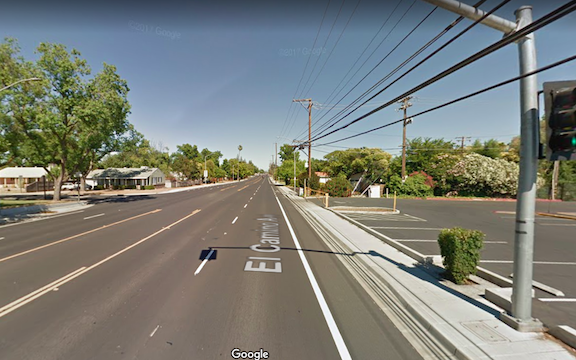
El Camino complete street, 0.3 miles to the next safe crossing

Crossings: the second great weakness of the complete streets movement and Complete Streets documents is the lack of attention to frequent safe crossings. The new criteria does not mention crosswalks or crossings. The illustrations of a complete street often show an intersection with high visibility crosswalks and sometimes curb extensions to increase visibility and shorten crossing distance. But other illustrations show long distances along a “complete” street, with the next safe crossing often not visible.

In the Sacramento region, every complete street project along arterials has added sidewalks and bike lanes, but none of them have added safe crossings. In fact, several of them have removed crossings. If a busy street is hard for walkers to cross, they won’t cross it. They will either drive, or just avoid the other side of the street. So that fancy complete streets project, with the wonderful looking wide sidewalks, does not serve the very people it is claimed to serve. People need to be able to cross any land all Streets in a safe crossing at an interval of no more than 1/8 mile. The grid in downtown Sacramento is 1/12 of a mile. Few places in the suburbs are less than 1/4 mile, and many are 1/2 mile. To me, this is unacceptable. I would think a complete streets policy would address this distance between safe crossings issue as being key to walkability. Again, the Complete Streets movement ignores this issue.

55% threshold for transportation maintenance

State Senator Scott Wiener has introduced SCA 6, a constitutional amendment that would change the threshold for transportation measures from 2/3 (67%) to 55%. While I understand the desire to make funding of transportation easier, I am also scared by possible outcomes. The Sacramento County Measure B would have passed under this new threshold, but it failed with 65% when 67% was required. Measure B was chock full of bad projects, including Capital Southeast Connector (a new freeway), widening of Capital City Freeway, new interchanges throughout the county (mostly to serve new and planned greenfield developments), and additional road widening and extension. It also had some good things, such as fix-it-first and light rail car replacement with low-floor/level boarding cars.

I am concerned that if this amendment were adopted, there would just be more and more investment in the same old infrastructure solutions that got us into this mess in the first place, and still less dedicated to what we really need for the time being, which is maintenance.

Read More »

tomorrow on Broadway Corridor

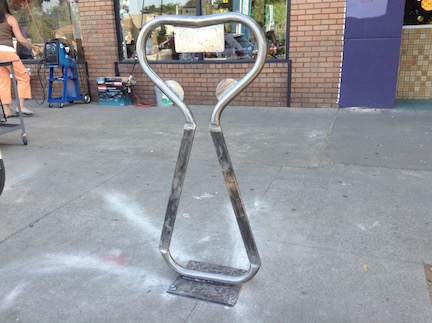
art bike rack at New Helvetia Brewing

The City of Sacramento is soliciting input on changes to be made on the Broadway Corridor to accommodate pedestrian and bicyclist use.

Broadway, as currently designed, is definitely a motor vehicle world, where pedestrians cross at considerable risk and bicyclists riding in traffic are routinely honked at (or worse). Some years ago an attempt was made to calm traffic by installing bulb-outs or curb extensions at some pedestrian crossings. But these did little to slow traffic and much to make bicycling more difficult. As one of the main business streets of Sacramento, and one that is considerably more diverse than many, the corridor, and the businesses along it, and the people who use it, deserve better. Please be a part of making that change happen.

“Broadway has many exciting destinations, but as an auto dominated arterial it is an unfriendly place to walk or ride a bike,” explained Sparky Harris, City of Sacramento Project Manager. “The goal of this project is to better connect sidewalks and bike lanes, enhance pedestrian crossings, and make the corridor an inviting destination for anyone attempting to travel without a car.” (from City Express)

Tomorrow, Wednesday, April 19 there are several mobile workshops along the corridor where people can find out more about the proposals and provide input. Check the City Express post City looking at improvements for Broadway Corridor for times and locations.

Sacramento Area Bicycle Advocates (SABA) is hosting a bike ride from Capitol Park that will end at the mobile workshop at New Helvetia Brewing on Broadway at 18th. The event is on Facebook: https://www.facebook.com/events/934340296639140/.