make streets rough again!

This is a follow-on to my 2016 post back to the old ways? Since that time I have watched several streets in downtown being torn up for utilities. Under the asphalt pavement on several of them are cobblestone and brick streets, covered over by asphalt to provide a smooth and fast ride for car drivers, and a less safe street for everyone. There are also a number of streetcar tracks that have similarly been buried beneath asphalt. Car drivers have won the battle for our streets, so far, but the trend is starting to reverse, even in Sacramento. The City of Sacramento, in its new general plan, has decided that walkers are more important than drivers!

The Strong SacTown street design standards team has identified four roadway typologies, Local Streets, Active Streets, Transit Streets, and Roads. Every redesign of Local Streets should consider installing rougher pavement to slow motor vehicles. Of course if a street is used by bicyclists, the pavement can be only moderately rough, not like the cobblestone pavement on Front Street in Old Sacramento Waterfront. Sidewalk level bike lanes, separated from the roadway and smooth, solve this for some kinds of streets, but local streets usually will not have bicycle facilities because they are low speed and low volume safer streets.

Rough pavement slows drivers, not just where there are traffic calming features such as curb extensions and chicanes, but for the entire block. Rough cobblestones like Front Street limit motor vehicle speeds to 10-15 mph, but a moderately rough street can enforce 20 mph or less, which is the goal for all local streets.

Brick streets do cost more to install than asphalt (the cheapest, in both senses of the word) and concrete streets. But they last much longer, according to The Planning Lady: It Pays to Save Your Brick Streets. “A concrete street will be replaced 3 times and asphalt 6 times over that time period.” Brick laying machines, originally invented in the Netherlands (of course), but now available from many companies, reduce the cost of creating brick streets considerably. I don’t know the range of brick roughness that can be laid by machine, but it should be sufficient for moderately rough streets. The roughness of historical cobblestone like Front Street might not be affordable today, with the material harder to source and labor more expensive, but many cities are using cobblestone for slow streets and gateway treatments.

Photos below of Clay Street in San Francisco cobblestone, Front Street in Sacramento cobblestone, and Liestal Alley in Sacramento brick.

San Francisco, Clay St, cobblestone pavement
Sacramento, Front St, cobblestone pavement
Sacramento, Liestal Alley, brick pavement

back to the old ways?

https://transportationist.org/2016/03/14/follow-the-red-brick-road-streets-mn/

A post two days ago on Transportationist, “Follow the Red Brick Road,” reminds me of a topic that has been much on my mind – how do we effectively slow motor vehicle traffic? Speed limits are ineffective, stop signs are a complete waste, physical structures such as speed humps, speed tables, and chicanes work but only where they are present, narrower lanes work pretty well but get pushback from commercial drivers and agencies (fire engines, trash trucks, buses, etc.). What is needed is something that works continuously, and street surfaces may be the answer. The post recommends the use of an old material, brick, hence, back to the old ways.

The Traffic Calming entry on Wikipedia provides a summary of traffic calming measures, and one of them is surface materials or textures, but other solutions are more prominent. A common practice in many locations is to make crosswalks visually different, and sometimes texturally different from the rest of the roadway, on the theory that the difference raises driver awareness of the crosswalk. To some degree this may be true, but it probably has much less than the desired effect on traffic speed, and textural differences can present a challenge to disabled people and even to less adept walkers. The many different crosswalks patterns are an attempt to increase visual contrast with the roadway, but again, that is only partially successful.

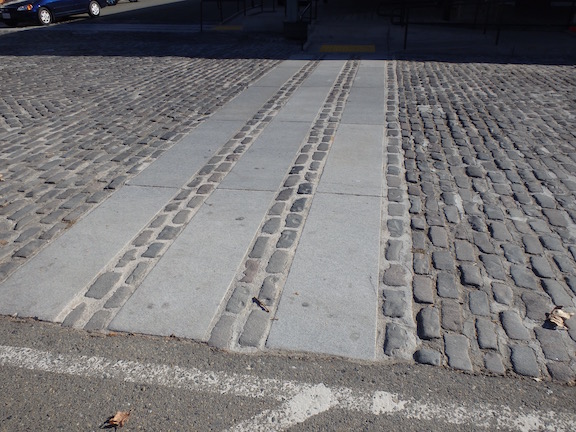
So the idea is to reverse this pattern: make the roadway rough and the crosswalk smooth. We have a great example of this right here on Front Street in Old Town Sacramento, pictured below.

Crosswalk and cobblestones, Front Street, Old Town Sacramento

If you have not observed this street in action, I encourage you to do so. No one drives too fast on this section of street, in fact all motor vehicles are going a pedestrian-friendly speed. Yet the smoother crosswalk is usable by all and still has a high contrast with the road. Compare that to nearby Second Street, where a normal pavement surface encourages some irresponsible drivers to go much faster than is safe given the tourist pedestrians that frequent the area.

Of course the cobblestones here are an historical artifact, and such a rough surface would only be appropriate in high pedestrian traffic areas. But brick would be a great middle ground between cobblestones and asphalt.

While I have long supported this reversal of textures, I doubted that it would be practical to implement. But the video at the bottom of the “red brick” post provides a solution, a machine designed to lay down brick in an efficient manner. The process is slow, but I think that is because they are changing brick patterns to demonstrate different possibilities. Where the pattern remains the same, it would go much faster, and the feed of bricks could be automated.

If you have ridden your bike on these cobblestones, you know that the surface is very rough. When cars are not parked along Front Street, the cobblestones can be bypassed on the asphalt parking area on the west, but when it is full, yow! Obviously brick is much less rough than cobblestone, but nevertheless bike access is an issue to be considered. Maybe brick would be no problem (if it is maintained, but then bike lanes often have unmaintained asphalt or concrete anyway), or maybe the bike lane would need a different surface. A visual or textural difference might cause drivers to notice and respect the bike lane more than they do now, with just a white stripe and occasional green paint to distinguish it. This needs more thought and study.

I would guess that brick streets would be more expensive than asphalt, which is sort of the lowest common denominator of pavement, but might be comparable to concrete, and cost is always an issue in constructing and maintaining streets. But I’d like to see some pilot street projects, starting with locations where it is really important to increase safety and promote walkability, right here in Sacramento. If the pilot goes well, then let’s make it the standard street surface for the grid, implemented anytime repaving is indicated.