a modest proposal to fix the budget deficit

I woke up this morning with thoughts about how Governor Newsom could largely solve the budget deficit. And shortly thereafter ran across the CalBike-led letter, co-signed by 25 organizations, to the governor about shifting budget priorities: Stop Fueling Climate Change: Coalition Challenges Governor to Shift Transportation Spending. In the Governor’s initial budget proposal, there is no reduction in highway building whatsoever. It is as though this is the sacred mission of the state, to fund and build highways at the level desired by Caltrans, and the asphalt lobby, no matter what else is going on in the state, with budget or climate. This is called the ‘Infrastructure Cult’ by Strong Towns.

The letter’s four asks are:

  1. Consider any proposed reductions in General Fund spending on transportation infrastructure in the context of our climate and equity goals
  2. Backfill any General Fund cuts by leveraging the existing statutory flexibility of federal highway formula funds as well as funding from the State Highway Account.
  3. Suspend California state investment in new highway capacity
  4. Develop a multi-year funding commitment that ensures at least 50% of the State Highway Account (SHA) funds go to VMT-reducing projects while prioritizing investments in California’s most burdened communities.

I support all of these ideas, but of course would go further:

  • Suspend SHOPP funding, the funding which is supposed to maintain and improve (but not expand) our highway system until an audit of the SHOPP program is complete. This would take at least a year, maybe more. SHOPP is the biggest part of the Caltrans budget, so the savings for this year would be considerable.
  • Suspend all STIP funding, the funding which is used to build new infrastructure, indefinitely, except for the TIRCP (rail and transit) and ATP (walking and bicycling) programs. This is much the same as the letter’s third action.
  • Propose to the legislature a bill that would convert all HOV (high occupancy vehicle) lanes (which are worthless in practice because so routinely violated), to tolled lanes, statewide, within five years. This effort would include state funding to accelerate creation of tolling authorities where they don’t exist, and to study merging of tolling authorities into regional entities.
  • Propose to the legislature a bill that would not only allow but encourage and/or require the conversion of general purpose lanes to toll lanes. For the time being, this would preserve two general purpose lanes on highways with more than two lanes per direction, but ultimately, all lanes would be tolled. Highways are incredibly expensive to build and maintain, and general funds should never be spent on highways because they are not used by a significant portion of the population. And if all users are tolled in all lanes, the tolls would be reasonable and equitable.
  • Propose a bill to the legislature that assigns CalSTA (California State Transportation Agency) a study of the charter and organization of Caltrans. Caltrans is an outmoded legacy agency which should be reoriented towards meeting the needs of citizen access and climate action, and most specifically maintaining what we have and not continuing to build new.

Meetings week of May 15

Note: This will not be a regular feature, but occasional, to share meetings you might be interested in. Some are organizations, some are agencies.

Monday

  • SACOG Bikeshare Policy Committee: 2:00PM, in person (1301 L St) or Zoom; the agenda is Overview of the Regional Bike Share Program (Nicole Zhi Ling Porter) and Update on Bike Share Technical Expert Agreement (Nicole Zhi Ling Porter). The presentations are not available ahead of time.

Wednesday

  • Walkable City Book Club: an informal group meets to discuss Walkable City, by Jeff Speck, on occasion of the 10th Anniversary Edition; this week the group is discussing Part 3: Getting the Parking Right (page 117). The group meets 6:00PM at Lefty’s Taproom, 5610 Elvas Ave, Sacramento, CA 95819. Usually second Wednesday, but for May third Wednesday. If you want to be added to the email list, please email me (allisondan52@gmail.com) and I’l get you added.
  • Sacramento Climate Coalition: meets 6:30PM once a month via Zoom to discuss climate action at the regional and state level; email info@sacclimate.org to get added to the email announcement list

Thursday

  • ECOS Climate Committee: meets 6:00PM once a month via Zoom to discuss local climate concerns and actions; this month the topic is the recently released City of Sacramento Climate Action and Adaptation Plan.
  • City of Sacramento Active Transportation Commission (SacATC): meets 6:00PM monthly in person (city council chambers) or via Zoom; agenda on the Upcoming Meetings page; this month the main agenda items are 21st Ave Beautification Project, Pocket Greenhaven Neighborhood Transportation Plan Final Draft, and Streets For People: Sacramento Active Transportation Plan Phase I Outreach.

Friday

  • SacMoves Coalition: meets 10:00AM on third Fridays via Zoom; the coalition is primarily a gathering of organizations working in transportation, environment, and housing, but individuals may participate in meetings; to get added to the announcement list, please email Mia Machado, MMachado@sacbreathe.org.

Sacramento Transit Advocates and Riders (STAR) maintains a calendar of transit and transportation meetings on groups.io. You may subscribe to that calendar at https://groups.io/ics/1509831/783555437945795328/feed.ics. The calendar is not intended to be exhaustive, but is useful.

Sac Transportation & Climate Workshop

The first City of Sacramento Transportation & Climate Workshop was held last night as part of the regular city council meeting. The first news, which was not at all clear before, is that this is the first of several workshops, which will develop the plan further. The next workshop has not been scheduled, but may be in March.

screen capture from city presentation

Some highlights:

  • No one spoke against the seven big idea projects.
  • People liked the enhanced bus lane on Stockton for SacRT route 51, but it didn’t receive much notice in the discussion.
  • Nailah Pope-Harden of Climate Plan and a local activist, said bold is the minimum, and said all projects should be about reconnecting communities. Many other speakers referred back to Nailah’s challenge.
  • The opening slide of the city presentation showed SacRT bus route 30 on J Street, pulled out of traffic and blocking the bike lane. Irony probably unintentional, but it does illustrate one of the ways in which the city does not support transit or bicycling. The bus should not be pulling out of traffic, but stopping at a bus boarding island with the separated bikeway running behind it.
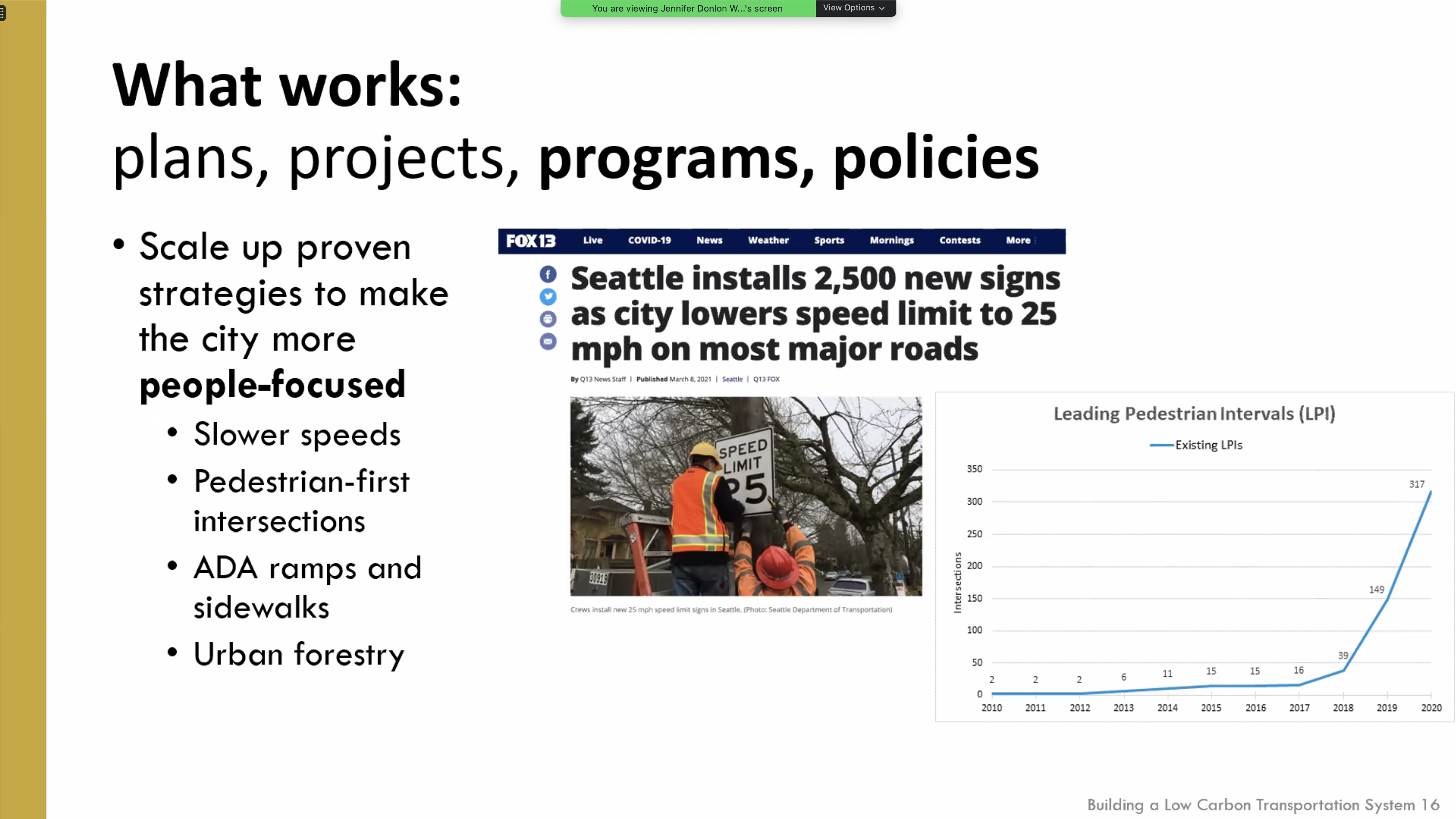
  • Sam Zimbabwe of Seattle DOT presented on the ways in which the city has shifted mode share to transit with projects and priorities. One of his slides showed the huge increase in the number of intersections at which they have programmed leading pedestrian intervals (LPIs) to enhance pedestrian safety.
  • Jeff Tumlin of San Francisco MTA said they have realized that waiting for a few big projects is an ineffective approach, and are now doing many small projects, often with temporary measures that can be improved when made permanent. He said that sales taxes don’t have to be regressive, if the benefits are directed to the right places and projects, and that well-designed congestion pricing is not regressive. He also suggested that city staff should be challenged to a higher level of productivity and innovation, and let go if they choose not to meet that. He also spoke about SFMTA’s approach, with partners, of working on transportation and housing as a unified goal, not siloed.
  • Darrell Steinberg mentioned several times the idea of the city doing a transportation ballot measure so that it could set its own priorities for investment rather than compromising with the county (SacTA) over projects which don’t meet the needs of the city.
  • City staff said transportation is now 56% of carbon emissions in the city, which is higher than numbers reported before.
  • Ryan Moore poo-poo’d the idea of lowering speed limits, saying the MUTCD prevents that, without mentioning the state law which allows reductions in specific circumstances. Others pushed back on this.
  • Rick Jennings spoke enthusiastically about getting more kids on bikes and his own experience of bicycling with kids.
  • Jeff Harris spoke about EVs, despite the setup of the workshop being about other transportation ideas, not EVs.
  • Mai Vang pointed out that the ideas are too District 4 (central city) focused, believes that there should be more focus on low-income and outlying areas. She said we need better access to light rail stations, not just bicycling access to downtown.
  • Civic Thread spoke (all their employees!) about the need for a city-wide Safe Routes to School program to address the recent parent death at school dismissal at Hearst Elementary, as well as safety needs at every school. They also highlighted equity and community access.
  • Henry Li and Jeff Harris pointed to micro-transit (SmaRT Ride) as being a great success, but SacRT has still not provided information to the community to judge that.
  • Henry Li spoke mostly about funding, and did not address the Stockton/Route 51 project. He again highlighted light rail to the airport, despite the transit advocacy community’s request that all light rail extensions including ARC/Citrus Heights/Roseville considered before selecting the next project.

The message from the invited speakers and the community was clear: we need to make big changes in a hurry, and city funding and commitment will be necessary for that to happen. How will the city respond?

What are your highlights from the workshop?

screen capture of Seattle DOT slide on speed limits and LPIs

Transportation Choices Summit

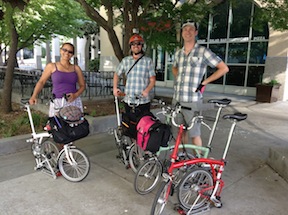
Bromptons at the summit, including Cynthia Rose of Santa Monica Spoke

Yesterday I attended the Transportation Choices Summit, sponsored by TransForm, at the Sacramento Library Tsakopoulos Galleria. The purpose of the summit was to bring together advocates and others in the areas of transportation, health, and housing. Speakers were Brian Kelly, Acting Secretary, CA Business, Transportation & Housing Agency, Mary Nichols, Chair, California Air Resources Board, and James Corless, Director, Transportation for America. There were plenary panels on Building California’s Future, and Cap & Trade Auction Revenues to Support Sustainable Communities. Breakout sessions were held on a variety of issues.

Read More »