Caltrans widening I-5 north of Sacramento

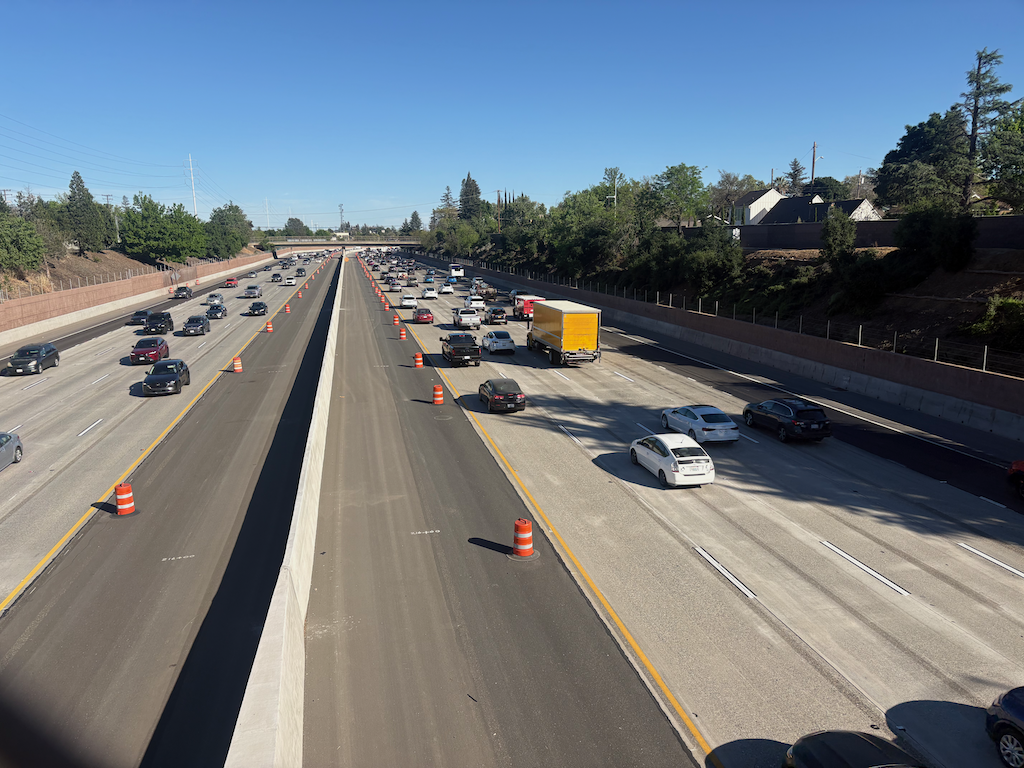
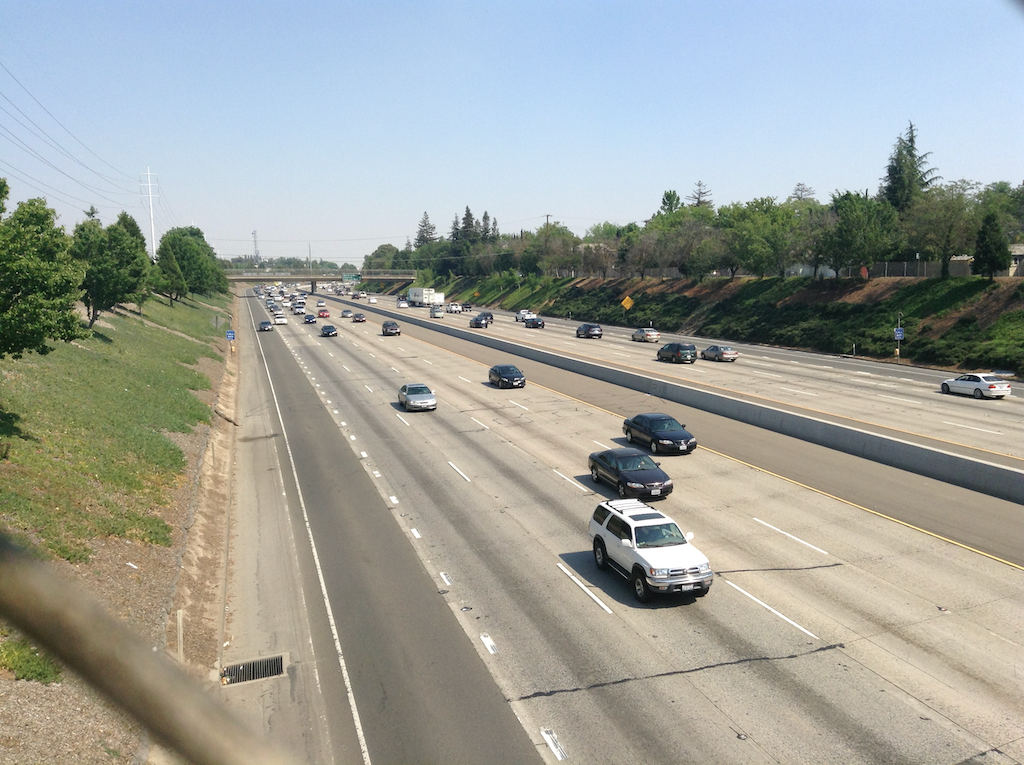
Yesterday I rode the bus to and from Sacramento International Airport, to see what the ride and buses and ridership were like. I noticed that there is significant construction occurring on I-5 between Arena Blvd and Airport Blvd, the entrance to the airport. The freeway width under overcrossings is being widened by one lane in each direction, and the roadway is being widened in between the overpasses and interchanges. I had not heard or realized that this work was already going on, but then, I rarely travel on I-5. This project is titled “SAC-5 Corridor Improvement Project – Phase 1”, and is being referred to as “Sacramento I-5 Auxiliary Lanes Project”. A fact sheet is available.

Caltrans claimed a categorical exclusion for this project, meaning that they claimed they did not need to do an environmental assessment or environmental impact statement for CEQA or NEPA because the project would not have a significant environmental impact. This is laughable. Capacity expansions ALWAYS have an environmental impact. It amazes me the number of agencies, including SACOG and California Transportation Commission, that sign off on this bullshit. The project number is 03-4H580, which means it is part of the Caltrans District 3 megaproject to increase the capacity of I-5 and I-80 in the Sacramento region. It may be that part of this widening is a separate project to add an auxiliary lane between Metro Airpark and State Route 99, using Trade Corridor Enhancement Program (TCEP). It appears that the main project is funded through Solutions for Congested Corridors Program (SCCP). The project also shows up on lists of State Highway Operation and Protection Program (SHOPP) projects, though it is not clear whether it actually received any SHOPP funding. This type of widening would be illegal as a SHOPP expenditure. There are literally 70 documents that relate to this project, and it is beyond me to figure out what they all mean, or how they relate to each other. Caltrans specifically does not gather these documents onto a project page. That would entail some transparency, which Caltrans District 3 is apparently opposed to.

The photo below shows the widening of I-5 at Airport Blvd, captured from Google StreetView. The freeway is being widened to the west to the Sacramento River crossing, and the widening appears to continue all the way to Arena Blvd. Caltrans calls these auxiliary lanes, meaning they extend only between interchanges but not through, but it appears to me that they will be continuous, and that is why the freeway is being widened beneath the overpasses. These modifications of the overpasses are called tie-backs by Caltrans, meaning the the original slope under the overcrossing bridge to the freeway is being truncated to add width to the freeway.

This is phase 1 of the project. Caltrans intends to add capacity to I-5 all the way from the Yolo County line to US 50, where the earlier project greatly expanded capacity from Elk Grove north.

If readers travel this section of I-5 and have comments about this project, or more knowledge of the project than I have been able to come up with, please comment or contact me.

SACOG Board on sales tax analysis

The SACOG Board met today, and agenda item 12 was on the SACOG Review & Analysis of Proposed Citizens’ Transportation Tax Initiative in Sacramento County. This was an information item, for discussion, not for action. This post is a brief summary of the discussion, to follow on to the earlier post on the analysis: SACOG analysis of Measure 2022. The analysis identifies 26 (or more) capacity expansion projects proposed in the measure’s Transportation Expenditure Plan, all of which would increase GHG/VMT, and most of which would also increase sprawl.

Nearly every representative of the cities and counties in Sacramento County rejected the analysis as being flawed, some even said it was unprofessional. They claimed that the analysis made so many assumptions that it could not be trusted, and that SACOG should not be in the business of producing documents like this. Despite that fact that planning for transportation and land use is specifically the purview of the MPOs, and that they instead support a measure that speculates about transportation needs for 40 years into the future. If you don’t like the message, blame the messenger.

I can’t resist pointing out that this has become a pattern for supporters of more of the same (more capacity expansion, more sprawl, more GHG/VMT):

Supporters of sprawl and the measure proponents: Show us the data!

SACOG: Here is the data.

Supporters of sprawl and the measure proponents: No, not that data. We don’t believe you.

On the other hand, every representative from the other five counties in the SACOG region expressed great concern that allowing the measure to go through would threaten their own transportation projects and funding due to the region not meeting GHG reduction goal of 19%. Don Saylor of Yolo County was the most succinct, saying that SACOG must consider the impact on the region as a whole, and that it is time to move past the limited vision of the past.

The out-of-left-field part of the discussion was that Darrell Steinberg talked about an ongoing negotiation with the measure proponents that would mitigate for the worst aspects of the measure. This apparently has been going on for six weeks, and is the reason the release of the analysis was delayed, even though it was completed a month ago.

Darrell talked about five elements of the negotiation (this is captured from his verbal report, and may not be accurate, no printed information was offered):

  • $300M in the measure for the connector would be contingent upon SACOG defining mitigation measures, and that the Capital Southeast Connector JPA accepted the mitigation.
  • SACOG would develop a scenario in the currently developing MTP/SCS that includes the connector.
  • SACOG would commit to putting the connector in the MTP if these other conditions where met.
  • An additional $300M would be provided for connector mitigation in the measure.
  • $100M will be added to the California Mobility Center, diverted from other projects.

It looks as though Steinberg is putting the onus on SACOG, not on the proponents. It is true that none of the government entities have any control over the measure, but if negotiations are going on, it should be from a position of strength, not weakness. If the City of Sacramento opposed the measure, it is very unlikely that it would pass.

The proponents intended to bully the agencies into supporting it, and to make sure that they got their message across, removed the climate protection language from the measure. They want the agencies to make their own decisions about whether and how to mitigate climate impacts, regardless of regional interests or the intent of the state legislature, or even the interests of the counties that would be impacted.

To my knowledge, no opponents of the measure, of which there are many, the majority of the transit, transportation, and environmental advocacy organizations, were asked to participate in the negotiations. Yet another example of excluding public engagement, just as the people who wrote the measure excluded public engagement.

SACOG said that the analysis would be presented to the various SACOG committees, and would come back to the board in June. It isn’t clear to me what, if anything will happen at that point. I assume the negotiations will have completed by then, successfully or unsuccessfully. It isn’t clear what kind of agreement could be reached that would actually be binding on Sacramento Transportation Authority and the other governments, since a measure, if passed and not found unconstitutional, has the force of law. Maybe there is a way.

For more on the measure, see Measure 2022 posts. The use of this category is not meant to confuse. A lot of people are referring to this as Measure A, but the measure letters are assigned by county elections after they have qualified, so this is in no sense Measure A at this time.