Part of an ongoing series of posts to support better streets in the City of Sacramento during their 2023 update of Street Design Standards. New standards must be innovative, safe, and equitable, and it will take strong citizen involvement and advocacy to make them so.
The purpose of designing streets for transit is to actively shift trips away from private motor vehicles and to transit. Most arterial streets in the city should have dedicated bus rapid transit design, and any street with more than one general purpose lane per direction should have a dedicated bus lane, with red paint.
Transit Street Design Guide will be used along with close collaboration with the transit agency to determine optimal and innovative street designs supportive of transit
Dedicated bus lanes will be provided on all 15-minute frequency bus routes on streets over one lane per direction
Light rail will be given exclusive right-of-way on streets with three or more lanes existing; and considered for streets with two or more lanes existing
Bus bays which force buses to pull out of and into traffic will not be used, except where the transit agency has identified the need to wait for a timed stop or to layover
Curb extensions may be lengthened to provide in-lane bus boarding
Dedicated bus lanes shared with bicyclists will be used only when high quality bicycle facilities on an immediately parallel street are not available, or to solve right-of-way issues of one block or less
Bus routes with 15-minute or better frequency, and light rail, will have transit signal priority at all intersections
Design diagrams will be developed in cooperation with the transit agency:
Bus stops, including stop amenities, with preservation of sidewalk passage
Concrete bus pads to lessen pavement deterioration
Bus boarding extensions on streets without bike facilities
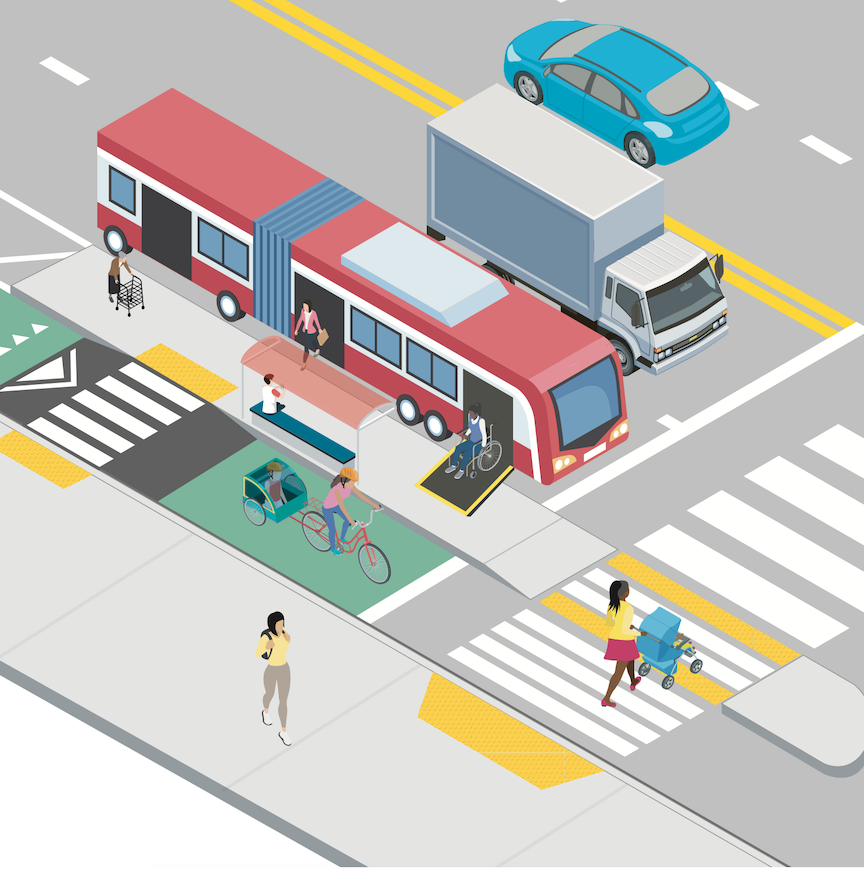
Bus boarding islands with bicycle facilities behind, including design features that slow bicyclist traffic behind the island to prioritize walkers
Raised platforms for low floor or level boarding of light rail vehicles
Bus rapid transit streets, including potential raised platforms
I recently attended a meeting of SacTRU (Sacramento Transit Riders Union) and heard complaints about the bus stops along J Street between 19th Street and 29th Street, in the section where a separated bikeway (cycletrack, protected bike lane) was installed. I have heard these concerns before, so let me talk about them. Two SacRT routes run along this section of J Street, Bus 30 and Bus 38.
The concerns are two:
The bus stops are too widely spaced.
The bus stops are very difficult for disabled people (and bus operators) to use because the bus no longer stops at the curb, but rather in the street.
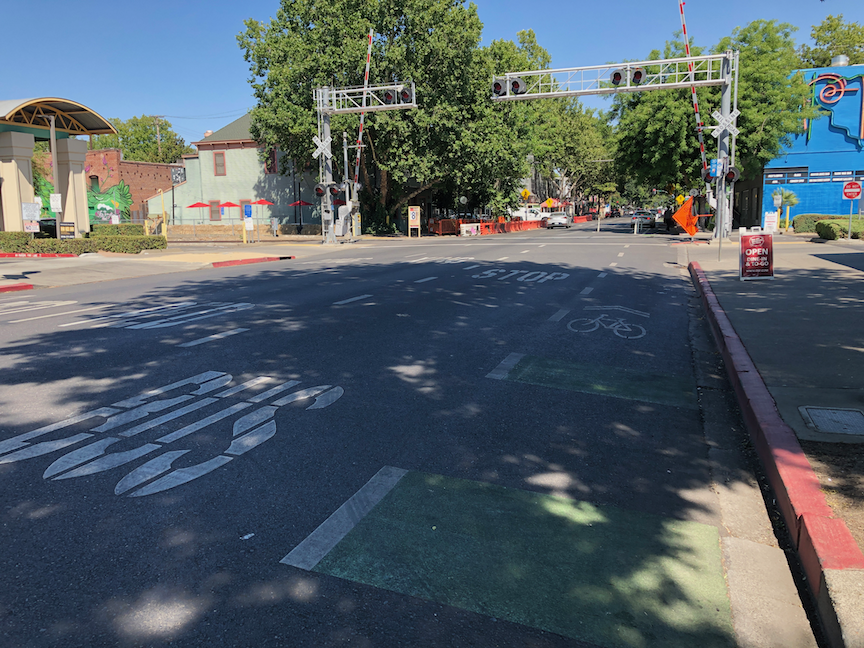
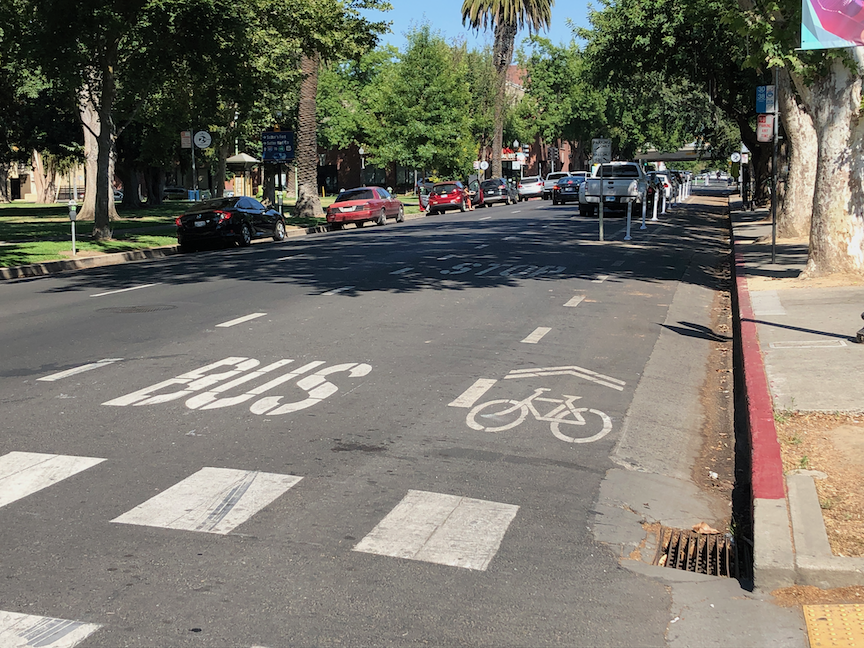
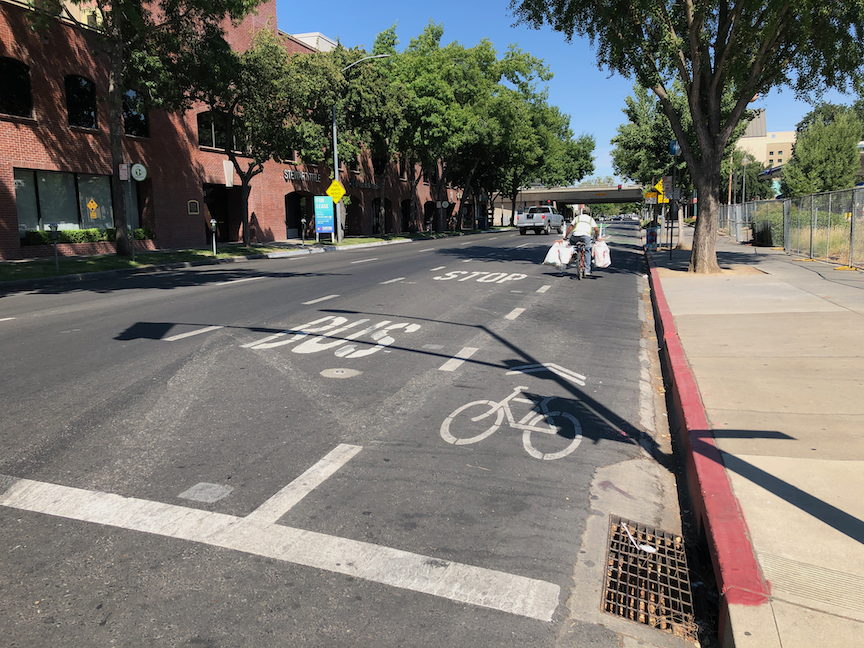
Actually, there are TOO MANY bus stops in this section of 10-1/2 blocks, from 19th Street to nearly 29th Street where the separated bikeway ends. Five bus stops, two of them only one block apart. In a central city setting like midtown, bus stops should be no closer than three blocks apart (about 1/4 mile), and preferably more, like four to six blocks. Why? Because every stop slows the bus significantly, not only the deceleration to the stop and acceleration from the stop, but dwell time. Buses in some areas like this actually spend more time stopped than moving, and as a result, the speed of the route is often below 10 mph. The following five photos show the five bus stops. It is significant that there are too many stops, because solutions to issue 2 are not inexpensive.
J St near 19th StJ St near 22nd StJ St near 25th StJ St near 27th StJ St near 28th St
The second issue is real. Bus operators can have a hard time deploying ramps to the street, particularly when the street is strongly crowned as parts or J Street are. A disabled passenger needing the bus ramp, which might be a wheelchair user or someone with a disability making stepping up to and down from the bus difficult, have to wait in the bikeway to board, not appreciated by the rider or by bicyclists. After debarking, the person must travel along the bikeway to the nearest driveway or corner curb ramp, again, not appreciated by the rider or bicyclists.
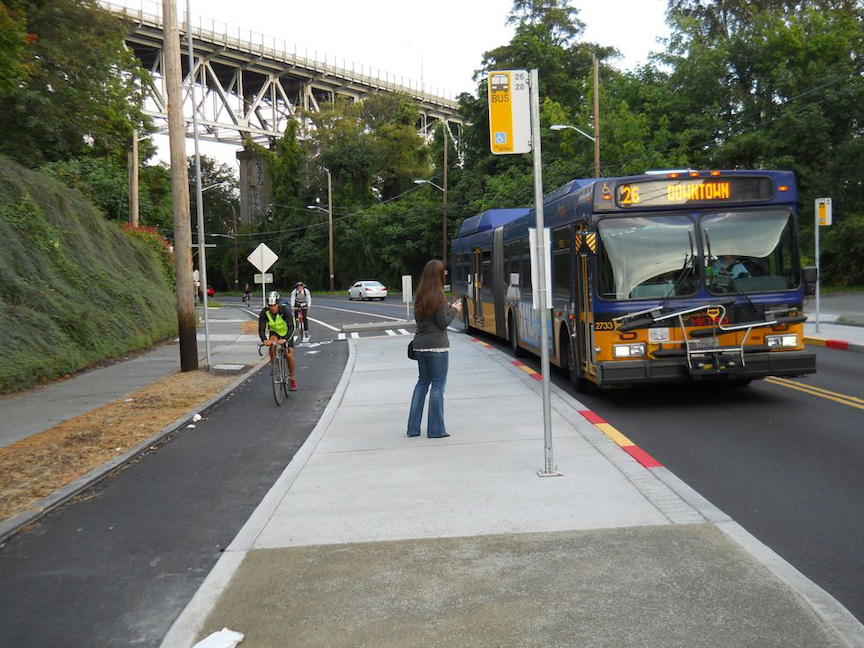
So, what is the solution? Bus boarding islands, which have been implemented in many cities. The first photo below is from Seattle. Riders have an large area to wait for the bus, the bus ramp is easy to deploy, and there is a safe crossing to the sidewalk at the end of the island. A slight disadvantage for the rider is that they must ramp down off the island and then back up to the sidewalk.
Seattle bus boarding island (from NACTO)
The diagram shows an alternative configuration, where the bikeway humps up over the crosswalk, but the route from platform to sidewalk for bus riders is level. This is probably safer for both riders and bicyclists.
diagram of bus boarding island with level crosswalk (from Vision Zero Network)
There are two significant challenges for these bus boarding islands. First is that installing them may require addressing drainage, which can greatly increase the cost of the installation. If three of the five bus stop photos, you can see drainage inlets, so this would be an issue on J Street.
The second is that by placing the bus boarding island where the bus stop now is, buses then stop in the travel lane rather than pulling out into the bus stop. The positive of this is that they don’t then have to negotiate their way back into traffic, which can be challenging and lead to significant delays to the bus schedule. The negative is that private vehicle drivers will complain about the slight delay to their drive from having to wait behind the bus. The convenience and safety for the many people on the bus outweighs the slight inconvenience for private vehicle drivers, but there will be complaints. Timed points on the route, where the bus would stop to wait if it is ahead of schedule, should not be in the travel lane, but that is not true for any of these stops.
To solve the boarding issue on J Street would take a cooperative project with SacRT and the city, and funding from both sides. The number of bus stops should be reduced, probably to three, so that fewer bus boarding islands are needed. This should be carefully planned so that they don’t need to be changed. It is possible to install temporary bus islands, as Oakland and other cities have done in a few places, so if the stop doesn’t turn out to be the best location, it can be moved without great expense.


 Getting Around Sacramento