14 foot lanes

There has been a discussion on the Association for Pedestrian and Bicyclist Professionals (APBP) listserv for the last two weeks on what to do with an outside lane of 14 feet (without on-street parking), particularly when there is a seam between the asphalt pavement and the gutter pan. Several people encouraged the use of narrow, substandard bike lanes in an effort to get something on the street, rather than using sharrows in the wide lane, or just leaving the lane unmarked. I believe we need to be very careful to not create “bike lanes at any cost,” and to carefully consider the actual roadway conditions before specifying anything that does not meet or exceed standards. The diagrams below are from the NACTO Urban Bikeway Design Guide. The first shows a high quality bike lane adjacent to a curb; the second one shows sharrows rather than a bike lane where there is not sufficient roadways width.

bike lane adjacent to curb (right side): NACTO Urban Bikeway Design Guide
shared lane markings adjacent to curb (left side); NACTO Urban Bikeway Design Guide

Read More »

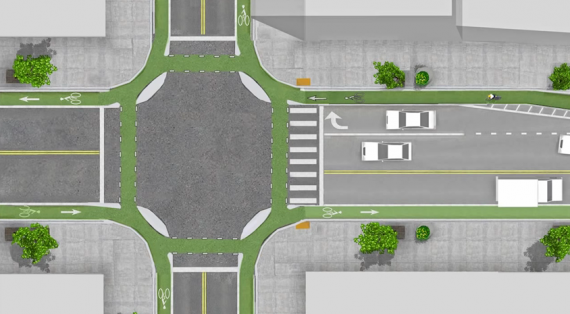
Protected Intersections

When I posted on the North 12th Street Complete Street Project, I expressed concern about how the  cycle track to the north would transition to the bike lane to the south, and how bicyclists northbound would access the cycle track. On Wednesday I attended the project open house at City Hall. Preliminary designs presented by the contractor Echelon Transportation Group indicate one possible design for the intersection of 12th Street and C Street, a protected intersection. These conceptual design drawings are not yet available on the North 12th website, so I don’t have a drawing to share here. Comments from the open house and online will be used to revise the concepts, and they should then be available on the website for further review and comment.

The protected intersection is a design new to the United States, and so far not built anywhere in its entirety. The design is fairly common in bicycling friendly countries in Europe. The Protected Intersections for Bicyclists website provides a great video showing how the design works by providing a higher level of safety for bicyclists and pedestrians without much impact on motor vehicles. The design has not yet been included in the NACTO Urban Bikeway Design Guide, but I would guess it soon will be.

protected intersection

The diagram at right shows the general outline of a protected intersection. The intersection at 12th and C would look like the right half of the diagram on the west side, with the almond shaped corner medians, but would not look like the left half on the east side. Bicyclists heading south out of the cycle track would either continue south in the bike lane or use the protected intersection to turn east and then continue south on lower traffic streets. Bicyclists coming from the east would use the protected intersection to get to the west side and the cycle track.

At the other end of the bike lane

bike-lane-symbol-farI have long wondered why so many people ride the wrong way in bike lanes. The common label for these bicyclists is “salmon,” probably from Portland, signifying they are swimming upstream against the current. Good for spawning salmon (and bears), bad for bicyclists. There are some evident reasons for wrong-way riding:

  1. The completely wrong but common misunderstanding that bicyclists should ride facing traffic. The origin of this is the “walk facing traffic if there is no sidewalk” rule. It doesn’t apply to bikes, but when teaching bicyclist education to youth, I often hear them mention this as something their parents have taught them. In fact, riding the wrong way is the most common bicyclist-caused source of crashes, though these are usually injury crashes and not fatal crashes.
  2. One way streets make it difficult to get where you are going, so many people ride the wrong way to get where they are going. Understandable, but wrong.

I’ve recently come to realize, however, that the common bike lane design fails to discourage wrong-way riding by not marking the end of the bike lane with a direction. The beginning, departing an intersection, is marked with the bicycle symbol and arrow, but the end, approaching an intersection is not. So a person entering the bike lane does not immediately realize they are going the wrong way. Once they do realize it, I think they often just continue along their way rather than changing course to ride with traffic.

The solution? Mark bike lanes at both the beginning and end. That way a person going the wrong way immediately sees that they are going the wrong way.

What is the downside? There may be some confusion induced between the dashed line message, which is that this is a merge area for the regular lane and the bike lane, and the bike lane symbol, which seems to indicate that the exclusive bike lane continues. I don’t see this as a stopper, but it is an issue to be addressed. It is possible that a different variation of the pavement marking could be used, but another symbol is probably not what is needed.

what to do with recovered street width

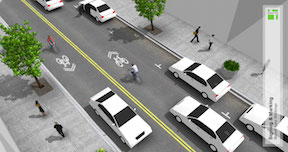
When 3-lane streets are narrowed to 2-lane streets, street width is recovered for other uses. Traffic lanes are commonly 12 feet wide, though they can be as narrow as 9 feet and as wide as 14 feet or more. Most streets in the downtown/midtown area that I’ve recommended for narrowing are really five lanes wide, three traffic lanes plus two parking lanes. Eight ways in which this recovered right-of-way width can be used:

  1. Widen sidewalks: In some areas, sidewalks are too narrow to carry the number of walkers using them. For example, on 16th Street between P Street and O Street, the sidewalk is much too narrow to handle the foot traffic. There are six businesses on the east side of the street: Pronto by Paesano’s and the associated Uncle Vito’s Pizza, Super Cuts, Nishki Sushi, and Starbucks, plus a storefront that is being refurbished to be Thai Canteen. These generate a lot of customers on foot and on bike, and the narrow sidewalk is frequently crowded.
  2. Add sidewalk buffers: In cases where the sidewalk is immediately adjacent to the street, or a there is a buffer but it is too narrow, width can be devoted to these buffers. Sidewalks with buffers are called detached sidewalks. These may not appropriate in commercial areas because the isolated high-turnover parking from the sidewalk, but are completely appropriate in residential areas and may be in mixed areas.
  3. Add bicycle lanes: Bicycle lanes take up five feet of width if adjacent to the curb, and six feet if adjacent to parking. (AASHTO standards are a minimum of four and five, but these widths are unsafe.) Normally a street will have bike lanes on both side, so two bike lanes will take about the same space as one traffic lane. If we were to otherwise leave the street system as it is, with high speed one-way streets, the protection of bike lanes is critical to making downtown/midtown more bikeable. However, if the recommendations I have made were implemented, streets would move more slowly with lower volumes of traffic, and bike lanes would be less necessary.
  4. Add protected bike lanes: A protected bike lane (cycle track) is a protected bike way, with some sort of physical protection from motor vehicle traffic. The protection can be a painted no-vehicle area, hit posts, curbs, parked cars, or a surface raised to a level between the roadway and the sidewalk. Because the protection takes up space, in many situations only a single protected bike lane can be gained from the removal on one traffic lane.
  5. Add dedicated transit lanes: Bus routes on streets with heavy traffic are often slowed by congestion and by turning vehicles. Both bus and light rail can be sped up by removing some of the conflict with dedicated transit lanes. Long distance dedicated lanes can be used to create bus rapid transit routes, but short segments of lanes can be useful for solving spot congestion problems. If light rail and buses run more freely, transit times are reduced and people will be more likely to choose transit over privately owned vehicles. It is not clear to me at the moment whether any of the 3-lane streets are logical locations for dedicated transit lanes, but I will look at this in the future.
  6. Create wide medians: Medians can be created along the middle of the street, separating the two travel directions. These medians can have plantings, artwork, rainwater basins, sitting areas, and a number of other amenities that may be absent along the street. These parkways or boulevards are probably not appropriate in commercial areas, but would be in residential or mixed areas.
  7. Convert from parallel to diagonal parking: Conversion from parallel parking to diagonal parking (60 degree reverse angled parking) uses up about 8 feet of street width, and roughly doubles the amount of parking. Because parking takes more of the street width, it is even more important to consider curb extensions (bulbouts) to increase pedestrian – driver visibility at intersections and mid-block crossings.
  8. Create center turn lanes: If the street is also being converted from one-way to two-way, the center lane can become a turn lane. I think that this is the least useful of the solutions because it serves a single and not very common need, left turns, with an entire dedicated lane. If the traffic on a street is so heavy that it is difficult to make left turns, a left turn pocket or a block-long center turn lane can be provided every four to eight blocks, but having a continuous lane is just a waste of precious right-of-way.

Certainly not every solution is right for every situation, and each roadway segment should be analyzed to determine the best overall use of the width recovered from 3-lane to 2-lane conversion.

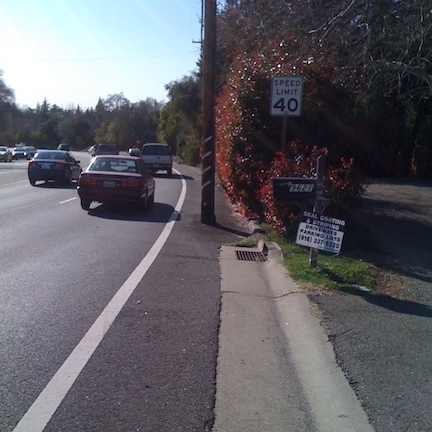
Utility pole in the bike lane

Note: I have moved this post here from my personal blog, since it fits better here, and it is the post that got me started on this blog.

The photos are of a bike lane with a utility pole in the middle of it. This is Fair Oaks Blvd westbound, just west of New York Ave, in the Carmichael area of Sacramento County. The first photo is from a distance, showing the clear bike lane markings. The second photo is closer, showing the pole dead (yes, DEAD) center in the bike lane.

I can think of a million irate things I’d like to say about this situation, but perhaps I’ll restrain myself and let the photos speak for themselves. I will say that, though this is the most egregious bike facility hazard I’ve seen in Sacramento County, it is far from the only.