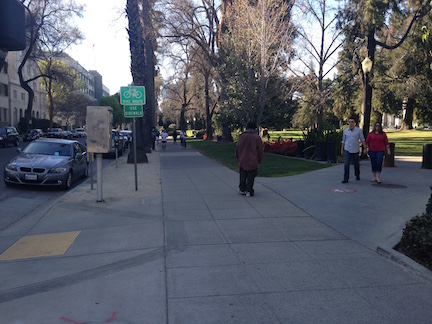
Broadway bicyclist press the button

Additional posts on Broadway Complete Streets are available at category ‘Broadway Complete Streets‘.

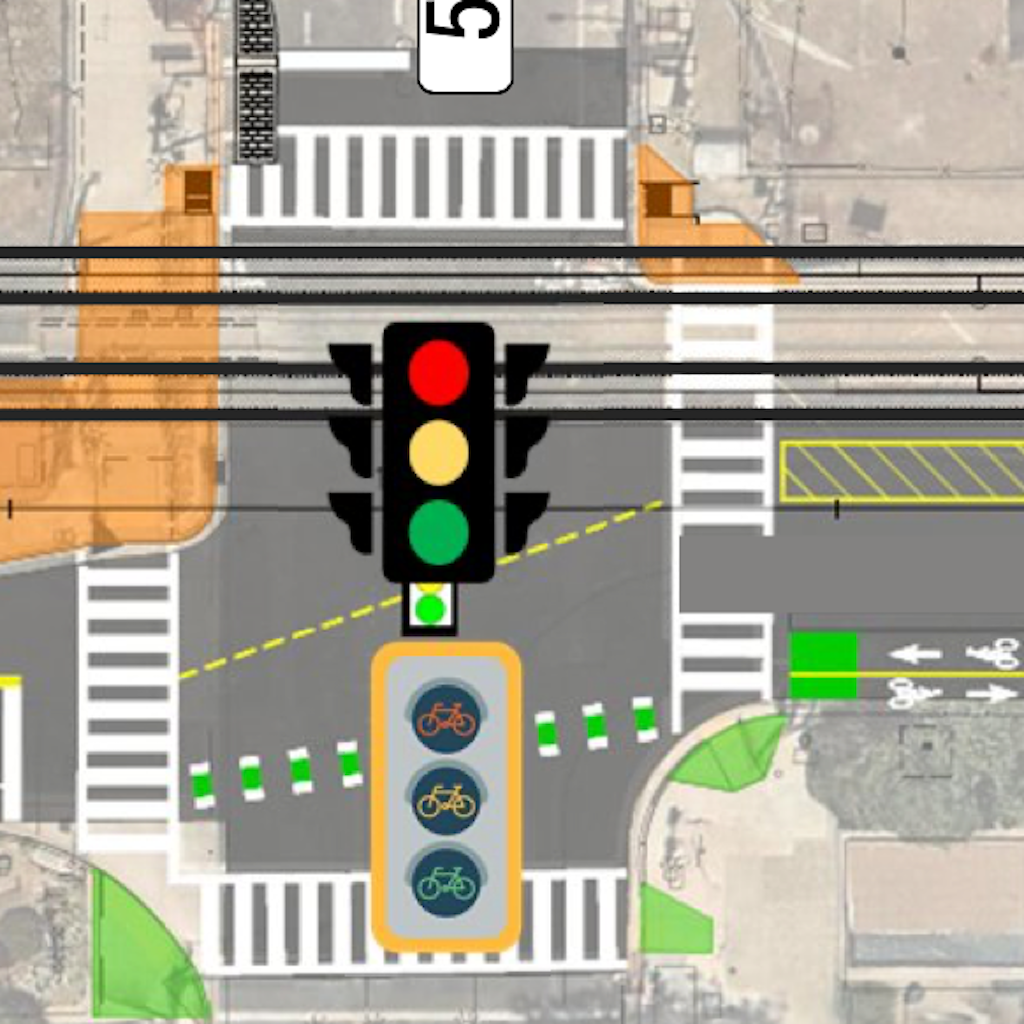
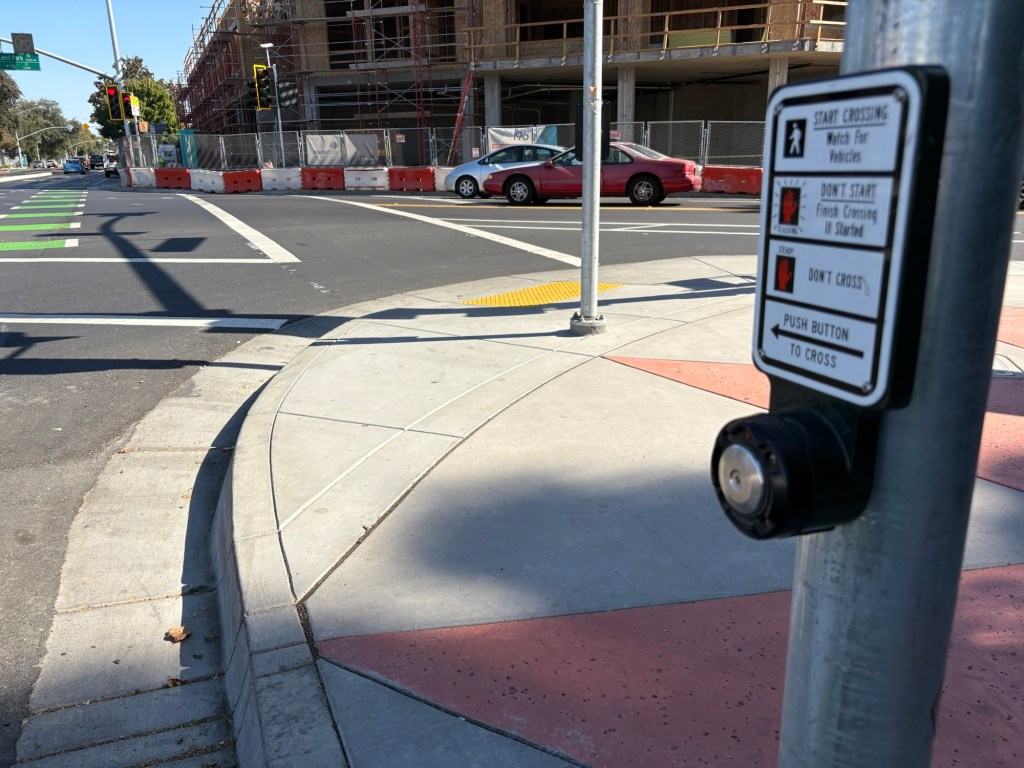
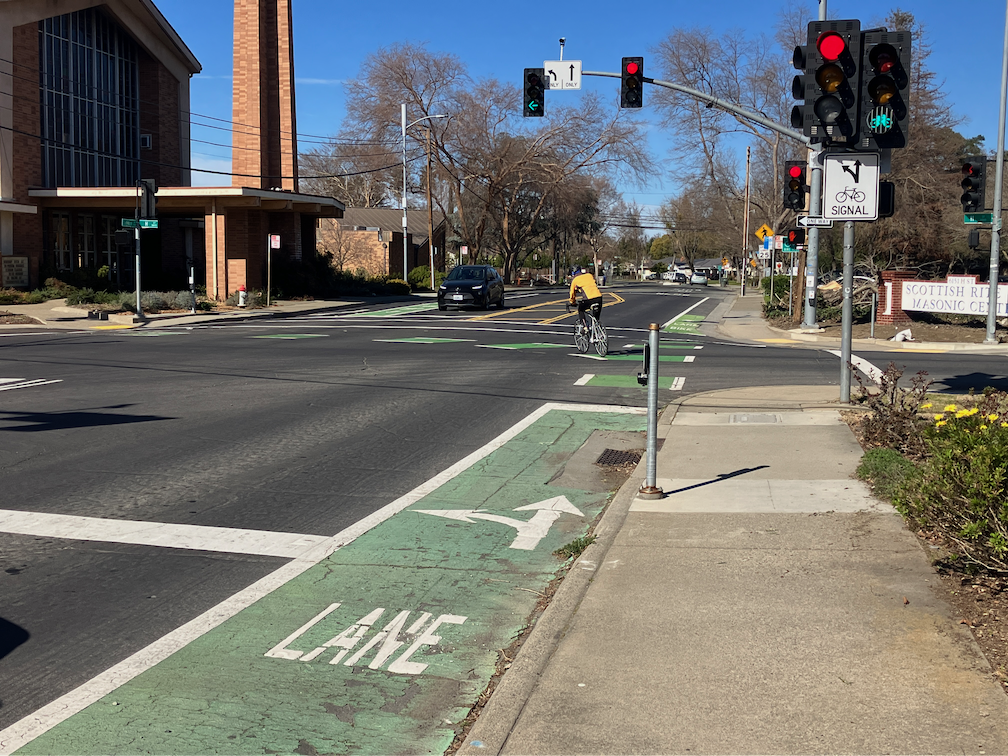
The bicycle signal face for Broadway eastbound at Land Park Drive/16th Street did not work for several weeks after it was turned on. Then it was ‘fixed’ so that it was part of every signal cycle. Now it has been further ‘fixed’ by the installation of a beg button which the bicyclist must press to trigger the bicycle signal. The beg button is the standard pedestrian button, it says nothing about bicyclists.

This signal should detect bicyclists and trigger the bicycle phase, without requiring any action by the bicyclist.

This is yet another example of the incompetence of city traffic engineers, who not only cannot design a signal that works properly, but will actively make things worse for bicyclists. Their concern is foremost, and only, with the free flow of motor vehicle traffic.

Bike signal for Broadway eastbound requires button push

dangerous bike signal on Broadway

Additional posts on Broadway Complete Streets are available at category ‘Broadway Complete Streets‘.

On Broadway eastbound at Land Park Drive, there is a bicycle signal face, shown below. The signal is permanently red, it never changes to green. The presence or absence of bicyclists makes no difference; it does not change from red. This is confusing both motor vehicle drivers and bicyclists. Bicyclists wait for it to change, and it never does. Drivers wonder why bicyclists are proceeded along Broadway with the green ‘car’ light when the signal clearly says that they should not be proceeding. I have seen drivers yelling at bicyclists for going when it is not their turn, and this has been reported to me by a number of people.

This issue has been reported to the city, twice by myself, and multiple times by other people. It has been this way for at least two weeks, perhaps longer. The city has decided to ignore these reports and to not fix the issue. The city is endangering bicyclists, and is in fact legally liable for knowing that a safety hazard exists and doing nothing to respond. This is criminal behavior on the part of the city. Sorry to be so blunt, but when city employees, or contractors acting on behalf of the city, ignore a known and easily solvable safety problem, that is criminal behavior. Period.

This would be so easy for the city to temporarily solve, by covering the bicycle signal face so that it is not visible. The pedestrian crossing sign over Broadway at the east side of the intersection is covered, due to the construction on the corner closing the crosswalk. Beyond a temporary fix, the city needs to determine why the bicycle signal face is not working, and make it work.

Broadway Complete Streets update

This is the eighth post (I think) on the Broadway Complete Streets project. Additional posts on Broadway Complete Streets are available at category ‘Broadway Complete Streets‘.

The long-line striping on Broadway is essentially complete, with the addition of yellow lines for center dividers and the center turn lane. There is still no green paint for bicycle facilities, and the shared transit/bike areas. None of the crosswalks have been installed. This lack of attention to crosswalks is typical of the entire project, motor vehicles first, sidewalks last and walkers crossing last.

Broadway at 3rd St striping

The short curb-separated bikeway eastbound between 15th Street and 16th Street was closed yesterday, though I had used it a few days earlier. I noticed a bicycle signal on Broadway at 16th Street / Land Park Drive, which may have not been there before or may not have been activated and so I didn’t notice it. In a short while of observing, it did not change to green, so perhaps it is awaiting completion of the curb-separated bikeway.

Broadway at 16th St / Land Park Dr, eastbound, bicycle signal

I continue to have concerns about the RRFBs (rectangular rapid flashing beacon) used for several crosswalks along Broadway. The one in the photo below seemed to be stuck on, for unknown reasons. The rate of driver yielding to people crossing is very low. An observer pointed out that because RRFBs are not common in Sacramento, drivers may not know how to deal with them, and that this would be a perfect time for a city educational effort to bring drivers up to speed (so to speak). The particular location shown below, Broadway at 22nd, has a median island in the center, preventing drivers from passing stopped motor vehicles by using the center turn lane. Other locations do not have this protection, and I observed at least one instance of a driver passing a stopped vehicle by using the center turn lane at Broadway and 18th Street. Reduced general purpose lanes, from two per direction to one per direction, do significantly reduce the multi-lane threat, where one vehicle stops and others do not, but the center turn lane allows drivers to continue to threaten walkers, and to violate the law.

Broadway at 22nd Str, RRFB and walker

As recently as the Broadway Fact Sheet in 2019, conversion of 16th Street between Broadway and X Street from one-way to two-way was part of the project. I’ve seen no evidence of work on that part, so it may have been delayed or may have been dropped. Also, work on Broadway between 19th Street and 21st Street has been delayed to another phase due to prolonged negotiation with Union Pacific over whether there will be one or two traffic lanes per direction approaching the railroad tracks between 19th Street and 20th Street.

I’ll post again when green paint has been installed, and the crosswalks completed.

where the bike lane ends – update

This is Central City Mobility Project update #11.

On Wednesday afternoon, the sign below was on 21st Street approaching I Street. The sign was not there on Tuesday morning. If a bicycle signal was intended at this intersection in the design, why was it not signed earlier? Why wasn’t the signal already installed, since there was signal communications infrastructure installed at this intersection several weeks ago? Or was this a design oversight that the city decided to fix after being called out on it? And when is ‘coming soon’?

21st St at I St, sign for future bicycle signal

I observed bicyclist behavior at this location for a while on Tuesday. Every single bicyclist who was headed north on 21st Street crossed against the red light, so as to not be hit by left turning drivers who generally do not yield to anyone in the crosswalk, and then onto the sidewalk on the west side of the street, continuing through the area at Old Soul Weatherstone which is congested with tables and walkers. So the city has trained bicyclist to ride on the sidewalk. Those who have been so trained will be likely to continue sidewalk riding even after installation of the signal. Ouch!

Useless Turn Wedges

I have ridden 21st Street a number of times, to see how the project is progressing and to see how drivers are responding to the new layout. Most drivers are parking correctly in the parking that provides parking-protection for the bikeway, but a few continue to park against the curb. I’ve reported these to 311 for parking enforcement, but of course as always, parking enforcement reports that the vehicle is no longer there, whether it is or not.

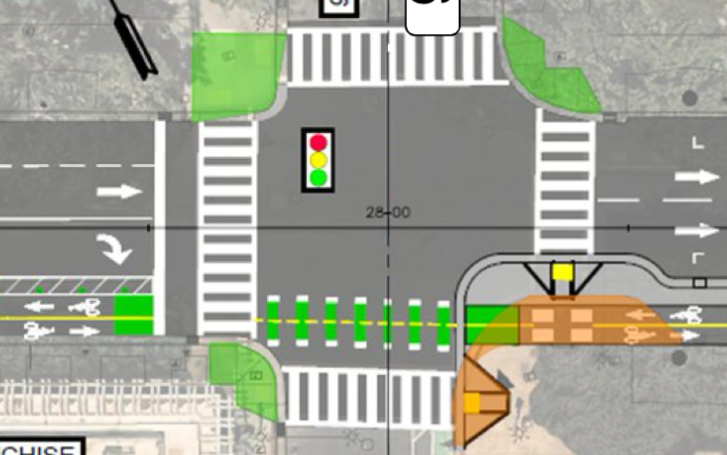
Several times in a row drivers have turned across my path at high speed, left from 21st Street to L Street, over the green paint and the white turn wedge paint. At the times of day I was there, there were few to no parked cars, so I was clearly visible to the drivers, not in any way hidden. In both cases I had to slam on my brakes to avoid being hit by the drivers. They did not slow. The turn wedge diagram provided on the Central City Mobility Project page, shown below, clearly shows bumps and posts (vertical delineators) in the wedge. Without more detail, I can’t say whether these will actually affect driver behavior, but in general only hard curbs or real bollards (steel or concrete) actually affect driver behavior. In the meanwhile, drivers are being trained to turn across bicyclists, with impunity, and will not likely change their behavior when and if something is installed in the turn wedges.

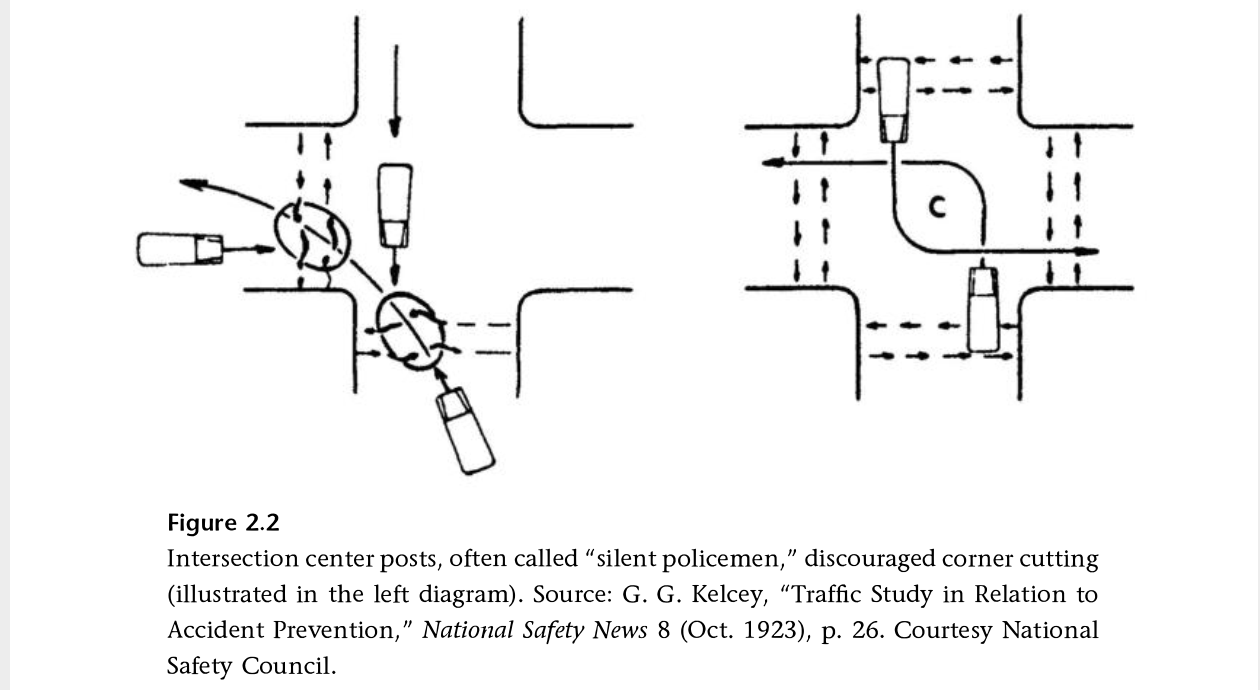
I have been reading Fighting Traffic by Peter Norton, and in Chapter 2 he introduces the concept of the outside left turn, which worked to prevent drivers from cutting the corner on left turns, and was later enforced with ‘silent policemen’, hard structures that provided serious consequences for drivers who insisted on cutting corners. Later, when motor vehicles were given dominance on the roadway, these were removed. It is time to bring these back!

Other

Striping and green paint is very nearly complete on 21st Street. 19th Street has been repaved and preliminary marking installed (the dashed white lines). P Street was just stripped for new pavement (I’m not sure what this process is called, removing 2 to 3 inches of old pavement so that new pavement can be laid), and is being repaved today (Thursday). Q Street has been patched but not stripped. I’m not noticing any active work on I Street, 5th Street, 9th Street, or 10th Street, though I Street has had ‘no parking’ signs up for some while.

The repaving is being done to the full width of the roadway, including the parking lane. This is a waste of materials and money. The parking lane does not need to be repaved, except in a few circumstances where it has been damaged. Nor does it need to be paved to the same standards as the general purpose travel lanes, which receive far more traffic and wear and tear. But the city loves pavement, and loves to add on unnecessary work to projects, ensuring that less is left for actual improvements to the street that would help walkers and bicyclists.

SacCity street design for bicycles and shared mobility

Part of an ongoing series of posts to support better streets in the City of Sacramento during their 2023 update of Street Design Standards. New standards must be innovative, safe, and equitable, and it will take strong citizen involvement and advocacy to make them so. See also separated bikeways and bus routes, sidewalk-level bikeways, and bike lane widths.

  • Bicycle facilities will be provided within 1/4 mile of every origin/destination
  • Regular bike lanes (Class 2) may only be used where design and posted speeds are 30 mph or less
  • Separated bikeways (Class 4) will:
    • be used for design and posted speeds above 30 mph
    • have a minimum width of 8 feet, to accommodate passing and wider devices
    • use hard curb protection where parking protection is not available, or parking utilization is low
  • Signals
    • Bicycle signals will be used as necessary to ensure safe crossing of intersections, appropriate priority for bicyclists, and safe transitions to and from separated bikeways
    • Signals at intersections will detect bicyclists in any lane
    • Streets that host large volumes of bicyclists in general purpose lanes or bike lanes will have signal timing for a green wave, accommodating bicyclist speeds of 12-15 mph and slowing motor vehicle traffic
  • Parking
    • Parking for shared mobility devices will be provided in sufficient quantity on wide sidewalks (over 8 feet) or in the street
    • On-demand bicycle parking (BikeLink or equivalent) will be provided at locations where bikes are commonly parked for more than two hours
    • The city will work closely with transit agencies to ensure that bus stops with significant bicycling first mile/last mile have sufficient bike parking
  • Transit
    • All bus routes with 30 minute frequency or better will have bus boarding islands with bike lanes or separated bikeways passing behind the island; shared bus/bike lanes will only be used to distances of not more than one block, in order to solve right-of-way issues
  • Streets that provide long distance travel on with low volume and low speed motor vehicle traffic will be designated as bike boulevards, with appropriate marking, signing, and traffic calming treatment
  • Shared mobility will be managed and/or owned by the city or transit agency with sufficient control to ensure social and transportation objectives, and stability

Design diagrams will include:

  • Bike lanes (Class 2)
  • Separated bikeways (Class 4)
  • Bike boulevards
  • Contra-flow and two-way cycletracks, for use where safe bicycle facilities are not 
  • available on an immediately parallel street
  • Sidewalk level bike facilities
  • Bicycle signal faces
  • Bicycle detection at signalized intersections
  • bus boarding islands

bike left turn Carlson Dr to H St

I was at a meeting last evening with transportation advocates when the subject of the turn left from Carlson Drive to H Street came up. Most people expressed discomfort about this turn, and most of the people were also experienced and skilled bicyclists. They felt that left turning motor vehicles, which go at the same time as left turning bicyclists, would encroach on the dashed green lane and hit bicyclists. They were also uncomfortable turning across the straight through lane, as they had seen people run this red light. This is a critical intersection and area for bicyclists, as it is one of four main routes onto and off the Sacramento State campus for bicyclists.

So today I went to take a look. I have not written about this intersection before, but two articles are of interest: SABA https://sacbike.org/carlson-corridor/ and City of Sacramento https://www.cityofsacramento.org/Public-Works/Engineering-Services/Projects/Completed-Projects/Carlson-Drive-Improvements.

So far as I know, this was the first use of green paint, and the first use of a bicycle signal head in the city. The installation was intended to be innovative, and it was, for its time, in Sacramento, but it hasn’t stood up to the test of time.

Here is what it looks like from above. As you can see, it is a complicated intersection with several features intended to ease and speed motor vehicles. The city attempted to make the intersection safer without really changing it at all, beyond the green paint. Green paint helps communicate, but it does not protect in any way, and it has no legal meaning under California Vehicle Code or city code.

Carlson Dr - H St intersection aerial
Carlson Dr – H St intersection aerial

The two photos below show the setting of the left turn. The bicycle lane on the right side of the street leads to a dashed (skip) green lane turning through the intersection. The bike lane stop line is somewhat in front of the motor vehicle stop line, and there is a button to trigger the bicycle signal. The bicycle signal face is mounted to the right of the motor vehicle signal face, and there are two, before the intersection and on the far side.

bicyclist pressing the button to trigger the bicycle signal
bicyclist turning left from Carlson to H St; bicycle signal face green

I was there at a low traffic (motor vehicles and bicyclists) time of day and was unable to capture a bicyclist and motor vehicle adjacent to each other on the turn.

I have to say that I was not uncomfortable with the left hand turn. I’m a strong bicyclist and good at anticipating and mitigating for driver misbehavior. But I’m not the person bicycle facilities should be designed and built for. They need to be comfortable and legible (understandable) for any bicyclist, of any age and skill level, including Sac State students who seem to be the majority of the bicyclists here. This left turn is not.

There has been only one reported bicyclist injury crashes at this intersection since the green paint was put in (as of December 2020), and one in the 6-1/2 years before, so it is not a high injury intersection. But intersections like this discourage bicyclists, and so fewer people are willing to bicycle here. The poor quality of most of the access points to the Sac State campus probably in large part explains why the school has a much lower bicycling rate than most universities.

I don’t have a ready solution for fixing this intersection so that it is safe and comfortable (low stress) for bicyclists. But I do believe it is the city’s responsibility to study it, design a safe and welcoming intersection, and install it.

N Street bike route to cycle track

Unknown, or unnoticed, by many people, there is a bike route along N Street on the sidewalks. The route is well-signed from 8th St, where it crosses over from the south side to the north side of N Street, to 12th Street. The route extends east along Capitol Park to 15th Street, and I believe it also extends west to 3rd Street, though it is not well signed at these ends. On the City of Sacramento bikeways map, the route is shown on both sides of N Street, as “Existing Off-street (wide sidewalk).”

The bike route allows bi-directional travel along N Street, which would otherwise not be possible. The city has recognized that N Street is a significant barrier to east-west bicycling.

Read More »