barricades

An article in the MinnPost makes me very happy, and engenders thoughts of what citizen action could do on the streets of Sacramento.

In occupied Minneapolis, neighborhood barricades rightly slow injustice, MinnPost, 2026-02-11

Here upon these stones
We will build our barricade
In the heart of the city
We claim as our own!
Each man to his duty
And don’t be afraid.

Les Miserables, Upon These Stones (At the Barricade)

Though nothing currently happening in Sacramento rises to the level of government initiated violence and oppression in Minneapolis, it is true that motor vehicle hegemony here creates a hostile city for people who walk and bicycle. Law enforcement, both CHP and SacPD, are either supportive of this hegemony, or indifferent to its effects.

There are parts of the city government trying to change this, but the cultural norm is still an acceptance and celebration of car dominance. It is not just the people killed and injured, but the intimidation of walkers and bicyclists that denies them their right to the city, and to the streets of the city.

Is it time for citizens to rise up, and erect barricades?
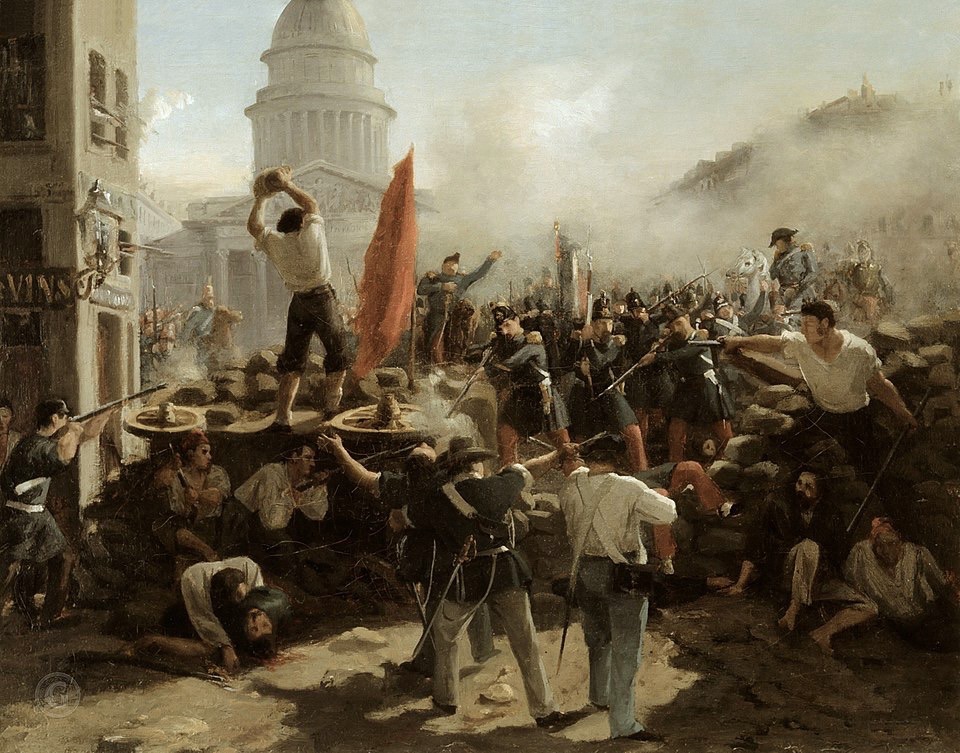
Horace Vernet: On the barricades on the Rue Soufflot

SacCity work zone barricades and audible

I’ve spent more time looking at the 2023 MUTCD, Part 6, Temporary Traffic Control. The document is a bit convoluted, and I didn’t realize there were references in several locations, which taken together though not separately, provide better guidance for sidewalk barricades.

Figure 6K-2 provides a diagram for ‘pedestrian channelizing device’. The example is for the side of a temporary walkway, shown curved (though Figure 6P-29 shows right angles).

diagram of MUTCD-2023 Figure 6K-2 pedestrian channelizing device
MUTCD-2023 Figure 6K-2 pedestrian channelizing device

In a separate location, the notes page for Figure 6P-29, the text reads, Standard 1 “When existing pedestrian facilities are disrupted, closed, or relocated in a TTC zone, the temporary facilities shall be detectable and include accessibility features consistent with the features present in the existing pedestrian facility. A pedestrian channelizing device (see Figure 6K-2) that is detectable by a person with a vision disability traveling with the aid of a long cane shall be placed across the full width of the closed sidewalk.” The same channelizing device can be used as a barricade to close sidewalks. Imagine the left-most panel in the diagram, extending across the width of the sidewalk. I think that the three examples I used in my previous post (SacCity work zone comments) would be compliant, though I am not certain.

Audible Warning

Another item of critical importance, that I did not initially pick up on, is the new requirement for audible warning: Notes for Figure 6P-28, Standard 5 (page 914): “SIDEWALK CLOSED CROSS HERE signs shall include audible information devices to provide adequate communication to pedestrians with vision disabilities.” The ‘sidewalk closed cross here’ sign is MUTCD R9-11a, which is the advance warning, used at the last available crosswalk.