An article today in the Sacramento Bee is about two traffic fatalities on Freeport Blvd, but also does an excellent job of summarizing the city’s lack of general fund investment and action street safety, and over-dependence on long-term grant funded projects. Yay, Ariane Lange for the excellent reporting on roadway safety and solutions, and the real people who are the victims of poorly designed roadways and traffic violence.
The city’s solution to fatalities and severe injuries on our our streets has been the Vision Zero effort and Vision Zero Action Plan (2018), and related documents. This resulting in a focus of grant applications on corridors with a high level of traffic violence, the high-injury corridors. For more posts on Vision Zero, see tag: Vision Zero. What has not occurred since 2018 is a significant increase of city general funds to address traffic safety. Since that time, Sacramento Police Department has largely ceased traffic enforcement, while their budget has continually increased, though there are strong safety benefits for people of color in that reduction of enforcement which tends to be pretextual and biased.
The city council has repeatedly suggested allocation of some general funds to traffic safety and fixing roadways, but City Manager Howard Chan, and perhaps Public Works, has resisted this. With the departure of Chan, this may change (more to come on that). The city has no program for quick-build projects, though a few have happened. The city’s transportation budget goes to pavement maintenance (which is a good thing, as your roadways are in poor condition for everyone), new capacity expansion, and grant matches. Almost none goes to quick-build solutions.
I am not suggested dropping the approach of grant applications for big projects, as those long-term projects are important. What I am suggesting, and the SacBee supports, is investment in fixing some of the worst roadway designs, now rather than someday.
It is likely that council member Caity Maple, along with Mayor Darryl Steinberg and council member Karina Talamantes, will introduce an emergency declaration on traffic safety at the city council meeting tonight, starting at 5:00 PM. The item is not on the agenda, so I presume it will be introduced during the ‘Council Comments-Ideas, Questions’ part of the agenda, after all the numbered agenda items. Council members get their ‘matters not on the agenda’ time, just like the public does. None of the advocates I have asked have a clear picture of how emergency declarations work. I presume the idea will come back to council one to many times in the near future, but tonight is your first chance to hear what the council has to say and comment on the ideas.
Caity Maple has posted about the recent injury (now fatality) and the emergency response she wants the city to take:
I’m devastated to see yet another person critically injured after being struck by a vehicle on Sacramento’s roads. Even beyond our City’s commitments to eliminate traffic deaths through Vision Zero, we need to take immediate and urgent action. This coming Tuesday, alongside my colleagues Mayor Darrell Steinberg and Mayor Pro Tem Karina Talamantes, I will be introducing a proposal that:
Declares a state of emergency for the City of Sacramento regarding the road safety crisis
Directs the City Manager to identify funding for a public education campaign focused on driver education, pedestrian/ bicyclist awareness, and traffic safety
Directs the City Manager to work with SacPD to ramp up enforcement of traffic laws that protect pedestrians, including speed limit enforcement, crosswalk violations, and distracted driving, especially in high-injury corridors
Reaffirms our commitment to Vision Zero and directs staff to expedite safety projects
I posted to Instagram about this, but it deserves amplification. “The Sacramento Bee had an article today that provided in-depth information about the death of a person crossing San Juan Rd in North Natomas. It included information about the dangerous roadway and lack of crosswalks and about the individual and family of the person killed. This is the kind of crash reporting we need to raise awareness and get the city to allocate resources to save lives.”
intersection of San Juan Rd and Airport Rd in North Natomas, Sacramento
I have worked off and on doing bicyclist education in North Natomas, and therefore crossed through this intersection many times, mostly bicycling but occasionally walking. It is not a safe intersection, for anyone.
Walking
The lack of crosswalks is obvious. The posted speed limit is 40 mph, but common practice and the design of the road sets that as a minimum rather than maximum. Knowing that this is a dangerous situation, the city has cross-hatched out the area from Azevado Drive to Airport Road on the north side, narrowing the roadway to one lane, but drivers routinely use this area for both travel and turning. Westbound drivers coming down off the overpass over I-80 accelerate to 60 mph. People walk across San Juan here. The city has decided to leave them to fate, and in this case the fate was death. A crosswalk without any additional protection would not be appropriate given the high speed traffic. It would require, at the least, a RRFB (rectangular rapid flashing beacon), which is a sign with flashing lights activated by the person wanting to cross. But given actual speed, it probably would need additional protection. Fixing poorly designed roadways is expensive, but so are lives.
There is a crosswalk over Airport Road, but given the wide-open design of the intersection, it is meaningless. Drivers turning from San Juan Road are unlikely to notice it. Drivers southbound on Airport Road generally stop over or beyond the crosswalk, because they need the visibility, and as much head start on the dangerous turn as possible. I know this from extensive observation.
Bicycling
Some people would say “but it has bike lanes”. Not really. Eastbound, motor vehicles turning onto Airport Road cross over the bike lanes at many points, regardless of any paint on the ground. If a person stayed in the bike lane, they would be exposing themselves to high speed traffic for along distance. Hug the curb to be further from motor vehicles, or use the bike lane so that you are more visible? It is a devils choice, forced by road design. West of Airport Road, the bike lane is missing for a distance, implying to drivers that they have the right-of-way over bicyclists. Eastbound, the bike lane is mostly continuous, except for the intersection itself (why?), but it is full of debris from construction traffic and car parts. To my knowledge, the city has never swept this bike lane.
It is difficult many times of the day to turn east from Airport Road to San Juan Road. High speed traffic, high volume at certain times, does not slow in the least in this area, and there is no signing to indicate they should.
Regular Class 2 bike lanes should be illegal on roadways posted over 35 mph. This road was mis-designed from the beginning. I don’t know whether the city later added bike lanes, though it is probably so given all the striping on San Juan to the east. The bike lanes did not make it safer for bicyclists.
Journalism
News media in general does a very poor job of reporting on traffic crashes, particularly when the victim is a walker or bicyclist. The initial news item parrots the law enforcement statement. Unless waiting for ‘notification of family’, the victim’s name is given, but the driver’s name never is. This is a strange inversion of ‘innocent until proven guilty’, making the driver innocent and the victim guilty. As I have stated many times before, law enforcement personnel have no training in analyzing the ways in which roadway design contributes, if not causes, traffic crashes. But they have a lot of ideas, not based in any research or training, that they are too happy to relay. One that will ring home with bicyclists is the repeated phrase ‘they weren’t wearing a helmet’, as though wearing a helmet protects against being hit by a driver traveling over the speed limit (they almost all are) or well over the speed limit, as is likely in this case.
A good summary of the issue is by SafeTREC, Media Narratives of Pedestrian and Bicyclist-Involved Crashes. If you want more, simply search the Internet for ‘poor journalism on traffic crashes’ or similar terms. Angie Schmitt wrote an entire book, Right-of-Way, about this issue and others. What about the next reporting? There usually isn’t any. The incident is never mentioned again. Law enforcement contributes to this by making sure that the incident report is delayed for weeks or months after the crash. In California, there is the common practice of law enforcement claiming that incident reports can never be released to anyone but immediate family. This is no backed up by state law, but it is common practice. So even when the incident report is completed, the public is unlikely to ever know the facts of the crash. All the public ever knows is the untrained, biased speculation of the law enforcement officer on the scene. The cynic in me can only see this as an intention on the part of law enforcement to protect drives and keep the public in the dark about traffic violence.
So, it was a wonderful breath of fresh air to read the Sacramento Bee article by Ariane Lange: A father died crossing a dangerous Sacramento road. His 13-year-old son was watching. The article went into depth about the person who was killed, and his family. It looked at the dangerous design of the road, and the fact that the city rarely fixes dangerous roads except with state or federal grants, not its own money. It talked about Vision Zero and the high injury network, of which San Juan Road is one, though in part due to problems further east. It talks about the statistics for death at various vehicle speeds, including 50% death at 40 mph (though it is very unlikely the driver was going that slow).
Traffic violence is pervasive in Sacramento, with the highest rate of fatal crashes in the state. The usual media reporting glosses over this, basically selling the story that if it wasn’t someone you know, it wasn’t that important. But it is always important, and sooner or later it will be someone you know, or you. These are real people with real lives, and real families and friends, and their death leaves a huge hole, whether they are homeless or not.
Thank you, Ariane, for telling the real story behind the death.
The SacBee published an article yesterday: After a deadly crash, Sacramento fixed a dangerous road. Why isn’t this the norm? Apologies for linking to a firewalled article; if you have a subscription or access to a printed newspaper, it is well worth reading.The article is quite in-depth, more like the investigative reporting that the SacBee used to do, but rarely does any more. The author is Ariane Lange.
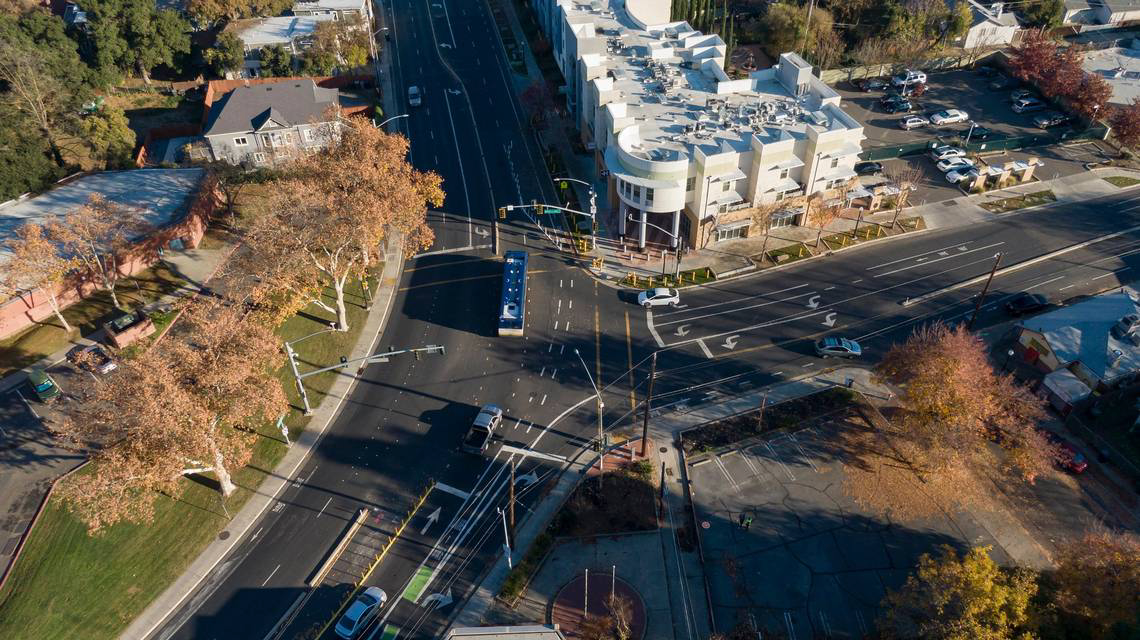
The article highlights changes made to the intersection of Broadway and Martin Luther King, Jr. Blvd (MLK) after a fatal crash single-vehicle crash in 2021. Though the article did not make clear, the driver was likely eastbound on Broadway and continued straight into the building. Google maps, below, does not show the changes, but a photo from the article does (second).
Broadway & MLK intersection, Google Maps (not up to date)Broadway & MLK, SacBee photo (more recent)Read More »