Sacramento disdains walkers

The City of Sacramento, both the city government and many people who live here, have a picture of a pretty good place to live, and work, and play. And that is true, to some degree. Good climate (except middle of summer), a wealth of trees, interesting and useful businesses (at least in midtown), mostly flat (for bicyclists), two rivers and the confluence, moderately friendly people. But the transportation network sucks.

Heavy rain of course brings out the flaws in the transportation system. Flooded roadways that at the least make it hard to get places, and at worst kill people. Trees and tree debris blocking both sidewalks and bike lanes. Light rail that runs late or not at all, buses behind schedule. All of those are important issues. But this post is about flooded ADA ramps.
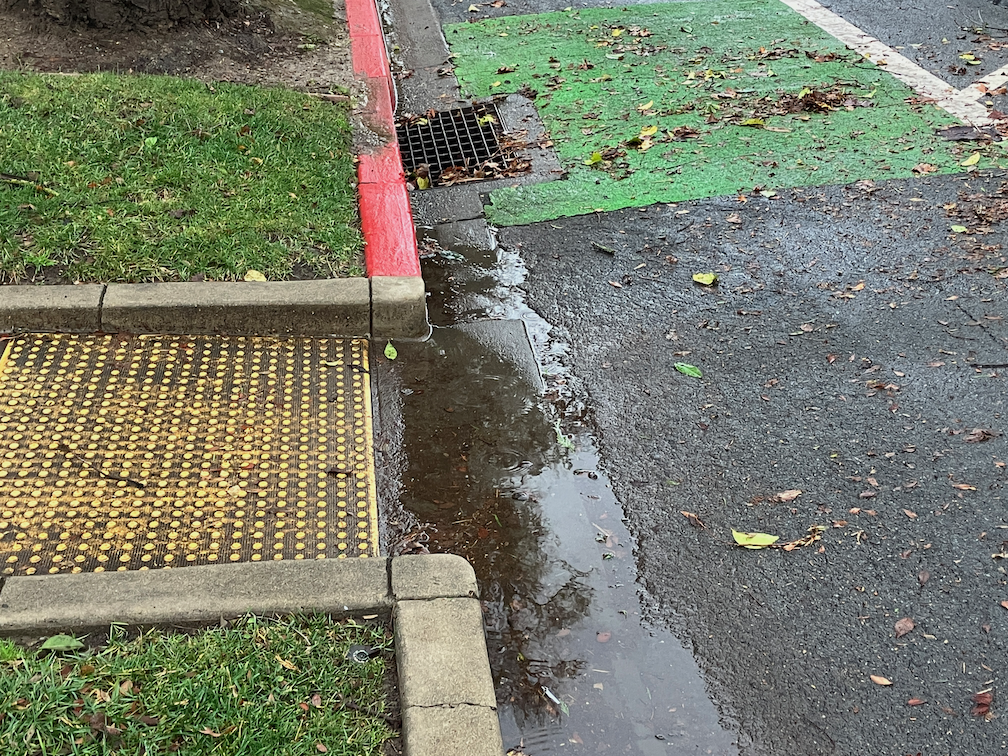
flooded ADA ramp, Q St at 13th St

The above photo is a mild case, as it does not make the ADA ramp and connecting sidewalks impassible. It just means wet feet for people who can’t jump the puddle, or wet wheels for people with mobility devices. You might think that this is a problem created by the storms. But look closer. The ADA ramp was built so that it is LOWER than the drain inlet. This puddle will remain until it evaporates, and if the rain continues, it will be there for quite some while. There are two explanations, and I don’t know which is correct. 1) The ramp and drain inlet was designed by an incompetent engineer; or 2) ramp and drain inlet were not built as designed, meaning that the construction inspector did not notice or did not care that it was not installed as designed. In either case, it is the fault of the city.

You might think that this is an unusual circumstance, but if you walk and notice, about half the ADA ramps in the city have this same problem. Why is this so common? Because the city doesn’t care. The engineer doesn’t care, or the inspector doesn’t care. Every one of these situations expresses the city’s disdain for walkers, and users of mobility devices.

I started with a mild example, but to present a much worse example:

flooded ADA ramp and sidewalk, 3rd St at O St

This puddle won’t disappear for at least a week, even without additional rain. This is not a problem of a plugged drain inlet. The ramp and sidewalk was designed to be BELOW the gutter level along the street.

I have reported this location multiple times to the city, over the years. It has never been fixed. When I submit a 311 report, it is marked as complete without anything being done. Which is not untypical for the city, most of my 311 reports are ignored, marked as complete without anything being done.

Does this bother you? Get in touch with your city council member, provide photos and stories about how this impacts you and the people you know. Ask council members to hold city staff responsible for their incompetence and lack of care. If the city manager can’t fix these problems, it is time for a new city manager. If Public Works can’t fix this problem, it is time for a new head of Public Works. Anything else is not acceptable.

Slow Transportation (part 1)

Recently I was emailing a friend about a Slow Food gathering, and facetiously used the term “slow transportation” for getting there by train rather than flying. But the more I thought about it, the more the term resonated with what I believe in and what I work on. I have not heard, so far as I’m aware, the term used anywhere else, but I think readers of this blog will immediately resonate with it as well. What follows is a first attempt to pin down a working definition of Slow Transportation.

I am going to break this topic up into several posts, but at the end I’ll make it available as a single document in case that is of use to you.

1. What is wrong with our present transportation system?

I am going to keep the list short and succinct because I think most readers of this blog will either already be aware of the issues, and/or will agree that these are the problems. Entire books have been written about each of these issues!

Note: Don’t be depressed by the list of problems below. I promise I won’t leave you there for long.

  • transportation accounts for a significant part of greenhouse gas emissions (37% in california, 26% in the US, and 14% worldwide) as is therefore a major driver of climate change
  • we have emphasized mobility over access, the ability to get somewhere – anywhere, rather than the ability to get to places we want to go; there is an incredible amount of aimless driving, just for something to do, running a small errand to take up time and fill an empty life; only about 15% of car trips these day have anything to do with commuting to work
  • the convenience and low cost of driving has encouraged the separation of functions, where we live, work, recreate and socialize, diminishing the value of each place; though this has started to reverse, we are so far down this road (literally) that it will be hard to bring these back together
  • privately owned motor vehicles isolate people rather than bring them together
  • traffic violence is inherent in a system based on private motor vehicles; even when people are not killed and injured by the drivers of motor vehicles, they are still intimidated out of the public space, knowing they are at risk there and are being actively discriminated against
  • our cities, counties and states are either already insolvent or on their way to insolvency, in part due to the fact that we do not have and cannot ever have enough money to maintain the transportation infrastructure we have already built; though roadways are the worst of this, it is also true to some degree of transit systems, and most certainly our air transport system
  • our current wars are in significant part about oil, oil wars; if you don’t think this is so, ponder the fact that the former head of Halliburton, an oil exploration and facilities company, got us into the Iraq war and Halliburton was the prime contractor for that war; it is not just the US with guilt and blood, most of the wars today are at least in part about oil
  • we transport our food long distances, disconnecting us from the source, the soil, and the people who grow it; industrial agriculture is both dependent on and a driver (literally) of our unsustainable transportation system; again, this is starting to reverse, but we have lost much of the smaller farmer and small processor capacity of our country, and it will take time to rebuild
  • the housing affordability crisis is in part due to a focus on housing costs without considering the transportation costs; the Center for Neighborhood Technology’s H+T calculations indicates that much of the current housing stock is unaffordable because it is located so far from jobs and amenities; it is not really the urban areas (so much in the news) where housing is unaffordable, since transportation costs there are so much lower, but the suburbs and exurbs
  • our transportation system takes up too much of our wealth, particularly in the preference for mega-projects like new bridges and freeways, and inattention to small projects that would have greater benefits; there are plenty of things we could be spending transportation money on instead; I dont’ want to minimize the value of transportation investments, but to ask that they have the a similar social return to other things we could spend on
  • our transportation system takes up too much of our space, not just with roadways and interchanges, but with parking garages and parking lots and on-street parking; as a result of all this space devoted to one mode of travel, the private vehicle, everything must be further apart, thereby requiring even more driving, in an ever-downward spiral
  • our transportation system both encourages and depends upon greenfield development, which leads directly to loss of wildlife habitat and agricultural lands; we already have enough housing stock, but a preference for heavily subsidized greenfield development leads to abandonment and neglect of the sufficient housing stock we already have; greenfield development must stop, now and forever
  • there are so many externalities to private car use, costs that are borne by other individuals and society as a whole, that it really amazes me that we even allow private car use
  • we have reached peak car; peak does not necessarily mean the greatest number of cars or the greatest vehicle miles traveled, but it means the point of diminishing returns; the costs are now overwhelming the benefits and nothing we do can change that, except to walk away (literally) from dependence on motor vehicles

“The automobile has not merely taken over the street, it has dissolved the living tissue of the city. Its appetite for space is absolutely insatiable; moving and parked, it devours urban land, leaving the buildings as mere islands of habitable space in a sea of dangerous and ugly traffic.” —James Marston Fitch, New York Times, 1 May 1960

rank transportation projects by accessibility?

Just in time to serve as an alternate method for ranking transportation projects in Sacramento, which I criticized a few days ago in my Sacramento Transportation Programming Guide post, comes A Better Way to Grade City Transportation Systems (Streetsblog, 2013-04-16). The new method uses a measure of accessibility, how far things are from each other, rather than mobility, which equates to level of service or lack of congestion. The Access Across America study, from the University of Minnesota’s Center for Transportation Studies, uses accessibility to jobs by car. Of course accessibility by foot and bike would yield even better results, but even just focusing on distance rather than congestion yields interesting results. It is jobs, not roadway miles, that create economic health.

Sacramento overall ranks 32 out of 51 metro areas studied, not great but not horrible either. The example maps and the geographic mapping utility seem to only be available for Minneapolis/St. Paul, but the concept is usable for any metro area.

The top three accessible metro areas are Los Angeles, San Francisco, and New York City. People associate these cities with congestion, but since they also have a high density of jobs in a small area, they rate as highly accessible. What if we see congestion as not something to be solved but as a sign of economic vitality? What kind of transportation system would we build?