Street Design Team

This is the second post on working differently to achieve the streets we want, and heal the streets we have. The first is Crash Rapid Response Program for SacCity.

Strong Towns Street Design Team

The concept of a street design team came to me from the Strong Towns Academy course ‘Establishing a Street Design Team‘. This is a paid course, but I’ll offer the key concepts here.

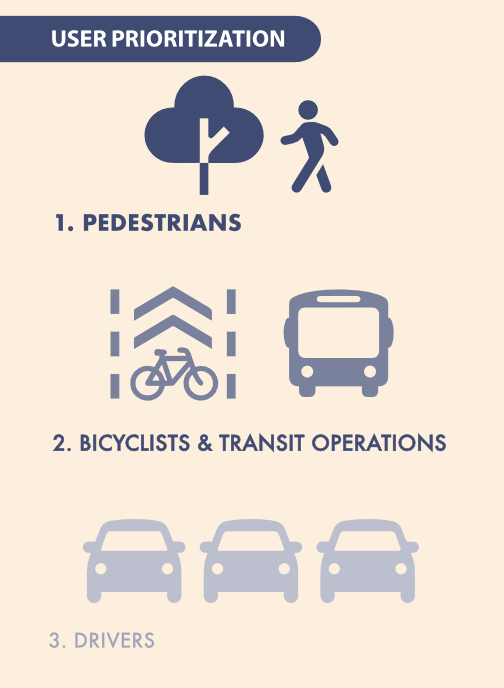
The origin the street design team is the Strong Towns post Engineers Should Not Design Streets. The upshot is that engineers do not have the training or expertise to design streets. Streets should be designed by everyone, and then the engineer will implement that design. The way to do that is to create a street design team with both professionals and citizens. The course presents this chart.

In the presentation, Mike Lydon recommended starting with designing streets that already have some good things about them, and making them better, rather than starting with horrible streets (stroads) that can take a lot of money and time to heal. Anthony Garcia said that if either engineers or politicians are not initially supportive, starting with a small project can show them that alternatives work and are supported by the public. He also said, don’t pick something really controversial or really challenging, rather, pick something likely to be successful.

The whole street design team concept is based on one of the core principals of Strong Towns, four steps for public investment.

for SacCity

I would say that the number of non-technical people should outnumber the technical professional. I would also include in the non-technical list the regional walking and equity organization, Civic Thread, and/or the regional bicycling organization, SABA, and/or one of the transit advocacy organizations. And I would include a member of the SacATC, which has 11 members. Non-technical people should be compensated in some way for their participation, such as stipends, food, transportation, child care.

People could speak up for being on a team, and then a team for each issue or block would be assembled from those available. Though team application and team formation could be managed by the city, they would not be in charge of the team. Though the concept does not specify how big the team should be, I find that teams of more than 12 people tend to have issues with hearing from everyone. Team members would have to agree to a set of group guidelines or community agreements about how to treat each other, with respect, listening more than talking.

A team might stay together for more than one project, or might do only one before the team members disperse to other projects.

Next step? I’m not sure. I intend to talk to some SacATC member and city staff about the idea.

Crash Rapid Response Program for SacCity

Note: This post has been significantly revised and published as two separate posts, one on OakDOT’s Rapid Response Program, and the second a proposal for a City of Sacramento program.

When a fatality or severe injury for walkers and bicyclists, people often ask, what can we do right now to prevent or reduce the severity of the next crash? This topic has come up a number of times at the Sacramento Active Transportation Commission (SacATC), and communication by Slow Down Sacramento, Civic Thread, SABA, and other organizations. I believe now is the time for the City of Sacramento to establish and fund a crash rapid response program.

OakDOT Rapid Response Program

The City of Oakland Department of Transportation (OakDOT) seems to have the best program I could find on the Internet. This is not surprising – since being formed in 2016, OakDOT has led on developing programs for safer streets that are informed by equity. So far I have not found a single document that describes the program and procedures, so I’ve selected some information from the Safe Oakland Streets (SOS) and related pages and documents. Safe Oakland Streets is Oakland’s version of Vision Zero.

Rapid Response Projects: OakDOT seeks to eliminate traffic fatalities and severe injuries while promoting safe, healthy, equitable mobility for all. OakDOT’s efforts to make streets safe include rapid responses to fatal and severe crashes involving the most vulnerable users of Oakland’s roadways. A Rapid Response is a coordinated effort in the days and weeks following a traffic tragedy that may include investigations, targeted maintenance, near-term improvements, and the identification and prioritization of longer-term capital needs.”

“A Rapid Response may be activated for traffic crashes resulting in pedestrian or bicyclist fatalities, or severe injuries to pedestrians or bicyclists who are youth or seniors. A Rapid Response may be activated for additional crashes based on the individual circumstances of a crash.”

The two elements most relevant to rapid response are:

  1. Maintenance Treatment: If the crash location has a maintenance issue that may be related to traffic safety e.g., pavement defect, faded striping, missing sign), the maintenance issue will be rectified by field staff.
  2. Quick-Build Improvement: If there are design treatments that could be implemented quickly at low cost, engineering staff will prepare the design and issue a work order for field staff to construct.

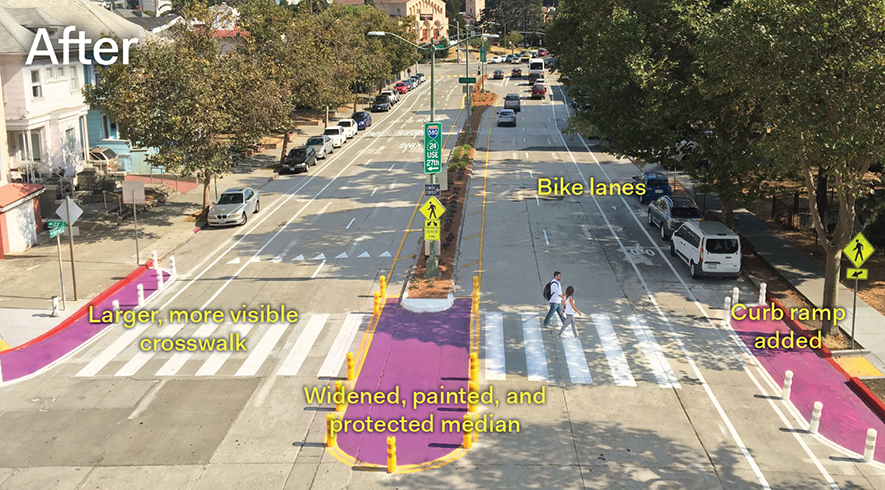
The following photos shows the setting after rapid response to a fatality that occurred at Harrison & 23rd. See Harrison & 23rd St Crash Response for more information.

photo of OakDOT rapid response project at Harrison & 23rd

OakDOT has a Crash Prevention Toolkit with photos of solutions, most of which are inexpensive and quick to implement.

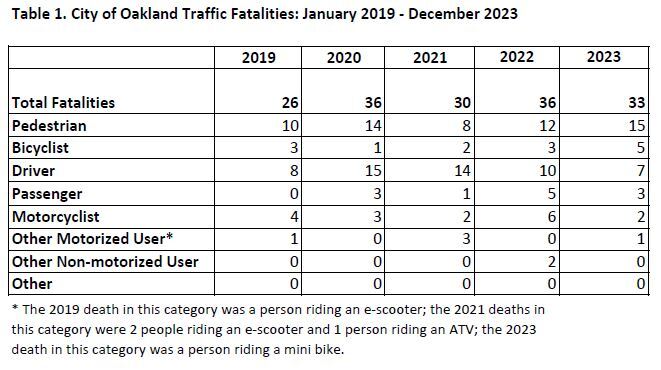
OakDOT offers a map with locations of fatality crashes and relevant features such as high injury network and equity, Traffic Fatalities, City of Oakland. A chart, below, also shows yearly data for modes of travel. A Crash Analysis Infographic also communicates data visually.

OakDOT chart of traffic fatalities by mode over time

SacCity program outline

The city program should start small to make sure that there are sufficient resources of staff time and funding to do a good job. I would suggest in the first year responding only to crashes on the high injury network. Yes, those will get fixed with grants, but those are very long term projects, whereas quick fixes are also needed. An alternative would be to do only fatalities, not severe injury crashes.

A rapid response team should be composed of at least three people. One must be a traffic engineer. Others could be planners, law enforcement, and a member of an advocacy organization (Civic Thread for walkers and SABA for bicyclists). Though the participation of law enforcement may not be useful to the outcome, it is useful for educating police about street design.

It is important that the team review existing documentation and make a site visit. The full law enforcement incident report will not be available within the rapid response time frame, but sufficient detail should be available to determine the movements of the people involved in the crash.

The team should make a report within five working days of the crash, listing obvious and inexpensive fixes, prioritized by effectiveness. One or more of the fixes should be implemented within 20 working days of the crash.

Public Works staff should report to SacATC on a yearly basis on the rapid response program, the projects undertaken, staff time, and money spent. After the first year, this information should be used to develop a budget request for future years.

City of Sacramento should create a fatalities map similar to Oakland’s, with frequent updates, from SacPD information. The state SWITRS database always lags too far to be useful.

A dashboard should be developed that includes fatalities and severe injuries by type of mode and trends. SacATC has already requested a dashboard that would also show projects applied for, in progress, and complete.

As with any new program, this one would and should evolve as experience is gained and the public sees the value of the program in reducing or eliminating fatalities.

SacCity Council save the date for General Plan adoption

Adoption of the 2040 General Plan will likely be on the Sacramento Council on Tuesday, February 27, one month from now. Though the plan could be even better, and its success will depend on a number of documents to be finished after adoption, this is an innovative and forward-looking document, much better than the last one. I hope that you will speak in favor of adoption at this meeting. The Climate Action and Adaptation Plan, developed separately but supposed consistent with the general plan, will be adopted at the same time. The concepts of the Missing Middle Housing Project are also largely contained in the general plan. The documents that will be developed later include Streets for People Active Transportation Plan, Parking Management Plan, and Street Design Standards, and many others.

My previous posts on the 2040 General Plan are available in category ‘General Plan 2040‘.

Save the date – put it on your calendar now! It will likely be a 5:00PM meeting, though when the General Plan comes up for comment depends on what else is on the agenda.

I am expecting widespread support for the plan, from the public and council members, but nothing is guaranteed, and there are certainly forces for the status quo.

See you then! I will post more details when they become available. Many advocacy organizations will also be supporting the plan, so look to your own organizations for additional information.

21st St bikeway issue at W St

Note: This post is not about the bicyclist fatality that occurred in this area recently. Not enough is known about that to post, yet. This is Central City Mobility Project update #34.

There is an issue with the 21st Street separated bikeway at W Street. The northbound bikeway transitions from the east side of 21st Street to the west side of 21st Street at W Street. There is a two-stage turn box on the northeast corner, intended for bicyclists who have crossed W Street on the green light to wait to cross 21st Street on the green light, to access the separated bikeway on the west side of 21st Street. The photo below shows the box being used by a walking bicyclist, who waited in the box. The signal has turned green and he has started to cross. A right-turning driver from W Street to 21st Street stopped suddenly to avoid hitting the bicyclist/pedestrian, because the driver did not expect to see someone there. The vegetation somewhat but not completely obscures someone in the box.

photo of 21st St at W St NE two stage turn box with bicyclist in box
21st St at W St NE two stage turn box with bicyclist in box

The city has placed a ‘no turn on red’ sign on W Street, photo below. In about 40 minutes of observation, 60% of the drivers who could turn, meaning they were not blocked by a vehicle in front of them, did turn on red. This is the time when the box would be occupied by a bicyclist.

photo of W St 'no turn on red' sign to 21st St
W St ‘no turn on red’ sign to 21st St

On the green light, drivers are taking the right turn at high speed. If there were a bicyclist or a walker crossing 21st Street, here, it is doubtful that many drivers would notice the person and brake in time. This is a severe injury or fatality waiting to happen. The video below shows drivers cutting across the two-stage turn box.

video of drivers cutting across the two-stage turn box on 21st St

Solution

A temporary solution is to install vertical delineators (flex posts) to block off the right hand lane of W Street approaching the intersection. There is a short section of red curb here, where the ‘no turn on red’ sign is, but the blocked off area should extend 20 feet up to the crosswalk, and be the width of the parking lane. A green K-71 vertical delineator, or two, should be placed at the southwest corner of the two-stage turn box, to force drivers to go around the turn box, and also slow turning movements. The diagram below indicates possible locations of vertical delineators, white dots. Base excerpted from CCMP plans.

diagram of 21st St at W St NE corner, vertical delineators to slow and control vehicles

A more permanent solution would be to reconfigure the northeast corner to add concrete barrier protection for the turn box. The city, having enticed bicyclists to this location, owes them a much higher level of protection that is currently offered.

LWV Climate Justice Mayoral Candidates Forum and bike share

The League of Women Voters Sacramento sponsored an online Climate Justice Mayoral Candidates Forum on Monday, January 22. Thirteen local climate and transportation advocacy organizations co-sponsored. Seven questions were asked of the five candidates (Jose Avina, Flo Cofer, Steven Hansen, Kevin McCarty, and Richard Pan). You can view the forum on YouTube.

Questions asked:

  1. In 2019, the city council adopted a resolution declaring a climate emergency, committing to carbon neutrality by 2045 and to accomplishing as much action as feasible by 2030. Would you modify these dates, and if so, how would you do it?
  2. Sacramento is getting hotter each summer, with more and longer heat waves. Other extreme impacts of climate change include flooding and stronger winter storms. These conditions impact our residents and especially our most vulnerable communities and the unhoused. How can the city do better in addressing these impacts for all residents of Sacramento?
  3. Mayor Steinberg has proposed a countywide ballot measure that would establish a one and a half cent sales tax (incorrect) for an integrated approach to housing, safe and complete streets, transit,  and climate innovations. Would you support such a measure in 2026? Why or why not?
  4. Transportation is by far the greatest contributor to greenhouse gas emissions in our region. It is critical that we improve our public transit system and increase ridership. What role do you see the city and mayor playing in making this happen. What type of innovative transit projects would you seek to prioritize, and please include in your answer, the last time you used public transit.
  5. The Mayors Climate Commission completed its work in 2020, and provided comprehensive recommendations for achieving carbon zero by 2045. Many of these recommendations are included in the city’s proposed Climate Action and Adaptation Plan which is scheduled for adoption this spring. The proposed plan has a price tag of over $3 billion, yet the city does not have funding set aside for this purpose. What would you do to ensure that funding and financing are addressed in a meaningful way so that the plan does not sit on the shelf?
  6. Sprawl development continues throughout the region and contributes to increased vehicle miles traveled and greenhouse gas emissions. For example, massive development is proposed for the Natomas basin north of downtown. What is your view on annexing city and county boundaries to facilitate this type of development? How do you balance the arguments that these developments would create new jobs and bring in revenue with the need to prevent further emissions-producing sprawl and encourage infill and urban development?
  7. Active transportation options, walking, cycling and rolling, play an important role in reducing greenhouse gas emissions as well as improving health and quality of life. Safety is a reason often cited for not using these options. What can the city do to improve safety, provide additional opportunities, and encourage and incentivize active transportation? 

As a strong believer in bike share, I note Steve Hansen’s reply that promoted bike share.

I helped work with the city of Davis, West Sacramento, and the City of Sacramento through SACOG to launch our shared mobility program. Our JUMP system before the pandemic before the pandemic hit was as successful as the City of Paris, and what happened, though, is after it was sold to Uber and then Lime, disinvestment happened. We need to get back to likely a publicly owned system where we have connectivity.

Caltrans widening I-5 north of Sacramento

Yesterday I rode the bus to and from Sacramento International Airport, to see what the ride and buses and ridership were like. I noticed that there is significant construction occurring on I-5 between Arena Blvd and Airport Blvd, the entrance to the airport. The freeway width under overcrossings is being widened by one lane in each direction, and the roadway is being widened in between the overpasses and interchanges. I had not heard or realized that this work was already going on, but then, I rarely travel on I-5. This project is titled “SAC-5 Corridor Improvement Project – Phase 1”, and is being referred to as “Sacramento I-5 Auxiliary Lanes Project”. A fact sheet is available.

Caltrans claimed a categorical exclusion for this project, meaning that they claimed they did not need to do an environmental assessment or environmental impact statement for CEQA or NEPA because the project would not have a significant environmental impact. This is laughable. Capacity expansions ALWAYS have an environmental impact. It amazes me the number of agencies, including SACOG and California Transportation Commission, that sign off on this bullshit. The project number is 03-4H580, which means it is part of the Caltrans District 3 megaproject to increase the capacity of I-5 and I-80 in the Sacramento region. It may be that part of this widening is a separate project to add an auxiliary lane between Metro Airpark and State Route 99, using Trade Corridor Enhancement Program (TCEP). It appears that the main project is funded through Solutions for Congested Corridors Program (SCCP). The project also shows up on lists of State Highway Operation and Protection Program (SHOPP) projects, though it is not clear whether it actually received any SHOPP funding. This type of widening would be illegal as a SHOPP expenditure. There are literally 70 documents that relate to this project, and it is beyond me to figure out what they all mean, or how they relate to each other. Caltrans specifically does not gather these documents onto a project page. That would entail some transparency, which Caltrans District 3 is apparently opposed to.

The photo below shows the widening of I-5 at Airport Blvd, captured from Google StreetView. The freeway is being widened to the west to the Sacramento River crossing, and the widening appears to continue all the way to Arena Blvd. Caltrans calls these auxiliary lanes, meaning they extend only between interchanges but not through, but it appears to me that they will be continuous, and that is why the freeway is being widened beneath the overpasses. These modifications of the overpasses are called tie-backs by Caltrans, meaning the the original slope under the overcrossing bridge to the freeway is being truncated to add width to the freeway.

This is phase 1 of the project. Caltrans intends to add capacity to I-5 all the way from the Yolo County line to US 50, where the earlier project greatly expanded capacity from Elk Grove north.

If readers travel this section of I-5 and have comments about this project, or more knowledge of the project than I have been able to come up with, please comment or contact me.

Senator Wiener introduces road safety bills

California State Senator Scott Wiener has introduced two bills to improve road safety in California.

The more important is SB 961, which requires changes to vehicles directly, including a first-in-the-nation requirement that all new vehicles sold in California install speed governors, smart devices that automatically limit the vehicle’s speed to 10 miles above the legal limit. The old name for these is speed governors, which limited speed with a physical device that disengaged the driver train when a certain speed was reached. They were required on all early motor vehicles before vehicle manufacturers managed to eliminate laws requiring them. Today, speed can be digitally read and limited. Already, almost all new vehicles have built in the ability to limit speeds to the posted speed limit, but it is not implemented. The bill would require it be implemented by 2027.

Speed is a contributing factor in all motor vehicle crashes. Whether it is driving too fast for conditions, or simply driving way over the speed limit, speed is a contributing factor to carnage on our roads. Of course there are other factors such as roadway design which encourages speeding. And speed limiters won’t prevent drivers from running red lights, as has become so common, but at least the resulting crashes will be at a lower speed, less likely to result in fatalities.

Speed limiting of vehicles also would remove law enforcement from most speed enforcement, which increases safety for everyone on the road, including officers.

SB 960 requires Caltrans to implement and report on a complete streets policy. In vetoing a Wiener bill to require complete streets, the governor implemented a executive order that purported to accomplish this, but Caltrans has done almost nothing since then, and has weakened and then delayed release of its complete streets policy directive. The bill also requires Caltrans to develop a transit priority policy with performance targets.

Caltrans headquarters has, to some degree, gotten on board with the idea of designing and re-designing roads for better safety and productivity, but the Caltrans districts, including our District 3, are still full speed ahead (pun intended) on building unsafe highways that kill walkers and bicyclists. They must be reigned in by the legislature.

CalBike is a sponsor of both of these bills, along with other organizations. Yay, CalBike!

Links:

SacATC review of work zone policy

Please see previous posts in category ‘Work Zones‘.

The City of Sacramento is hosting a webinar on the draft Work Zone and Event Detour Policy Update, today, January 24, 6:00PM. You can register for the Zoom webinar here(registration is not available on the Work Zone webpage).

I have neglected to post on the SacATC (Sacramento Active Transportation Commission) review of the Work Zone and Event Detour Policy. Commission members had several good ideas and questions, which are worth capturing. You can view the meeting video at https://sacramento.granicus.com/player/clip/5786. Note that the sound quality is very poor, with many dropouts. Since I was at the meeting, I have filled in some details on the comments.

Comments/questions from commissioners:

  • Houpt: advocates should have a chance for input, is that part of the noticing process?
  • Hodel: Old Sac boardwalk (promenade) has been completely closed to bicycles for events; should be consequences for blocking access; supports rerouting motor vehicles is necessary; hefty fines for non-compliance
  • Moore: Class 2 bike lanes are already dangerous so reproducing them as diversions or detours is still dangerous; provide physical safety; rely on automated enforcement, not police presence
  • Gonzalez: is there a definition for ‘short pinch point’?; concerned about monitoring, suggested QRcode at location for immediate report of dangerous situation
  • Gibson: asked for details on enforcement at events; should be separate for short term events versus long-term construction project
  • Banks: how will the city get word out about events and construction that impact access; suggested more photos, particularly for events
  • Erasmus: assistance for event sponsors who may not have the resources to post events
  • Doerr Westbrook: could longer term projects be reflected in Google maps?; there may be some more recent Caltrans info on bicyclist detours; is there a database for locations and TCP documents? Can the document refer to federal guidelines on bicycle facilities for ADT levels, rather than city? (Reply was that the Streets for People Active Transportation Plan will update that guidance, and replace old Bicycle Master Plan at that time)

The Community Development AgencyCounter map (https://sacramento.agencycounter.com/) could be one location to store TCP locations. It does not appear to have document links, but would at least allow people to find locations and request documents.

Central City Mobility: new beg buttons on 5th Street

This is Central City Mobility Project update #33. Note that 5th Street has not yet been converted from one-way to two-way.

When looking at 5th Street, part of the Central City Mobility Project to convert this from a one-way street to a two-way street, I was focused on the looking at the new signals and the mast arms. I failed to notice all the new beg buttons that have been installed. These are the ‘wave at’ variety. Installations are at Q Street, P Street, N Street and Capitol Mall. At Q, P, and N Streets, there are 8 new buttons per intersection. At Capitol Mall there are six, all on the east side of the intersection, because there is a pedestrian crossing prohibition on the west side. I don’t have documentation of what was here before these were installed, but I’m pretty sure that these intersections were on auto-recall, meaning that the button did not need to be pressed, or waved at. I have to admit I have been fooled again by City of Sacramento Public Works. I had been assuming that either things would remain the same, or things would get better. They have proved me wrong by making things worse.

photo of 5th St & Q St SE new wave beg button
5th St & Q St SE new wave beg button

There are beg button posts installed at R Street as well, but since this crossing of 5th St has not been activated, I don’t know how the beg buttons will be labeled.

Read More »

construction violation on 6th St

You may be getting tired of these posts on construction zone failures to accommodate walkers and bicyclists, to to comply with ADA regulations. Well, I’m getting tired of the City of Sacramento Public Works Department completely failing at its responsibility to protect people walking and bicycling. I wonder why it falls to the public to report these issues, rather than to city employees whose job it is to take care of these things. Maybe they should not have their jobs.

This most recently noticed problem is on the east side of 6th Street between I Street and Improv Alley. The building is Riverview Plaza Apartments, a Sacramento Housing and Redevelopment Agency (SHRA) housing, and the project is apparently Riverview Plaza Rehabilitation Project. This construction is not on the city’s AgencyCounter website, perhaps because SHRA is a city/county partnership and assumes it does not need to inform the public.

The sidewalk on the east side of 6th Street is completely blocked by construction. At I Street, there is no advance warning of the sidewalk being closed ahead. At the closure, southbound, there is a chainlink fence, which is not a detectable barrier, and no sidewalk closed sign. The construction extends to the curb, including the sidewalk buffer. From the south, there is no advance warning of the sidewalk being closed ahead, either at Improv Alley or at J Street. At the closure, there is a scaffolding, which is not a detectable barrier, and a small paper sidewalk closed sign, not compliant with CA-MUTCD or PROWAG. At the time I walked past, there were two delivery vehicles double-parked on the street, so even if a person wanted to walk around the closure, they would be forced out into traffic on 6th Street. This situation is a complete failure on the part of the construction company, and the city.

photo of SHRA construction on 6th St, no advance warning, no sign on chainlink fence
SHRA construction on 6th St, no advance warning, no sign on chainlink fence
photo of SHRA construction on 6th St, scaffolding as barrier, non-compliant paper sidewalk closed sign
SHRA construction on 6th St, scaffolding as barrier
photo of SHRA construction on 6th St, scaffolding as barrier, non-compliant paper sidewalk closed sign

SHRA construction on 6th St, scaffolding as barrier, non-compliant paper sidewalk closed sign