pavement condition in Sacramento County

A report on pavement condition in Sacramento County was presented today to the Sacramento Transportation Authority (SacTA): 2023 Regional Pavement Analysis, written by consultant NCE, agenda item 12.

The report has two main sections:

  • What are the existing pavement conditions, countywide, and by each agency (city or county).
  • What are funding scenarios and how would the allow, or not allow, substandard conditions to be improved.

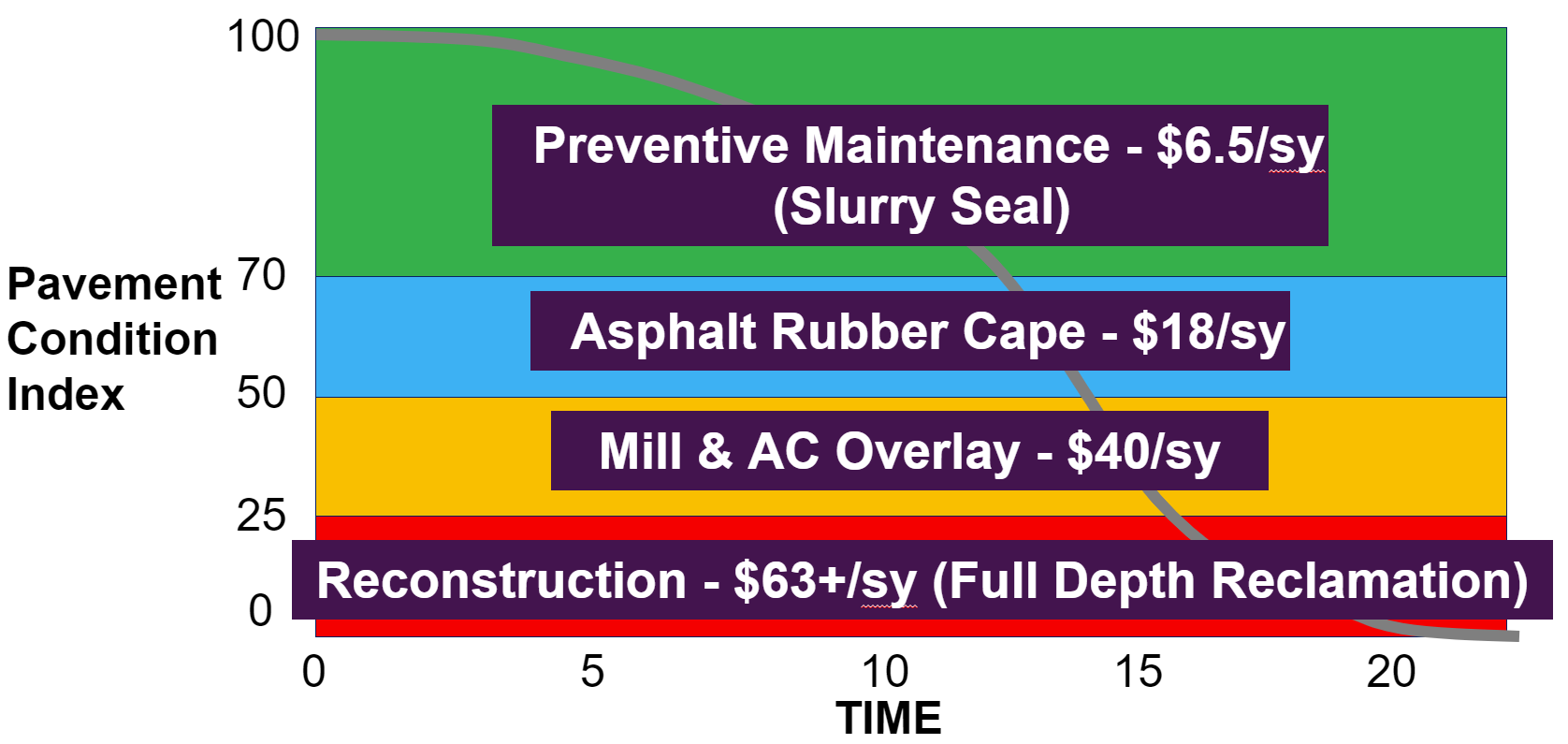
Existing conditions are summarized in the chart below. The countywide PCI (pavement condition index) is 53, out of a possible 100, with a target of at least 70 for ‘good condition’. Only Elk Grove has the target 70 or better, in large part because their roadways are newer than most of the county.

The second section presents five possible funding scenarios, and how pavement condition would vary over time. In each of the scenarios except the first, ‘improve PCI to 70’, pavement condition declines, sometimes slowly and sometimes quickly. SacTA already recognized that there is no likely funding source that would allow scenario one. Scenario four includes new sales tax income, but still does not keep pavement conditions from declining.

Many people question where SB 1 Road Repair and Accountability Act of 2017 funding (mostly gas tax) is going and why it hasn’t fixed our roads. SB 1’s main intent was to allow Caltrans to maintain freeways and other state-owned roads. It had only minor funding, a fraction of what would be needed, to maintain local roadways.

Why are we in this crisis of pavement condition? Because we have built roadways (and bridges and freeways) that we will never be able to maintain. It would take a tax rate many times higher than it is today to actually maintain all we have. That isn’t happening. We’ve built ourselves into a corner. But that doesn’t mean we can’t address the problem. We can shift funding from road building to road repair. This is called ‘fix my pothole’ or ‘fix-it-first’ or ‘state of good repair’.

I made these comments today about the issue:

  • I’m a active transportation and transit advocate, but what everyone in the county wants is to have good streets.
  • Under no reasonable funding scenario does pavement quality improve
  • There will be less money coming through the state, as demonstrated by the LAO presentation (the previous agenda item, 11)
  • $8.3B roadway ‘asset’ is really a $8.3B ‘liability’, requiring a significant investment to maintain
  • Every new pavement mile is an additional liability
  • Authority funding should shift from creating new pavement to maintaining and rehabilitating existing pavement
  • This shift is even more important for the member agencies, cities and county
  • Each potential infrastructure project should be evaluated on the question “Does this project add enough economic activity to pay for maintenance?” If the answer is not, they should not be built.
  • If the authority is going to voters for increased sales tax in the future, it will be necessary ahead of time to show that the authority and agencies are already working to solve this issue, not just waiting for more money

Two bicycle advocates spoke after me, pointing out that safety for bicyclists is actually a very high priority. I agree, even above economic productivity. But economic productivity must be considered. I roadway projects don’t create enough income to pay for them, and maintenance and rehabilitation of them, we are sliding further down the slope of pavement deterioration.

Board comments were mostly in recognition that we must invest differently than in the past, we must keep our existing roads in better condition, and that includes consideration not doing projects which increase future liability.

The Importance of Street Design

The second post by Strong SacTown to improve and promote the City of Sacramento update to its Street Design Standards. Other posts at tag: street design standards.

Over time, the major use of our streets and public right of way has shifted: from pedestrians and horse-drawn carriages, to streetcars and bicycles, and — over the last several decades — to ever larger private vehicles. In designing our streets for vehicle throughput, our network of roads has become a transitional space focused on getting as many cars from Point A to Point B as fast as possible. This means dedicating an ever increasing amount of space to travel and parking lanes, with only the space left over from vehicle use — if any — allocated to people: pedestrians, bicyclists, and public transit.

The Importance of Street Design – Strong SacTown

Street Design Standards

Strong SacTown Street Design Team will be posting a series to improve and promote the City of Sacramento update of their street design standards. This is the first. You can follow their website at https://www.strongsactown.org/, and the series at https://www.strongsactown.org/tag/street-design-standards/. Getting Around Sacramento / Dan Allison is participating in the team planning and writing, but these posts are the work of the team.

“We are Strong SacTown — Streets for People, a group of Sacramentans advocating for updated street designs that will rank safety, livability, and economic vitality above vehicle throughput or speed; where congestion relief will not be the goal in street design.

The City of Sacramento is updating the street design standards for the first time since 2009. The city is embarking on this effort as it is becoming increasingly apparent that the existing standards do not meet the needs of all users in the modern era.”

Streets for People – Street Design Standards – Strong SacTown

RRFBs are being ignored

I was a strong supporter of RRFBs (rectangular rapid flashing beacon), where a safer crossing of the street is intended mid-block. I worked with transportation agencies in a number of locations to get them installed, and was very happy to see them go in.

They are used where multi-use trails cross roadways, and at intersections where additional traffic calming and safety are needed, but where the transportation agency does not want to add stop signs, or is unwilling or financially unable to install a traffic signal. The cost savings of an RRFB over a traffic signal are significant, about $25K for a RRFB, and upwards of $1M for a full traffic signal.

But…

Driver behavior has rendered RRFBs untenable for protecting people walking. I have observed a number of RRFB locations over the last few months. All of them are failing. Between 25% and 50% of drivers are failing to yield to people using these crossings, bicyclists or walkers. I have seen several people almost get hit by car drivers. Some drivers are slowing but failing to stop, or yield, and some drivers are not even slowing. Apparently the attitude of many drivers is that the RRFBs are only advisory and do not require yield to people in the street. Of course the law requires yielding to people crossing the street in a crosswalk, whether there is any type of signing or signaling, or not. But drivers don’t see it that way.

So, I find myself having to withdraw support for RRFBs. I will not support them as freestanding safety improvements, not as part of project. It is sad that driver behavior has erased the benefit of a safety enhancement, but it is a fact, and driver behavior gets continuously worse, never better.

Drivers are terrorists.

photo of RRFB on J St at 17th St, Sacramento
RRFB on J St at 17th St, Sacramento

lawsuits against Yolo 80

For earlier posts on Yolo 80 and managed lanes, see category ‘managed lanes‘.

Two lawsuits have been filed against Caltrans over the Yolo 80 freeway widening project.

Sierra Club and ECOS: Sierra Club, ECOS file lawsuit against Caltrans over I-80 project; Sierra Club and ECOS Sue Caltrans over Yolo I-80 Freeway Widening Project

“Caltrans’ Environmental Impact Report (EIR) grossly underestimates increased vehicular travel, which would emit far larger quantities of greenhouse gases (GHG) and air pollutants than claimed. The EIR fails to consider viable alternatives, such as increased public transit or alternate tolling strategies. Therefore, the project neither adequately manages demand nor produces adequate revenue to fund needed transit alternatives. Also, Caltrans’ proposed mitigation is woefully inadequate to offset the resulting increased GHG and air pollutant emissions.” – Sierra Club/ECOS Press Release

NRDC (Natural Resources Defense Council)/Planning and Conservation League/Center for Biological Diversity: Environmental Groups File Suit Against I-80 Highway Expansion; Environmental Groups Challenge Highway Expansion Project in Court

“First, Caltrans improperly chopped this project into two pieces to use funding in illegitimate ways and obscure environmental impacts, as documented by a Caltrans whistleblower. The first project, already underway, is using maintenance-only transportation dollars to strengthen the shoulders of the highway so they can accommodate heavy vehicle travel. The second project would restripe the road to accommodate the additional lane of traffic in each direction.” – NRDC

I tend to be cynical about the chances of stopping this widening project. However, the lawsuits can have several beneficial impacts:

  • requiring Caltans to supplement or revise its Environmental Impact Report, because it failed to consider several impacts, and failed to address induced demand
  • requiring Caltrans to allocate more funding to environmental and GHG mitigation; the existing project only partially mitigates impacts, and depends on income from a single tolled lane, which may fall short of projections
  • highlighting the failure of the California Transportation Commission, and in particular Chair Carl Guardino, to provide legally required oversight of Caltrans

I am in favor of tolling freeway lanes in order to recovered construction and maintenance costs, and to fund mitigation measures, not just for GHG but for other environmental impacts. A tolling authority (CARTA) has been set up to administer the added toll lane, but there are great uncertainties about how much will be raised, and the fee structure (vehicles and time of day) has not been developed.

“The EIR does not consider tolling existing lanes, which could be based on income, with funds used to provide clean public transit and bike and pedestrian options along the corridor, facilitating affordable infill development.” – Ralph Propper, ECOS Climate Committee Chair, from the press release

Civic Thread petition to eliminate pedestrian and cyclist fatalities

Civic Thread has posted a petition to Caltrans, SACOG, City of Sacramento, and others in the region asking for immediate action to eliminate pedestrian and bicyclist fatalities. I encourage you to sign the petition, and to follow the efforts of Civic Thread and many other advocacy organization in holding government and particularly transportation agencies accountable for the traffic violence that impacts us all. As with everything that Civic Thread does, action is through an equity lens. It would be a great first step if every agency adopted the list of five commitments that Civic Thread says is required, though of course it is action and not language that will make the difference.

  1. A commitment to work collaboratively and cross-sectorally at the City, County, and regional level to prioritize a consistent focus on equity and racial justice for project planning, funding, and implementation, particularly since evidence continues to show the majority of pedestrian and cyclist fatalities occur in low-income, communities of color, with Black residents disproportionately experience the highest risk of death while walking, in addition to a high risk of being killed by police in routine traffic stops.
  2. A commitment to prioritize funding mechanisms and set aside funding within the city, county, regional, and state budget for active transportation programs, Safe Routes to School, and matching funds for state and federal funding programs at the local jurisdiction level.  
  3. A commitment to thoroughly vet community proposed infrastructure recommendations and to work closely with neighborhood groups and residents to identify solutions and ideas the community supports, including road diets, speed reduction, and quick builds along High Injury Networks
  4. A commitment to analyze current roadway conditions, transportation design policies, and guidelines and develop a plan to address design flaws equitably and immediately. 
  5. A commitment to building a comprehensive, seamless, low-stress network of active transportation corridors that is centered on equity and prioritizes investment in low-income and environmental justice communities. 

Broadway Complete Streets update

Additional posts on Broadway Complete Streets are available at category ‘Broadway Complete Streets‘.

The section of Broadway from just west of 3rd Street to 19th Street has been repaved, and marked for striping, but no striping has been done yet. The section from 21st St to 24th Street has been ground down in preparation for paving, but no paving has occurred.

There are construction vertical delineators scattered all over the street, along with delineator bases without the vertical. Most of the delineators were placed in what will be the bike lane, not in what will be the bike lane buffer. Presumably the construction company wishes to keep them further away from motor vehicles, which is sort of understandable since more than one-third of the delineators have been hit by drivers.

I’ll post again when there is actual striping installed.

cycletrack in West Sacramento Bridge District

Note: I’ve added text and a photo of the approach from the north.

The City of West Sacramento has installed a section of cycletrack (a two-way Class 4 separated bikeway) on South River Road and 5th Street in the Bridge District. Apparently completed late 2023 (shows how long since I’ve ridden that way), it is part of the Riverfront Street Extension and 5th Street Widening Project.

From 15th Street (the connection to Jefferson Blvd) north to almost Mill Street, the bikeway is separated from motor vehicles by a hard curb divider. The on-street bike lane southbound still exists, but this bikeway provides a much safer alternative. The onramp to Hwy 50 east (or Business 80 as it is designated), was an extreme hazard for bicyclists due to drivers turning at high speeds. See two photos below.

South River Rd cycletrack / separated bikeway at 15th St
South River Rd cycletrack / separated bikeway

From Mill Street north to Bridge Street, the cycletrack is separated by a buffer and vertical delineators (K-71). At Bridge Street and north, the roadways returns to traditional Class 2 unprotected bike lanes. Though it would have been great to extend the curb-protected cycletrack all the way north to West Capitol Avenue, at least the truly dangerous section at the freeway onramp was fixed.

To the south of 15th Street, South River Road has more traditional bike lanes, with buffers in a few locations, as it crosses the ship channel and goes through two roundabouts.

The transitions to and from the bikeway seem a little awkward as they swoop through the intersection, but are probably not unsafe. I observed several bicyclists heading westbound to 15th Street who were not following the skip green bicycle markings, but the maneuver was not unsafe. I did not observe any bicyclists at the Bridge Street intersection.

Approaching the cycletrack from the north, the southbound traditional bike lane on the west side of 5th Street transitions to the cycletrack on the east side of 5th Street at Bridge St. Though the transition does not feel safe, I think it actually is, with signals preventing inappropriate motor vehicle movements.

5th St bike lane transitioning to cycletrack approaching Bridge St
signs and signals for bicyclist on 5th St at Bridge St

Folsom Blvd alternative

The city has proposed a Folsom Blvd Safety Project.  See previous post on that project. I would like to present an alternative to the bicycle facilities aspect of this project, improvement of the M Street corridor. M Street, and related streets including Elvas Ave, provide an alternative route. This route is already used by hundreds of bicyclists per day, students at Sacramento State, other commuters, and recreational bicyclists accessing the American River Parkway. Folsom, on the other hand, sees very little bicycle use. This is because it feels dangerous for most bicyclists, and because it is not the most direct route for many destinations.

The lack of bicyclists does not indicate that the street does not deserve bicycle facilities. Folsom has no bicycle facilities in the section to be revised, does not feel safe for bicyclists, and is not safe for bicyclists. The classic saying is that you can’t judge the need for a bridge by the number of people swimming the river. Bicyclists deserve safety on every street.

However, since bicycle facilities are a primary feature of the project, so it is worth asking: ‘Is this the best investment of limited funds?’ I’d suggest that upgrades to the M Street corridor might be a better investment.

Neither route actually offers safe access to and through Sacramento State. M Street is a low volume, mostly low speed street, from Alhambra Blvd to Elvas Blvd, However, the section along Elvas to the Hornet Tunnel that goes under the railroad tracks, is hazardous and intimidating for bicyclists. Folsom Blvd, with this project, would provide basic bicyclist facilities from Alhambra to 65th Street. However, access to and through Sacramento State beyond 65th Street is poor. The ‘safer’ crossing of Folsom at 69th Street and Elvas Avenue is awkward, was designed for walkers and not bicyclists, and not really safe. I have observed a number of drivers blowing the red light at this crossing. After crossing Folsom, a bicyclist can jog west to Elvas Avenue, and ride that to Hornet Tunnel, though the street is very deteriorated, of widely variable width, and the entrance to the tunnel is awkward.

The map below shows both routes, M Street from Alhambra Blvd to Elvas Avenue, in orange, and Folsom Blvd from Alhambra Blvd to 65th Street. Both are of equal length. Folsom Blvd has bike lanes from Alhambra to 47th Street, and discontinuously from 49th Street to 57th Street, with nothing to the east. M Street does not have bike lanes, but is is a low volume, low speed roadway along which most bicyclists feel comfortable riding. It is a ‘low stress bikeway’. Some of the route is marked with bike sharrows. Though improvements could certainly be made to M Street, it is functional as is, as a bicycle route.

Folsom Blvd has a posted speed limit of 35 mph, and much higher speeds are routinely observed. The fatal crash was in fact due in part to egregious speed violation by a driver. The proposed project would reduce speeds somewhat due to prudent drivers, but will probably encourage passing in the center turn lane. The project would leave the posted speed limit unchanged. M Street has a posted speed limit of 25 mph throughout, and speeds above 30 mph are rare. Would bicyclists rather ride on a non-bicyclist facilities roadway with 30 mph traffic, or on a buffered and un-buffered bike lane with 50 mph traffic?

Both of these routes are unacceptable because they don’t create a safe corridor all the way to Sacramento State. However, I feel that an investment in improving the M Street corridor section along Elvas would be a better investment than bicycle facilities along Folsom Blvd which end at 65th Street.

I wrote about improving the section of the M Street corridor between 62nd Street and Hornet Tunnel earlier this year: Elvas Ave and Hornet Tunnel. I don’t have a cost estimate for this project.

I am not saying the the Folsom Blvd Safety Project is a bad idea, just raising the question of where funds can be best invested to improve safety and comfort for bicyclists.

Folsom Blvd safety improvements

I said in my post about the Sacramento Active Transportation Commission meeting of May 16, and in an eComment, that I was generally in support of the Folsom Boulevard Safety Improvements Project, agenda item 3. I am still in support of the project, but conversations with a number of people since them have pointed out weaknesses in the project that I will comment on.

  • Speed limit: The city does not propose to reduce the posted speed limit on the revised sections of roadway. The posted speed limit is 35 mph, and of course the design speed and typical speed is much higher. The reduction of general purpose (motor vehicle) lanes from four to two will result in lower speeds under some conditions, where a prudent driver sets the pace, but where there isn’t a prudent driver, other drivers will continue to travel well over the speed limit, creating the threat of traffic violence for all roadway users. Though not common, some drivers will use the center turn lane to pass slower drivers, increasing the danger for everyone. The city must reduce actual speeds with a safer design that enforces the desired speed.
  • Gutter pan bike lane: For several segments, the project proposes to keep the existing wide gutter pans and use them as part of the bike lane. This is probably illegal under state law, but even if not, it is poor practice. The gutter pans are acceptable in some locations, but in many cases are quite deteriorated and not rideable. Either the gutter pan must not be counted as part of the bike lane, or it must be replaced.
  • Lane widths: The projects indicates lane widths of 11 feet for the center turn lane and the two general purpose (motor vehicle) lanes, or 33 feet of the available roadway width. This is unnecessarily wide and will encourage drivers to travel at a higher speed than is safe. It is worth remembering that the fatality which initiated this project was due in part of excessive speed.
  • Bike lane design: The bike lanes are indicated as five feet. This is the minimum required by law, but is insufficient. It does not allow for safe passing of one bicyclist by another, and limits use by wider bicycles such as cargo bikes and three-wheeled bikes. The bike lane buffer is as narrow as 1.2 feet in some segments. This does not provide any real sense of security for less confident bicyclists. In some sections, the bicycle buffer has vertical delineators (shown as K-71 green delineators), but in other sections has no delineators. The narrow buffers and lack of delineators will not encourage bicyclists to use Folsom Blvd as a travel route. It might be better to improve bicycle facilities on M Street and Elvas Avenue, which is a parallel route commonly used by bicyclists, students and others, from east Sacramento to Sacramento State via the Hornet Tunnel.
  • Sidewalks: At no location in this entire project are sidewalk improvements shown. The sidewalks, where present, meet minimum standards, but do not have sidewalk buffers (planting strips), and there are several short sections with no sidewalk at all. Sidewalks without sidewalk buffers do not encourage people to walk. This is yet another city project with claimed safety benefits in which sidewalks are ignored as though they are not a critically important part of the transportation network. New ADA-compliant curb ramps are indicated in a few locations, but safer crossings are irrelevant if travel along the corridor is discouraged.
  • Slip lanes: The slip lane for 51st Street southbound at Folsom is retained. The small pedestrian island between the two travel lanes is not comfortable for walkers. The project also retains slip lanes for Folsom Blvd eastbound to 65th Street south, and 65th Street eastbound to Folsom Blvd east. Slip lanes are hazardous for all roadway users, and should be removed whenever a street in reconfigured.
  • Center turn lane: As with almost every project the city has proposed, there is a center turn lane along the entire length. I consider these to be a waste of roadway space except where the frequency of turning movements, to or from the major roadway, justify a center turn lane. Otherwise, they are just empty, seldom used space that could be better allocated to other uses.
  • Driveway closures: Driveways are the single feature that creates the most difficulty for people rolliing, and people walking. Commercial properties should be limited to one driveway in/out, of 20 feet, or two driveways, one in, one out, or 20 feet each. Twenty feet is required for commercial driveways by fire regulations. Where driveways are available on side streets for commercial properties, they should be used and driveways on the main roadway closed or greatly narrowed.
  • 48th Street flared intersection: The intersection of 48th Street to the south has a flared design, with extremely wide turning radii, leading to a crossing distance curb to curb of 140 feet! This is a crossing that intimidates walkers, yet the project makes no effort to correct this, or even acknowledge it.

In summary, this project presented as a safety improvement project has major weaknesses that reduce its effectiveness for safety. Remember that the fatality was on a sidewalk, and the result in part of a speeding driver. It was not a bicyclist. Of course I am in favor of higher quality and safer bicyclist facilities, but it seems to be the view of the city that if things are improved for bicyclists, walkers can be ignored. I strongly disagree.

This is another city project that could be transformative, but falls short. The city is unwilling to make our streets significantly safer by prioritizing walkers over others. The General Plan has this diagram. Worth repeating again and again, until the city finally takes it seriously.

I have to admit that I missed a number of these issues when I quickly scanned the project document. If readers see additional issues that I have missed, please comment.

The cross-sections below are from the project document. Each is option two, which has more visual separation of bicyclists from motor vehicles by using buffers and/or vertical delineators. Option one does not provide any separation. But the buffers reduce the bike lane widths to five feet. Whether narrower bike lanes with visual protection, or wider bike lanes with no separation except a white stipe, are better, is a question I do not have a clear answer for. But modern bikeway designs provide both visual, or actual, protection, and wider bike lanes. These bicycle facilities are the minimum acceptable.

Folsom Blvd cross-section, 47th to 53rd, option 2
Folsom Blvd cross-section, 53rd to 63rd, option 2
Folsom Blvd cross-section, 63rd to 65th, option 2