Another bicycle related project was added to the Sacramento Bee’s Book of Dreams holiday effort today. Cycles 4 Hope, a nonprofit organization which serves primarily homeless people dependent on bicycles for transportation, needs to move bikes and tools between locations. The need a larger trailer to do so. This is a great organization who is really making a difference day to day in the quality of people’s lives.
I attended the six hour long (!) hearing on Wednesday. Supervisors Don Nottoli and Phil Serna asked a series of probing questions, many of which had to do with what effect the lack of a university would have on the project benefits and impacts. The private university that had been part of the project withdrew, no replacement has been found, and many people including myself doubt that a replacement will be found. What university would want to be located on the far edge of the Sacramento region, in a place not accessible by public transportation from the rest of the region? Every other institution of higher learning in the region is accessible by public transportation, and SacRT is currently spending millions to extend light rail to Cosumnes River College. Free land is not a sufficient enticement.
Planning staff could not really answer questions about the lack of a university because they had decided that they would only analyze the “with university” scenario in the environmental impact statements and other documents. Supervisor Serna clearly felt that this was a mistake, as did most of the people in the room. Without any hard information, planning staff could make only vague guesses, and seemed lost at sea.
Specifically, the lack of a university would change the jobs/housing balance and would increase vehicle miles traveled (VMT) for the development, leaving it further from meeting SB375 greenhouse gas reduction goals. Somehow, the developer and planning staff were able to get a midnight agreement from the Air Quality Management District (AQMD) that additional mitigations would meet the goals, but there was doubt expressed by many about this. Since SB375 requires that developments “adopt all feasible measures to mitigate those impacts”, it left me scratching my head as to how planning staff and developer were suddenly able to come up with more mitigations that they hadn’t initially included.
Since the development is outside the Urban Services Area, which under the Sacramento County General Plan defines the area which is expected to be developed in the next 25 years, the planning staff and developer kept touting that the development met the criteria established by LU-120, so that it should be accepted even though it was outside the area. The LU-120 is a series of criteria which judge the quality and sustainability of the project. The document is here, but be prepared to spend some real time working to understand it. I spent much of the six hours looking at and trying to understand it, and I’m not completely there yet. Planning staff presented a slide which contains the same information in a different format, and I was not able to find that slide on the website. The slide crammed text onto the slide so that no one could read it.
When challenged by supervisors to explain why the project had received the scores on several of the criteria, planning staff was very vague in their answers, basically saying “well, that’s what we decided.” When asked how the lack of a university would affect those scores, they really had no idea, because, again, they had chosen not to look at this scenario. I suspect that the LU-120 scores will end up being the major flaw in the planning process, and will leave any approval of the development open to legal challenge.
The hearing was closed with no decision. The development will be taken up again by the Board of Supervisors on January 29 at 2:00PM, at which time planning staff promised that they would have answers to some of the supervisor’s questions, and a response from SACOG on the implications of this development which was not included in the MTP (Metropolitan Transportation Plan for 2035 / Sustainable Communities Strategy “The Blueprint for Sustainability”).
The Environmental Council of Sacramento (ECOS) and members spoke eloquently and in great detail about why the project should be disapproved. Two ECOS references of great interest:
I will have more to say about Cordova Hills, as I have the time. The developer’s lawyer said that this development was a “poster child” for quality, sustainable development. Well, it certainly is a poster child, but it is a poster child for sprawl. I think that this particular development has much more impact than one would expect, as approval would open the floodgates for sprawl developers wanting to go outside the Urban Services Area, to latch on the to Southeast Connector for access, and to try to sell their development with promises of a university.
The article misses that the Traffic Safety Fact: 2011 Motor Vehicle Crashes: Overview (TSF), linked from the National Highway Traffic Safety Administration (NHTSA) press release, also shows that the injury rate per vehicle mile traveled (VMT) has been flat for three years. What does this mean? It probably means that the number of crashes has not declined, just the likelihood of fatality in a crash. The rate per VMT is the only useful measure of traffic safety. Fatality counts and injury counts are a mis-measure because they are affected by the rate of driving and a number of other factors, rather than the safety of driving.
The TSF provides counts of pedestrian fatalities, up 3%, and bicyclists (the NHTSA uses the obscure term pedalcyclists), up 8.7%. To go with the counting game, this is an increase of 130 dead pedestrians and 54 dead bicyclists in just one year. No statistics are presented on the fatality rate per bicycle mile traveled. Why? I believe that it is because NHTSA is too lazy or too disinterested to compile information on bicycle miles traveled. Though pedestrian miles traveled would be difficult to compile, at least a rate could be developed per pedestrian trip, which would be a more accurate measure of the rate of fatalities. Again, the NHTSA can’t be bothered. I am certainly not the first to point out that pedestrian and bicyclist fatality counts are a mis-measure of safety, yet the federal, state, and local governments continue to ignore the issue.
“Previous sprawl has sent Fresno to the edge of bankruptcy.” – Keith Bergthold , City of Fresno Planning and Development, at the Partnering with K-12 Education in Building Healthy, Sustainable & Competitive Regions, 2012-12-06
The Cordova Hills development is on the agenda for the Sacramento Board of Supervisors on this Wednesday, December 12. The meeting starts at 2:30 pm in the county board chambers at 700 H St in Sacramento.
I hope that a many people will attend and protest this development. This is sprawl of the worst kind. Not only is it beyond all developed areas, it is even beyond the county’s generous growth boundary. With no significant employment opportunities within or near the development, people would be commuting long distances to work in Sacramento, Elk Grove, Rancho Cordova, Folsom, and Roseville. More vehicle miles, more air pollution, more climate change, more taxes required to maintain infrastructure. Less community cohesiveness, less time, less open space.
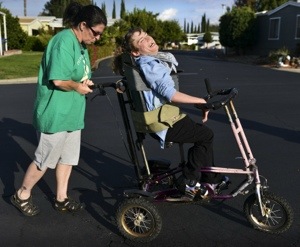
I’ve already made a donation to both, and I’d recommend that every bicyclist donate. Adaptive bikes are expensive because they have a large number of adjustments and features for the specific individual. The donations are to a fund managed by the Sacramento Region Community Foundation.
I have long been thinking about a policy for construction of roads and highways, that would result in no more pavement. A post by Charles Marohn on Strong Towns blog titled “What is the federal role?” reminded me that I’d not posted on my idea. An excerpt from his post:
So if you forced me to have a federal transportation bill, then I would want it to do two things. First, I would want it to place a moratorium on the expansion, extension or construction of any new auto-oriented facilities. No new road miles anywhere. There is no need for this country to ever build another mile, another lane, another overpass or anything — we have far more than we can take care of now, most of it very unproductive. I would make this exception, however: any state that wants a new mile of highway has to remove two miles of existing. This would allow flexibility for states that wanted a strategic contraction, allowing them to allocate scarce resources to areas that would have the greatest benefit. In short, I would ensure the bill funded maintenance (which would make it politically irrelevant in the current context, but that is beside the point).”
I worked for several years in the Lake Tahoe basin, doing watershed education. The policy for hard coverage such as buildings and pavement, which produces runoff to the lake and a decline in water quality, is that there be no net increase in coverage over time. If a developer or homeowner wants to increase their coverage by expanding the areal extent of a building or parking lots, they must retire other buildings or pavement. The policy has been quite effective, and is primarily responsible the reversal in the steep decline of lake clarity. I realized that the policy would be a good one to apply everywhere. Pavement everywhere has the same effect, causing rain and snow to run off, carrying sediment and debris into waterways. Less pavement equals cleaner water. But there are so many more benefits of less pavement to the environment and to livability in towns and cities, that it makes no sense to continue paving, anywhere, anytime.Read More »
 Another bicycle related project was added to the Sacramento Bee’s Book of Dreams holiday effort today. Cycles 4 Hope, a nonprofit organization which serves primarily homeless people dependent on bicycles for transportation, needs to move bikes and tools between locations. The need a larger trailer to do so. This is a great organization who is really making a difference day to day in the quality of people’s lives.
 Getting Around Sacramento