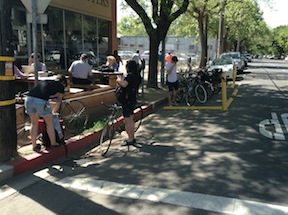
bike corral overflow

bike corral and overload at Insight Coffee

The bike parking corral at Insight Coffee on 8th Street is a great service to customers, but on nice days like we have been having, it is far too little. On Sunday morning, there were almost three times the bicycles parked around Insight Coffee as the 10-space bike corral could handle. There were bikes locked to parking meters and sign posts on both sides of the streets, and some bicycles simply unlocked for lack of a place.

We need more bike parking! Most customers are arriving by bike, few by car, at least when the weather is nice. It is a little hard to judge the number of customers by car on Sunday in this neighborhood, because car parking is filled with churchgoers for the churches to the south, and customers cannot park close to the business, but while sitting and watching for over an hour I saw only a few customers who seemed to be arriving by car. In contrast, there was a continuous turnover in the bicyclists, representing more than fifty customers in just an hour. And a lot of people arrived on foot, walking in from the neighborhood.

I am not being critical of Insight Coffee. They deserve praise for welcoming the Park-A-Bike demonstration bike corral, and for keeping it. I am pointing out that we have too little bike parking and too much car parking in downtown/midtown. Customers are coming by bike!

The other bike corral is at Pangaea Two Brews on Franklin.

News summary April 21

Legislation

Note: I’ve created a separate page for California legislation under consideration in the 2013-2014 session, and will keep updates there, with only major actions included in my weekly news summaries.

Note: It seems as though the Sacramento Bee has removed its monthly article viewing limitation. It also seems that the Sacramento Business Journal is putting fewer articles behind its paywall, so more are available in full without subscribing.

Sac TPG allocation

I’ve now had time to look at Sacramento’s 2010 Transportation Programming Guide in more detail. What I’ve seen convinces me that updating the project list without revisiting the ranking criteria would be a huge mistake. The ranking criteria represent at 1970s view of transportation planning, with a little 2000s language thrown in. It will not lead to a modern transportation system that welcomes all transportation modes, but to the same system that got us in the fix we are already in. What fix? That we spend huge amounts of money to reduce congestion and increase mobility, which is the ability of people to drive long distances at high speeds. In contrast, we spend very little on accessibility, which is the ability of people to get to services they need, including but not limited to employment. As mobility goes up, accessibility goes down, because we allow everything to spread out, and then have to build wide, high-speed arterials and freeways between these far-flung places.

2010TPG-allocationThe chart at right shows the allocation to auto, walking, bicycling, and transit. It is based on the standard that sidewalks add about 3% to the cost of transportation project, and bicycle lanes add about 5%. Reading the project descriptions of the top 20 projects (out of 42 projects), I assigned a percent to ped and bike, and then calculated the project cost. I was pretty liberal, increasing the percentage for projects that actually had some purpose beside widening or extending streets, and only decreasing it when the project didn’t have any significant ped or bike component at all. Transit is even worse. The TPG doesn’t really even address transit, though it should. Transit is usually the best solution to congestion problems, yet it is never identified in the TPG as a solution. And in fact roadway projects can have a negative impact on transit when they clog areas that buses need to move freely, and place cars on top of light rail tracks.
Related posts:

rank transportation projects by accessibility?

Just in time to serve as an alternate method for ranking transportation projects in Sacramento, which I criticized a few days ago in my Sacramento Transportation Programming Guide post, comes A Better Way to Grade City Transportation Systems (Streetsblog, 2013-04-16). The new method uses a measure of accessibility, how far things are from each other, rather than mobility, which equates to level of service or lack of congestion. The Access Across America study, from the University of Minnesota’s Center for Transportation Studies, uses accessibility to jobs by car. Of course accessibility by foot and bike would yield even better results, but even just focusing on distance rather than congestion yields interesting results. It is jobs, not roadway miles, that create economic health.

Sacramento overall ranks 32 out of 51 metro areas studied, not great but not horrible either. The example maps and the geographic mapping utility seem to only be available for Minneapolis/St. Paul, but the concept is usable for any metro area.

The top three accessible metro areas are Los Angeles, San Francisco, and New York City. People associate these cities with congestion, but since they also have a high density of jobs in a small area, they rate as highly accessible. What if we see congestion as not something to be solved but as a sign of economic vitality? What kind of transportation system would we build?

arena or not…

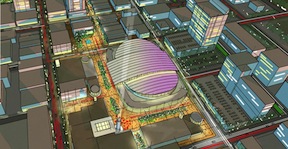
arena arial, from City of Sacramento

Whether the arena is built or not, I care little, and whether the Kings stay or not, I care not at all. But what I find interesting is that no one any longer talks about a public asset like this being located in the suburbs. When it was in the railyards, it was a downtown arena. As it is now proposed on the footprint of the mall, it is the downtown arena. It is the same in Seattle, where the arena location is not so central but is still part of downtown.

Sacramento has grown up! It realizes that downtown is the place for public assets. Downtown has a high density of public transit, walkable and bikeable areas, a grid street pattern, established businesses that can serve patrons of an events center, and yes, even freeways.

The ARCO/Power Balance/Sleep Train facility squats in the middle of acres of parking, a 12,000 parking space wasteland. It is far from light rail, is poorly served by bus (you can get there, but you can’t get home, for evening events, and not at all on Sunday, transit score 24, minimal), is in an un-walkable and un-bikeable area (all high speed arterial roads, walk score 48, car dependent), where almost no streets go through (the classic suburban street system of cul-de-sacs and streets that wind interminably). Why anyone ever thought an arena in Natomas was a good idea, I don’t know, but at least no one any longer thinks it is. And that is progress!

Downtown Plaza, the currently proposed location, has a walk score of 94, walker’s paradise, and a transit score of 67, good transit.

News summary April 14

Sacramento Transportation Programming Guide

Sacramento is updating its Transportation Programming Guide, and has sought public input on projects. A survey (deadline April 15) seeks input on specific improvements at specific locations, but it does not seek input on the overall approach of the guide. The 2010 guide is available for review. Since the survey did not allow me to comment on the overall plan, I submitted some comments, below. I could have said a lot more about each of these, but only have time for this at the moment.

  • Roadway widening is not needed anywhere in Sacramento. Widening generally induces more traffic, and when it does not, is a waste of limited resources. We need a fix-it-first policy, and roadway widening is not part of that.

Read More »

legislation update

There are several bills before the California Legislature that would affect bicycling, walking, and livability. For additional information, see Richard Masoner’s Cyclelicious blog (search for “legislation”) and the California Bicycle Coalition’s 2013 Legislative Agenda page.

AB-184: Statute of limitations: lengthens statue of limitation for hit and run, probably a good bill

AB-206: Vehicles: length limitations: buses: bicycle transportation devices (SacRT): amended to add an onerous process for approval, but probably still a good bill

AB-417: Environmental quality: California Environmental Quality Act: bicycle transportation plan: no changes so far, a good bill

AB-666: Automated traffic enforcement systems: violations: red light cameras, it restarts the program, but with civil rather than criminal penalties, supported by CaliforniaWALKS and California Bicycle Coalition; hearing in Assembly Judiciary 04/23/13

AB-738 Public entity liability: bicycles: no changes so far, still a bad bill; hearing in Assembly Judiciary 04/23/13

AB-840: Vehicles: driver’s licenses: application requirements: stripped of all bicycling knowledge language, now only requires that drivers license applicants acknowledge the dangers of distracted driving

AB-956: Vehicle accidents: fleeing: no changes so far

AB-1002: Vehicles: registration fee: sustainable communities strategies: changed to remove urgency language and detail use for sustainable communities; still a good bill; hearing in Assembly Transportation 04/22/13

AB-1179 Regional transportation plan: sustainable communities strategy: schoolsites: language slightly diluted, still a good bill

AB-1193 Bikeways: allows cities and counties to use industry standards rather than the requiring the use of the Highway Design Manual; language improved, a great bill; hearing in Assembly Local Government 04/24/13

AB-1194: Safe Routes to School Program; maintains SRTS program at state level, added non-infrasture, statewide coordinator, and TARC; better; hearing in Assembly Transportation 04/15/13, 1:30PM

AB-1290: Transportation planning: broadens representation on the California Transportation Commission and requires reports on progress of transportation agencies in reaching sustainable community goals; seems to be a good bill; hearing in Assembly Transportation 04/29/13

AB-1371: Vehicles: bicycles: passing distance: this bill originally had a different purpose, and was revised to be a three foot passing law, it looks to me to be good; hearing in Assembly Transportation 04/22/13

Please let me know if you are aware of any other bills. I’ve signed up for tracking on these particular bills, but may not be keeping up to date.

News summary April 7

Suspect in Carmichael DUI murder looking for heroin at time of crash, witness says (SacBee, 2013-04-07)

Sac City Unified board votes to convert Rosa Parks Middle School to K-8 (SacBee, 2013-04-05)

County may downzone land from homes to ag (Sacramento Business Journal, 2013-04-05)

Midtown streets getting lit up (Sacramento Press, 2013-04-04)

Streamlined Sacramento zoning code goes to council (Sacramento Business Journal, 2013-04-03)

Lawsuit signaled over Sacramento’s arena plan (SacBee, 2013-04-03)

Hearings scheduled for California bicycle legislation (Cyclelicious, 2013-04-03)

Tom Ammiano: Let’s Make Pedestrians and Cyclists Safer (Huffington Pose, 2013-04-02)

Ask Sacto 911 crime Q&A: What’s latest in case of driver who struck children in Citrus Heights? (SacBee, 2013-04-02)

Core-city crimes inch upward; police say it’s still pretty safe (SacBee, 2013-04-01)

Get smart (Sacramento News & Review, 2013-03-28); How an environmental law is harming the environment (Sacramento News & Review, 2013-03-28)