News summary June 23

Carnage

Development, infill and otherwise

Other

What are stop signs for? Part 4

Continued from Part 3

The personal upshot…

I have decided that stop signs that are installed solely to slow traffic do not apply to me. I’m already going less than the speed limit, about 15 mph, and I don’t need to be slowed down, so the purpose of the stop sign does not apply. Instead, the correct behavior is to slow, look, and proceed when it is safe. I will follow the standard yielding rules, as they apply. This behavior is codified in the “Idaho stop law” (Idaho Statutes | Streetsblog). Though I know it is against the law in California, it is the rational and safe behavior.

I am much less sure about safe bicyclist behavior at red lights. The Idaho stop law allows bicyclist to proceed after they have stopped and there is no conflicting traffic. I’m still thinking about this one.

What are stop signs for? Part 3

Continued from Part 2 (note: I posted this part 3 early, and then had to delete it, my apologies)

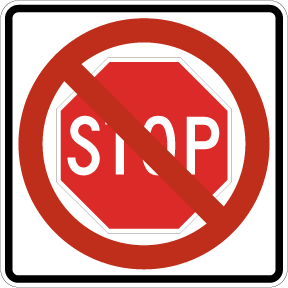
stop-slashAs part of my job, I spend a lot of time at intersections observing the behavior of motor vehicle drivers, bicyclists, and pedestrians. What I observe is that about 20% of motor vehicle drivers come to a full legal stop at stop signs, when there are no other vehicles present that might cause a collision. What about bicyclists? Wait for it… About 20% of bicyclists come to a full legal stop at stop signs. Yet the perception of many motor vehicle drivers is that they are stopping and bicyclists are not. Motor vehicles drivers complain in letters to the editor, news shows, blog comments, and conversations about flagrant violations of the law by bicyclists, which they either say or imply should result in harsh enforcement, restrictions on where bicyclists may ride, and “licensing.” A few crazies even say that it is OK to run down a bicyclist who is violating the law. But the fact of the matter is that bicyclist and motor vehicle driver behaviors are nearly identical when it comes to stop signs.

News summary June 16

Carnage

Development, infill and otherwise

Miscellaneous

What are stop signs for? Part 2

Continued from Part 1

Streets should be designed to induce traffic speeds that are appropriate to that street, consistent with surrounding uses. In my mind, that means 20 mph in residential areas and up to 30 mph in commercial areas. What about all those other roadways? They are mis-designed stroads. Properly designed streets:

  1. have a grid pattern so that use is spread out rather than concentrated on a few streets, so that intersections may functions without stop sign or signal control
  2. have good visibility at intersections
  3. have both physical constraints and visual clues to ensure that they are used at the intended speed
  4. have a minimum of signs

Of course that is largely not what we have now. What to do?

r1-2The solutions to an excess of stop signs are:

  1. Roundabouts, covered in my previous post What is a roundabout?
  2. Spread out traffic by installing traffic calming equally on parallel streets, rather than focusing traffic on select streets by installing traffic calming on other streets.
  3. Change intersections to increase visibility, by modification or removal or vegetation, fences, and parking.
  4. Replace four-way stops with two-way stops where there are sufficient gaps in traffic on the busier street.
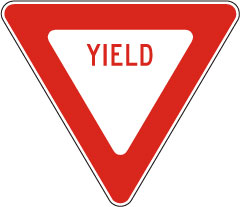
  5. Replace both four-way and two-way stops with two-way yields, with the yield signs being on the lower traffic street.
  6. Remove all signs from low traffic streets, and allow vehicles normal yielding behavior at the intersection.
  7. Analyze all intersections over time to assess whether signing is really necessary, with the default assumption being that it is not.

I suspect that after analyzing intersections for the purpose of the stop sign, and alternate solutions, the number of stop signs would be reduced by at least 60%. Safety would not be reduced. Speeds would not increase. Both motor vehicle drivers and bicycle drivers would be happier.

What are stop signs for?

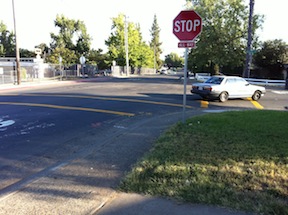
Rosswood-GrandOaks_crosswalksIn the month of May I bike commuted to work in Carmichael and Citrus Heights most of the days. I had plenty of time to think about stop signs, as there are a lot of them on my regular routes. A few less, now that the county has removed some from the parkway path, but still, a lot. At most of these stop signs, there are no cars anywhere in sight, particularly at the beginning of AM and PM commute hours when I’m riding, but even at other times of day. So I started thinking, why are these stop signs here, and what are stop signs for?

Stop signs get used for these purposes:

  1. When there is a busy intersection with a more or less equal flow of vehicles on both streets. The four-way stop signs assist people in taking turns.
  2. When one street is so busy that gaps long enough to cross that street are rare.
  3. When there are visibility issues that prevent vehicle drivers to see each other.
  4. When motor vehicles are going too fast, and they need to be slowed down.

Looking at each purpose in more detail:

Read More »

What is a roundabout?

I have noticed a lot of confusion in Sacramento amongst both transportation professionals and citizens interested in traffic calming about roundabouts. If you live, work or play in downtown and midtown Sacramento, you’ve seen a lot of structures in the intersections which people call roundabouts, but which are not, they are traffic circles. So what is a roundabout?

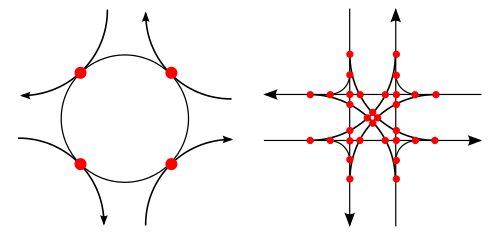
intersection conflict points

A modern roundabout is a structure that allows a free flow of traffic without stop signs. Instead, they use yield signs and markings. They are most appropriately used at street intersections where both streets are fairly busy. The biggest advantage of a roundabout, for all users, is the reduction of conflict points in the intersection from thirty-two to four, as illustrated in the diagram at right!

Read More »

Teaching children to cross

children crossing, Fauntleroy at Alaska, West Seattle (Seattle Bike Blog)

Streetsblog today posted an article “Our Streets Fail to Work for Children” which referred in turn to articles from Akron and Seattle. I commented on the Seattle Bike Blog post “We are failing our kids: A look at Seattle’s terrifyingly normal streets,” but I’d like to amplify my comments and specifically talk about pedestrian education.

Poor pedestrian infrastructure, as documented in these posts, is everywhere, more so in the suburbs and rural areas than in urban areas, but everywhere. The problems include:

Read More »

News summary June 9