non-functioning water fountain at Sunrise light rail station
On Wednesday evening, I rode from Woodside K-8 School in Citrus Heights to the Sunrise SacRT light rail station, and then caught light rail home. As I passed Sunflower in Fair Oaks, I thought of stopping for a drink of water, but decided to just head on down the hill to the drinking fountain on the north side of the red Fair Oaks bridge. It was not working, covered with plastic. I continued on to the Sunrise station, where both water fountains are not working. I suspect these have not been working for years, they look abandoned. By this time, I was pretty darn thirsty, and the long wait in the evening for the next light rail train was not pleasant. Even if I’d wanted to go to a convenience store for something to drink, there aren’t any close to that station.
A “green wave” is a traffic signal sequence set so that vehicles will encounter green lights for some distance, so long as they are traveling at the selected speed. A green wave can also be set for bicycle speeds, though it very rarely has been, and never in Sacramento.
To some degree, all signals are set this way, though the degree and distance of sequencing varies widely. Many of the east-west streets in the Sacramento grid have signals set for motor vehicles, and when traffic is not congested, it may be possible to go all the way across downtown and midtown on green lights, for example on J Street. Very few north-south streets are set this way, I can think of only the 15th & 16th couplet, and the 9th & 10th couplet. At intersections with the east-west couplets, these north-south couplets seem to have their green wave broken. Only if the grid spacing and the selected speed calculate out is it possible to have a green wave in all directions. Sadly, many signal sequences in the Sacramento region are set above the posted speed limit, encouraging drivers to speed so that they make all lights.
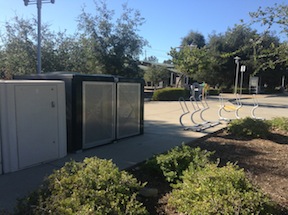
bike lockers at SacRT light rail Glenn station in Folsom (SacRT rental, BikeLink, bike racks)
If you are a light rail user, you may have noticed bike storage lockers at some of the stations. Two types of lockers exist:
rental lockers at 19 SacRT light rail stations, which are listed on the SacRT “Biking with RT” webpage
on-demand lockers at 3 SacRT light rail stations in Folsom, plus the Folsom Pedal Stop bike station
The rental lockers work well for people who routinely commute the same route to and from work, and are leased for 6 months or 13 months at pretty reasonable rates. The downside to rental lockers is that they can be used by only one person, and are empty when not in use by that person. Mike Mattos, SacRT Chief of Facilities & Business Support Services Division, said that these lockers were mostly purchased at the time of rail extensions, and they are repaired and replaced from operating funds. They move lockers from one station to others as demand changes. They have explored on-demand systems, but have not installed any because they don’t feel that any vendors so far meet their criteria. He pointed out that the downside of on-demand systems for typical commuters is that they don’t then have a guaranteed space at their station.
I’m never sure whether to list these walker vs. train and light rail collisions – do they have anything to do with a safe transportation system or not? Since there is rarely followup information in the media, except sometimes the name of the victim, most of these kind of incidents remain ill-defined, and their significance unknown.
M Street bike routeAs I said yesterday, I choose primarily two-way, two-lane streets to walk on, because they offer a quieter and calmer place to enjoy walking, looking around, and finding businesses to frequent. When bicycling, I’m more likely to be going someplace specific, and more likely to be in more of a hurry. If given the time, I’d almost always rather walk than bike, but bicycling certainly saves a lot of time, and so I bicycle more than walk.
The first criteria for choosing streets to bike on is traffic speed. In the grid, nearly all of the streets are posted 25 mph, but traffic speeds vary widely from 20 to 40 mph. When a street is designed for 40 and then posted for 25, motor vehicle drivers respond by going 40. Again, this is a street design issue. I am not afraid of 40 mph traffic, and I am OK mixing in with it – I’m a vehicular bicyclist, but why, when I don’t need to? So I pick other streets.
First preference is quiet streets with a design or signing welcoming to bicyclists. Best example is M Street in East Sacramento, my usual route to and from Trader Joes, and also when I jump off the parkway at Sac State and continue into downtown/midtown. Streets like M are the closest Sacramento has to bike boulevards or neighborhood greenways.
Second preference is narrow streets without bike lanes. Why? Because the traffic moves slowly on these streets, sometimes below the posted speed. Since I’m now treating stop signs as yield signs, the more frequent stop signs on these streets don’t slow me down very much, there are few vehicles to take turns with except at two brief times of day. Parking along these streets helps a lot, particularly when it is diagonal, because parked cars create friction that slows drivers.
Third preference is streets with bike lanes. But often these are higher volume, higher speed streets. If I’m really in a hurry, these are the streets I use. Fewer stop signs and fewer signals make for a faster trip. In that sense I’m making the same decision as car drivers.
business on a two-way, two-lane street (Capitol at 18th)
I walk a lot in midtown, going to and from various destinations such as the train station, nonprofits and agencies I work with, grocery stores, theatres, farmers markets, breweries, etc. I was thinking last night as I walked to and from Capital Stage about what streets I choose to walk on.
Almost all the time I choose to walk on two-way, two-lane streets. I rarely choose to walk on the multi-lane streets and the one-way streets, except for short distances as I zigzag to my destination. The two-way, two-lane streets are usually quieter, less traffic and traffic moving more slowly. I can relax more with the quiet, and I can look around more, paying more attention to everything around me and not just traffic.
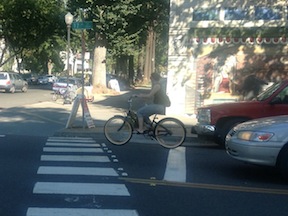
this bicyclist rode past a right-turning car on the right side, without letting the car driver go first
I often see or hear the statement “bicyclists run stop signs all the time.” The person making the statement is not just making an observation, but trying to justify some attitude or action on their part, such as “bicyclists shouldn’t be on the road,” “bicyclists should be on the sidewalk,” “bicyclists should be thrown in jail,” “it is OK to intimidate or run over bicyclists,” or “we should not be spending any of our transportation money on bicycle facilities.”
I think that it is time for all of us to confront that statement and end its use. Yes, it is true that some to many bicyclists run stop signs. It is also true some to many motor vehicle drivers run stop signs. To refer back to my earlier posts on stop signs, stop signs are installed largely to reduce vehicle speeds and to get drivers to take turns at intersections. Bicyclists are rarely exceeding the speed limit, so that function is not served by the stop sign, nor by a bicyclist stopping. In the case of taking turns, the issue is taking turns, not the act of stopping. If a bicyclist does not stop at a stop sign, but no other vehicles are present which should go first, then the function of the stop sign to get people to take turns is intact, it has not been violated.
Despite changes, labor and neighborhood groups remain opposed to big-box ordinance (Sacramento Press 2013-07-29); for any of you wondering why this is a transportation issue, it is because big box stores generate considerably more motor vehicle trips than do small, locally owned businesses, and they are part of the sprawl development patterns that many places are striving to eliminate




 Getting Around Sacramento