News summary September 15

CEQA

Other

News summary September 8

Carnage

Legislation update (see Legislation page for more info)

  • AB 1371, the three foot bill, passed the legislature and is before the governor; he has not indicated whether he will sign it or not, but he vetoed the previous two bills

Other

the problem with rolled curbs

Curb&GutterDiagramsRolled curbs slope up from the gutter pan to the sidewalk, whereas standard curbs have a more vertical face. Standard curbs are both old and modern, but there was a period of time in the 1950s through 1970s when rolled curbs were very popular, seen as a sign of the new suburbs. In the grid area of Sacramento, including the first ring suburbs, standard curbs are quite common. In the second ring suburbs and the sprawl suburbs, rolled curbs are quite common, not only being found in residential neighborhoods but even on arterial roads.

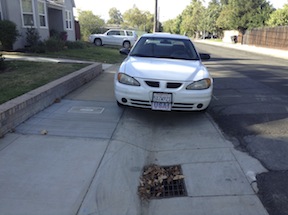
parking up on the sidewalk with rolled curb

So, what’s the problem with rolled curbs? Drivers use rolled curbs to drive up on the edge of the sidewalk, constraining the sidewalk width, reducing walkability, and not infrequently causing blockage of the sidewalk for people in wheelchairs. ADA regulations require at least 36 inches of clear width. Combine the narrow 4-foot sidewalks that were popular in the suburbs with this driver behavior, and the car-influence zone is expanded to the complete width of the right of way, leaving no place for pedestrians. [Note: This photo is for illustration purposes only, not to give this driver a hard time. This is common practice, and I’ve seen many instances where much more of the sidewalk was blocked.]

A side affect of parking up on sidewalks is that it leaves more of the street width for moving motor vehicles, which then increases the speed at which people drive. By trying to get their vehicles out of the way of the “speeding drivers,” they are actually making it easier for drivers to speed.

What are the solutions?

Read More »

Caltrans Watch

As though I need something else to do, I have started another blog called Caltrans Watch, following a conversation with Jim Brown in which we realized that someone needs to be calling Caltrans to account on its sprawl-inducing and livability-killing approach to transportation. Please take a look and make suggestions for improving it, hopefully with your own contributions. There is a Twitter handle to go with it, @CaltransWatch.

whose responsibility are sidewalks?

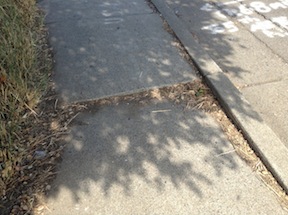
broken sidewalk, Sutterville Road at 24th Street

Note: As I wrote this post, I realized that some background info was needed, hence two related posts: sidewalk buffers and surprisingly good sidewalks.

This week an article in the Sacramento Business Journal, “Rancho Cordova wants to make sidewalks problem of property owners,” talked about the city’s efforts to shift responsibility for sidewalks to the property owners, both residential and commercial. The city spokesperson, Davis Gassaway, attempts to gloss over the impact by saying that it should only cost $1000-1500 to repair a sidewalk, and that Sacramento, Roseville, and West Sacramento already have such ordinances. I think the costs quoted are on the low side. At about $4 per square foot (significantly more for curbs), $1000 would buy 50 linear feet of five foot wide sidewalk in a residential area, and 25 linear feet of ten foot wide sidewalk in a commercial/mixed use area. And just because another city is doing it doesn’t make it a good idea. So, what’s wrong with the idea?

Read More »

surprisingly good sidewalks

repaired sidewalk around tree, P Street at 16th Street

When working on my post about responsibility for sidewalks, I realized I did not have a good illustrating photo for the post, so I went off walking in my neighborhood (midtown) looking for examples of broken sidewalks. After walking a couple of miles, I’d found only a few, and they were not bad. I guess my view of the world has been jaundiced by the time I spend in the suburbs, where many of the sidewalks are broken and deteriorating. There, it would take me less than a block in most areas to find something wrong with the sidewalk, or to find no sidewalk at all.

In midtown, that is not so. I see a lot of places where the sidewalk has been replaced or repaired, often many times over the years, in a patchwork of concrete of varying ages. There are asphalt patches over uneven sections, which work as long as they are kept up to date, but must eventually be repaired by removal and replacement.

Read More »

sidewalk buffers

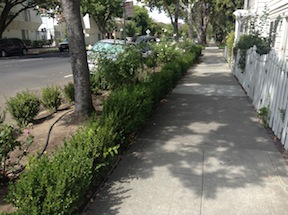
garden sidewalk buffer on Q Street

The purpose of sidewalk buffers, also called planting strips, is to isolate pedestrians from moving motor vehicles, where parking does not provide a sufficient buffer. Sidewalks adjacent to the curb are called attached sidewalks, while sidewalks with a buffer are called detached sidewalks.

Traditionally all residential, collector, and arterial streets had buffers. Retail areas often did not, in order to make getting from the car to the sidewalk more convenient.

Modern suburbs, however, usually eliminated the buffer strip from all streets in order to maximize the area available for development and roadways. Pedestrians do not like to walk next to fast traffic. In part, the elimination of buffers is why there is much less walking in the suburbs. The lack of buffers also makes an area look harsh, with a bland expanse of pavement rather than the welcoming and beautiful strip of nature. The planting strips and their vegetation require maintenance, and responsibility for those areas is another question of responsibility.

Read More »

News summary September 1

removing Business 80?

William Burg started a wonderful conversation on Facebook about removing Business 80 from B Street to Hwy 50, returning the traffic to surface streets. The post is now up to 115 comments, and still going after two weeks. I believe that you have to be a member of Facebook to view this thread, but don’t need to be friends with William Burg (though you should). I agree with Jared that this topic should be amplified for Sacramento Press.

Some people think that this is crazy thinking, it will never happen. I think it will. Why? Not because it is a good idea, though it is, but because we will not be able to continue to keep these freeways open and in decent condition with future transportation funding. Caltrans and others have just spent or are spending $202 million on Hwy 50, basically just to keep in it usable condition. Not to improve it in any significant way, but just to keep it working. Where is the money going to come from to maintain Hwy 50, Interstate 80, Interstate 5, and Business 80 (Capital City Expressway)?

Read More »

the magic water fountain on M Street

water fountain in the M Street mini-park

In my previous post, I complained about the non-functional water fountains at SacRT light rail stations, but in doing so, I remembered that I’d never posted about the water fountain on M Street in Sacramento. Herewith is my paean to the M Street water fountain.

In a tiny triangle park at M Street and 48th Street in East Sacramento is a wonderful thing, a public drinking fountain. Not only is there a drinking fountain, but also a decorative fountain, and benches, and flowers, and shrubs, and a patch of grass. I stop here on every trip, whether I’m thirsty or not, just to celebrate this little corner. Sometimes I’ll stop and lie on the grass, or sit on the bench and enjoy the fountain. Other times, it is just a quick drink and on with my trip. I’ve seen mothers here letting their kids play, and retired folks just passing the time. There is always a bowl beside the fountain for dogs to have a drink as well.

Read More »