Strong Towns approach to roadway safety
Strong Towns, an organization which provides leadership and thinking through five priority campaigns: End Highway Expansion, Transparent Local Accounting, Incremental Housing, Safe and Productive Streets, and End Parking Mandates and Subsidies. Safe and Productive Streets are the focus this week, with a podcast Prioritizing Safety in Street Design: A Conversation with Melany Alliston, posted today, and tomorrow, Beyond Blame Press Conference: How Cities Can Learn From Crashes To Create Safer Streets Today, and release of a report Beyond Blame: How Cities Can Learn from Crashes to Create Safer Streets Today.
Strong SacTown, the ‘local conversation’ or affiliate of Strong Towns is an active participant in the City of Sacramento Street Design Standards Update. Please join Strong SacTown. Slow Down Sacramento (Isaac Gonzalez) is also playing a major role in bringing awareness of roadways safety to the public, and his emails inform this post. Please join Slow Down Sacramento. Civic Thread and SABA, along with many other organizations, are providing both leadership and technical expertise on roadway safety. Please support them!
Strong Towns has offered the Crash Analysis Studio for two years now, with 19 studios. I have participated in several of these, and I think they are great, though only a part of the necessary response.

this week 2024-10-14
Monday 14
- SacRT Board Meeting (special), 4:00 PM, includes presentation and discussion of revised Smart Ride program
Tuesday 15
- Strong Towns Beyond Blame Press Conference: How Cities Can Learn From Crashes To Create Safer Streets Today, 9:00 AM, online; https://us02web.zoom.us/webinar/register/WN_0dai3to0RC6Zs5DpdmIsQA?apcid=00661a995d8b8c0fdb8d6701&utm_campaign=cas-report-and-conference&utm_content=cas-report-and-conference
Wednesday 16
- SACOG Transit Coordinating Committee, 9:00 AM, online
Thursday 17
- SACOG Board of Directors, 9:00 AM, includes workshop on Dangerous by Design
- CARTA (Capital Area Regional Tolling Authority) Board, 12:00 PM
- SacRT MAC (Mobility Advisory Council), 2:30 PM
- SacATC (Active Transportation Commission), 5:30 PM; includes speed limit report and annual report
- ECOS Climate Committee, 6:00 PM
Friday 18
- SacMoves Coalition, 10:00 AM, online
Saturday 19
- River District Open Streets Festival, Mirasol Park, 400 Pipevine St, Sacramento CA 95811; 12:00 – 4:00 PM; https://www.eventbrite.com/e/river-district-open-streets-festival-tickets-939893455627 (registration not required)
Prop 5 bonding for transportation?
Proposition 5
A Yes on 5 website offers details in support of the proposition. The arguments against, on the voter information guide, are just the standard anti-tax voice, so isn’t useful to this post, but you can read your guide if you are interested. Prop 5 was placed on the ballot by the legislature, as a result of two legislative resolutions. The proposition is entitled “Proposition 5: Allows Local Bonds for Affordable Housing and Public Infrastructure with 55% Voter Approval.“
The proposition would change the voting threshold from two-thirds, 67%, to 55%, for ballot measures by cities, counties and special districts (does this include SacRT?) that bond against property taxes for the purposes of affordable housing and public infrastructure. The proposition does not directly raise property taxes, nor would local bonding measures directly raise taxes, though since the bonds have to be repaid with interest, property taxes could eventually go up within the limits sets by other legislation. This has nothing to do with sales tax, which remains at two-thirds for govenment proposed sales taxes, and 50%+1 for citizen proposed measures.
The history of the proposal development indicates that it is more about affordable housing than public infrastructure, but infrastructure is definitely allowed, and could easily be justified when that infrastructure supports affordable housing. It can also apply to transportation infrastructure. The specific language in the ballot measure related to infrastructure is “construction, reconstruction, rehabilitation, or replacement of public infrastructure”, which is pretty open-ended. More specifically, the proposition lists the following infrastructure uses:
(I) Facilities or infrastructure for the delivery of public services, including education, police, fire protection, parks, recreation, open space, emergency medical, public health, libraries, flood protection, streets or highways, seaports, public transit, railroad, airports, and
(II) Utility, common carrier or other similar projects, including energy-related, communication-related, water-related, and wastewater-related facilities or infrastructure.
(III) Projects identified by the State or local government for recovery from natural disasters.
(IV) Equipment related to fire suppression, emergency response equipment, or interoperable communications equipment for direct and exclusive use by fire, emergency response, police, or sheriff personnel.
(V) Projects that provide protection of property from sea level rise.
(VI) Projects that provide public broadband internet access service expansion in underserved areas.
(VII) Private uses incidental to, or necessary for, the public infrastructure.
(VIII) Grants to homeowners for the purposes of structure hardening of homes and structures, as defined in state law.
The reason for raising this issue is that taxes based on property are progressive, meaning that people with higher incomes and therefore higher value property, pay more in taxes. Sales taxes are regressive, meaning that low-income people pay a higher percentage of their income on taxes than do higher income people. Proposals to increase the sales tax in Sacramento County have been resisted by many who think we have runs out that option and need to turn to options that are not regressive, like property tax.
I prefer pay-as-you go expenditures from most transportation projects, except for a few which are very expensive and of clear benefit to everyone. There are few transportation projects that would or should quality for this. The transportation projects we most need going forward are many small fixes, not the mega-projects done in the past which tend to be motor vehicle projects. But some transit projects could be or should be bonded. The problem with bonding is that interest payments raise the cost to about 1-1/2 times the project cost, depending on the bond length and bone rates, and that money goes to wall street investors, not to the project.
I am in favor of the proposition. It gives local governments, and therefore citizens, control over how they spend their property tax, rather than being constrained by statewide controls that were implemented by anti-tax interests.
If the proposition passes, would it be the solution, or a solution, to funding affordable housing and transportation infrastructure instead of or in addition to sales tax or other taxes and fees? I don’t know, but I do think it is worth exploring. Though the proposition applies to local measures on the same ballot, there are no transportation measures of any sort on the 2024 ballot in Sacramento Couny. There may be in 2026, as a Sacramento Transportation Authority new Measure A transportation sales tax, or a SacRT sales tax for transit with a limited geography, a citizen measure sales tax for housing, transportation, and active transportation (the SMART/Steinberg proposal), or other ideas that have not yet come forward. A property transfer tax has been discussed, which is another progressive tax. The state has a property transfer tax, as do other entities. It isn’t clear to me whether Sacramento County or any of the cities within the county have transfer taxes.
Yolo causeway bike path
Caltrans and Yolo County Transportation District are proposing to widen a section of Interstate 80 from Sacramento to the Yolo/Solano county line, a project called Yolo 80. This is not just a future project, subject to funding shortfalls and lawsuits, but is actually underway, as Caltrans illegally spends funds for highway maintenance on highway widening. I have written a number of posts on Yolo 80 and managed lanes, but today is just about the bike path that parallels Interstate 80 from the west edge of West Sacramento to Davis.
I am not a commuter or regular rider on the causeway path, but I do average riding it about once a week (I like concerts and beer and Mishka’s tea), and have been doing so for about 13 years.
Caltrans, in the Final Environmental Impact Statement (FEIR), Chapter 2, proposes a number of mitigation measures or policies, including the rehabilitation of the existing bike path, and extension of the bike path to county road 105, where a bicyclist can either use an existing though poorly maintained bike path along the freeway, or surface streets into Davis. In selling the project to the public, Caltrans and Yolo TD have promoted the mode shift potential of an improved and extended bike path, and in fact it seems a major part of the project.
However, this and all other mitigation measures are dependent upon excess tolling revenue, income above that necessary to maintain the section of freeway. It is not at all clear that there will be any excess funds, and Caltrans has made no promises that any mitigation measures will be implemented if there is no excess. Freeway maintenance is expensive!
To take Caltrans at their word, that they really want to do the bike path improvements and extension (if you take Caltrans District 3 at their word, you haven’t been reading this blog), it is instructive to look as the existing path and route.
First, the part along county road 32A, from where the path joins the road, to county road 105, where 32A crosses to the north of the railroad tracks, and the path along the freeway to Olive Drive begins. After a patch of gravel on the shoulder that gets worse over time, the bike ‘route’ is on the shoulder of road 32A, with a posted 55 mph speed limit (which means, in a practical sense, 65-75 mph). There is frequently trash on the shoulder, which is the responsibility of the county, but I have never seen trash picked up or the shoulder swept. This is not horrible for experienced bicyclists, I have ridden it a number of times, but replacing the shoulder with with an actual Class 1 bikeway would be an immense improvement. However, if the path is between 32A and the freeway, the noise and auto pollution will still be horrible. Could it be on the other side of the railroad tracks? Perhaps, but having the path pass under the railroad tracks to the north side would raise the issue of blocked access during flooding episodes, which are not uncommon in the Yolo Bypass (that is why it exists).


The second mitigation is rehabilitation of the existing bike path along Yolo causeway. I think it is useful to see how Caltrans is taking care of the existing path to see how they might rehabilitate it, and take care of it in the future. Preview: They don’t give a shit.
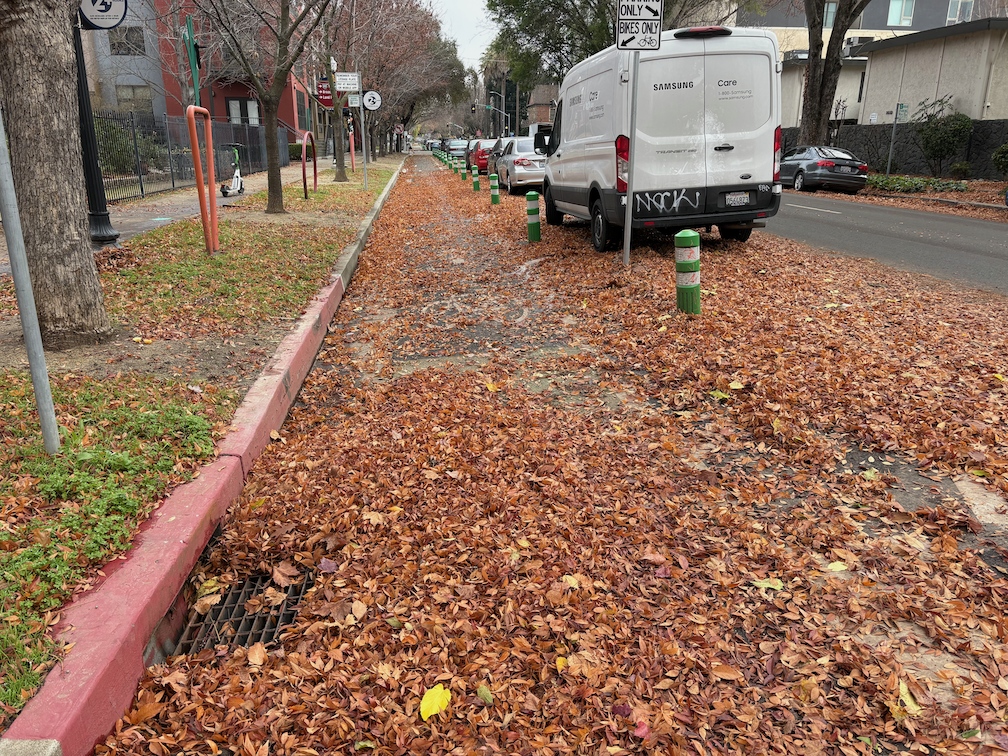
Trash coming off vehicles accumulates on the path. I don’t know how often it is cleaned, but I can tell you it is not often. Maybe twice a year. A lot of the trash eventually gets blown off into the Yolo bypass rather than getting picked up. This Wednesday, there were large accumulations of leaves shed from the trees along the path.


The path itself has not been maintained in the 13 years I’ve been riding on it. There are cracks that have been there so long tree sprouts are coming up in them. The asphalt parts of the path, where the path is on fill rather than bridge, are becoming unrideable. Many of these cracks are parallel linear, presenting the danger of wheel capture and falls for narrow-tired bikes.


When it rains, the path has large and persistent puddles. It was not well designed to drain. Note that the photo below was two days after the rain, and there is still standing water.

The path has been narrowed in several places for construction of the widened section of the freeway. This makes everything worse, removing the width that allows bicyclists to navigate around hazards.

There is a fence along the concrete barrier between the freeway and the path. This fence is not only intended to keep people from crossing (though it does have gaps from time to time, presumably to allow people from disabled motor vehicles to exit the freeway), it protects bicyclists on the path from flying debris from cars. Not only the trash they lose, but actual car parts. You can find a variety of car parts along the path, and I’m sure far more is prevented from getting onto the path by the fence. Cars lose a lot of parts! But construction has removed the fencing along a number of sections. In some cases there is wood fencing on top of the K-rail temporary barriers, but it is flimsy and only half the height of the fencing. And in several locations, there is no fencing at all, it has simply been removed. For no reason, so far as I can see.

At the western end of the causeway section, where the path turns north to connect to road 32A, there should be a permanent barrier to make sure that bicyclists don’t continue onto the freeway. But the barrier, created with leftover materials, is frequently damaged, probably by construction crews, and has several times been missing completely. Imagine riding here at night!

What Does It Mean?
It means that Caltrans cannot be trusted to construct, rehabilitate, or maintain a bike path along the route of Interstate 80 through the Yolo Causeway and into Davis. They are lying that they have, they are lying that they will. Do not, under any circumstances, trust Caltrans District 3 to serve or protect bicyclists. This is criminal neglect by Caltrans.
SacTA Board 2024-10-10
I realize that posting meetings so close to the meeting makes it impossible to schedule your possible attendance, and sometimes even to submit comments through email. But it is still useful, I think, to keep up on transportation issues and government agencies. Discussion and even decisions on the agenda are often not the final word.
The Sacramento Transportation Authority (SacTA – I label it SacTA rather than STA, to distinguish from the California State Transportation Agency which goes by STA or CalSTA) Board of Directors will meet today, Thursday, October 10, at 1:30 PM in the Sacramento County Board of Supervisors chambers, 700 H Street in downtown Sacramento. The agenda can be viewed on the SacTA Board Meetings page, or here. The entire meeting packet is available on SacTA, but it is quite a large document, and you may find looking at individual agenda items to be more efficient. I’ve commented on a linked to three items of greatest interest to me.
Agenda 08: SB 1 Cycle 4 Local Partnership Program (competitive) Project Prioritization
There are two projects to be prioritized for application to the state SB 1 Local Partnership Program, one related to the I Street Bridge Replacement project, and the other for a transit bus yard, hydrogen buses, and hydrogen refueling in north Sacramento, and other transit and transportation projects. Generally only one submitted project is funded, so the prioritization is important.
I don’t have any strong feelings about the two projects, though I will caution that the rush to hydrogen, which is fueled (pun intended) by strong federal, state and local subsidies, is risky. Though hydrogen fuel cells may turn out to be the best solution for some transit routes, the paucity of green hydrogen (that does not rely on fossil fuels or biomass conversion), and the lack of really addressing this issue, is concerning. Much of hydrogen boosterism comes from the fossil fuel industry, trying to maintain its grip on our energy system.
I think everyone would agree that the I Street Bridge replacement is critical, but the city has made sure that it is an expensive trophy bridge rather than a utilitarian bridge.
Agenda 11: Potential Legislative Changes (I’ll let you read the full agenda item title)
The charter for SacTA, established with the passage of the existing Measure A (not the failed Measure As) limits the agency to pass-through of transportation funds to local transportation agencies, with limited influence over the projects implemented. The ‘Measure C’ proposal by SMART (Sacramento Metro Advocates for Rail and Transit) and Mayor Steinberg, places an emphasis on transit, housing, and safe streets. And no roadway capacity expansion. The measure being considered by SacRT, for the City of Sacramento and Elk Grove portion of its service area, would provide some support for infill transit oriented development and first mile/last mile active transportation, but would be primarily for transit. SacTA does not have the authority to fund anything other than direct transportation projects. This agenda item would allow SacTA to consider legislation to broaden it mandate to include housing or housing-supportive infrastructure related to transportation.
It is not clear whether any measure proposed by SacTA would approach the model proposed by active transportation and transit advocates, but this idea is worth pursuing.
I support this agenda item.
Agenda 12: Consider the Creation of a Temporary New Transportation Funding Subcommittee
This agenda item would form a subcommittee to explore the possibility of, and chances for success, of a 2026 transportation sales tax measure sponsored by SacTA.
We know that a transportation measure heavily weighted towards roadway capacity expansion has failed and will fail, but with a possible shift in priorities to roadway maintenance (fix-it-first), transit and active transportation, there is some chance of success. If Proposition 5 passes this November, it is possible that a ballot measure in 2026 would require only a 55% yes vote, rather than a 67% yes vote, which is difficult to pass in Sacramento County with its strong suburban and semi-rural opposition to all taxes.
Several transportation advocacy organizations are opposed to any additional sales taxes since they are regressive, having a much greater impact on low-income people than other taxes. However, at this time, it does not looks as though any of the potential proposals uses alternative taxes.
I support this agenda item.

more on Broadway-Land Park bike signal
I have written before about the problematic bike signal for Broadway eastbound at Land Park Drive (dangerous bike signal on Broadway, Broadway bicyclist press the button). Now some more detail, from a full hour of observation on the signal and driver behavior.
I had hoped to observe bicyclists reacting to the signal, but unfortunately there were no bicyclists. Despite the city devoting much of the street right-of-way to bike lanes (not protected, on only sometimes buffered), it appears that no one is riding their bicycle on Broadway. I’m not surprised. Broadway continue to be an unpleasant place for bicyclists and walkers, and regular bike lanes are unlikely to change that.
The last post I had noted that there was a required beg button for bicyclists to trigger the bike signal, but had failed to look up and notice that there was a complete set of regular signal, bike signal, and blank-out no-right-turn sign on the same post. It looks like:

For those unfamiliar with the blank-out signs, which are relatively uncommon in the city, it illuminates when turns are prohibited, and is blank when not prohibited. See photo below for the blank-out phase.
This signal array is definitely mis-communicating to drivers. When the bicycle signal is on, the no-right-turn sign should be on, and the regular signal red. This is mounted close to the right hand turn lane, and drivers see it as applying to that lane.
Most of the time, it is necessary to press the pedestrian beg button to trigger the bike signal. But then sometimes it is triggered without any press, and not due to the presence of bicyclists, as there were no bicyclists. Most signal cycles the bike signal remains red.
When the bike signal is on, there is a period of time when the no-right-turn sign is not on (blanked out), as below.

Do drivers follow the no-right-turn sign? In an hour of observation, I did not see one driver follow the sign. Every driver turned across the no-right-turn sign and across the green bike signal. Every. Though I did not observe it at this time, I have experienced drivers yelling at me, and other bicyclists have reported being yelled at, by drivers who think they have the right of way and wonder why bicyclists are proceeding and interfering with cars. The photo below shows just one of about 70 drivers who turned against the no-right-turn sign.

Solutions
- The regular signal should remain red while the bike signal is green. The placement of this signal is interpreted by drivers as applying to the right hand turn lane, so it must be red.
- The bike signal must have an exclusive phase where all other vehicle movements are prohibited. A properly designed intersection with a properly designed signal system probably would not need an exclusive phase, but this is NOT a properly designed intersection and NOT a properly designed signal system.
- The pedestrian beg button should be removed from the bike lane, and automatic detection of bicyclists installed. The city knows how to do this, and has done it at a few other intersections, but chose not to here.
Bicyclists will be fatally or severely injured here, and the cause of the crash will be mis-designed roadways, for which city engineers are directly responsible. Drivers are just responding to a mis-designed roadway, the guilty party is the traffic engineers.
The design document for Broadway Complete Streets, and as built, has a through lane, a dedicated left hand turn lane, and a dedicated right hand turn lane. This right hand turn lane is the source of the conflict, the source of the danger. The roadway as built prioritizes motor vehicle throughput over safety.
a trip to San Francisco
My last major trip for the Week Without Driving was a trip to San Francisco.
Friday, I walked from a transportation safety meeting to Sacramento Valley Station, and caught Capitol Corridor train to Richmond, then transferred to BART into San Francisco Embarcadero Station, and walked to Trader Joe’s and then to the Hostelling International hostel near Union Square. That evening I walked to San Francisco Playhouse to see The Play that Goes Wrong, only two blocks away, which is why I stay at that hostel when I’m seeing a play.
Saturday morning I walked to the Ferry Building farmers market to grab a few picnic items, then took Muni Metro N Judah light rail to 9th & Irving. From there I walked into Golden Gate Park and to Hardly Strictly Bluegrass (HSB), a three day free festival (I missed the first day due to the transportation meeting) that I’ve attended seven times since 2010 (the festival is 24 years old). I realized sitting on the grass that I really wanted a lightweight folding chair to Sunday, and other uses, so I took two Muni buses to Sports Basement in the Presidio, bought the chair, and then one bus back to Union Square area and the hostel.
Evening, I went to a contra dance in Oakland, Circle Left. Short walk to BART, BART from Powell Station to 19th St Oakland, walk to the dance center. I didn’t last the entire dance, because a hot day in the sun and dancing at the festival left me drained. Walk and BART and short walk back to the hostel.
Sunday I again took Muni Metro N Judah to 9th & Irving, and walked to the Japanese Tea Garden, my favorite part of Golden Gate Park (among many), spent some while just being, and then had Hojicha tea. From there, a walk along JFK Promenade to HSB. The promenade is a long now car-fee route in the park, one of the best outdoor spaces in the city. The day was slightly less hot, but no less sunny, so in between main stage performances, I wandered to shadier stages (six stages total). The closing act by Emmylou Harris draws the biggest crowd of the festival, and of course I joined the many dancers on the grass to the left of the stage. Everything over, I walked out of the park and caught N Judah back to Union Square to pick up my travel pack left at the hostel, then BART to Richmond.
I missed the Capitol Corridor train that I intended to catch, so had to wait for the last. For an unknown reason, this last train was scheduled for an hour later than normal. The last train is often delayed to accommodate people attending the 49er’s game, or other major sports events, but the game on Sunday was an afternoon game, so the delay made no sense. And then the train was late. The plus was that I met and talked with several people on the platform who had also attended HSB. The train got me home after midnight, and I walked back home (there is no light rail service after 11:00 PM).
I do tend to cram in as many activities as possible when I take trips to San Francisco and the Bay Area, and this weekend was no exception. A big part of what enables this is the great transit system in the Bay Area. Not perfect, but great. Could I have done all this with a car? No, because I’d have spent so much of my time looking for parking that I’d have missed other activities, and paid more for parking than I spent on the entire trip travel.
I plan almost all of the travel with the Transit App, and pay for all of my transit in the Bay Area with a Clipper Card (on my watch). Capitol Corridor travel I buy in the Amtrak app, which is now easier to use than the website.
These are my three big trips during the Week Without Driving (a trip to San Rafael, a trip to Fair Oaks). I did a lot of bicycling and walking as well. I am not a person who has to walk, bicycle and transit. I do it by choice. Though having a car would probably eat up so much of my income that I’d likely end up living in my car. That is not a joke. If you look at areas in Sacramento where unhoused people are living, you will often see high value cars. I suspect paying for those very expensive cars is what pushed many people over the edge into homelessness.


Stockton Blvd Plan to Planning and Design
The City of Sacramento Planning and Design Commission is holding a hearing on the Stockton Blvd Plan this Thursday, October 10, 5:30 PM. It is item 3 on the overall agenda.
The Stockton Blvd Plan is largely about development and necessary utility infrastructure along the corridor between Alhambra Blvd and 65th Street. I am making documents available here. Note that two of these are huge. I’ve downsampled them a bit, but if something you wish to see is fuzzy, you will have to go back to the original documents on the city website, Upcoming Meeting Materials.
- Stockton Blvd staff report
- Stockton Blvd Plan (62 MB)
- Stockton Blvd EIR (32 MB)
I do not have time to look at these documents, but I’m posting them in the hopes that someone will. Though I use Stockton Blvd a few times a year, I don’t spend enough time there to have useful comments from a community perspective.
The Stockton Blvd Plan is NOT about transportation, which is addressed by a separate Stockton Blvd Corridor Plan. In fact, the Stockton Blvd Plan EIR refers all transportation related comments to this document. This plan was a draft in 2021 (Stockton Blvd Corridor Study, Stockton Blvd needs trees, Stockton Blvd draft available). The related project page has disappeared from the city’s website, and the draft plan is quite hard to find (which is why I’ve linked to my copy). The city and SacRT came to an agreement to consider Stockton Blvd for bus rapid transit (BRT), or something approaching that, rather than the weak tea attention to transit in this draft plan. However, there doesn’t seem to be any trace of that project on the city website. SacRT has a webpage about the project: Ride the Future: Sacramento’s Bus Rapid Transit Solution, but there are few details and no timeline.

Broadway bicyclist press the button
Additional posts on Broadway Complete Streets are available at category ‘Broadway Complete Streets‘.
The bicycle signal face for Broadway eastbound at Land Park Drive/16th Street did not work for several weeks after it was turned on. Then it was ‘fixed’ so that it was part of every signal cycle. Now it has been further ‘fixed’ by the installation of a beg button which the bicyclist must press to trigger the bicycle signal. The beg button is the standard pedestrian button, it says nothing about bicyclists.
This signal should detect bicyclists and trigger the bicycle phase, without requiring any action by the bicyclist.
This is yet another example of the incompetence of city traffic engineers, who not only cannot design a signal that works properly, but will actively make things worse for bicyclists. Their concern is foremost, and only, with the free flow of motor vehicle traffic.