
Californians for Quality Schools, led by the development community, is proposing a new statewide school bond issue for the November 2016 election. Many people would assume this is a good thing: schools are good, schools are needed, so a bond issue is needed. The last school bond issue from 2006 is nearly exhausted. See two local articles about the school bond effort: California school builders, others to gather signatures for November 2016 bond measure (SacBee 2015-01-13) and Builders to gather signatures for $9 billion school bond (Sacramento Business Journal 2015-01-13).
I think that the school bond issue is a transportation issue, and is a huge mistake. Though I’m part of the educational system, I am opposed to this bond. Why?
Statewide bond issues largely pay for new schools in developing areas. They could be used to pay for reconstructing existing schools (modernization), or for building new schools to replace old ones in urban areas (new construction), but they generally are not. They could be used to level the playing field between low-income or disadvantaged communities (partially the critically overcrowded schools program), but they generally are not. Local school districts are expected to largely pay for reconstruction and replacement from their own school bonds and developer impact fees.
Though it is difficult to track down the allocation of funds to new construction versus modernization, one six-month allocation totaling $337.2 million had only $2.8 million for modernization. There have been a large number of criticisms of the current funding formulas that seem to allocate much more to high income school suburban districts rather than to students who need higher quality classrooms.
So where are these new classrooms that are being paid for? Nearly all are in greenfield developments in the suburbs and exurbs. As such, they are a huge subsidy by state taxpayers (who have to repay the bond issues and interest) to development interests. It is yet another taxpayer subsidy to suburban sprawl. It is no surprise that the leading advocates for the new bond are corporations that build schools (through Coalition for Adequate School Housing) and corporations that build greenfield developments (through California Building Industry Association). An interesting acronym, CASH for Coalition for Adequate School Housing, which sees the taxpayers as a cash cow for lucrative contracts.
We do need a solution, given that greenfield development is still happening. The best solution is that development impact fees pay for 100% of new schools: land, buildings and contents, and that new development pay into a school district reserve account that will fund normal maintenance on the school for a period of ten years. This of course would be strongly opposed by proponents of the bond issue. They don’t want to pay their own way. But full funding from impact fees and a maintenance reserve would ensure that existing students and residents are not harmed by new development. And it would greatly reduce the financial incentive for greenfield development, which is my primary purpose after all because greenfield development to the greatest block to rational transportation planning.
If we pass the bond, we will perpetuate sprawl. Please do not sign the petitions to place the bond issue on the ballot, and if the issue does make it to the ballot, please do not vote for it. Of course additional reform is needed so that state monies do go to solving specific problems, particularly in underserved communities, but at least stopping the bond issue will stop the gravy train and allow us to focus on reform.
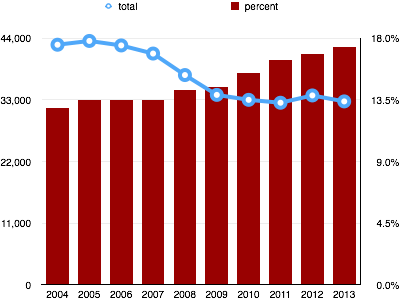 Foxx says “Unfortunately, in the five years from 2009 to 2013, bicyclist deaths were up 15 percent and pedestrian deaths are up 16 percent. In 2013, more than 5,000 pedestrians and bicyclists were killed, and more than 100,000 were injured.” More significant is that pedestrian and bicyclist fatalities are have continued to be an increasing portion of total fatalities. In the chart at right, the blue trend line, of total fatalities is clearly down, and NHTSA (National Highway Traffic Safety Commission) and others have tooted this horn at every chance. What they rarely talk about, and in fact try to hide in their reports, is the other trend, shown by the red bars, that the percentage of fatalities for pedestrians and bicyclists has continually climbed. These are not two unrelated trends. We have spent tremendous amounts of transportation money, and imposed increasing requirements on car manufacturers, in order to reduce the fatality and injury rate of motor vehicle drivers. But this reduction has led to an increase in pedestrian and bicyclist rates. They are inversely correlated to a remarkable degree. This data in the chart is from the
  Getting Around Sacramento