- Houses to spill south of Highway 50 in Folsom (SacBee 2015-03-08)
- Elk Grove considers express bus connections to light rail (SacBee 2015-03-06)
- Steve Hansen fights to bring Washington Elementary back to the grid (Sacramento News & Review 2015-03-05)
- ‘Starbucks effect’ is said to give a jolt to home prices (SacBee 2015-03-04)
- Developers envision new life for 700 K (Sacramento Business Journal 2015-03-04); Building begins on blighted block of Sacramento’s K Street (SacBee 2015-03-06)
11th St bike fix
 The section of 11th Street between L St and Jazz Alley (the alley south of J St) is largely a pedestrian place, but it is also a bike route. For bikes wanting to enter from L St, there are two choices, using the sidewalk area to the right of the fenced seating, or riding the wrong way on the parking garage exit. It is signed against bicycles (see photo at right). And to be honest, it should be signed against bicycles in the sidewalk area because this walkway gets such heavy pedestrian traffic from the Capitol and all the retail and offices in this area.
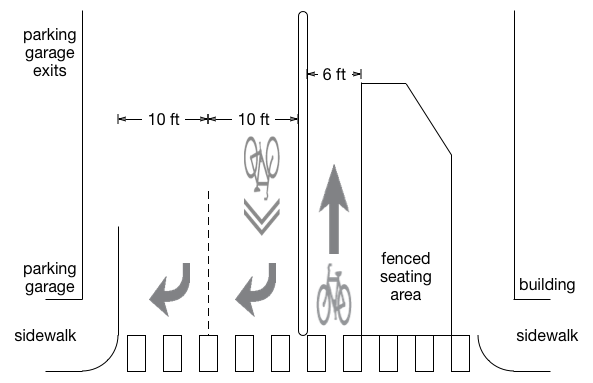
 So, I’m proposing that a short protected bike lane be created that would carry bicyclists from L St to the open part of the pedestrian plaza. The roadway here is 27 feet wide, wide enough for two traffic lanes exiting the garage, and one contra-flow bike lane heading north. I’ve watched traffic exiting the parking garage, particularly at the end of the work day, and there is a lot of crazy, erratic driving, and almost continuously an attempt to form three lines of traffic and cut around other cars. A stripe of paint on the ground is not enough. There must be either delineators or a curb (asphalt or concrete) separating motor vehicles from bicyclists. The Google maps at right shows the general setting.
Below is a graphic showing how the traffic lanes and the contraflow bike lane would be installed. Southbound bicycle traffic would use the left hand of the two traffic lanes, which could be marked with a sharrow.
N Street bike route to cycle track
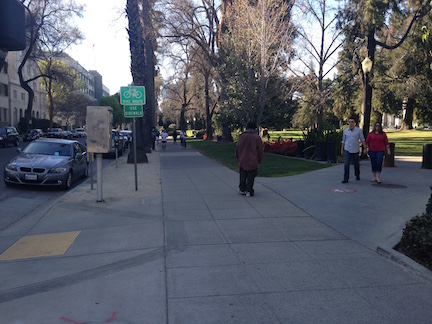
Unknown, or unnoticed, by many people, there is a bike route along N Street on the sidewalks. The route is well-signed from 8th St, where it crosses over from the south side to the north side of N Street, to 12th Street. The route extends east along Capitol Park to 15th Street, and I believe it also extends west to 3rd Street, though it is not well signed at these ends. On the City of Sacramento bikeways map, the route is shown on both sides of N Street, as “Existing Off-street (wide sidewalk).”
The bike route allows bi-directional travel along N Street, which would otherwise not be possible. The city has recognized that N Street is a significant barrier to east-west bicycling.
Scofflaw bicyclists, or drivers?
I was walking around midtown this afternoon, and riding this evening, watching the behavior of bicyclists, and wishing it was better. I saw bicyclists running stop signs without looking, failing to yield to pedestrians crossing the street, and not taking turns at intersections. Yes, we’ve all seen it before. But what struck me is that almost all of these bicyclists are also car drivers, and they are exhibiting exactly the same behavior driving their bike and they do driving their car. These are all the same thing motor vehicle drivers do. The only real difference is that the car drivers are almost all exceeding the speed limit, whereas the bicyclists are not.
Though there are some car-fee people living in midtown, and the number is growing, it is not large, and most of the people riding also drive. What they are showing is the same me-first attitude that shows up on the streets all the time, and it shows because these people are me-first whether they are riding their bike or driving their car. The problem is not bicyclists, it is attitude.
Curtis Village to City College bridge starts
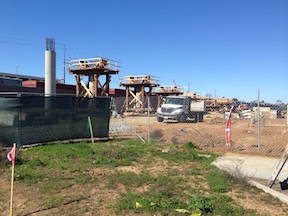
Work has started on the bridge that will connect Curtis Village to Sacramento City College over the Union Pacific railroad right-of-way. The bridge supports on the Curtis Village side have been installed. I did not see any signs of work yet on the section over the tracks nor on the west side at the light rail station and campus. The bridge will be usable by bicyclists, though I am not sure whether the design really addresses bicyclists. The paucity of east-west routes over the rail and light rail corridor means that both bicyclists and walkers have rather unpleasant routes to choose from, so this will be a great improvement. The Sutterville Road bridge, though it has sidewalks and even a narrow bike lane, is a very unpleasant place to be due to the high speed traffic and poor visibility.
Sacramento does well on economic segregation
A recent report Segregated City: The Geography of Economic Segregation in America’s Metros indicates that Sacramento is better than most cities in economic segregation. Unfortunately the full data set has not been released, and Sacramento shows up in only two of the tables and one text location. The paper is highlighted in a CityLab post America’s Most Economically Segregated Cities.
“Interestingly, the large metros where the wealthy are least segregated (Exhibit 2.3) are mainly on the East and West Coasts and include some of America’s leading high-tech knowledge centers, which have some of the highest income levels in the nation. San Jose is the metro where the wealthy are the least segregated from other segments of the population, followed by nearby San Francisco, Washington, D.C., Seattle, Hartford, Boston, Providence, Portland, Oregon, Minneapolis-St. Paul, and Sacramento. The relatively high wages that knowledge and professional workers receive enable them to share some neighborhoods with the super-wealthy, even though the gap between rich and poor may be substantial in these places.” (page 17)
In Exhibit 2.3: Large Metros where the Wealthy are Least Segregated (page 17), Sacramento (Sacramento-Arden-Arcade-Roseville, CA) is ranked number 10. In Exhibit 3.3: Large Metros with the Lowest Levels of Income Segregation (page 24), Sacramento is ranked number 6.
News summary 2015-03-01
- A new lease on life for old Marshall School (SacBee 2015-02-28)
- Public Invited to Kammerer Road Project Meeting (Sacramento County 2015-02-27)
- L Street work downtown causing major traffic jams (SacBee 2015-02-27); L Street, never a pleasant bike route, is even more challenging with this construction which has moved at a snail’s pace
- RT investigating runaway light-rail train (SacBee 2015-02-27)
- RT’s historic moment: Can it improve service? (SacBee 2015-02-26); How to improve Sacramento’s light rail? The debate starts this week (SacBee 2015-02-23)
- Sacramento Gentrification Is Getting the Streetcar Boost (Next City 2015-02-25)
- Siemens promotes its Sacramento home base in bullet-train pitch (SacBee 2015-02-25)
- Re-use of Sleep Train Arena site faces big challenges (Sacramento Business Journal 2015-02-25); What’s being planned for Sleep Train Arena? (Sacramento Business Journal 2015-02-25); Natomas leaders want timeline for Sleep Train arena redevelopment (SacBee 2015-02-25); Kings, city can’t neglect Natomas (SacBee 2015-02-26)
- One day, we’ll wonder what all the fuss about high-speed rail was about (SacBee 2015-02-24)
- Warwick announcement of university doesn’t faze Cordova Hills developer (Sacramento Business Journal 2015-02-24)
- Artist lofts lead downtown renaissance (SacBee 2015-02-23)
- Streetcar Split (Comstock’s 2015-02-23)
Fresno county is sinking, so punches holes in the ship
“You have no conceivable way of raising the money you need to build the new facilities to enhance your existing operations, much less provide for the growth.” – Mike Prandini, president of the Building Industry Association of Fresno and Madera counties (Fresno County supervisors suspend — but don’t eliminate — building fees charged to developers Fresno Bee 2015-02-10)
What he meant, I think, is that since no amount of developer fees could possibly pay for the expense to the county of greenfield development, that the county might as well just continue the practice of subsidizing greenfield development with taxpayer general funds, so as to not make the beneficiaries of new development, the developers and home buyers, pay anything at all. This is insanity.
When the ship is sinking, might as well deep-six it. Full speed ahead with development, though the iceberg looms dead ahead.
Thanks to Strong Towns for the reference.
News summary 2015-02-22
- Plan to replace downtown’s Hotel Marshall moving forward (SacBee 2015-02-22)
- Keep the strong momentum going for streetcar line (SacBee 2015-02-19)
- State must spend smarter on roads and ‘fix it first’ (SacBee 2015-02-19)
- East Sacramento County expressway takes step forward (SacBee2015-02-19)
- Construction to improve Old Sacramento traffic access could begin this summer (Sacramento Business Journal 2015-02-19)
- Engineering work beginning for Capital Southeast Connector project (Sacramento Business Journal 2015-02-19)
- Property owners vote for Sacramento streetcars (SacBee 2015-02-19)
- McKinley Village gets approval for underpass (Sacramento Business Journal 2015-02-18)
- County to reduce sign clutter on American River Parkway (SacBee 2015-02-17)
- Placer County Subsidizes Bicycles To Get Cars Off The Road (CapRadio 2015-02-17)
- Helmet law isn’t only route to safety for bike riders (SacBee 2015-02-16)
- Sacramento overhauling vintage train station (SacBee 2015-02-16)
- An urban shift toward West Sacramento (SacBee 2015-02-16)
News summary 2015-02-15
- Bill would require helmets for adults cycling in California (SacBee 2015-02-13)
- Streetcar line is a strong investment (SacBee 2015-02-11)
- Senator calls for mandatory helmets for California cyclists (SacBee 2015-02-11)
- Railyards, K Street redesign at core of Downtown Sacramento Partnership agenda (Sacramento Business Journal 2015-02-10)
- How about honesty and transparency on road fees? (SacBee 2015-02-10)
- Sacramento considering half-cent county transportation sales tax (SacBee 2015-02-09); New Light Rail Extension to Sacramento Airport Proposed, Comes at a Cost (Fox40 2015-02-10)
- Home on the Range (Comstock’s 2015-02-06)
 Getting Around Sacramento