You might have thought you had other plans for the evening, but…
The City of Sacramento is holding the last of four public meetings on Vision Zero and Bicycle Master Plan implementation tonight, January 31, 5:00 to 7:00PM at city hall.
A post two days ago on Transportationist, “Follow the Red Brick Road,” reminds me of a topic that has been much on my mind – how do we effectively slow motor vehicle traffic? Speed limits are ineffective, stop signs are a complete waste, physical structures such as speed humps, speed tables, and chicanes work but only where they are present, narrower lanes work pretty well but get pushback from commercial drivers and agencies (fire engines, trash trucks, buses, etc.). What is needed is something that works continuously, and street surfaces may be the answer. The post recommends the use of an old material, brick, hence, back to the old ways.
The Traffic Calming entry on Wikipedia provides a summary of traffic calming measures, and one of them is surface materials or textures, but other solutions are more prominent. A common practice in many locations is to make crosswalks visually different, and sometimes texturally different from the rest of the roadway, on the theory that the difference raises driver awareness of the crosswalk. To some degree this may be true, but it probably has much less than the desired effect on traffic speed, and textural differences can present a challenge to disabled people and even to less adept walkers. The many different crosswalks patterns are an attempt to increase visual contrast with the roadway, but again, that is only partially successful.
So the idea is to reverse this pattern: make the roadway rough and the crosswalk smooth. We have a great example of this right here on Front Street in Old Town Sacramento, pictured below.
Crosswalk and cobblestones, Front Street, Old Town Sacramento
If you have not observed this street in action, I encourage you to do so. No one drives too fast on this section of street, in fact all motor vehicles are going a pedestrian-friendly speed. Yet the smoother crosswalk is usable by all and still has a high contrast with the road. Compare that to nearby Second Street, where a normal pavement surface encourages some irresponsible drivers to go much faster than is safe given the tourist pedestrians that frequent the area.
Of course the cobblestones here are an historical artifact, and such a rough surface would only be appropriate in high pedestrian traffic areas. But brick would be a great middle ground between cobblestones and asphalt.
While I have long supported this reversal of textures, I doubted that it would be practical to implement. But the video at the bottom of the “red brick” post provides a solution, a machine designed to lay down brick in an efficient manner. The process is slow, but I think that is because they are changing brick patterns to demonstrate different possibilities. Where the pattern remains the same, it would go much faster, and the feed of bricks could be automated.
If you have ridden your bike on these cobblestones, you know that the surface is very rough. When cars are not parked along Front Street, the cobblestones can be bypassed on the asphalt parking area on the west, but when it is full, yow! Obviously brick is much less rough than cobblestone, but nevertheless bike access is an issue to be considered. Maybe brick would be no problem (if it is maintained, but then bike lanes often have unmaintained asphalt or concrete anyway), or maybe the bike lane would need a different surface. A visual or textural difference might cause drivers to notice and respect the bike lane more than they do now, with just a white stripe and occasional green paint to distinguish it. This needs more thought and study.
I would guess that brick streets would be more expensive than asphalt, which is sort of the lowest common denominator of pavement, but might be comparable to concrete, and cost is always an issue in constructing and maintaining streets. But I’d like to see some pilot street projects, starting with locations where it is really important to increase safety and promote walkability, right here in Sacramento. If the pilot goes well, then let’s make it the standard street surface for the grid, implemented anytime repaving is indicated.
Courtesy of Families for Safe Streets, Transportation Alternatives and the Vision Zero movement in New York City, there is a new effort and pledge to stop using the incorrect word “accident” for crashes involving vehicles, at Crash Not Accident. Though this is an effort that has been going on locally and nationally for some while (see We Save Live’s Drop the “A” Word). In the Sacramento region, the two most egregious users of the incorrect term are @SacRegion511 and law enforcement officers.
I ask all of you to join this effort. Every time you hear the word accident used when people are talking about vehicle crashes, correct them. Every time you see something on the Internet that uses the wrong word, comment. Yes, those people who prefer to absolve motor vehicle drivers of fault and consequence will not be happy. They may unfriend or unfollow you, and they will reply with angry requests to consider the poor “victim,” the motor vehicle driver, who will be scarred for life. In my opinion, scarring for life is a tiny price to pay for taking someone else’s life with irresponsible use of a motor vehicle. Am I angry? You bet I’m angry!
This is one of the nerdier posts I’ve written in a while, and much of it probably won’t make sense to anyone who has not been involved in SHSP. Why is it important? Because all of the safety funds in California, some of the transportation budget, and much agency effort go to the priorities identified by SHSP. In the past, that has meant a focus on the safety of motor vehicles drivers, focus to issues such as distracted and drunk driving (which are important but not everything), and in a perversion of priorities, stings on pedestrians and bicyclist funded by OTS.
On November 14, 2015, the SHSP (Strategic Highway Safety Plan) Safety Summit was held on the CSU Sacramento campus, part of the SHSP Update process that seeks to revised the Strategic Highway Safety Plan for California. The summit was very well attended, nearly filling the ballroom. After some introductions from various agencies (Caltrans, Office of Traffic Safety, and California Highway Patrol are the main partners in the program, but several other agencies participate), there were six breakout sessions to provide input on different topics, and an opportunity to participate in two of the six.
I participated first in the Active Transportation (bicycling and walking) breakout, which was facilitated by Katherine Chen & Jill Cooper. Issues identified: we really don’t know why there has been an increase the last few years in bicyclist and pedestrian injury and fatality, whether due to increased mode share or some other reason; the CHP 555 form and SWITRS database do not offer all the information we need; there is almost no injury/fatality rate data available because agencies are not collecting counts; rather than transportation funds being allocated based on injury/fatality rates, bicycling and walking receives a tiny portion construction and safety funds. The session went well, with good discussion and a lot of good information gathered onto charts by Katherine.
I also attending the Infrastructure and Operations breakout session, which was facilitated by two individuals from Cambridge Systematics, the contractor being used for the update process. This session did not go well. The participants provided thoughtful input, but much of it was rejected by the facilitators, either not written onto charts, or crossed out because they didn’t agree with it. The group wanted to use rates rather than counts, education is needed to create a culture of safety, distracted driving is epidemic, automated enforcement of red lights and speed are critical to changing behavior, and we need to focus on intersections since that is where most problems occur. The facilitators wanted to hear none of it, and were disappointed that no one seemed interested in spending money on “improving safety” for motor vehicle drivers by building more highways.
We were promised at the summit that the breakout session notes would be tabulated and made available to participants “soon.” As of today, 11 weeks later, no information has shown up on the SHSP Update web page. I doubt that the information will show up before the process is complete. I would guess that the contractor and Caltrans didn’t like what they heard and decided to suppress the information.
Despite the lack of input from the SHSP Safety Summits (there was one northern and another in southern California), the SHSP Steering Committee has been pushing forward with updating the SHSP strategies. The SHSP Bicycling committee (formerly Improving Bicycle Safety) on which I serve, and the other committees, were given a very short deadline to provide a new short set of strategies (up to five). It seems as though we will be locked into these for several years. In the committee’s January meeting we made remarkable progress on coming up with strategies, coming to consensus on a number of issues that we’ve discussed for years and never quite come to common understanding or agreement. When we ask where the Safety Summit information was, we were told by Pamela Beer of Cambridge Systematics that she had all the information we needed, that the printed notes that we were given at the meeting but not beforehand where all we would get, and that we should not expect to see any outcomes from the summit before the strategies finalized. Somehow she had inserted herself into our committee meeting as a facilitator/controller, without the knowledge of anyone on the committee.
The strategies adopted by the Bicycling committee, pending some wordsmithing, are:
Improve roadway and bikeway planning, design, and operations to enhance bicycling safety and mobility while supporting bicycling to and from all destinations.
Improve data collection regarding bicyclist trips, injuries and fatalities on California roadways and bicycle paths.
Improve education and enforcement based on the protection of everyone’s right to travel by lawful means.
Encourage more bicycle travel by improving public attitudes about bicycling safety and the need for safe and courteous behavior toward all roadway users.
Develop safe, direct, and connected routes on which bicycling is a priority mode of transportation.
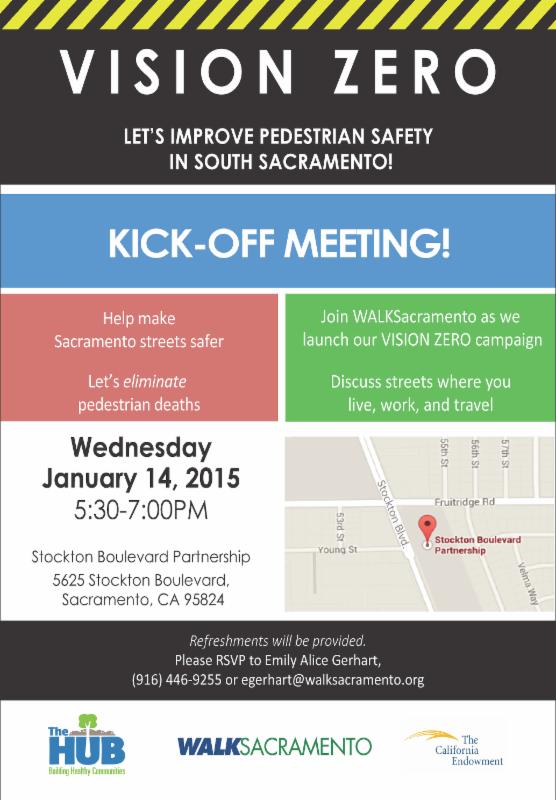
WALKSacramento and other partners are hosting a Vision Zero Kick-Off Meeting on Wednesday, January 14 in south Sacramento, part of the ongoing Building Healthy Communities project. This is the first event in Sacramento, and I encourage you to participate, even if you don’t reside or work in south Sacramento. A city, county and region can be judged by how it treats its most vulnerable citizens, and there is no doubt that walking (and bicycling) safely is a major justice challenge for south Sacramento. Click on the thumbnail at right to view the flier.
From WALKSacramento’s email:
You are invited to join WALKSacramento on January 14, 2015 as we launch “Vision Zero” in South Sacramento.
Vision Zero aims to reduce pedestrian and bicycle fatalities to ZERO by improving infrastructure, education, and enforcement. We’re starting a Vision Zero project in South Sacramento because we know that it is within our power to prevent these tragedies on our streets.
We need better street design, better regulations, and better enforcement.
Let’s start talking about what we can do to help make Sacramento streets safer.
For more information and to RSVP, please contact Emily Alice Gerhart, egerhart@walksacramento.org
Vision Zero, which started in Sweden, is now a wordwide effort to eliminate pedestrian, bicyclist and motor vehicle fatalities. In the United States, New York and San Francisco are leaders, but the idea is now being talked about nearly everywhere, including Sacramento.
 You might have thought you had other plans for the evening, but…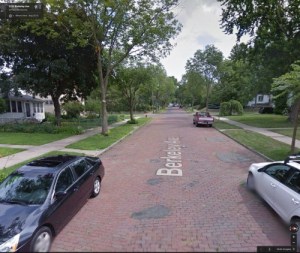



 Getting Around Sacramento