Abogo

Abogo

A reference to the Abogo calculator from the Center for Neighborhood Technology (CNT) in Kaid Benfield’s post today sent me there. Abogo is based on CNT’s Housing + Transportation Affordability Index, which I was familiar with, so I’m surprised I’d not noticed Abogo, but now I have.

At right is the calculator result for where I live. Hard to read the legend, but the dark green is less than $1000 per month. Of course I spend a good deal less, $100 for a transit pass plus about $20 a month for bicycle maintenance, but the numbers seem reasonable for others who live in downtown/midtown.

Read More »

Who knew?

@sactraffic twitter profile

I stumbled across a twitter feed about a week ago, and it is filling up my twitter timeline, by far the busiest thing I follow. It is Sac Traffic, which is a CHP feed of traffic alerts in the Sacramento region, at @sactraffic.

As a bicycle rider and walker I’m hyper aware of the risk out on the roadway, and assumed there were more incidents than I was aware of, but I had no idea there were so many in the Sacramento region. I follow the Sacto911 blog on the SacBee for the purpose of tracking carnage to pedestrians and bicyclists. It includes traffic and other crime, but it generally only has a few to no incidents per day. I’ve long suspected there were more, but never had any solid information.

It is basically a game of bumper cars out there!

Read More »

Slaughter on the roadways

In the last there days, Monday through Wednesday, at least four people died when struck by car drivers, and two others were injured. I know that the Sacramento Bee does not report all pedestrian and bicyclist fatalities and injuries, so there may have been more in the region, but this is an incredible level of slaughter.

The SacBee articles so far are:

The better of these articles describe the outcome and location in a factual manner. The poorer ones place the blame on the victim. This victim blaming is aided and abetted by the law enforcement officers who make the assumption that either a) it was a “tragic accident” that could not have been prevented or b) the driver was not drunk and remained at the scene, so clearly it is the pedestrian or bicyclist’s fault. Both are nonsensical statements and ideas.

Read More »

Caltrans Watch

As though I need something else to do, I have started another blog called Caltrans Watch, following a conversation with Jim Brown in which we realized that someone needs to be calling Caltrans to account on its sprawl-inducing and livability-killing approach to transportation. Please take a look and make suggestions for improving it, hopefully with your own contributions. There is a Twitter handle to go with it, @CaltransWatch.

removing Business 80?

William Burg started a wonderful conversation on Facebook about removing Business 80 from B Street to Hwy 50, returning the traffic to surface streets. The post is now up to 115 comments, and still going after two weeks. I believe that you have to be a member of Facebook to view this thread, but don’t need to be friends with William Burg (though you should). I agree with Jared that this topic should be amplified for Sacramento Press.

Some people think that this is crazy thinking, it will never happen. I think it will. Why? Not because it is a good idea, though it is, but because we will not be able to continue to keep these freeways open and in decent condition with future transportation funding. Caltrans and others have just spent or are spending $202 million on Hwy 50, basically just to keep in it usable condition. Not to improve it in any significant way, but just to keep it working. Where is the money going to come from to maintain Hwy 50, Interstate 80, Interstate 5, and Business 80 (Capital City Expressway)?

Read More »

a thirst for working water fountains

non-functioning water fountain at Sunrise light rail station

On Wednesday evening, I rode from Woodside K-8 School in Citrus Heights to the Sunrise SacRT light rail station, and then caught light rail home. As I passed Sunflower in Fair Oaks, I thought of stopping for a drink of water, but decided to just head on down the hill to the drinking fountain on the north side of the red Fair Oaks bridge. It was not working, covered with plastic. I continued on to the Sunrise station, where both water fountains are not working. I suspect these have not been working for years, they look abandoned. By this time, I was pretty darn thirsty, and the long wait in the evening for the next light rail train was not pleasant. Even if I’d wanted to go to a convenience store for something to drink, there aren’t any close to that station.

Read More »

Sacramento’s Transportation Report Card

The lead article this week in the Sacramento News & Review is Sacramento’s report card. I can’t resist getting in on the fun.

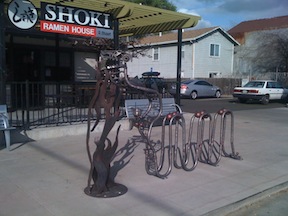
R-St_Dragon-bike-rackThe article covers bicycle transportation in the “On two wheels” paragraph, and does it pretty well, giving a C grade. I’d add that art bike racks can be fun if they are also functional. The dragon at Shoki Ramen House and the bottle openers at New Helvetia Brewing are good examples. I think bicycling really works pretty well in the central city and some of east Sacramento, with people getting along in sharing the road most of the time. The further out you go, though, the worse things are, with belligerent drivers traveling at high speeds. I’d give central city a B and the far suburbs an D-. Does this average to a C?

Read More »

freeway teardown

Synchronously today, Terry Preston (WALKSacramento) and SABA (Jim Brown) posted to Facebook with a link to an article “Is it time to start dismantling downtown freeways?” I encourage you to follow and join in those discussions: Sacramento Area Bicycle Advocates and Terry Preston. I am glad to see this being discussed. I posted on this blog about the same topic, “and the freeways” back in March.

SF-FerryBuilding_Embarcadero
San Francisco Ferry Building, with and without the Embarcadero Freeway

Read More »

What are stop signs for? Part 4

Continued from Part 3

The personal upshot…

I have decided that stop signs that are installed solely to slow traffic do not apply to me. I’m already going less than the speed limit, about 15 mph, and I don’t need to be slowed down, so the purpose of the stop sign does not apply. Instead, the correct behavior is to slow, look, and proceed when it is safe. I will follow the standard yielding rules, as they apply. This behavior is codified in the “Idaho stop law” (Idaho Statutes | Streetsblog). Though I know it is against the law in California, it is the rational and safe behavior.

I am much less sure about safe bicyclist behavior at red lights. The Idaho stop law allows bicyclist to proceed after they have stopped and there is no conflicting traffic. I’m still thinking about this one.

What are stop signs for? Part 3

Continued from Part 2 (note: I posted this part 3 early, and then had to delete it, my apologies)

stop-slashAs part of my job, I spend a lot of time at intersections observing the behavior of motor vehicle drivers, bicyclists, and pedestrians. What I observe is that about 20% of motor vehicle drivers come to a full legal stop at stop signs, when there are no other vehicles present that might cause a collision. What about bicyclists? Wait for it… About 20% of bicyclists come to a full legal stop at stop signs. Yet the perception of many motor vehicle drivers is that they are stopping and bicyclists are not. Motor vehicles drivers complain in letters to the editor, news shows, blog comments, and conversations about flagrant violations of the law by bicyclists, which they either say or imply should result in harsh enforcement, restrictions on where bicyclists may ride, and “licensing.” A few crazies even say that it is OK to run down a bicyclist who is violating the law. But the fact of the matter is that bicyclist and motor vehicle driver behaviors are nearly identical when it comes to stop signs.