Part four of what’s next, part three being What’s next: squeeze roadways, part two being What’s Next: parking, and part one being What’s next: freeways. Radical ideas for what to do now that the road safety and transit initiative SaferSacStreets did not make the November ballot.
The SaferSacStreets citizens initiative would have provided about half of the funds to transit, mostly SacRT. SacRT is a seriously underfunded transit agency, surviving on about 1/6 of a cent sales tax, which is far less than any other city transit system. What is does get is about a 1/3 part of the Sacramento County Measure A transportation sales tax, 1/3 of 1/2 equals 1/6. Of course SacRT gets some other funds from state and federal sources, but these are mostly for infrastructure, and it also obtains grants from time to time, which help, but again, are for infrastructure and not operations. Infrastructure is important, as it maintains and replaces buses, and maintains and replaces light rail vehicles, as well as other needs including expansion. If you have seen or ridden the old light rail cars, which are far, far past their expected lifespan, you will know what neglect of maintenance and replacement looks like. Fortunately, SacRT has replaced part of its fleet with new Siemens S700 light rail cars, now used on the Gold Line, and to be used throughout once enough new cars are purchased.
The other significant issue for SacRT is that they have been using money designated for infrastructure to pay for operations, for several years now. The state encouraged this, and federal government allowed it with some funds, but the state funds are running out, and under this administration federal funds are uncertain, so a crisis is coming when there won’t be these extra funds for operations. Without a new revenue source, cutbacks will be necessary. The new sales tax in City of Sacramento would have allowed SacRT to shift funds back to maintenance, and to at least some expansion of service. SacRT is in a planning process, SacRT 2025, which identified what an additional 1/4 cent or 1/2 cent of sales tax would do. The 1/4 cent summary and map is below. Note that this planning is for the entire system, basically Sacramento County. The City of Sacramento would have generated about 1/3 of this amount (in very rough terms, 1/3 of the population and 1/3 of the sales tax income is from the city), and would have been spent on enhancing transit in the city, though of course expenditures in the city would have beneficial impact throughout the system.
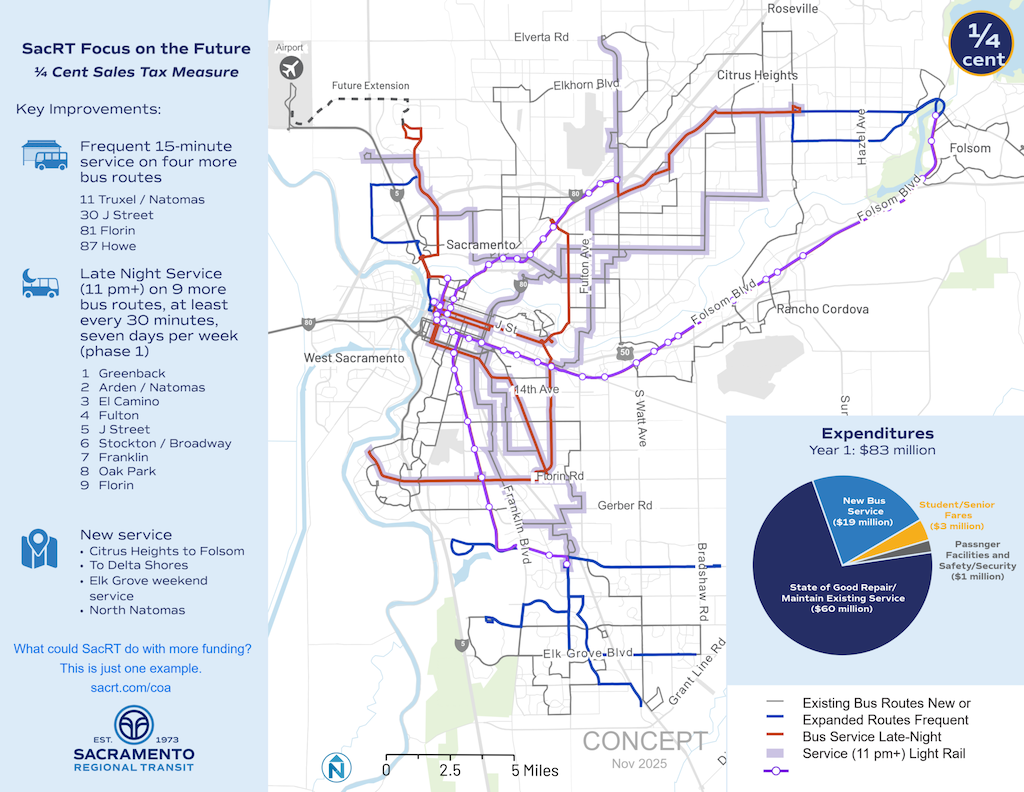
So, no new income. What can be done to maintain service, and to mitigate the cutbacks that will be needed? I have more uncertainty and fewer ideas than I did with the three previous posts that focused on the roads portion of the initiative. But here are some:
Third lanes become transit lanes: I recommended that the third lane of roadways be closed to reduce motor vehicle capacity. Instead of closure, these can be converted to full time transit-only lanes. Most arterials with three lanes per direction are also bus routes, so there is overlap in the benefit. Transit-only lanes would require some paint and signing, so probably somewhat more expensive than closure, but on the other hand, no concrete barriers, and vertical delineators only in some locations. Probably just as important is making light rail tracks exclusive to transit use, for example on 12th Street where motor vehicle traffic interferes with light rail trains. But the locations where transit-only lanes for buses and trains are few enough that this is not going to make huge difference for the system. Eventually, there should be transit-only lanes on smaller streets, but that requires planning that will take time, and money.
Rebalance frequency vs coverage: It is time for a quick system revision process, similar to the SacRT Forward process in 2019. There won’t be the money to do a comprehensive cut, so this would be rougher. My preference is to eliminate low ridership routes, or reduce span of service to higher ridership times. I realize this would leave people in lower density areas with poorer service, or without any service, but something must be cut, and I’m less sympathetic to people who have chosen to live in lower density areas where efficient bus service is just not possible. When there was extra money, lower density areas were served by SmartRide, but those funds are long gone, and the current on-demand Flex program only serves seniors, disabled and low-income riders. There won’t be money for in-depth planning and public engagement process, so staff’s best guesses will have to do.
Drop light rail extension ideas: Green Line light rail to the airport, and Blue Line light rail to Elk Grove projects continue to receive support from politicians, SacRT board members, and some SacRT staff. Under current funding and reasonable likelihood of funding, these project will never happen. There are other longer term light rail extension projects that are still on the table but not current focus. I think SacRT should drop planning, and discussion, for all of these extensions. Someday, once society shifts interest and funding away from private motor vehicles and towards transit, these projects might come back, but by that time, current planning would be so out of date as to be largely useless. Let it go!
Evaluate staff: It is characteristic of SacRT that staff decisions often turn out to be wrong. Sometimes they are reversed or modified after public feedback, and sometimes they aren’t. These poor decisions are, I think, the result of significant incompetence with some staff. Not all staff, not even most staff, but staff in key decision making positions. Repeated mistakes are not held to account, but are glossed over. This must end. Under constrained funding, every decision should be the best that can be made with current knowledge and experience. Some current staff is just not capable of that. They should be held to account or let go.
That’s it for my radical proposals, for now. I look forward to hearing from other individuals and organizations about their ideas. One the standards answers is ‘do more with less’, but we were already doing more with less. At least for the time being, less is what it is. I have doubts about future funding, from sales tax or other sources, and I’ll write about that eventually.
What do you think?

