Measure 2022: congestion relief – ha!

A group calling themselves A Committee for a Better Sacramento is sponsoring a citizen-initiated ballot measure for the November election, titled “Sacramento County Transportation Maintenance, Safety, and Congestion Relief Act of 2022—Retail Transactions and Use Tax”. (Note: Some people are referring to this as Measure A, but measure letters are assigned by county elections, not by the sponsors. I’ll continue to refer to it as Measure 2022, for now.)

As pointed out in Measure 2022: words have meaning, the word congestion or the term congestion relief is used 24 times in the proposal. It is in fact the major theme of the Transportation Expenditure Plan. 22.4% of the measure is set aside specifically for major congestion relief categories. Since most projects are not individually costed, it can’t be determined how much of the 47.3% for local roads and streets is for congestion relief, but Citrus Heights has two and Elk Grove four called out. The 3.7% for Capital Southeast Connector is also congestion relief.

Not acknowledged, but likely true, is that many of the projects could be considered ‘congestion prevention’, meaning that if roadways and freeways and interchanges are expanded now, future congestion can be prevented.

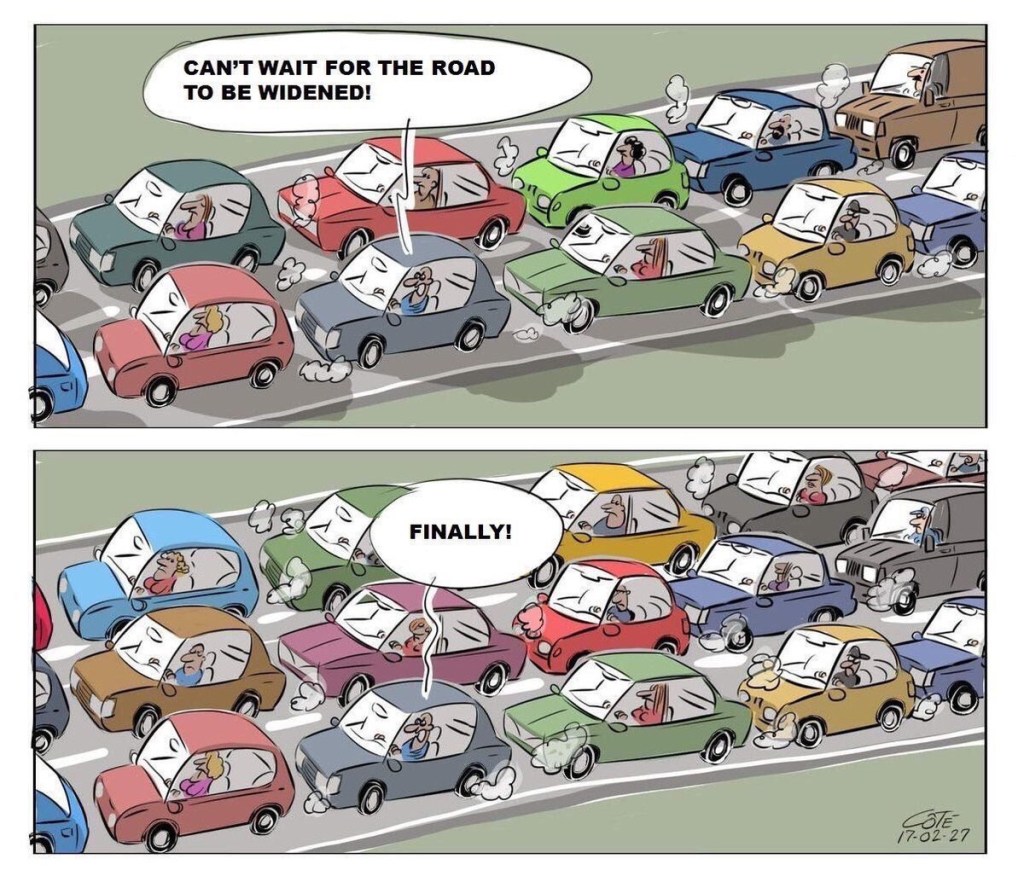
The committee and supporters seem to have bought into the falsehood that capacity expansion solves congestion. It does not, or rather, solves it for a short period of time, then induced travel returns congestion to previous levels, or higher. It is a never ending cycle. Congestion is not a major contributor to air pollution. It does have an effect, but the effect is very limited in time and space. The big contributor to air pollution, and of course greenhouse gas emissions, is vehicle miles traveled. The measure will increase, not decrease, VMT.

Twenty-eight lanes on the Katy Freeway in Texas have not solved congestion, nor reduced air pollution in Houston. The 405 freeway over the Sepulveda Pass in southern California was widened to the tune of $1 billion dollars in 2011-2012. Traffic is now much worse on the freeway than it was before the widening, and air quality is of course also worse.

Induced travel or induced demand is broadly accepted by researchers in transportation both on a theoretical basis and with many, many case studies, but there is still resistance among some traffic engineers and politicians. The question for me is why those who resist the obvious are writing transportation sales tax measures.

Induced travel says that after spending billions to try to reduce congestion, our roadways will be as congested, or more congested, than they were before.

But over many years of observation and analysis, we have learned that adding supply has a paradoxical outcome. It generates more driving, which is both costly to personal budgets and the environment, and which often re-congests the very roadways we built or expanded.

Caltrans, Rethinking How We Build So Californians Can Drive Less, https://dot.ca.gov/programs/sustainability/sb-743

Empirical research shows that expanded roadway capacity attracts more vehicles. However, environmental impact assesments of roadway expansion projects often ignore, underestimate, or mis-estimate this induced travel effect and overestimate potential congestion relief benefits.

National Center for Sustainable Transportation, https://ncst.ucdavis.edu/tags/induced-travel

Induced demand is “the great intellectual black hole in city planning, the one professional certainty that everyone thoughtful seems to acknowledge, yet almost no one is willing to act upon.”

Speck, Jeff (2012). Walkable City: How Downtown Can Save America, One Step at a Time. New York: North Point Press. ISBN 978-0-86547-772-8.

Induced traffic occurs when new automobile trips are generated. This can occur when people choose to travel by car instead of public transport, or decide to travel when they otherwise would not have.

Wikipedia, https://en.wikipedia.org/wiki/Induced_demand?wprov=sfti1
Search for category Measure 2022 to see posts as they are added.
Measure 2022: ‘complete streets’

This post is a follow up to (in)complete streets and streets – stroads – roads, and will make more sense if you read those first.

The proposed sales tax measure Transportation Expenditure Plan (TEP) for Sacramento County has 20 occurences of the term ‘complete streets’. The first is this phrase: “complete streets with or without capacity expansion”. This alone should make everyone uncomfortable – the sponsors are perfectly happy with expanding roadway capacity so long as all modes are accommodated in some way. The roadway could be 20 lanes wide, and that would be fine so long as there is some facility for walking and bicycling. Within the ‘Local Street and Road Repair and Transformative System Improvements’ section, Citrus Heights lists 15 possible projects, and within the ‘Local Projects of Regional Significance’ section no projects. The table below shows the complete streets summary (note that Isleton is an insignificant portion of the measure and is not listed). Only County of Sacramento specifically calls out that 15 of the projects will include road capacity expansion, but many of the other projects in all of the locations might also include expansion.

In the lead implementation section, paragraph H, ‘complete streets’ are sort of defined:

Complete Streets. Transportation projects provide opportunities to improve safety, access, and mobility for all users of streets, roads, and highways in Sacramento County and recognizes bicycle, pedestrian, vehicle, and transit modes as integral elements of the transportation system. The term “Complete Streets” describes a comprehensive, integrated transportation network with roadways designed and operated to enable safe and convenient travel for users of all abilities, including motorists, pedestrians, bicyclists, persons with disabilities, seniors, children, movers of commercial goods, operators of public transportation, public transportation users, and emergency responders, in a balanced manner that is compatible with an urban, suburban, or rural context.

Transportation Expenditure Plan, I. Implementation, H. Complete Streets

Sounds OK, but it is so vague as to allow practically anything, based on the preference and judgement of city or county. No reference is made to state or federal definitions or guidelines.

The TEP does require the cities and counties to adopt a ‘complete streets’ policy. So far as I’m able to determine, only the City of Sacramento has a policy at this time. That is good. But again, no guidelines as to what a good policy would address. No reference to the National Complete Streets Coalition model, or state or federal guidelines. All of the General Plans address complete streets to some degree. It is not clear whether these existing aspirations constitute a policy.

Within one year following the implementation of this Measure, each local jurisdiction in Sacramento County receiving Measure funds shall adopt or maintain an existing “complete streets” policy or a similar document that incorporates design guidelines and standards promoting safe and convenient travel for all users including bicyclists and pedestrians when considering any construction, reconstruction, retrofit, or alteration of streets, roads, highways, bridges, and other elements of the transportation system.

Transportation Expenditure Plan, I. Implementation, H. Complete Streets

And lastly, the TEP says that projects should be consistent with policy. But again, the language is vague. What does consistency mean? Always, or only when it doesn’t impact traffic flow? No performance measures for the jurisdictions to achieve, or against which to judge their success.

Planning and design of projects affecting the transportation system shall be consistent with any local bicycle, pedestrian, transit, multimodal, and other relevant plans and/or the local complete streets policy to ensure that all transportation types and users are considered in the expenditure of Measure funds.

Transportation Expenditure Plan, I. Implementation, H. Complete Streets

So, does use of ‘complete streets’ and identifying projects as complete streets mean anything. No, not really. It is up to each transportation department to determine for themselves whether the project is complete streets, and what it would have to do to ensure that.

Even if the project does produce a ‘complete street’, it still won’t address frequent safe crossings of the corridor for walkers, nor the need to significantly reduce motor vehicles speeds to create comfortable walking and bicycling streets.

Search for category Measure 2022 to see posts as they are added.

Measure 2022: allocation to places

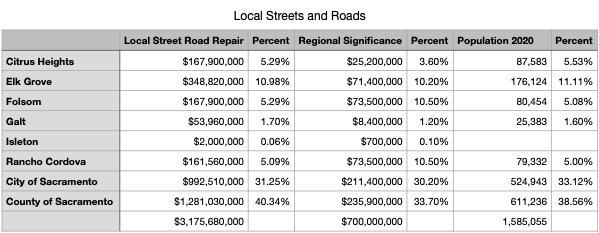
Under the Transportation Expenditure Plan major category of Local Streets and Roads (page A-8 of Exhibit A), both ‘Local Street and Road Repair and Transformative System Improvements’ and ‘Local Projects of Regional Significance’ funds are allocated to the cities and county. The table below show these allocations.

The percentages for each city and the county are not too far off of what would be their allocation if based solely on population. So this aspect of the TEP can be considered to be not unfair. However, as with all transportation funding, the question arises whether this ‘formula grants’ allocation, as it is called, is the best way to meet the transportation needs of the county. 47.25% of the entire measure is dedicated to local streets and roads, so this is an important question. But one which I don’t have a clear answer to.

A future post will take a closer look at the 93 projects that are listed under both ‘Local Street and Road Repair and Transformative System Improvements’ and ‘Local Projects of Regional Significance’, and the fix-it-first language in this section.

Search for category Measure 2022 to see posts as they are added.

Measure 2022: transit congestion improvement???


A group calling themselves A Committee for a Better Sacramento is sponsoring a citizen-initiated ballot measure for the November election, titled “Sacramento County Transportation Maintenance, Safety, and Congestion Relief Act of 2022—Retail Transactions and Use Tax”. (Note: Some people are referring to this as Measure A, but measure letters are assigned by county elections, not by the sponsors. I’ll continue to refer to it as Measure 2022, for now.)

One of the categories in the Exhibit A: Transportation Expenditure Plan is Congestion Relief Improvements (page A-16), and the subcategory Transit and Rail Congestion Relief Improvement Projects, which is allocated 10.85% of the measure, or about $890M over the 40 years. Projects listed are (they are not numbered in the document, but are here for reference):

  1. LRT peak service trains
  2. LRT extensions, Green Line to the airport, Blue Line to Elk Grove and Citrus Heights, Gold Line to Folsom
  3. High capacity bus corridor network throughout Sacramento County, including but not limited to Stockton Blvd, Watt Ave, Sunrise Blvd, Florin Rd, and Arden Way
  4. BRT to Citrus Heights, Stockton Blvd, and Sunrise in Rancho Cordova
  5. In coordination with the Capital Southeast Connector Joint Powers Authority, design, plan and construct a transit component, such as a bus rapid transit service, along the Capital Southeast Connector corridor to mitigate greenhouse gas (GHG) emissions and meet air quality targets. SacRT will match $40 million in revenues generated by this Measure with $80 million in state and federal funds for a total of $120 million in resources toward this goal. The project would consist of providing signaling and a bypass at critical connector sections to improve service, lower travel time, and reduce GHG impacts

The document does say that funding is ‘intended to be flexible’, which is good since the types of projects that might be constructed over 40 years will likely have little to do with this list. None of this funding is available for operations, which is in a different category, Sacramento Regional Transit District (SacRT) Maintenance, Operations, and Transformative System Improvements. More about that soon.

Light rail extensions and improvements for more frequent peak service (not for operating more frequent peak service, just for the infrastructure) sound appealing (items 1 and 2). Currently SacRT has unofficially prioritized Green Line to the airport, even though that would do almost nothing to reduce congestion. Infrastructure for Gold Line to Folsom is already funded, so it is strange to see it here. On the other hand, Blue Line to Citrus Heights is here, even though SacRT has removed it from consideration for the foreseeable future.

The terms ‘high capacity bus corridor network’ and ‘BRT’ (items 3 and 4) are not defined in the document, so the public really has little idea what is intended. SacRT has not been very clear about this either. Projects in other places have revealed that the quality of the improvements to a corridor, and the restraints placed on private vehicle travel, make all the difference in whether bus corridor enhancements are valuable or pointless.

The $40M for the Capital Southeast Connector (item 5) is small in comparison to the size of the allocation, but it points out how poorly thought out the entire measure is. Who would even use transit on this corridor? The connector is designed to serve commercial traffic between Folsom (really El Dorado County) and Elk Grove, and to promote greenfield development along the connector. Greenfield developments are not designed to appeal low income workers, they are designed to appeal to high income white collar workers, who might be commuting to Folsom, Rancho Cordova, and Elk Grove. But those are not the sort of people who use transit unless it is clearly superior to drive-alone, and transit on this soon-to-be-congested corridor will not make the grade.

All of these projects are premised on the idea that the other projects in the measure will maintain or increase congestion, so it is necessary to improve transit to mitigate for that other congestion. Sadly, the SACOG MTP/SCS makes the same assumption, that transit projects will counteract the increased VMT and GHG emissions from other projects and poor land use.

Transit should not be a mitigation; it should have standing in its own right as a superior mode of travel. It should not be an attempt to make up for bad decisions made elsewhere. The question should be: what can we do to better serve existing riders, and what can we do to induce new riders?

This section of the Transportation Expenditure Plan is so-so. Not bad, not good, but mostly not well thought out and not clear what the benefits and trade-offs will be.

Search for category Measure 2022 to see posts as they are added.

Measure 2022: Southeast Connector exceptionalism

A group calling themselves A Committee for a Better Sacramento is sponsoring a citizen-initiated ballot measure for the November election, titled “Sacramento County Transportation Maintenance, Safety, and Congestion Relief Act of 2022—Retail Transactions and Use Tax”. (Note: Some people are referring to this as Measure A, but measure letters are assigned by county elections, not by the sponsors. I’ll continue to refer to it as Measure 2022, for now.)

One of the major projects in the measure is the Capital Southeast Connector, a new freeway from Folsom to Elk Grove. Future posts will talk about what a bad transportation idea this is, but for now, what a bad part of the measure it is.

The measure essentially makes the Capital Southeast Connector JPA the judge of whether the project meets air quality requirements – the fox watching the henhouse. It is somewhat obscure what the language means, and takes a close reading, but the gist is that if the project fails to meet air quality requirements and therefore is not included on the project list in the MTP (SACOG Metropolitan Transportation Plan), the JPA can go its own way and decide for itself that the project meets requirements.

K. Metropolitan Transportation Plan & GHG Reduction Targets. The Sacramento region Metropolitan Transportation Plan/Sustainable Communities Strategy (MTP) currently requires that the region meet a 19% per capita greenhouse gas (GHG) reduction target. Expenditure Plan projects that are planned or programmed for construction in an MTP, as may be amended from time to time, shall be eligible for Measure funds. Expenditure Plan projects not planned or programmed for construction in an MTP shall be eligible for Measure funds if the construction phase of the project is exempt from project-level and regional level air quality conformity.

For any non-exempt projects that are not planned or programmed for construction in an MTP, as may be amended from time to time, the following requirements will apply:

For any non-exempt projects that are not planned or programmed for construction in an MTP, as may be amended from time to time, the following requirements will apply:

1. In order to meet the then applicable regional GHG reduction target for the MTP, project sponsors (parties) shall develop mitigation measures for any project(s) that increases GHG emissions.

2. If the parties can mitigate any such project impacts to maintain adherence to the then applicable regional GHG reduction target, the project(s) shall be eligible for Measure funds.

3. If the GHG impacts are not mitigated to meet the region’s then applicable GHG reduction target, and as a result the region cannot meet its applicable GHG target, the funds planned for the non-exempt project(s) may be used by the corresponding Implementing Agency at their discretion, for other than the originally intended project(s), provided any alternative project(s) are consistent with the Expenditure Plan and included in an MTP, as may be amended from time to time, that meets the then applicable target. Per above, alternative project(s) not planned or programmed for construction in an MTP shall be eligible for Measure funds if the construction phase of the project(s) is exempt from project-level and regional-level air quality conformity.

Measure 2022, Exhibit A, Chapter 1, Section K

This treatment of the JPA might very likely be found to be unconstitutional, but the measure proponents have thought of that too:

If any portion of this Measure is held by a court of competent jurisdiction to be invalid, we the People of the Sacramento Transportation Authority indicate our strong desire that: (i) the Authority use its best efforts to sustain and re-enact that portion, and (ii) the Authority implement this Measure by taking all steps possible to cure any inadequacies or deficiencies identified by the court in a manner consistent with the express and implied intent of this Measure, including, to the extent permitted by law, adopting or reenacting any such portion in a manner consistent with this Measure.

Section XII, Paragraph B, of the potential measure

In other words, if we, the sponsors included something illegal or unconstitutional in this measure, we expect the Sacramento Transportation Authority to defend the measure and make sure it all gets implemented.

To mitigate the immense GHG/VMT (greenhouse gas emissions / vehicle miles traveled) generated by the Connector, the measure proposes Transit and Rail Congestion Improvement Projects. With somewhat less money allocated to this than the Connector, these expenditures might make up for the harm of the Connector, but would not address any other needs in the county. It also proposes BRT features for the Connector, which is ridiculous as this is the last place in the county that a transit agency would propose BRT.

If the Connector, as a whole or in the piecemeal projects by which is has already been partially constructed, causes the region to not meet its legally required greenhouse gas reduction target of 19%, the entire region would therefore be under non-compliance, and therefore ineligible for federal grants.

The proponents see the value of the Connector as enabling greenfield development in the southeast area of the county. Though touted as a solution to congestion on Hwy 50 and Hwy 99, it will not be. What it will do is encourage long distance commuting between El Dorado County and Elk Grove, and generate VMT trips due to the greenfield developments along the corridor. The Connector will not turn out to be a boon to Folsom, Rancho Cordova, and Elk Grove, but yet another congested highway, sucking value away from the cities and citizens.

Search for category Measure 2022 to see posts as they are added.

ECOS presentation on sales tax measure

Tonight (March 10, 2022), the ECOS Climate Change Committee received a presentation on the potential transportation sales tax measure (which I’m calling Measure 2022, until it receives an official name). The presentation was given by Roger Dickinson, who was a member of the state Assembly and the Sacramento County Board of Supervisors. It was very well presented, concise and on topic. My summary will not cover all the points of the presentation and following discussion, but I think will interest people who are starting to follow the potential measure.

Roger said the measure is very much like the 2020 measure which was not placed on the ballot: 1) fix-it-first; 2) solving congestion; and 3) transportation alternatives. But there are some poison pills included in this measure that were not in the 2020 measure, specifically the Capital Southeast Connector and related issues.

The language included in the 2020 measure to make sure the Capital Southeast Connector complied with air quality requirements of the SACOG MTP/SCS (Sacramento Area Council of Governments Metropolitan Transportation Plan / Sustainable Communities Strategy) was removed. This language was specifically worked out by Sacramento Mayor Darrell Steinberg as a compromise to ensure the city’s support for the measure. The removal is likely to ensure opposition from Steinberg and others in the city. The potential measure essentially makes the Capitol Southeast Connector JPA the judge of whether the project meets air quality requirements – the fox guarding the henhouse. More on this in an upcoming posts.

If the Connector causes the region to not achieve the legally required 19% reduction in greenhouse gas emissions, the region will be non-compliant and likely not eligible for federal transportation grants.

Discussion that followed Roger’s presentation largely revolved around two issues: 1) is it possible to stop this measure, before or after it makes the ballot, and what would that take?; and 2) should the measure be opposed even though it is likely the only significant source of match funding for SacRT grant applications to advance capital projects including light rail modernization, light rail extension, and BRT (bus rapid transit) corridors?

No answers yet, but this will likely be a major topic of conversation within and among all the transportation advocacy and equity organizations in the county, for many months to come.

Measure 2022: ouch!

A friend pointed out the statements of support for the transportation sales tax measure which are scrolling on the A Committee for a Better Sacramento home page. These are all local politicians, and mostly well respected.

I’m disappointed. They seem to have bought into two falsehoods: 1) congestion can be solved by adding roadway capacity, and 2) congestion is a significant contributor to air pollution. I wonder if they actually read the measure with a skeptical eye before signing on. There are enough things wrong with the measure to fill up many blog posts. I hope to be able to convince these people to become neutral on the measure.

Funding generated by this initiative will enable us to complete the Capitol Southeast Connector project that will connect Interstate 5 to Highways 99 and 50 and link the Cities of Elk Grove, Rancho Cordova and Folsom to relieve congestion, improve safety and drive future economic growth.

David Sander, Chair, Capitol Southeast Connector Joint Powers Authority (also member of the Rancho Cordova City Council)

This initiative will provide a blueprint for transforming our transportation system in the decades ahead and enable us to leverage billions in state funding to help us achieve our aggressive goals.

Bobbie Singh-Allen, Chair, Sacramento Transportation Authority (also Mayor of Elk Grove)

Improving the County’s transportation system will create significant progress towards improving our air quality and addressing climate change. Less congestion will reduce transportation emissions and increased ridership on public transit will add to the positive impact to our air quality. Additionally, the measure invests tens of millions into essential air quality measures.

Eric Guerra, Sacramento Air Quality Management District (also member of the Sacramento City Council)

This initiative will create major benefits to our light rail and bus system. Having additional local funding will help secure millions in federal and state funding to expand the system, modernize our fleet, reduce greenhouse gases and improve congestion on our roadways.

Steve Miller, SacRT Board Chair (also member of the Citrus Heights City Council)

Search for category Measure 2022 to see posts as they are added.

Measure 2022: no public engagement


A group calling themselves A Committee for a Better Sacramento is sponsoring a citizen-initiated ballot measure for the November election, titled “Sacramento County Transportation Maintenance, Safety, and Congestion Relief Act of 2022—Retail Transactions and Use Tax”. (Note: Some people are referring to this as Measure A, but measure letters are assigned by county elections, not by the sponsors. I’ll continue to refer to it as Measure 2022, for now.)

It has been relayed from others that the committee did not feel that it needed to do any public engagement before developing the text of the measure. The rationale is that since the Transportation Expenditure Plan (TEP) is very similar to that proposed in 2020, and before that in 2016, that is all the public engagement necessary. The TEP was indeed approved by the county and city councils, but there was no real public engagement on the issues. Transportation engineers and planners developed a wish list, and the government bodies adopted it without analysis. Except in the City of Sacramento, where the council challenged the plan developed by Public Works, and demanded a plan that better addressed the needs of the citizens and critical issues such as climate change and equity. None of the other entities did this. So the overall TEP is essentially a list of pet projects of the engineers and planners, developed without any real criteria and without reference to the desires of the community. Some board and council members will claim that they know what the public wants, and their approval is all that is necessary. But the fact is, they never asked the public what they thought.

So, the committee is running with that. No public engagement. This is a citizen-led measure, but the committee decided they didn’t need to hear from anyone else. No meetings, no outreach, no nothing.

We do not know who the committee is, and won’t know who it is until they file the measure with county elections, due July 18. I guessing since they have posted the measure and their sponsors on their website, not listing committee members is likely an effort to hide that information from the public. They will be gathering signatures between now and when they submit. I ask that you not sign their petition. To bring up the old adage: “No taxation without representation.” Therefore, no public engagement, no measure, no taxes.

Search for category Measure 2022 to see posts as they are added.

Measure 2022: greenfield developer sponsors

A group calling themselves A Committee for a Better Sacramento is sponsoring a citizen-initiated ballot measure for the November election, titled “Sacramento County Transportation Maintenance, Safety, and Congestion Relief Act of 2022—Retail Transactions and Use Tax”. (Note: Some people are referring to this as Measure A, but measure letters are assigned by county elections, not by the sponsors. I’ll continue to refer to it as Measure 2022, for now.)

The sponsor of the measure is Cordova Hills Development Corporation. So far as can be determined, the entity does not have a website, though there are references to the development on the website of some of the contractors who have been hired to plan the development. There is apparently an interlocking series of shell companies related to Cordova Hills, but none have websites.

So, what is Cordova Hills? It is a greenfield development proposed for former farm and ranch lands south of Rancho Cordova. Greenfield development is not needed in the Sacramento region; there is plenty of land available for infill development that can serve all the same needs as Cordova Hills. So, why does this company, and many others like it, want greenfield development? Because they can purchase land at agricultural prices, develop it, and then sell it at urban prices, with a huge profit potential. I am not against development, but it is important to remember that there are two types of development and developers: infill and greenfield. Infill is socially and environmentally sound, greenfield is not. Infill builds wealth in the community, greenfield destroys wealth because the development never ends up generating enough tax income for the infrastructure and particularly infrastructure maintenance it incurs.

What Cordova Hills is asking is that the taxpayers of Sacramento County subsidize their development by providing transportation infrastructure. There is less and less support for sprawl greenfield development in the county, so the sponsors are wrapping the subsidy in a measure with other benefits. The developers do not have a good record with the public. During the Sacramento County Board of Supervisors hearing which approved the project, the developer lied about several aspects of the development, and intimidated the supervisors with implied threats to run candidates against them. It was only a last minute agreement between SACOG and the supervisors with language that that the development would not break the MTP/SCS that allowed the development to pass.

The biggest benefit claimed by the developers was a university that was to be part of the project. The proposed university withdrew, and it has never to date been replaced with another, but since the development was approved with a university implied but not required, the developer intends to move forward without.

More about Cordova Hills:

Of course this greenfield development is tied at the hip to the Southeast Connector. More about that in coming posts.

Search for category Measure 2022 to see posts as they are added.

Measure 2022: words have meaning


A group calling themselves A Committee for a Better Sacramento is sponsoring a citizen-initiated ballot measure for the November election, titled “Sacramento County Transportation Maintenance, Safety, and Congestion Relief Act of 2022—Retail Transactions and Use Tax”. (Note: Some people are referring to this as Measure A, but measure letters are assigned by county elections, not by the sponsors. I’ll continue to refer to it as Measure 2022, for now.)

As your parents no doubt told you, words have meaning. So what are the words used in the proposed measure?

  • congestion (in the context of congestion relief) = 24 occurrences
  • greenhouse gas = 6
  • climate = 3
  • low-income = 3
  • community engagement (only in Exhibit B ITOC) = 1
  • equity = 0

A major purpose of this measure is to fund capacity expansion, in an effort to provide congestion relief. But it is well documented and uncontroversial (except among greenfield developers and engineers whose jobs depend on expansion) that attempts to relieve congestion through expansion actually induce new traffic that fills every bit of added capacity. The sponsors of this measure do not believe that. They refuse to believe that. This is a 1970s version of transportation investment, that time when the only issue was building infrastructure that would allow cars to go further and faster. Walking, bicycling, and transit was either an afterthought, or actively discriminated against. We don’t live in those times any more, but the sponsors still do.

Search for category Measure 2022 to see posts as they are added.