Common Ground California has produced a white paper Transit Value Capture for California, by Derek Sagehorn and Joshua Hawn. In my previous posts about funding transit and transportation (how to fund transit in Sac county, transportation funding ideas, no Measure A in 2020, Against Measure A, etc.), I had not really looked at this option because I didn’t understand it very well. But the white paper and additional research has given me a better understanding.
“Regressive consumption taxes instituted by local and state governments to fund public transit investment are approaching legal and political limits.”
Transit Value Capture for California, December 2020, Derek Sagehorn & Joshua Hawn, Common Ground California
The first of the tax options is a Land Gain Tax, basically a capital gains tax on sales of property, applied through the capital gains section of California’s personal income tax. The paper presents some models, based on the distance from rail stations and major bus hubs, with Transit Value Capture Districts, and the type of property (commercial or owner-occupied). This tax would be implemented at the state rather than local level, because it is an income tax which counties and cities in California are not permitted to levy, so the funds would be redistributed to the transit agencies. This option would require some legislation, but not anything on the level of a constitutional amendment.
The second option is a Regional Real Estate Transfer Tax, a tax on the transactions like a county or city level tax, but intended to fund large infrastructure projects of regional significance. For the Sacramento region, that might be enhancements to Capitol Corridor and San Joaquins train service, and bringing high speed rail to Sacramento. This option would also require some legislation.
…windfall gains due to increased development potential to affected landowners.
Transit Value Capture for California, December 2020, Derek Sagehorn & Joshua Hawn, Common Ground California
Several other options are mentioned in the paper. Regular real estate transfer tax (RETT), implemented at the county or city level in some but not all locations (City of Sacramento is one), though the percentages are generally low except in a few cases. But counties can set their levels, and could allocate the increase to transit. It is not clear to me whether any transit agencies have the authority to levy this tax, but of course funds could still be used for transit. The state documentary transfer tax is an insignificant source of income, and it appears to go into the general fund.
2020 Proposition 15 would have removed the Proposition 13 property tax reductions for commercial property, resulting in $billions of dollars in state income, much of which would have gone to education but some to other uses such as transit. It did not pass, but it will be back on the ballot in the future.
Mello Roos community facilities taxation districts can be established around specific projects, as was attempted for the Sacramento Riverfront Streetcar. I don’t know enough about these to say whether they are useful or appropriate.
The other major mechanism the paper presents is development value capture, where the transit agency is directly involved in development, the profits of which can go to transit capital and operations. Since in the Sacramento region almost all transit agency owned property is associated with SacRT’s light rail system, the use of existing properties would be limited to those properties that are excess or are currently used for underutilized parking lots. SacRT has preferred to sell off properties, which has a one-time income impact, but can’t lead to ongoing income. They have been encouraged to become involved as leads or partners in development, but have so far resisted. The transit agency most involved in development in California has been BART in the bay area. Legislation has allowed them more flexibility and types of involvement than most transit agencies have, though even they have some unfortunate restrictions. To be effective, additional legislation would be required.
Of these options, the one over which people at the local level have significant control is the Real Estate Transfer Tax. But having transit agencies, cities and counties getting behind legislation necessary to ease or implement the other value capture ideas would be very worthwhile.
As with all my posts on transit and transportation funding, I am not presenting myself as an expert. If you have corrections to fact or implication, please let me know.

 Sacramento (highlighted dot, which is otherwise hard to find):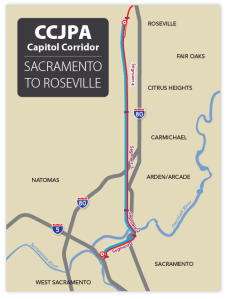


 Getting Around Sacramento