Things That Work: Traffic Posts is the eighth post by Strong SacTown to improve and promote the City of Sacramento update to its Street Design Standards. Other posts at tag: street design standards.
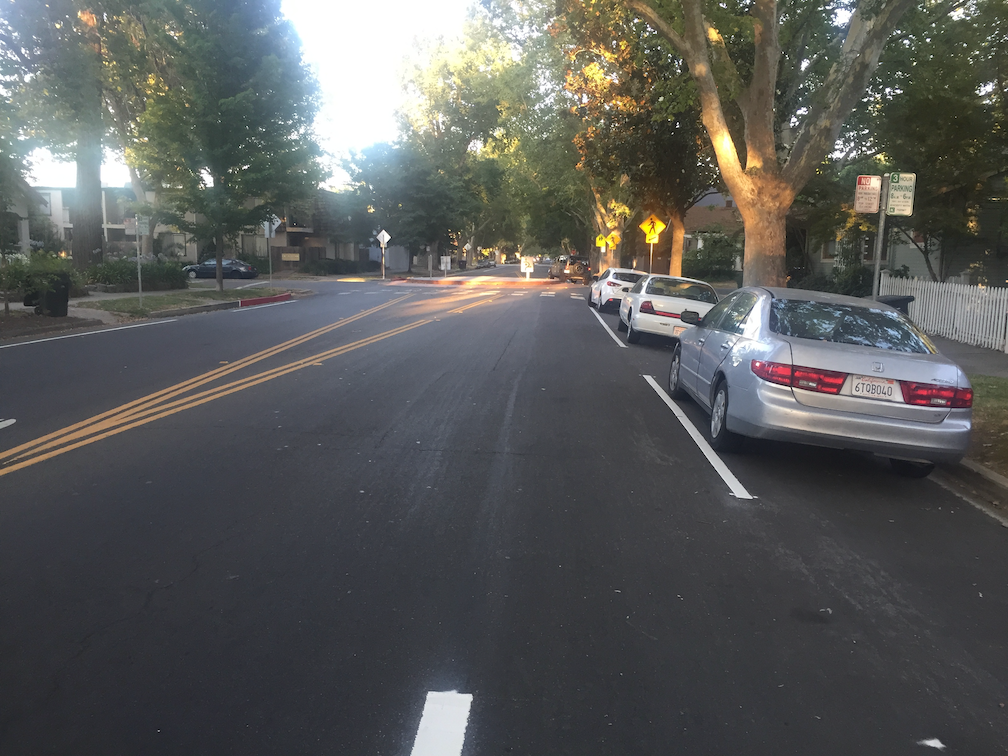
“You don’t often hear news about the crashes that didn’t happen. Today we’d like to highlight something already making real-world safety impacts in Sacramento: traffic posts (aka. delineators) on 15th & 16th Streets in Downtown. These traffic posts reduce the speed of cars (and severity of injuries) as well as channelize traffic – stopping cars from changing lanes at the crosswalk and potentially striking pedestrians who have started crossing.
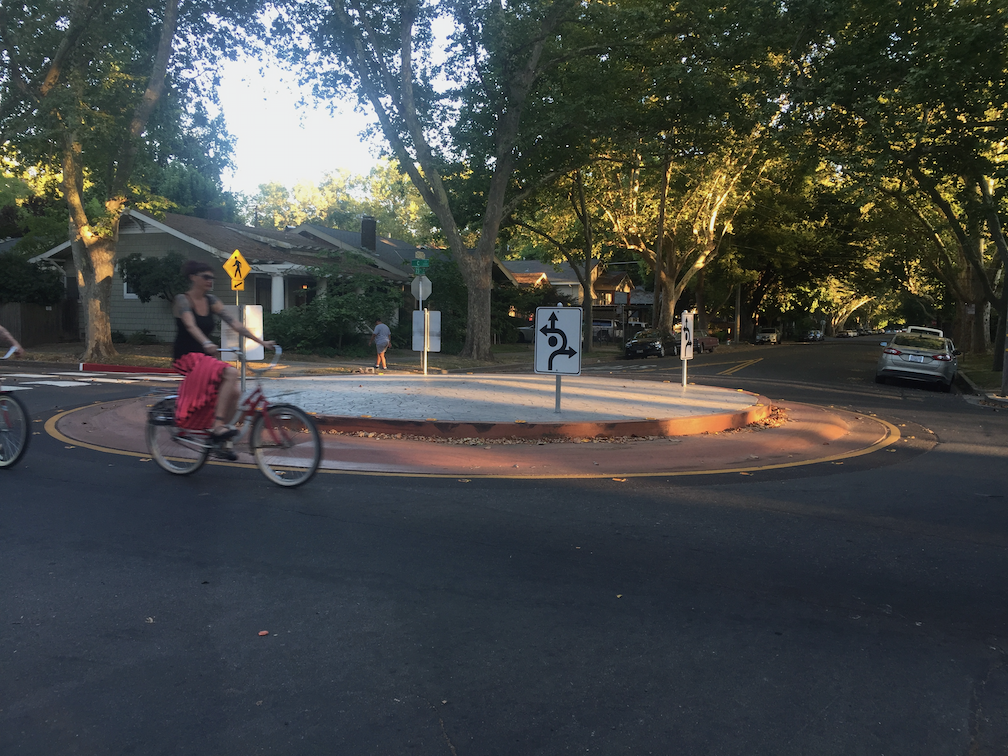
For National Roundabouts Week, here are sample of some traffic circles. True roundabouts have significant horizontal deflection to slow motor vehicles, and do not have any traffic control devices such as stop signs. I do not consider multi-lane roundabout-like structures to be roundabouts, but unfortunately have not come up with a term to distinguish them.
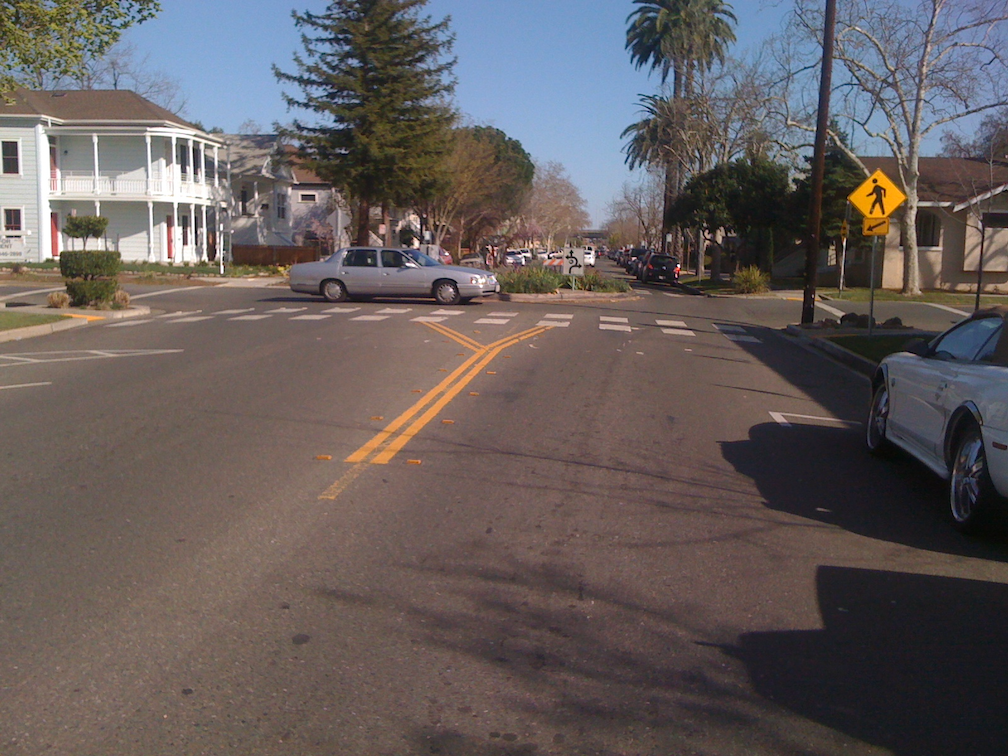
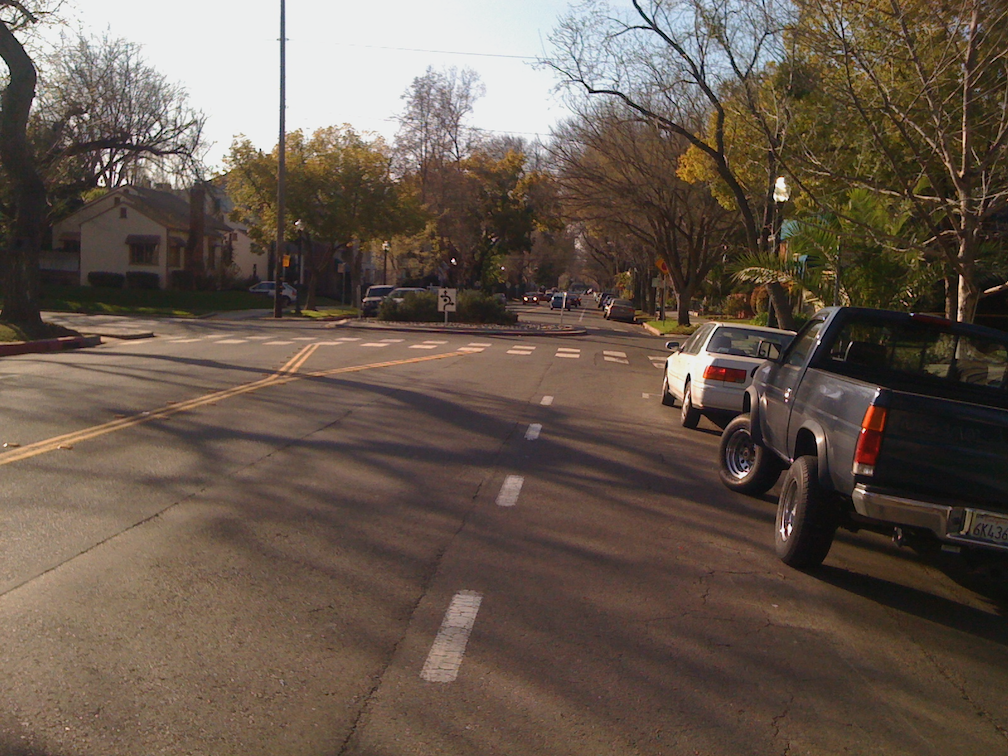
Traffic circles are not roundabouts, at least not as implemented here in the Sacramento region. They are sometimes called mini-roundabouts, which is OK, but they should never be called roundabouts without a modifier. The eight photos below of traffic circles in the Sacramento region, most in the northeast portion of the central city, show some of the settings, and the wide variation in diameter. If the traffic circle is large enough, occupying a significant portion of the intersection, they do cause significant horizontal deflection and therefore slow traffic. Some of the traffic circles are too small, and do not force horizontal deflection and slowing. All of these examples have stop signs on one of the cross streets, so they do not meet the criteria of a true roundabout.
The safety of these structures is somewhere between a true roundabout (high safety) and a regular perpendicular intersection (low safety). Regular intersections are the location of most crashes, whether they are controlled by 2-way stops, 4-way stops, or signals.
See traffic calming measures for additional information on roundabouts and other traffic calming devices.
I have many. fewer photos of true roundabouts, in part because there are many fewer in the region, but I will post on those shortly.
September 16 to 20, 2024, is National Roundabouts Week, sponsored by Federal Highway Administration (FHWA). Two graphics from FHWA below. I hope to have most posts this week on local examples of true roundabouts, traffic circles, and multi-lane roundabouts. I hate that multi-lane roundabouts are called roundabouts at all, since I believe they are no safer than regular intersections and lose the tremendous benefits of single-lane roundabouts.
The Strong SacTown Street Design Standards Team has posted on Modal Filters, which are probably the most effective tool we have for calming and slowing traffic. But there are a number of others than can be used, sometimes more effective depending on the context of the street being redesigned. The traffic calming features below are listed in approximate order of effectiveness, following modal filters of course, but each street to be redesigned for traffic calming is unique, so the best solutions will vary.
The city has a parallel project, the Streets for People Active Transportation Plan. The Neighborhood Connections storymap Traffic Calming tab (scroll the menu bar right if you don’t see this tab) has great examples of many of the traffic calming features. I am using some of those in the recommendations below.
Note: A recently release study of traffic speed reductions engendered by complete streets elements in Minnesota identified roundabouts as the most effective as slowing drivers. Crossroads: Measuring the Effects of Road Features on Driving Speeds, 2024-09-11.
Marked Crosswalks
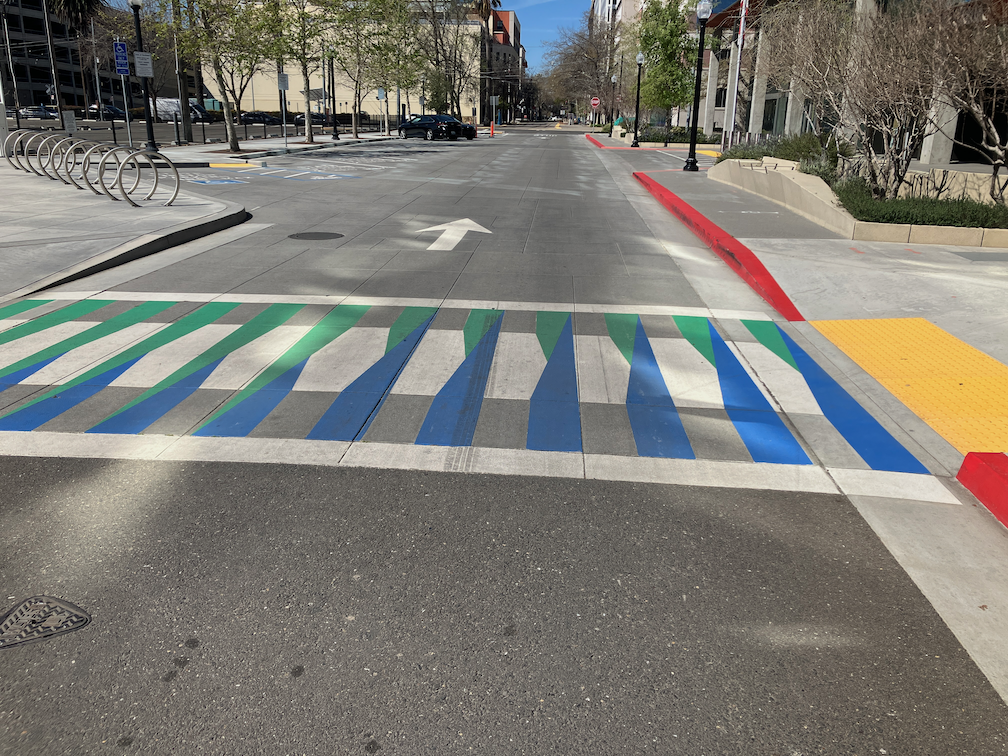
Though state law recognizes that there is a legal crosswalk on every side of every intersection, unless signed against, many drivers do not understand that they must yield to walkers crossing, whether the crosswalk is marked (painted) or not. The crosswalk at every side of every intersection should be painted, though low volume low speed streets may not require marked crosswalks. Decorative designs within the crosswalk further increase visibility.
decorative crosswalk, O Street in SacramentoRead More »
This is a follow-on to my 2016 post back to the old ways? Since that time I have watched several streets in downtown being torn up for utilities. Under the asphalt pavement on several of them are cobblestone and brick streets, covered over by asphalt to provide a smooth and fast ride for car drivers, and a less safe street for everyone. There are also a number of streetcar tracks that have similarly been buried beneath asphalt. Car drivers have won the battle for our streets, so far, but the trend is starting to reverse, even in Sacramento. The City of Sacramento, in its new general plan, has decided that walkers are more important than drivers!
The Strong SacTown street design standards team has identified four roadway typologies, Local Streets, Active Streets, Transit Streets, and Roads. Every redesign of Local Streets should consider installing rougher pavement to slow motor vehicles. Of course if a street is used by bicyclists, the pavement can be only moderately rough, not like the cobblestone pavement on Front Street in Old Sacramento Waterfront. Sidewalk level bike lanes, separated from the roadway and smooth, solve this for some kinds of streets, but local streets usually will not have bicycle facilities because they are low speed and low volume safer streets.
Rough pavement slows drivers, not just where there are traffic calming features such as curb extensions and chicanes, but for the entire block. Rough cobblestones like Front Street limit motor vehicle speeds to 10-15 mph, but a moderately rough street can enforce 20 mph or less, which is the goal for all local streets.
Brick streets do cost more to install than asphalt (the cheapest, in both senses of the word) and concrete streets. But they last much longer, according to The Planning Lady: It Pays to Save Your Brick Streets. “A concrete street will be replaced 3 times and asphalt 6 times over that time period.” Brick laying machines, originally invented in the Netherlands (of course), but now available from many companies, reduce the cost of creating brick streets considerably. I don’t know the range of brick roughness that can be laid by machine, but it should be sufficient for moderately rough streets. The roughness of historical cobblestone like Front Street might not be affordable today, with the material harder to source and labor more expensive, but many cities are using cobblestone for slow streets and gateway treatments.
Photos below of Clay Street in San Francisco cobblestone, Front Street in Sacramento cobblestone, and Liestal Alley in Sacramento brick.
San Francisco, Clay St, cobblestone pavementSacramento, Front St, cobblestone pavementSacramento, Liestal Alley, brick pavement