transit in Boston

I’m traveling on a Amtrak Rail Pass, three weeks from Sacramento to the east coast, and back. So far I’m mostly been in Boston and the Boston region of Massachusetts.

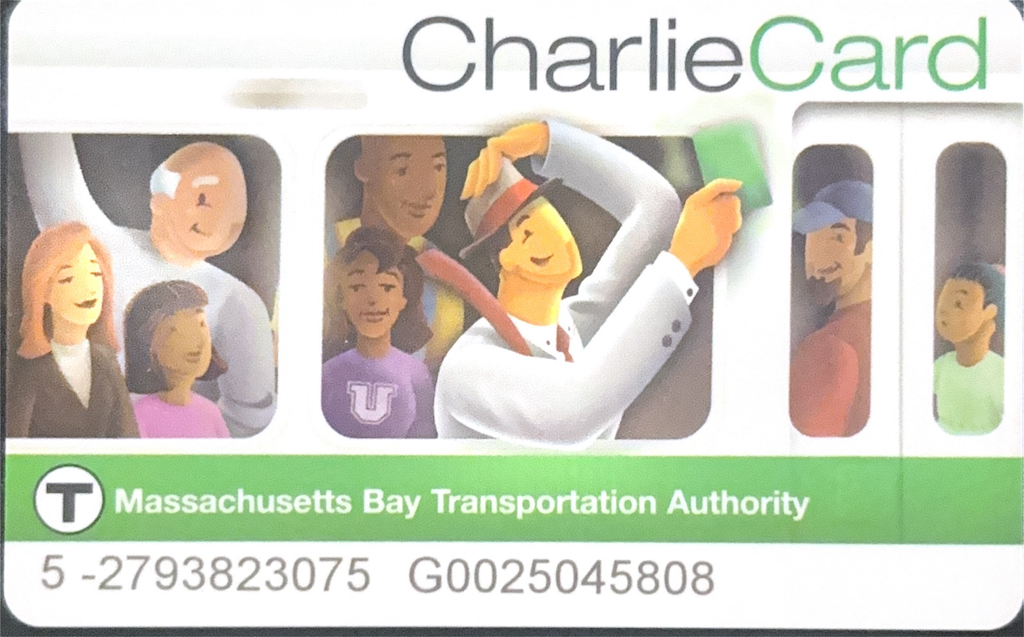
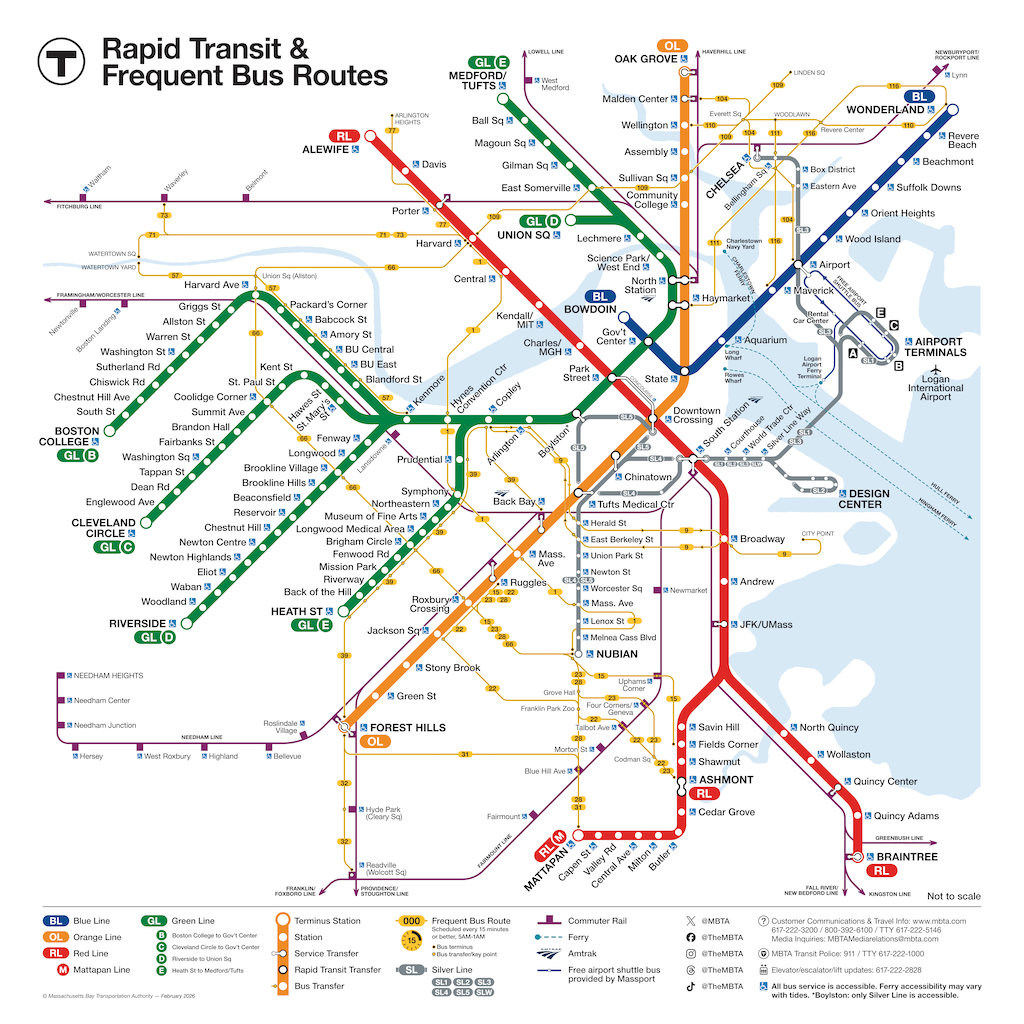
The transit agency is MBTA, Massachusetts Bay Transportation Authority. If you are as old as I am, you will probably remember the Kingston Trio version of “M.T.A.” where Charlie couldn’t get off the train because he didn’t have the exit fare: “Did he ever return? No he never returned, And his fate is still unlearn’d, He may ride forever ‘neath the streets of Boston, He’s the man who never returned.” MTA is now MBTA, but Charlie lives on through the CharlieCard, a fare payment card. Knowing I was going to Boston, I applied for a senior CharlieCard, which provides half off subway, light rail, and bus trips. The system is in transition, so the card is only proof of senior qualification, and fares can’t be added. Yet. But MBTA is one of the major transit systems that have implemented contactless fare payment, and also provides registration for contactless credit cards, so I could use my registered credit card to get the senior fare, $1.10 instead of $2.40.

The MBTA Commuter Rail lines, which go to distant suburbs, and even as far as Providence in Rhode Island, use the mTransit app, but I also get half off on that with the RTA senior card. I look the Framingham/Worcester line to Southborough, and then a local bus to Marlboro, to attend the New England Folk Festival (NEFFA). The train I took was an ancient single level train, with very worn seats, though I can’t pin down how old. There are also newer bi-level cars on the route. Both the bus and commuter rail have a much less frequent and less span of service on Sunday, so I caught a ride back into the Boston area and took the Red Line subway back to my hostel (which is only five blocks away from the Red Line).

I also used the Green Line light rail (which is underground in the central city) to get to the Museum of Fine Arts (MFA) and other destinations. This is the original but still existing service, and the cars are noisy and rickety, though much better than when I last rode about 30 years ago. The Green Line was also very close to my hostel, about two block to the Boylston Station at Boston Commons. I did not have occasion to ride the Orange Line or Blue Line subways. These apparently have nearly modern subway cars. There is also a BRT line that serves the airport and downtown, which I have not used.

The City of Boston is about 676,000 population over 48 square miles, in a MSA (Metropolitan Statistical Area) of 4.9 million over 49 square miles. For comparison, City of Sacramento is about 525,000 over 100 square miles, in an MSA of 2.5 million over an MSA of 21,500 square miles. Though the population of the two areas is not dissimilar, Sacramento has a primitive transit system while Boston has a world-class (for the US) system. Why? Density, density, density. Of course transit in Boston started in 1834, and subway service in 1897. Sacramento didn’t even exist in 1834. In 1897, Sacramento had a population of about 30,000. Sacramento is a wet-under-the-collar cow town.

If Sacramento had developed as a dense urban place instead of a sprawl city, it could have had a transit system like Boston, below.

Boston has busy arterials, just like Sacramento. But off the arterials, there is very little car traffic. People get around on transit. About 1/4 of workers (which does not include people too old or too young to drive) are car-free in Boston, and even those that have motor vehicles do not use them on a continuous basis like many in Sacramento.

Yeh, that classic excuse of, well, Sacramento is not Boston. No, but it could have been. It could have been a real city, a ‘world-class city’.

map of MBTA rail and major bus routes
MBTA Rapid Transit and frequent bus routes map

my Amtrak rail pass and contra dance trip

The main reason that posts here have been absent for the last month is that I was gone on a 30-day trip with an Amtrak Rail Pass. I went to Los Angeles, New Orleans, Charlotte, Greensboro, Asheville and Carrboro/Chapel Hill (not on Amtrak), Philadelphia, Chicago, Denver, and home. Almost half of my trip was in North Carolina, where I’d never been before, with contra dances four evenings and a weekend. And visited friends in North Carolina, and my cousin in Denver.

There are a millions things I could comment on about Amtrak trains, about transportation and transit in the places I visited, and about livability of different cities and neighborhoods. I suppose I could have posted while on the trip, but I was too busy! Whether I’ll post now that I’m home, time will tell.

There should be more posts upcoming, at least until my summer backpacking season starts. Crossing the Sierra Nevada on the California Zephyr through Truckee, I saw that it will be a while before the passes are clear enough for may backpacking, though lower elevation areas are already clear or patchy.

State Rail Plan webinar March 4

Seamless Bay Area and Californians for Electric Rail are hosting a webinar, New State Rail Plan Explained: A vision for an integrated, cohesive California rail network on March 4, 2025, at 12:00 PM. Registration is required, but free.

The Caltrans/California State Transportation Agency 2024 California State Rail Plan (2024-12) is available for review. An earlier draft emphasized hydrogen trains to the exclusion of overhead catenary wire electric trains, but the current version includes catenary, battery electric and hydrogen fuel cell electric.

From the registration page: “The newly released State Rail Plan lays out strategies that can significantly impact how Californians and visitors get around the state – and can make California a place that’s easier for everyone to get around in an affordable, low-carbon, safe, and accessible way. The plan establishes a long-term vision for an integrated, cohesive statewide rail system that offers passenger and freight service and helps achieve California’s mobility, economic, and climate goals. Tune into this webinar to learn about the plan from California State Transportation Agency staff. Researchers and advocates will give their reaction to the updated plan including cost analysis, the political changes needed to implement reforms, and upcoming funding and reform opportunities.”

Whether or not you can attend this webinar, I encourage you to read the 2024 California State Rail Plan, focusing on the routes or concepts that are most important to you.

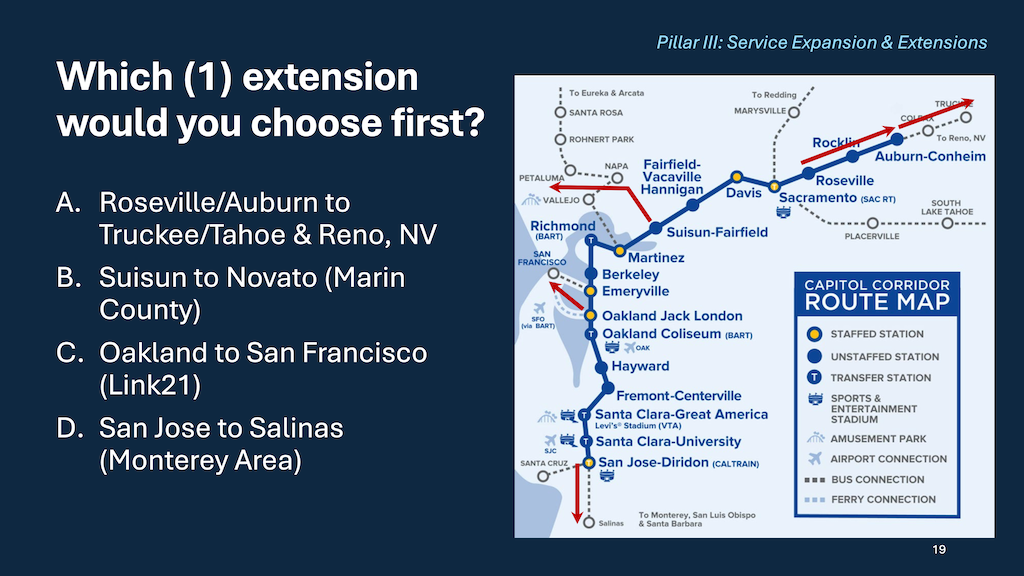
The Capitol Corridor, Sacramento/Roseville to San Jose, is called out for electrification, but the source power is not defined. Capitol Corridor is not specifically a single project, but part of several projects including Transbay Crossing, Leveraging Mega-Investments, Sea Level Rise, and Sacramento and San Joaquin Valleys. In stages, Capitol Corridor service is planned to reach once per hour in the mid-term, and once per 30 minutes in the long term. Current service is one hour at peak times of day, but two to three hours at other times.

Many transportation advocates strongly support catenary electrification of the Capitol Corridor route between Sacramento and San Jose. I have also advanced the idea of state purchase of the rails in heavy passenger rail corridors, which would include Capitol Corridor, either through willing seller or condemnation if necessary. Freight rolling stock would still be owned and operated by the railroads, but passenger trains would now have priority over freight trains, and the freight railroads could not resist catenary electrification.

I hope to provide more detailed analysis of the state plan in the near future.

timeline for Tier 4 diesel and zero emissions
2050 electrified corridors
long-term service plan

Amtrak lost and never found

As readers may know, I travel a lot by train and throughway bus, especially on the Capitol Corridor (Sacramento to San Jose), the San Joaquins (Sacramento or Oakland to Bakersfield and bus to Las Vegas or LA), and the Amtrak long distance trains.

Over the years I have lost a few items on the trains and buses, perhaps 15. Not a lot, but mostly things that were important to me. Back in the old days, lost and found was handled through the end point stations, or which Sacramento was one. In the new days, it is handled through a reporting system that contracts with ChargerBack for lost and found tracking.

I have never gotten back a lot item. Not once. Never. My most recent loss was on a bus from Las Vegas to Bakersfield, connecting to the San Joaquins back home to Sacramento. Though the bus is operated under contract, and serves Amtrak, Flixbus and Greyhound tickets, Alvand Transportation said they do not handle lost & found, it is handled by Amtrak. It took a long while to find the contact info for lost & found, on the Capitol Corridor website, not on the Amtrak website, and here it is: https://www.amtrak.com/onboard/baggage-policy/reporting-lost-items.html.

I have to assume my experience is typical. What happens to the items? Are they just discarded, or do they go home with Amtrak employees or contractors? I don’t know. What I do know is that they are not ‘found’.

So if you travel on Amtrak services, which includes state funded routes such as Capitol Corridor, San Joaquins, Pacific Surfliner, or Amtrak national long distrance trains, or connecting bus service, double-check, triple-check, before you get off to make sure you haven’t forgotten anything. Sometimes the conductors will remind passengers to check around their seats, in the overhead bins, or specifically, for phone chargers, which seem to be frequently left behind. Take it to heart.

a trip to San Rafael

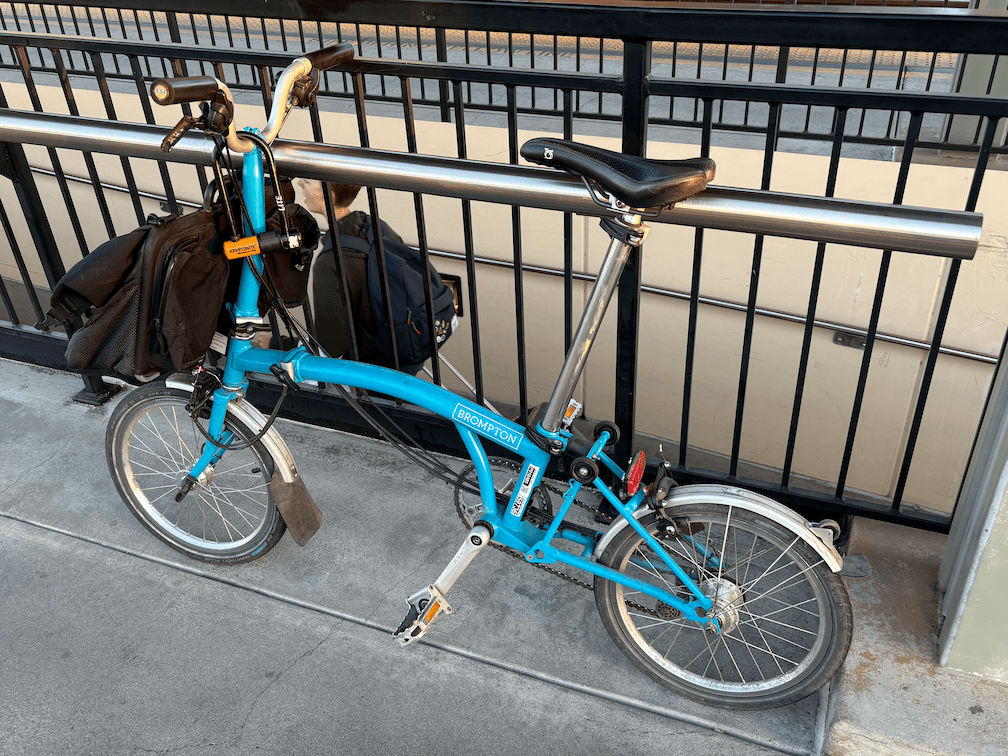
Dan Allison, author of this blog, took a trip to San Rafael, California, in north bay Marin County, on Monday of Week Without Driving. To be transparent, I have been car-free for over 13 years, and car-light for about 7 years before that, so a trip on bicycle and public transportation is just the way I live life, not an exploration of the challenge that people who can’t drive face. My income is lower middle income, so I have enough money to travel, at least locally. I went to San Rafael to retrieve my phone charger and battery pack that I’d left on a Marin Transit bus last Wednesday. It took three days for Marin Transit to find the item and get it to lost and found. It was entertaining, and sad, to watch the included AirTag travel around on multiple bus routes. AirTags are bluetooth, so only report when they are close to a modern iPhone, but they do keep showing up in new locations.

So, the Monday trip:

  • bicycle from home to Sacramento Valley Station
  • Capitol Corridor train from Sacramento Valley Station to Richmond Station, $22.95
  • BART from Richmond to El Cerrito del Norte, $0.85
  • Golden Gate Transit bus 580 from El Cerrito del Norte to San Rafael Transit Center, $3.50
  • bicycle to a local coffee shop, where I worked on Week Without Driving communication
  • bicycle to Sprouts Farmers Market for lunch supplies
  • bicycle to Larkspur Ferry
  • Golden Gate Larkspur Ferry to San Francisco, $7
  • bicycle to San Francisco Bay Ferry gate G1
  • San Francisco Bay Ferry to Oakland Ferry, $2.30
  • bicycle to Oakland Jack London Station
  • Capitol Corridor from Oakland to Sacramento, $24.65
  • bicycle from Sacramento Valley Station to home

All of the public transportation was using my senior Clipper Card, on my watch. Capitol Corridor train travel was pre-purchased tickets through the app. The total was $61.25, which is rather expensive for a none day trip, but is quite a bit less than I would have spent driving. At about 83 miles there, and about 105 miles back, using the IRS rate of $0.67 per mile, driving would have cost $126. Plus $17.25 for Golden Gate Bridge and Carquinez Bridge tolls. Most people think only about gas costs, or charging costs, and forget about depreciation, insurance, maintenance, parking, and tolls.

Travel time is hard to compare, since I made so many stops along the way, and did not travel by the most direct route. Looking at the simpler Sacramento to San Rafael trip, driving would be 1 hour 20 minutes, whereas I spent about 2 hours 20 minutes on public transportation.

This is a trip that I’ve taken many times, so there was very little planning involved, and in fact I changed my plans for the leg back home several times on the fly, without problems. Less familiar trips would take more planning.

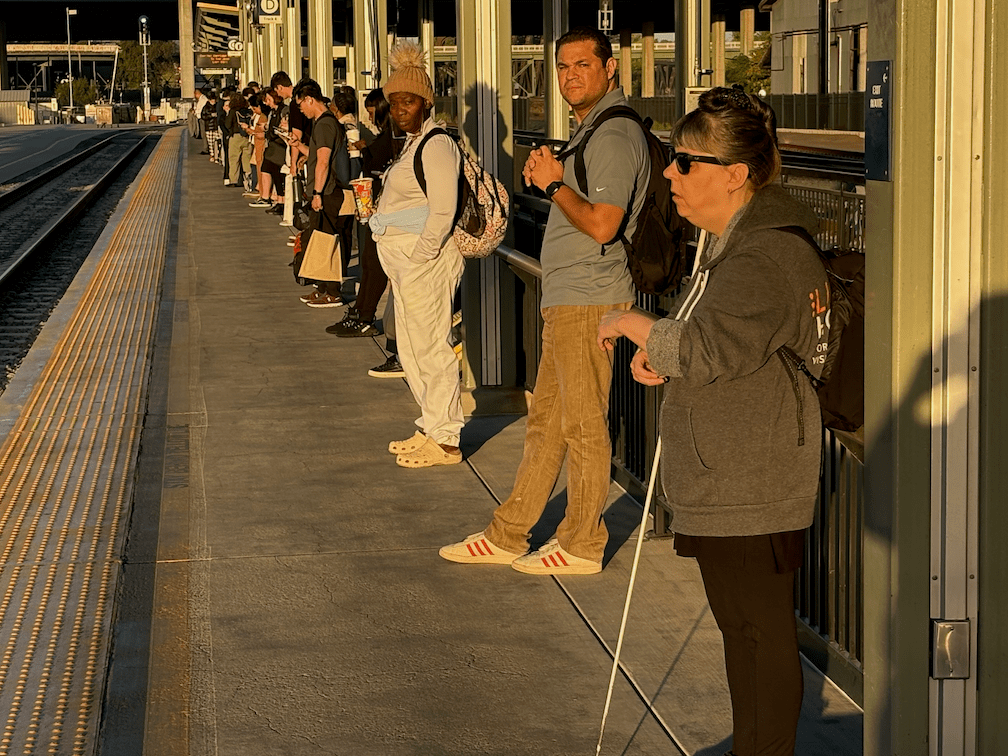
A few photos from my trip are below, but many parts are missing. I’m not used to documenting my public transportation travels, and even less for selfies.

San Joaquins on new Siemens Venture trainset

This is a followup to its a rough ride!

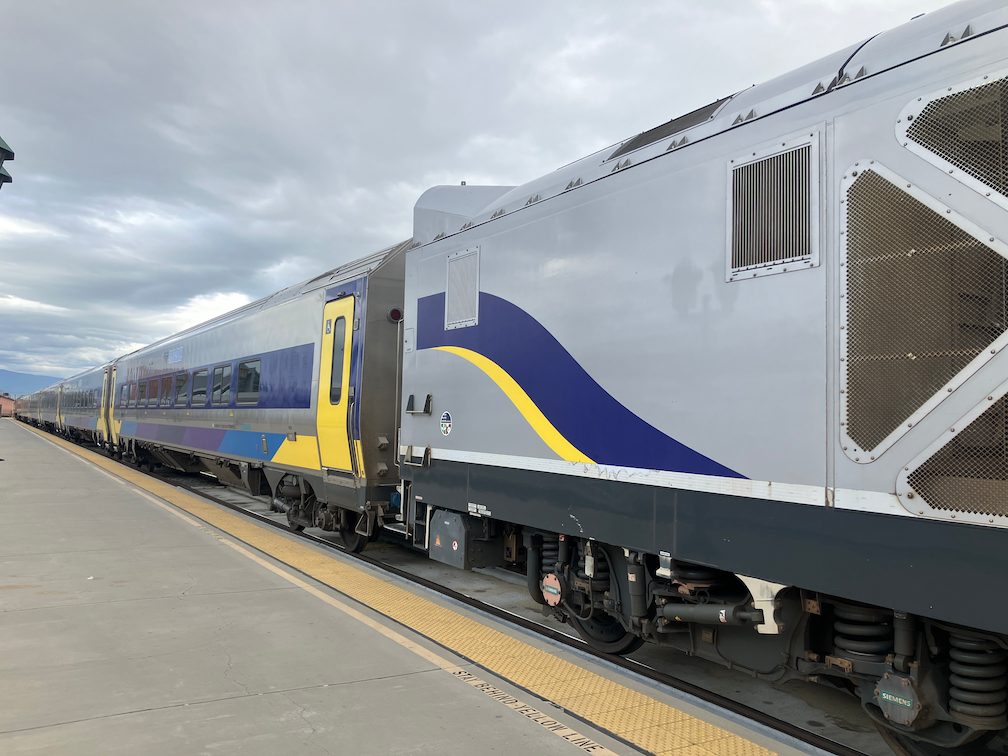
On March 1, I rode San Joaquins 719 from Bakersfield (4:12PM) to Stockton (8:55PM). The 719 continues on to Oakland Jack London, but there is a bus connection to Sacramento from Stockton. I had picked that schedule specifically to experience the new Siemens Venture trainset used on that route.

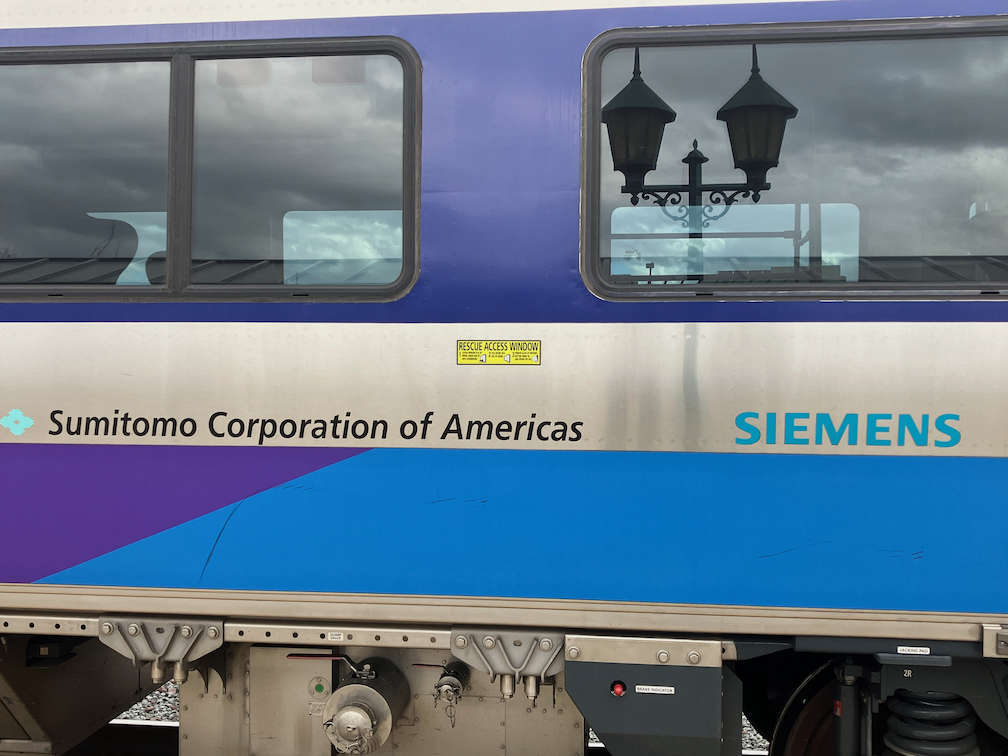
The official page is Welcome Aboard Amtrak San Joaquins New Venture Cars. I did not know until observing the cars more closely, that Sumitomo Corporations of America is actually the lead contractor, and Siemens is the subcontractor who built the cars. Roger Rudick wrote Review: Amtrak California Passengers are Starving for New Trains on StreetsblogSF. Though the trainsets have been in service since December, I haven’t found any other reviews that have details.

Seats: Roger talked about narrow seats. They are indeed narrower than those in the California Cars (I don’t have measurements; an online source says 19.1 inches for the new seats), though I did not find them uncomfortable. Others may.

No food or water: As noted, there is no food service on the train. The announcements said ‘snack packs’ and water were available for free, but what was actually offered was Cheez-Its. Though there are rumors of eventual vending machines, none were present, and it is not clear where they might be placed, perhaps in vestibules. No water dispenser is available on the trainset, only bottled water.

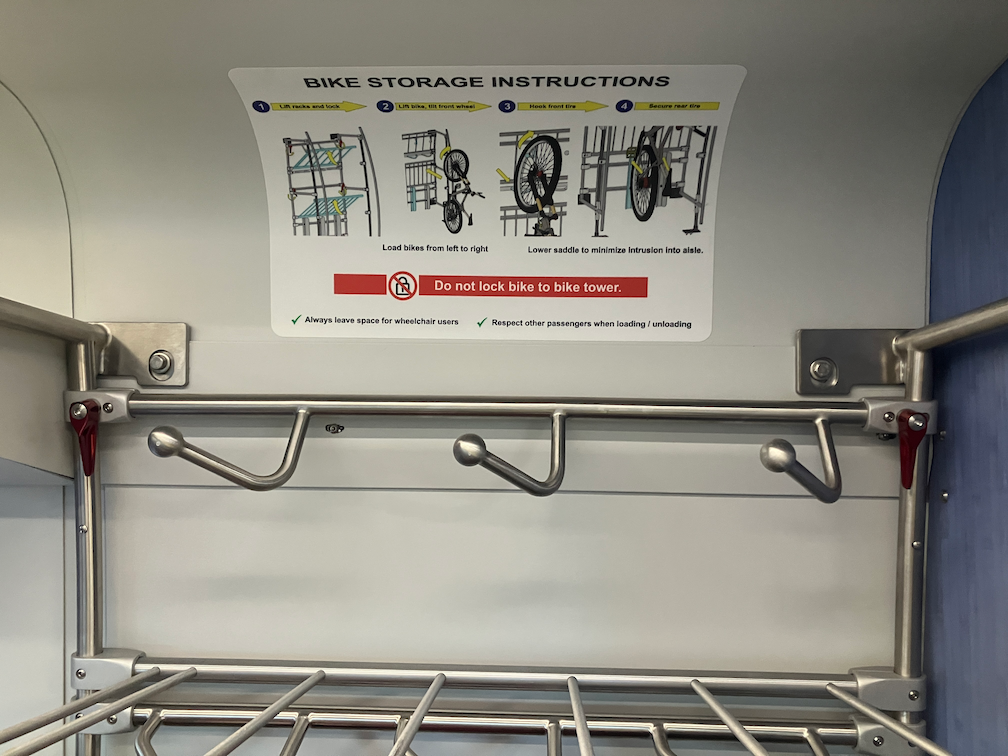
Bikes: One of the luggage racks in each car has three bicycle hooks, but the luggage racks were fully occupied by luggage, so not available to bicycles. A conductor told a bicyclist to take his bike to the baggage car rather than on board. I don’t know if that is policy. Given that there is not space set aside for bicycles, I’d have to say these new track sets have zero bicycle capacity. The baggage car is a false locomotive that has been used on San Joaquins for years, not part of the new trainset. Bicycle use on the San Joaquins has always been low. It will be a long time before these trainsets are used on the Capitol Corridor – San Joaquins and Pacific Surfliner first, with California Cars moved to Capitol Corridor and prolonging that. But the bicycle configuration would be totally unacceptable on Capitol Corridor, where bicycle use is moderate and sometimes high.

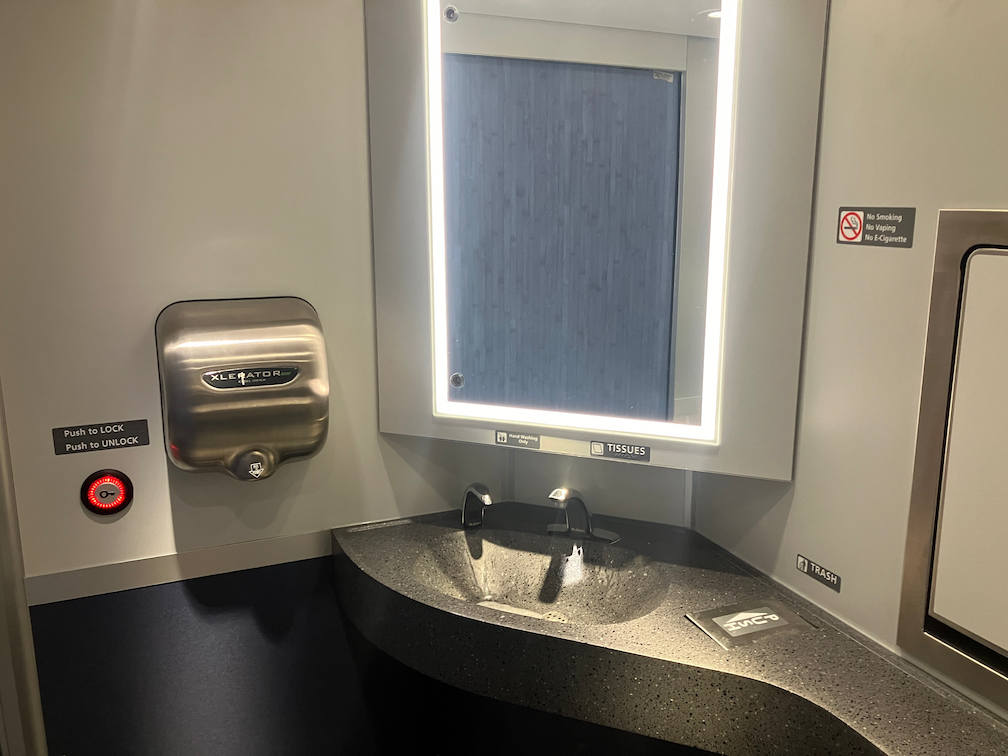
Automation: Many things are automated: the doors between the passenger seating and vestibules; standard announcements; restrooms doors. The toilet, water, soap and dryer are no-touch.

Power: There are two power receptacles and two USB-A receptacles between each seat. Hello! This is 2024, and few people use USB-A anymore, but actually most people use plug-in chargers, so the USB-A is irrelevant.

Display: There are three display signs overhead in each car. At this time, the only useful information they carry is which of the six coach cars you are in. The destination was shown as Bakersfield, when the train was northbound with destination Oakland Jack London. I imagine they will have useful information in the future, otherwise they are a waste.

Access: On the train I was on, three doors were opened at each stop, between 2/3, 4/5 and 5/6, with a staff member at each (two conductors and one attendant, I believe). If one of the wheelchair doors were being used, then either staff would not be at one of the other doors, or one of the others would not be opened. Apparently they are never opening all doors.

ADA Access: One door at each end of the train is for wheelchair and device loading. I did not observe this in operation. One person with a wheelchair was on board for part of the trip. The aisles are wide enough for most wheelchairs, and each car has a wide aisle though only those two cars out of six have the loading door.

The Ride (the big question): Is the ride smoother? Yes. It is still a little rough, but much smoother than the California Cars. I did not feel unsafe standing up and walking around, though it is still too rough to write. So tracks condition continues to be a problem on the San Joaquins route (and everywhere else).

its a rough ride!

I’m on the San Joaquins train from Sacramento to Bakersfield, and then bus to Los Angeles. I am having a hard time typing because the ride is so rough. The times when I could write in my journal, at least occasionally, are years ago. Every trip I take on the San Joaquins, and my frequent trips on the Capitol Corridor, are rougher than the last. There are many slow zones on both routes where the trains simply cannot go at full speed due to the deteriorated tracks.

Some people have claimed that that problem is not the tracks but the antique California cars (1995) that are now quite old and have not been maintained well by Amtrak (see Wikipedia: California Car). That may be part of the problem, but so are the tracks. Single level cars such as the Siemens Venture should be somewhat smoother than the bi-level California cars.

What I can say for certain is that this level of service, a ride so rough that one can’t type on a laptop, nor safely get up and walk around in some sections, is unacceptable.

Siemens Venture Trainsets

I have not yet had a chance to ride on the new Siemens Venture trainsets so that I can compare the ride quality. I have, however, seen them in stations while waiting for buses. I may have a chance to catch one on my way back north.

Note the use of the term ‘trainsets’, meaning the each consist of cars is linked together, not intended to be separated for longer or shorter trains, during normal operation. The San Joaquins trains will be hauled by Charger locomotives, also from Siemens. A cab car is the operator car on the opposite end of the train from the locomotive, so that the train can operate in either direction without reversing.

photo of San Joaquins Siemens Venture trainset in Hanford
San Joaquins Siemens Venture trainset in Hanford

The Trains and Railroads website says this about the new Siemens Venture transets on the San Joaquins route:

“The California Department of Transportation has ordered seven Venture trainsets for the San Joaquins service with seven cars each: four coaches, two coaches with vending machines, and one cab control passenger car. Two cars per trainset will have built-in wheelchair lifts for compatibility with the low platforms used in California. The cab car and two other cars per trainset will have one vestibule per car, while the remaining cars will have two vestibules each. The San Joaquins service does not offer business class seating.”

Streetsblog California had a post on the new trainsets, which it said are running on service 710 (7:36AM from OKJ Oakland Jack London) and 719 (4:12PM from BFD Bakersfield): Review: Amtrak California Passengers are Starving for New Trains. It looks like only two trainsets are in service so far on the San Joaquins. Interestingly, there is no announcement from the San Joaquins on the new trainsets, nor any information about what trainsets are on what schedules.

Correction: There is one trainset, used both directions on 710/719. Rumor is a second trainset will be added soon, for 702/703. The 702/703 is the train that serves Sacramento directly without the bus to Stockton. A rumor from the Cafe Car attendant is that the trainsets will be modified to have a cafe car of some sort, in response to complaints such as from Streetsblog above, about the lack of food service on the new trainsets. It isn’t clear to me whether the San Joaquin JPA or Caltrans Division of Rail is more in charge of train configuration.

Capitol Corridor gets more TIRCP funds

Capitol Corridor has received more funds from the TIRCP (Transit and Intercity Rail Capital Program) for some projects in the Sacramento region. It includes full funding of the Sacramento Valley Station transit hub, additional funds for the Sacramento-Roseville third track project, and contactless readers for Thruway buses (presumable the same readers that have been installed on the trains, which will allow direct payment for trips once the Tap2Ride pilot is complete).

https://www.capitolcorridor.org/blogs/get_on_board/capitol-corridor-awarded-42-million-from-california-state-transportation-agency

freight and passenger rail

The strike by railroad workers seems to have been averted by the private railroads giving in just slightly. I don’t know enough about labor in the railroads to say much of intelligence on the issues, though I am pretty sure that as huge and very profitable corporations, the interests of the freight railroads are not those of the workers.

The possible strike has reminded me that I have ideas about railroads. I quite often use the Capitol Corridor regional service, Sacramento to the Bay Area, and also use the Amtrak long-distance routes, Coast Starlight and California Zephyr. My experience is that service on these routes has been continuously deteriorating over the years. Amtrak is not really very good at running trains, and they are even worse on maintaining trains. Equipment problems are a daily occurrence, and are often the start of trains falling behind schedule.

Passenger trains are guaranteed, by federal law, right of way over freight trains. But only if the passenger train is on schedule. So if a passenger train falls off schedule, due to equipment problems or slow loading at a station or slow crew changes (Amtrak personnel are often late to the job at crew change locations), the train will fall further and further behind. The long distance trains are either on time, because they never fell behind, or four to six hours late, because they did, and lost priority to freight trains. It is frustrating to sit on a siding, often for quite a while, while a slow and long freight train gets the right of way.

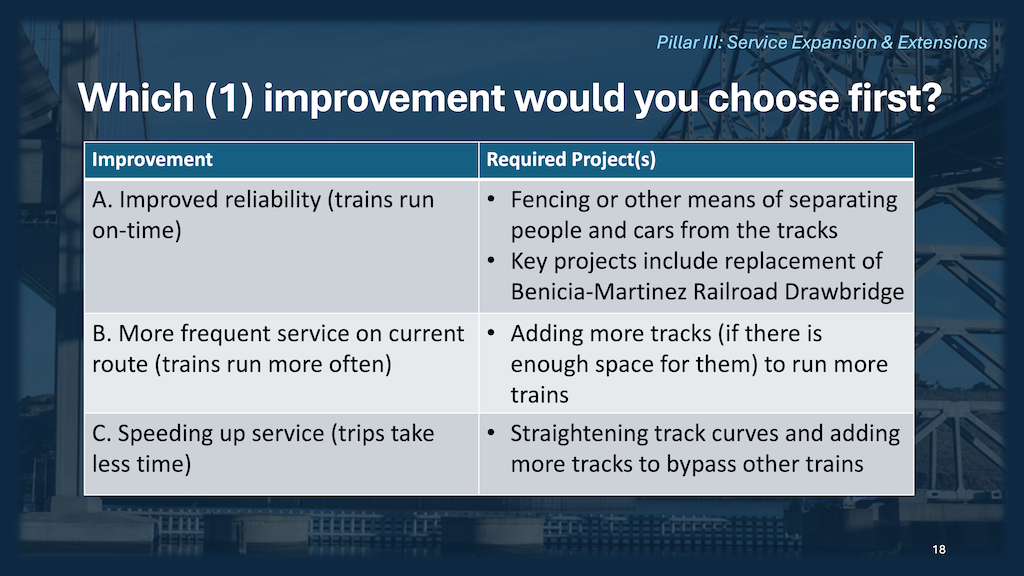
The Martinez rail bridge is a major problem for Capitol Corridor schedules. The only solution is a new high level bridge that would not be delayed by maritime traffic.

But the real issue to me is that maintenance of the rails is unacceptably bad. About two years ago, Union Pacific did a major maintenance project on part of the route between Sacramento and Martinez. The result? The rails were much worse after than before. It used to be I could write, not easily, but acceptably, on the Capitol Corridor. Those times are long gone. It is now difficult, and dangerous, to even get up and walk around. Sharp jolts from poorly maintained rails are a regular occurrence. I’ve seen people thrown to the ground by these jolts. A few years ago, a Capitol Corridor train almost derailed between Sacramento and Davis, with many passengers injured. Amtrak stonewalled the investigation, and Capitol Corridor JPA shrugged and accepted that no one was going to take responsibility.
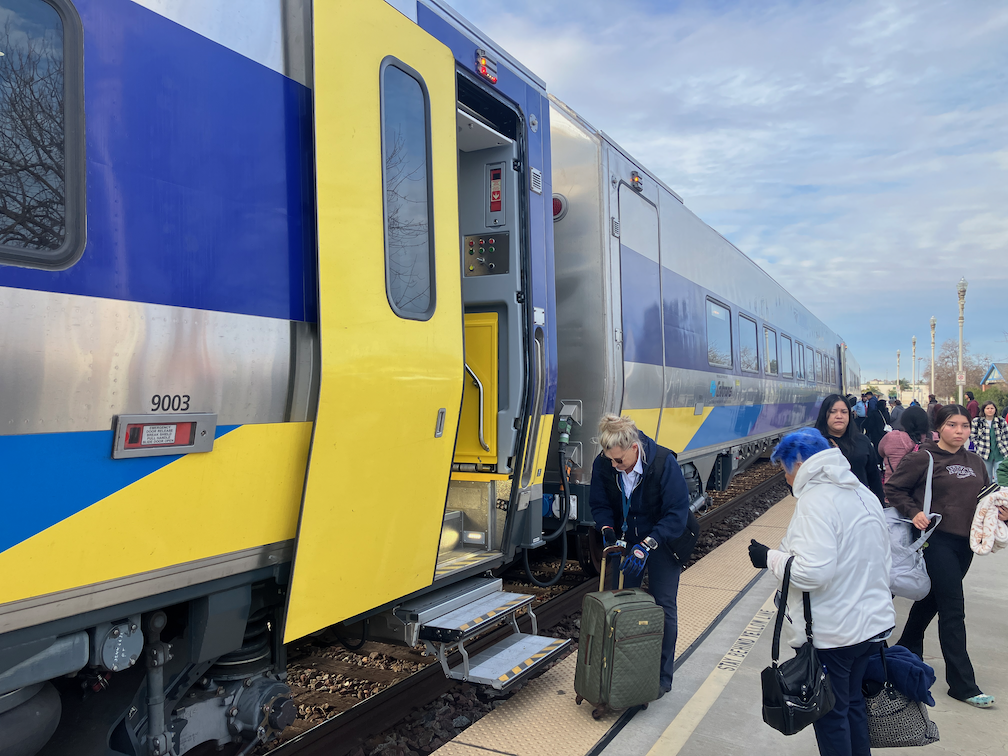
Transportation advocates have long pushed for electrification of the Capitol Corridor trains, and similar regional rail systems throughout the US. But Union Pacific does not want catenary wires (the overhead wires that power electrified trains) along its tracks. So Capitol Corridor will continue to use diesel locomotives forever. The current model is much cleaner than older ones, but still dirty. If you really want to see dirty, look at the ancient diesel locomotives that Amtrak uses for its long distance trains.

Capitol Corridor JPA has a project to add a third track between Sacramento and Roseville so that more passenger trains can be run on that section. Today, there is one train westbound and one train eastbound, up to Auburn, with a stop in Roseville. The project has been much delayed, and now has been trimmed back so that only part of the route with have a third track. As I see it, Capitol Corridor was extorted by Union Pacific.

So, solutions:

  1. Regional rail services, which are almost entirely funded by the states and not Amtrak, should start separating from Amtrak. The result will be better managed trains and better maintained trains. The only advantage regional rail gets from Amtrak is unified ticketing, so the solution there is to have a separate unified ticketing service that is not controlled by Amtrak.
  2. The states and/or federal government should take ownership of all rail lines that serve more than one passenger train per day. Freight railroads would still own their rolling stock, and could buy passage on the routes, but the routes would be managed (dispatched) to prioritize passenger rail at all times. If the freights are willing sellers, then fair market value, but condemnation would be used where they are not.
  3. All regional passenger service should be considered for electrification. The passenger service would be cleaner and quieter and faster (better acceleration than diesel). Not all would be electrified. Freight railroads would have to accept running under catenary, or better yet, just start running electric locomotives as well.
  4. California should commit to and fully fund a high level bridge at or near Martinez.
  5. Capitol Corridor should terminate the third track project as currently designed, and demand that Union Pacific provide the right of way for a third track without any freight use at any time. I’m sure UP would refuse, which takes us back to item 2 above, public ownership of the right of way and rails.

TIRCP grants for Sac region

TIRCP (Transit and Intercity Rail Capital Program) grants for 2022 have been announced, with two in the Sacramento region. One is a joint application from Capitol Corridor JPA, City of Sacramento, SACOG, SacRT, and Downtown Railyard Ventures, for work related to Sacramento Valley Station realignment of light rail and buses. The second is for SacRT to purchase eight more modern low floor rail cars.


4. Capitol Corridor Joint Powers Authority (CCJPA), with the City of Sacramento, Sacramento Area Council of Governments (SACOG), Sacramento Regional Transit District (SacRT), and Downtown Railyards Venture, LLC (DRV)

Project: Sacramento Valley Station (SVS) Transit Center: Priority Projects
Award: $49,865,000
Total Budget: $95,050,000
Estimated TIRCP GHG Reductions: 156,000 MTCO2 e

This project delivers a set of interrelated projects to introduce better connectivity between modes at the Sacramento Valley Station, as well as redesigned commuter and intercity bus service to the SVS and Downtown Sacramento, that will increase ridership on both trains and buses. Project elements include design of a new bus mobility center to facilitate convenient transfers between modes, realignment of existing light rail tracks and construction of a new platform, construction of a new cycle track on H Street to improve access to the station, and construction of a new pick-up and drop-off loop.

The light rail tracks will be realigned into a loop with a new north-south oriented platform just south of the Steve Cohn Passageway entrance (about 450 feet closer to the rail tracks than currently, and only 100 feet from the future Bus Mobility Center), as well as a new double track alignment from the new platform to the intersection of F Street and 6 th Street. The construction of the new pick up and drop off loop at the station will allow more efficient transfers. The project includes installation of a new storm drain trunk line which will enable new transit-oriented development on key parcels next to SVS.

A new regional bus layover facility will be built in a 2-block portion of X Street between 6th and 8 th Street. The proposed facility will allow buses to layover in Sacramento between runs, improving bus efficiency and reducing vehicle miles traveled, as well as fossil fuel consumption. Initial users of the facility are expected to include El Dorado Transit, Galt-Sacramento SCT Link, Placer Transit, Roseville Transit, San Joaquin RTD, and Yuba-Sutter Transit.

The project will also support the consolidation of downtown regional bus routes, building on the study SACOG completed with 2020 TIRCP funding. Construction of shared stops between SVS and the future Midtown Amtrak San Joaquin and Altamont Corridor Express station will be completed, including the reuse of seventeen bus shelters from the Temporary Transbay Terminal in San Francisco. This component will also complete an unfinished portion of 5 th Street between Railyards Boulevard and North B Street as the most efficient connector for all north area buses to access the freeway to SVS and serve the new state office complex on Richards Blvd. That will provide the connectivity to implement 10 additional bus stops (5 northbound and 5 southbound) north of H Street. Commuter buses operated by Amador Transit, Butte Regional Transit, El Dorado Transit, Soltrans, Galt-Sacramento SCT Link, Placer Transit, Roseville Transit, San Joaquin RTD, Yolobus and Yuba-Sutter Transit will be routed along new shared northbound and southbound routes. This work will complement SacRT’s TIRCP-funded network integration to better integrate its service with intercity rail at both SVS and the future Midtown station.

The project will also purchase and install contactless EMV readers coordinated with the California Integrated Travel Project on rail and bus vehicles to allow fares to be collected through contactless bank cards and mobile wallets.

Ridership at Sacramento Valley Station is also expected to be positively impacted by the city’s housing policies, confirmed with a Pro-Housing designation by HCD, the first city to receive such a designation in the state. A significant amount of housing is expected to be added in the Railyards District, adjacent to the station area.

These plans will be developed in cooperation with many transit partners and agencies throughout the Sacramento region, and with additional technical assistance provided by the California Department of Transportation, in order to ensure integration of regional and interregional capital improvements and service.

Project is expected to be completed by 2025.

Key Project Ratings: Medium-High
Cost per GHG Ton Reduced: Medium-High
Increased Ridership: High
Service Integration: Medium-High
Improves Safety: Medium
Project Readiness: Medium
Funding Leverage:High
Multi-Agency Coordination/Integration: Priority Population Benefits: Medium-High
Housing Co-Benefits: High


15. Sacramento Regional Transit District (SacRT)

Project: Fleet Modernization
Project Award: $23,600,000
Total Budget: $47,200,000
Estimated TIRCP GHG Reductions: 44,000 MTCO2 e

Purchases 8 new low-floor light rail vehicles (LRVs) to further expand low-floor fleet operations on the light rail system. Over one-third of SacRT’s light rail fleet has reached the end of its useful life, and this investment leverages past TIRCP grants, as well strong local match, to help modernize the fleet.

Low-floor LRVs will produce operational efficiencies by speeding up train times and optimizing boarding convenience and safety along with increased capacity. They also will increase fleet reliability and reduce the number of shorter than planned trains need to be operated on the system. These are significant benefits to persons with disabilities, seniors, parents with strollers, and bicyclists, who will have more boarding options and increased boarding and alighting safety. These improvements are expected to support retaining and attracting new light rail riders, including residents of disadvantaged communities, who make up 30% of the population within SacRT’s service boundary.

The project also supports sustainable housing and land use development while providing meaningful benefits to priority populations by improving mobility and access to transit options. The project complements several TOD/joint development projects underway along the light rail corridors, including a surplus SacRT property near a station that was sold to an affordable housing developer who has entitlements and plans to begin construction on 128 units.

Ridership on SacRT is also expected to be positively impacted by further rollout of integrated contactless payment throughout the light rail and bus system, as well as by the city’s housing policies, confirmed with a Pro-Housing designation by HCD, the first city to receive such a designation in the state.

19 Project completion is expected by 2027.

Key Project Ratings: Medium-High
Cost per GHG Ton Reduced: Medium
Increased Ridership: Medium-High
Service Integration: Medium-High
Improves Safety: High
Project Readiness: High
Funding Leverage: Medium-High
Multi-Agency Coordination/Integration: Priority Population Benefits: High
Housing Co-Benefits: High