what now?

It is Winter Solstice today, December 21. It seems like a good day to write the ‘what now’ post that I’ve been thinking about since the election. I’m not religious, so the four ‘sun-days’ of the year, two solstices and two equinoxes, are my main celebrations. And sometimes, but not as often, the cross-quarter days of Imbolc, Beltane, Lughnasadh, and Samhain (Halloween). I’m in Santa Cruz today to celebrate the solstice with good friends, fortunately this year on a weekend. I used to work and live in Santa Cruz, years ago now, but many of my best friends are here. Of course I got here on train and bus and bike. Santa Cruz has about the same number of coffee shops per capita as central city Sacramento, but they are busier here. I’m sitting in a coffee shop, drinking tea. I’ll do a update post on grid coffee soon.

I was very depressed by the 2016 election, but less so this time. Why? Because in 2016 I was uncertain. This time I’m not, I know we are in for a very dark four years. At the national level, things will suck for everything I care about, in transportation and equity. Many of my friends, both in transportation advocacy and otherwise, were far more depressed than I. I was in a personal growth seminar the day after the election, and some people were immobilized with depression. I understand.

But at the local level, I feel more hopeful. I don’t feel as though I do or can have much of an influence for better at the national level, but I do see positive influence and action at the local level. The parting of ways with Howard Chan was definitely a bright spot for me. And the organizations which support the same things I do and working hard on making Sacramento, both city and region, a better place.

I can’t do better at explaining than the Strong Town process, below. Of course this process is about way more than just transportation, it is about everything that makes a place, our place, a livable, vibrant place.

The other major thought I have is that most people will be harmed by Trump, both those who voted for him and those who did not. He is a vindictive, authoritarian person, who cares primarily for himself, and to some slight degree, for his rich powerful friends. No matter what he says, his actions indicate that he does not care for other people. So this will be a bad time for everyone, as he and his sycophants work to undermine everything that is good about our country. He intend to break everything, without having a better idea to put in place.

It would be tempting to blame what goes wrong on the people who voted for him, but I will not. They will be hurting, just like the rest of us. They deserve our empathy and forgiveness. Not that we need to give in to what they voted for, but to recognize that all humans, all life, are the victims here.

Our lives are affected by what happens at the national and international level. There is clearly a trend in many parts of the world towards fascism. But at the local level, there is work to do, past harms to heal, people to celebrate, people to listen to, people to see as neighbors no matter who they voted for. Obviously I do work in this blog, but coming to coffee shops to talk with people is also part of the work.

Strong Towns approach to roadway safety

Strong Towns, an organization which provides leadership and thinking through five priority campaigns: End Highway Expansion, Transparent Local Accounting, Incremental Housing, Safe and Productive Streets, and End Parking Mandates and Subsidies. Safe and Productive Streets are the focus this week, with a podcast Prioritizing Safety in Street Design: A Conversation with Melany Alliston, posted today, and tomorrow, Beyond Blame Press Conference: How Cities Can Learn From Crashes To Create Safer Streets Today, and release of a report Beyond Blame: How Cities Can Learn from Crashes to Create Safer Streets Today.

Strong SacTown, the ‘local conversation’ or affiliate of Strong Towns is an active participant in the City of Sacramento Street Design Standards Update. Please join Strong SacTown. Slow Down Sacramento (Isaac Gonzalez) is also playing a major role in bringing awareness of roadways safety to the public, and his emails inform this post. Please join Slow Down Sacramento. Civic Thread and SABA, along with many other organizations, are providing both leadership and technical expertise on roadway safety. Please support them!

Strong Towns has offered the Crash Analysis Studio for two years now, with 19 studios. I have participated in several of these, and I think they are great, though only a part of the necessary response.

Street Design Team

This is the second post on working differently to achieve the streets we want, and heal the streets we have. The first is Crash Rapid Response Program for SacCity.

Strong Towns Street Design Team

The concept of a street design team came to me from the Strong Towns Academy course ‘Establishing a Street Design Team‘. This is a paid course, but I’ll offer the key concepts here.

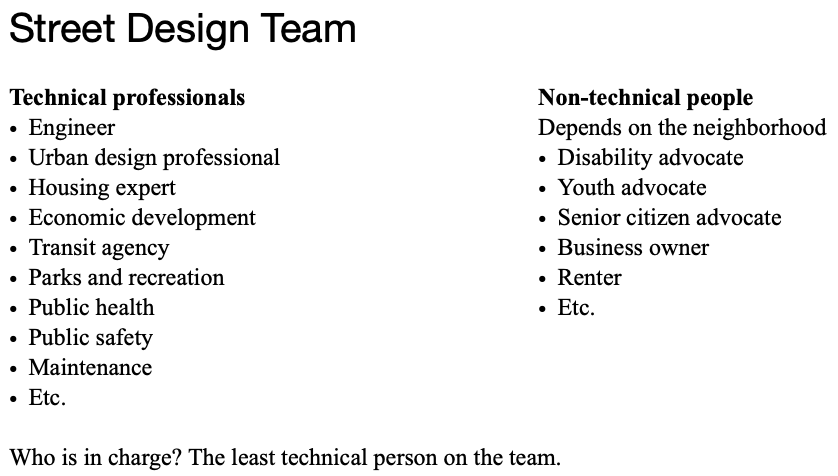
The origin the street design team is the Strong Towns post Engineers Should Not Design Streets. The upshot is that engineers do not have the training or expertise to design streets. Streets should be designed by everyone, and then the engineer will implement that design. The way to do that is to create a street design team with both professionals and citizens. The course presents this chart.

In the presentation, Mike Lydon recommended starting with designing streets that already have some good things about them, and making them better, rather than starting with horrible streets (stroads) that can take a lot of money and time to heal. Anthony Garcia said that if either engineers or politicians are not initially supportive, starting with a small project can show them that alternatives work and are supported by the public. He also said, don’t pick something really controversial or really challenging, rather, pick something likely to be successful.

The whole street design team concept is based on one of the core principals of Strong Towns, four steps for public investment.

for SacCity

I would say that the number of non-technical people should outnumber the technical professional. I would also include in the non-technical list the regional walking and equity organization, Civic Thread, and/or the regional bicycling organization, SABA, and/or one of the transit advocacy organizations. And I would include a member of the SacATC, which has 11 members. Non-technical people should be compensated in some way for their participation, such as stipends, food, transportation, child care.

People could speak up for being on a team, and then a team for each issue or block would be assembled from those available. Though team application and team formation could be managed by the city, they would not be in charge of the team. Though the concept does not specify how big the team should be, I find that teams of more than 12 people tend to have issues with hearing from everyone. Team members would have to agree to a set of group guidelines or community agreements about how to treat each other, with respect, listening more than talking.

A team might stay together for more than one project, or might do only one before the team members disperse to other projects.

Next step? I’m not sure. I intend to talk to some SacATC member and city staff about the idea.

Strong Towns Chuck Marohn in Citrus Heights on Thursday

Chuck Marohn, President of the Strong Towns organization, will be in the Sacramento area this Thursday (June 16). He is speaking in Citrus Heights, 6:00PM to 7:30PM, and it appears he is also presenting to the SACOG Board at a workshop, item 14 (immediately following consideration of the proposed transportation sales tax measure side agreement).

This conjunction seems appropriate, since Strong Towns has just released its five campaigns that are the core of its new strategic plan:

  1. We’re Advocating for Safe and Productive Streets
  2. America *Must* End Highway Expansions
  3. Your City’s Accounting Is Unnecessarily Obscure. It’s Time To Pull Back the Veil
  4. Legalizing Incremental Change—Everywhere—To Meet America’s Housing Needs
  5. End the Parking Mandates and Subsidies That Are Hurting Our Cities

So, how does the transportation sales tax measure measure up?

  1. It does almost nothing for safe and productive streets. It at least give lip service to complete streets, but since it does not define what that means, the transportation agencies will create arterials that look a little nicer, but do little to slow traffic or increase the number of safe crossings. In fact, it is the unwritten policy of each of the agencies that speed limits will NOT be reduced when a roadway is reconstructed.
  2. It is all about highway expansions. More freeways, more interchanges! More construction jobs dedicated to making our cities worse rather than better.
  3. Accounting. The Existing Measure A has an Independent Taxpayer Oversight Committee (ITOC), which ensures that no one is absconding with funds, but does not address whether the projects actually contribute to economic stability, nor whether bonding almost all projects was a good idea. Measure A income is going largely to pay off bond debt, which is why SacTA and other advocates are so wanting to pass another measure, so Measure A can be bailed out.
  4. The measure says nothing about the connection between land use and transportation. It just makes the assumption that more transportation infrastructure is good, and more sprawl (technically, low density exurban development) is also good.
  5. Parking is hardly mentioned. Yes, this is primarily the purview of local agencies (cities and the county), but it is interesting that none of the projects in the Transportation Expenditure Plan address management of parking. Isleton wants to rehabilitate a parking lot, and the City of Sacramento wants parking facilities (not defined).

I am a founding member of Strong Towns, and the organization has influenced my thinking about transportation and housing more than any other source. I don’t agree with everything, but I do agree with most, and it is these goals that I work to implement in the city, county, and region.

So – go see Chuck!

streets – stroads – roads

I have been a follower of the Strong Towns blog since 2008, and founding member when it became a formal organization. It has strongly influenced my thinking about transportation, land use, and housing. I recommend to everyone that you check Strong Towns out.

What really got Strong Towns off the ground is the concept of stroad, a roadway which is neither a street nor a road, but something in between. As is said, it is the futon of roadways, something that is neither a comfortable bed nor a comfortable couch. Strong Towns defines streets and roads as follows:

  • Streets: The function of a street is to serve as a platform for building wealth. On a street, we’re attempting to grow the complex ecosystem of businesses and homes that produces community wealth. In these environments, people (outside of their automobiles) are the indicator species of success. Successful streets are environments where humans and human interaction flourish.
  • Roads: In contrast, the function of a road is to connect productive places to one another. You can think of a road as a refinement of the railroad — a road on rails — where people board in one place, depart in another and there is a high speed connection between the two.
from Strong Towns, Matthias Leyer, https://www.strongtowns.org/journal/2015/5/28/7q1s8gg7h11w0y9rlxrvxy7ow1zd6u

In the Sacramento region, and really almost everywhere, streets designated as arterials and most collectors (in the Functional Classification System) are stroads. They have speeds too high for people to be safe and comfortable. They are often called traffic sewers, that flush traffic in and out of central cities every day. But they are also populated by businesses and public amenities such as schools, with so many driveways and turning movements that they can’t possibly function as high speed roads.

The reason this concept is so important right now is that transportation agencies try to make stroads better by turning them into ‘complete streets’ but do so with a poor understanding of the difference between a street and a road, leaving roadways that accommodate all modes (walking, bicycling, motor vehicles) but still don’t really work. Most complete streets are still stroads. And much of the proposed Measure 2022 sales tax measure for Sacramento County is invested in this flawed concept. So the next two posts will address those issues.

For a good introduction to stroads, see the Strong Towns page Slow the Cars, or Chapter 2 of Confessions of a Recovering Engineer.

Strong Towns approach to public investment

This is a follow-on to my post don’t forget the little things. Though my post doesn’t have the same message, it goes back to the idea presented by Strong Towns, that big projects are not the secret to improving communities, but small steps, refined and repeated. This applies just as much to transportation as anything else.

Strong Towns has informed my thinking about transportation in ways that I’m not always aware of and acknowledging, so here is a start. If you care about the livability of your community, and the financial stability of your city/county/state, I cannot more highly recommend the organization.

The Strong Towns Approach to Public Investment

Strong Towns and speed limits

I am a strong supporter of Strong Towns, and think their analyses of financial and transportation issues is almost always spot on. However, I think there is a blind spot when it comes to speed limits. In a recent broadcast, Chuck Marohn addresses a question from a member about whether it is better to change speed limits street by street, or all at once. In response, Chuck launches into his view that only design changes can control speed. This is the first question in the broadcast, so you can listen from the beginning.

Here is my response:

I have to push back against Chuck’s take on speed limits. Nothing he says is incorrect, but there is an underlying ideology that rejects changing speed limits without changing design, as any part of a solution.

  1. This is not about enforcement. I agree that much of traffic enforcement is pretextual, and intended to oppress people of color and low income. I’m not asking for any more enforcement, and am in complete agreement with the current movement towards removing most traffic enforcement from the responsibilities of armed law enforcement agents. And moving speed and red light running enforcement to automated systems. In high risk, high fatality/injury settings, we could even invest in automated enforcement of failure to yield to people in crosswalks, which is a driver behavior that not only kills people walking but intimidates them out of walking.
  2. Chuck correctly states that drivers respond to roadway design, and consider what feels safe in setting their own speed. However, he misses the fact that drivers also respond to the speed limit. Drivers are very aware of posted speed limits. I constantly hear drivers say things like “I always go 5 mph (or 10 mph, or…) over the speed limit”. If the speed limit is 25, they will go 30, or 35, not just based on roadway design, but on the posted speed limit. If we lower it to 20, they will go 25 or 30. That is a huge difference (see the fatality at various speeds charts), and should not be discounted.
  3. The problem with 85% is not just that it allows drivers to set their own speed limits, but speed creep. If 85% indicates a ‘safe’ speed of 35, and it is posted, then drivers will start going 40, and the next survey will show 40 is the ‘safe’ speed, and so on, ad infinitum. Regardless of the impact on drivers, every increase in actual speeds makes the street less safe for people outside vehicles. Which is why high speeds should be reserved for limited access, designed for higher speeds, roadways. Streets should always be posted for the desired safe speed, no matter the roadway design.
  4. I live in a city where, at the current rate of roadway redesign, it will take about 80 years to create a safe system, and in a county where it will take at least 120 years. I am not willing to accept the death and severe injury that will happen in the meanwhile. We must do anything and everything we can to reduce that trauma, and that includes lowering posted speed limits.
  5. There is evidence from around the world that when speed limits in a city are lowered wholesale, both the rate and severity of crashes also decreases. By as much as we want? No, but to reject this change out of hand for ideological reasons is, in my mind, a huge mistake.
  6. There will always be egregious violators, drivers who drive as fast as they can no matter what. I think these drivers are actually responsible for most crashes. If these drivers can be caught and punished (removal of driving privilege and confiscation of vehicle) by any sort of enforcement, that is great. Redesigning a roadway does not eliminate these drivers or reduce their speed, it just makes it more likely that they will kill themselves along with the other people they are killing. That is small consolation.

I am absolutely in favor of roadways designed to self-enforce lower speeds. I have supported and helped design projects to do exactly that. And at no time have I ever felt that was enough. I think we need to use every action at our disposal (except biased traffic enforcement) to lower speeds. Now, not at some time in the future.

parks and green space

Strong Towns had a post yesterday “Why greenspace is different from a park” that got me thinking about parks and green spaces in Sacramento. As a commenter said, it is the quality and use of the land, and the relationship to space around it, that is most important, not the park or greenspace binary. 

Two dead parks come immediately to mind, Winn Park in midtown (P & Q, 27th & 28th), and Crocker Park (N & O, 2nd & 3rd). How are they dead? Very few people ever use them, certainly not enough to make the space feel used and safe, as the blog post points out is so important. In Winn, there is finally a small playground, but overall it does not make the park feel any less abandoned. Crocker Park as nothing to do. Yes, both places have trees and grass, but those thing are not in short supply in Sacramento. Several other square block parks feel alive.

Roosevelt Park (P & Q, 9th & 10th) has sports and a nearly continuous pick-up basketball game going on. Fremont Park has a larger playground, a fountain in the summer, benches, and events such as Chalk It Up. Probably most importantly, it has both residences and business on adjacent streets. The park is not the only reason to go there. Cesar Chavez Park (I & J, 9th & 10th) is probably the busiest small park in the region. It is a homeless daytime retreat, has a lot of events, now has a cafe again, and is surrounded by business and government, particularly the library. Many reasons to go there. There are several other one-block parks in downtown and midtown that I’m less familiar with. 

Crocker Art Museum is working up plans to activate Crocker Park by integrating it better with the museum. I think they’ll do a good job, though funding may slow the solutions. The city is finally talking about activating Winn Park, but I don’t think there is a plan yet. I’m sure some people in the neighborhood would be horrified, but what Winn needs is not just a park with more things to do, but more facing retail business and higher density housing. There is a bit, such as Lou’s Sushi, but it needs more. More things to do not just in the park, but around the park. 

The Strong Towns post also talks about green spaces, those areas left to grass or sometimes more interesting vegetation, but not really serving any purpose. In Sacramento, there are green spaces along some of the freeways. This is dead land, and few people want to even be there, but as the commenter points out, it can be used to handle stormwater and to filter air pollution, if designed properly. In newer subdivisions, there is often green space along the main roads. How this is of benefit escapes me. Those people whose back fences face a busy street have and will alway have lower property values, and no amount of non-native plants is going to change that. Front yard greenspaces are a horror in the suburbs, perhaps the thing most responsible for making suburbs the low value communities they are. People retreating into a set back house with a moat of grass is the problem, not the solution, to livable and responsible communities. The inner ring, older suburbs have this issue to some degree, but the setbacks are much less, and the lack of snout houses (those showing their very best two, three, four cars garages to the street) makes it acceptable. Sacramento downtown and midtown of course have a lot of temporary green space, places where housing was torn down (some which could have been repurposed or rehabilitated, and some not) and the planned replacement never built. I suppose it is good to have some land “banked” in this way, but we have far too much. 

And then there is Capitol Mall. Vast grass in between tall buildings, and never used by anyone except for a few major events each year. I suppose that someone thought a grand entrance to Sacramento was needed, along the lines of a city of skyscrapers and parks envisioned by Le Curbusier. But it is pretty much useless. It is not a park in any sense of the word. There have been suggestions over the years of how to fix this, including Rob Turner in Sactown Magazine: Boulevard of Broken Dreams. But solutions will be expensive and contentious. 

Rain swales are another type of greenspace which I have apparently not written about, but will. There ar several close to where I live.