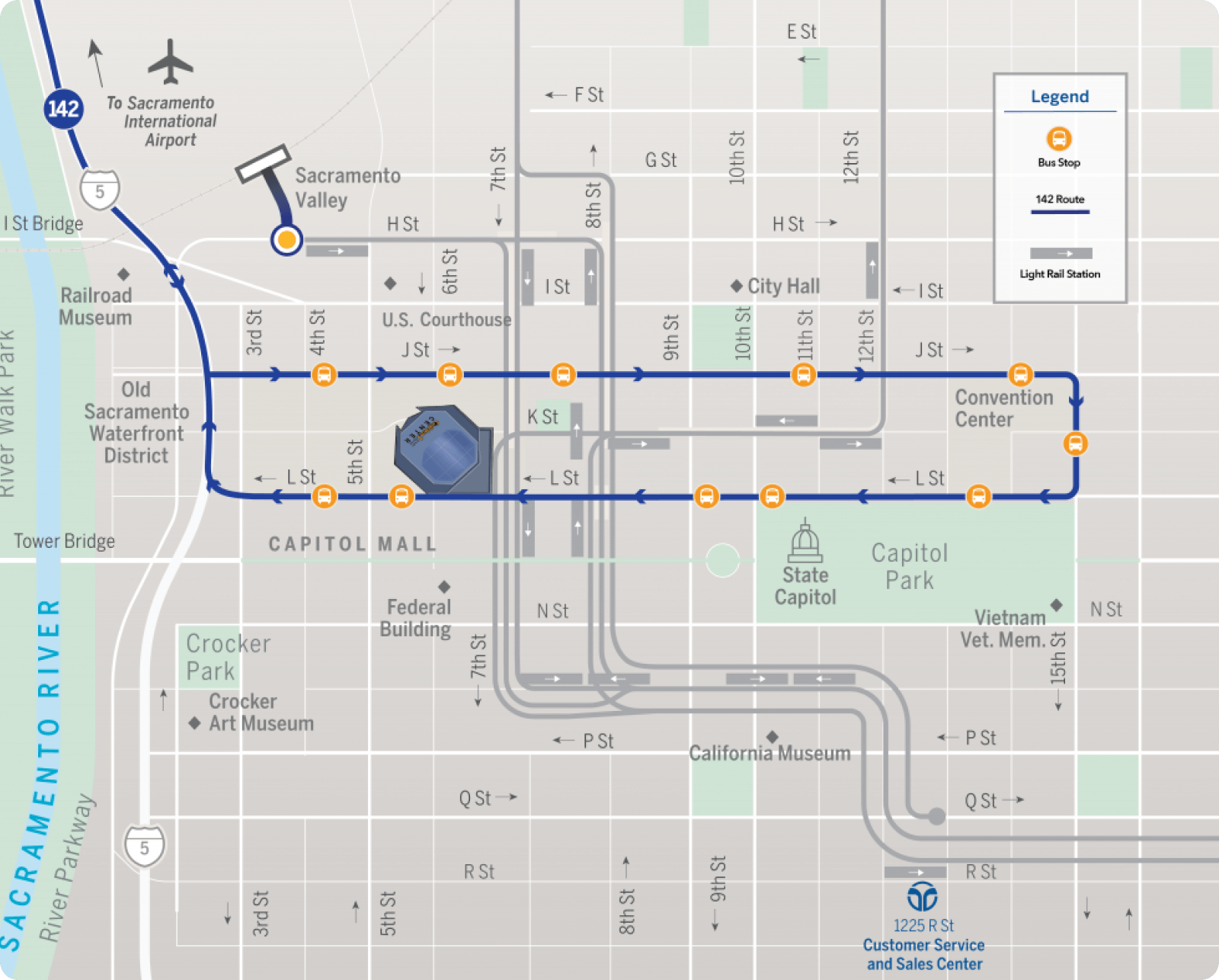
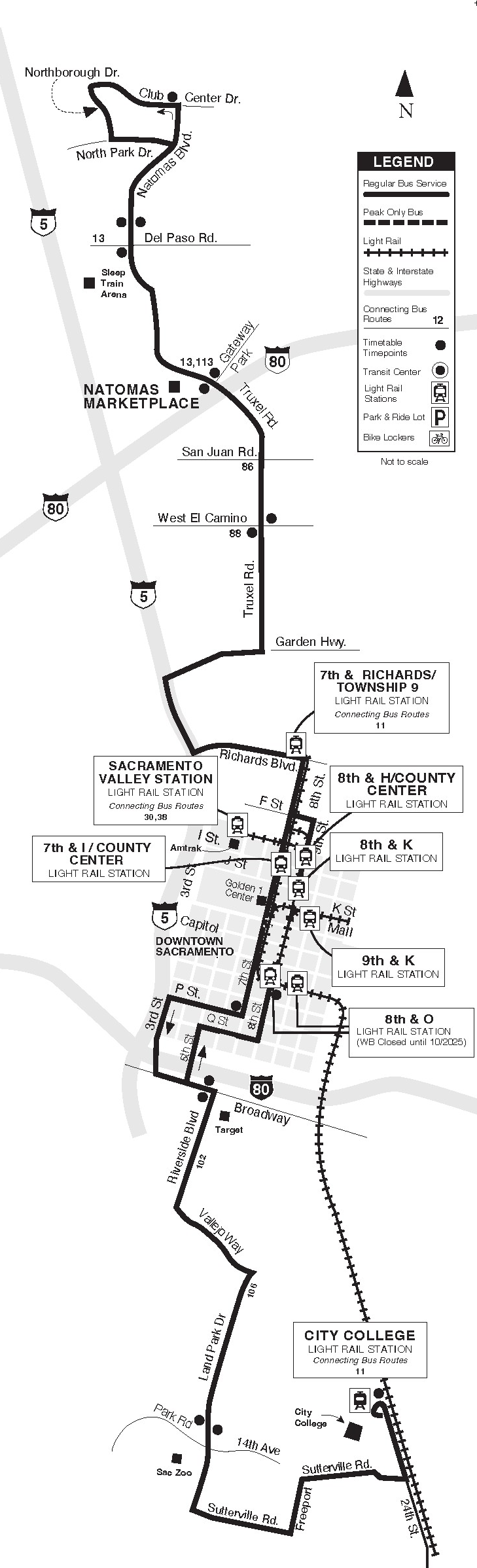
Whenever the topic of Green Line light rail to the airport comes up, SacRT board members and staff claim that this is the highest priority of the public. This is false. The last board meeting spent a lot of time on the Green Line, the reserved right-of-way, light rail, and BRT ideas. There is a funded BRT study: Green Line to the Airport: A Vision for the Future. Several board members said that they supported the BRT study, but that the ultimate solution was and remains light rail. Despite one of the parts of the 2026-09-28 board presentation being on the BRT study, the three maps in the presentation were all of the ultimate light rail alignment, not of the BRT project.
SacRT ran a public outreach process to gather input from the public on what they wanted from SacRT, as part of the Comprehensive Operational Analysis, to determine both short range and long range priorities. The Transit Idea Exchange: What We Heard & What Comes Next page provide information on the process and the outcome. The page lists five public priorities: Improving bus and light rail service frequency and reliability, Increase service hours on bus and light rail, Making stations and stops more welcoming and accessible, Enhancing safety, lighting, and cleanliness, and Keeping fares affordable for seniors, persons with disabilities, veterans and students. Light rail extensions, whether to the airport or Elk Grove, were not in the top five. The page does not contain details on process and results, but there are scattered documents that are relevant.
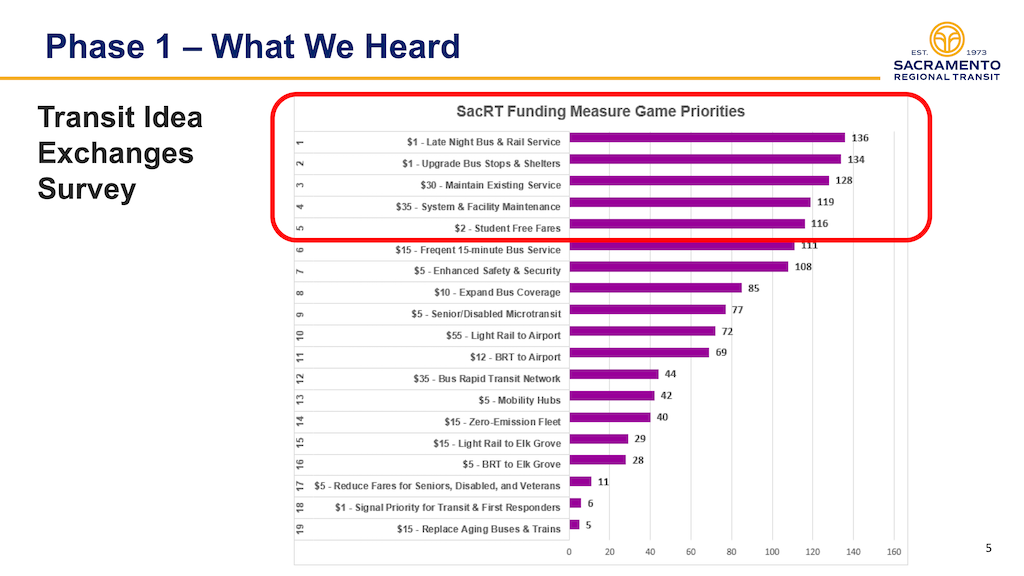
A presentation to the board on 2025-10-27 (https://startransit.wordpress.com/wp-content/uploads/2025/11/sacrt_2025-10-27_agenda-5-1-funding-presentation.pdf) has a chart from the Transit Ideas Exchange Funding Game (page 5). Green Line light rail to the Airport ranked 10, and light rail to Elk Grove ranked 15. A separate survey by FM3 (starting page 8) conducted to gauge support for a transit sales tax measure, again indicated that the public thought light rail extension less important than maintenance.
I was only able to attend one of the workshops, in Elk Grove (STAR: Transit Ideas Exchange in Elk Grove). Despite being located in Elk Grove, and given the City of Elk Grove’s desire to see light rail extended well into Elk Grove, and SacRT board member and Elk Grove city council member Rod Brewer’s support, the public was not interested. The public wanted better bus service.
So, given these facts, why does the board and staff continue to claim Green Line light rail to the airport is the public’s top priority? Because it is the shiny thing. ‘World class cities’ have light rail to the airport, and Sacramento city and county and region want nothing more than to be considered a world class city. The politicians on the SacRT board (all are elected officials, appointed from the cities and county) also want projects for which they can do ribbon cutting. Better bus service does not involve ribbon cutting.
World class cities also have great transit systems. We do not, far from it. Things like light rail, or subway, to the airport, which indeed many cities do have, are built on a base of high-frequency, affordable, effective bus transit. Without that, light rail to the airport is an isolated and very expensive shiny thing that is not useful because the basics have not been met.
STAR advocated, in How to build successful transit and many other posts, for an incremental approach to building transit service. Yes, light rail is on the list, but it is not the starting point. SacRT is running hourly service to the airport, Route 142 Airport. Ridership is low, in part because the service schedule does not meet the needs of workers at the airport, and in part because hourly service cannot be effective. Yolobus also runs hourly service to the airport, which is more successful because it also serves Davis and Woodland, but it is very slow. SacRT and Yolobus schedules are not coordinated. The next step for the airport is high frequency bus service with a long span of service. Not BRT, not light rail.
To use an expression, service to the airport is ‘sucking all the oxygen out of the room‘, meaning that a focus on the airport is taking up time and energy that could be devoted to improving bus service and starting to address the coming funding crisis that will require SacRT to reduce service.
Three maps below show routes that are relevant to the effort to serve North Natomas and the airport. The first two maps show Route 142 Airport Express bus, with a frequency of 60 minutes. This route uses Interstate 5 for much of the distance. The third map shows Route 11 Natomas/Land Park bus, with a frequency of 30 to 45 minutes (one of the two lowest frequency regular bus routes). This route jogs briefly to Interstate 5 to connect Truxel Road and 7th Street.